


Search
Search
4 Search Results:
New study shows technology could play an important role in mental health support
In a study published in MDPI Journal, a team of researchers at Lawson Health Research Institute have shown that the use of technology may assist in better outcomes for those living with both mental health and physical disorders.
Dr. Cheryl Forchuk, Assistant Scientific Director at Lawson, and her team embarked on a pilot study that used smart home monitoring solutions to assist those living with both a mental health disorder and other health challenges. The purpose of this pilot study was to see if technology could improve overall lifestyle and wellbeing.
“We began our research by using hospital prototype apartments – apartment style care spaces within hospital settings – that were equipped with smart home technology solutions such as a screen device, activity trackers, weigh scales and medication dispensers,” says Dr. Forchuk who is also the Beryl and Richard Ivey Research Chair in Aging, Mental Health, Rehabilitation and Recovery at St. Joseph’s Health care London. “Once we tested it in a hospital setting, we wanted to find a way to take this idea out into the community in different kinds of housing and living situations to see if it would be beneficial.”
The research team partnered with the Canadian Mental Health Association (CMHA) and the London and Middlesex Community Housing (LMCH) to work together to retrofit the homes of the 13 study participants.
“We worked together with the participants and their care providers to choose what combination of technology they felt would be best for them,” says Dr. Forchuk. “No matter their health condition each participant wanted to be more active and independent, with the goal of staying out of hospital.”
All smart devices were connected to the Lawson Integrated Database, which is a database that can securely collect data from multiple sources such as health devices. This allowed care providers to send reminders to participants, while also tracking usage and results.
“The key benefits we noted was that study participants started to live healthier lives,” says Jonathan Serrato, Lawson Research Associate. “Participants logged going for walks and exercising more often, as well as making healthier food choices. Those who used the medication dispensers did not miss a single dose. The touch screen devices also allowed participants to easily communicate with care providers and support networks, and access more resources.”
Following the pilot study, the research team also published a subsequent paper, as a ‘how-to guide’ for utilizing smart home technology interventions as a health care tool.
“This paper is a helpful resource that outlines implications and considerations when it comes to smart home technologies,” adds Serrato. “There are many areas we touch upon such as security, privacy and feasibility as well as hardware and software information for those who would like to take on their own similar type of smart home technology project.”
Investing in life-changing research
Through donor support, endowed research chairs are exploring and answering some of the most profound and complex research questions of our time.
Among cherished family photos and special mementos in the office of Jeremy Burton, PhD, is a slightly faded photo of a young woman. Burton points out the framed photo as he enthusiastically talks about his work. It’s a young Miriam Burnett, after whom the Miriam Burnett Chair in Urological Sciences is named. It’s also the first endowed research chair position Burton held at St. Joseph’s Health Care London (St. Joseph’s).
As the research chair for seven years, Burton speaks fondly about the relationship he has with the Burnett family and the crucial role their support has played in advancing his research.
“Thanks to their funding, we became one of the world leaders in urological microbiome research,” he says.
Endowed research chairs at St. Joseph’s receive consistent and sustainable funding so that research leaders and their teams can answer the most profound and complex health questions of our time.
For decades, donors have been inspired by the clinical research taking place at St. Joseph’s and have heavily invested in endowed research chairs. Today, St. Joseph’s Health Care Foundation manages seven endowed chairs focused on several areas, including molecular imaging, fetal and newborn growth and diabetes. Working in partnership with Western University, and with donor support, the foundation recently established four new endowed chairs in mobility, medical biophysics, medical imaging and ophthalmology.
“Medical research in Canada is chronically underfunded, and there is almost no sustainable funding for hospital-based research positions,” says Michelle Campbell, President & CEO, St. Joseph’s Health Care Foundation. “Private philanthropy has filled that gap for years. When a donor gives to an endowed research chair, they are building capacity in the present day and creating future value and opportunity. An endowed gift has a multiplier effect.”
Burton, now the endowed Research Chair in Human Microbiome and Probiotics, has many reasons to be grateful for this support. Not only does the endowed fund pay for Burton’s research salary, it also partially supports the salaries of a lab manager and technical team – all vital for a sophisticated lab to be successful.
The funding also provides the gift of time – a diminishing commodity for any busy research team.
“Scientists need more time to think,” says Burton, a Lawson Research Institute (Lawson) scientist. “We are incrementally being stretched in multiple directions, and the funding gives us the time to do what we are meant to do – find answers to important clinical questions and find solutions to medical problems.”
Distinguished Lawson scientist and university professor Cheryl Forchuk, PhD, wholeheartedly agrees. She recently completed her final term as The Beryl and Richard Ivey Research Chair in Aging, Mental Health, Rehabilitation & Recovery, another endowed position. As Chair, Forchuk provided scientific and administrative leadership to a large group of researchers based at St. Joseph’s Parkwood Institute focused on mental health, activity and mobility, and cognitive vitality and brain health.
Many research leaders, she explains, can afford to spend only two days a week on their own research projects. Endowed chair positions change that.
“Imagine travelling across the country to create a national study focused on homelessness, two days a week at a time,” she suggests candidly. “You couldn’t.”
Forchuk is referring to her landmark project to better understand how many people in Canada are homeless and who they are. The goal was to develop more accurate sources of data and recommend appropriate support and services. Her work is already resulting in important changes.
Today, Forchuk is embarking on another cross-country research project to find solutions related to homelessness for Canadian veterans who are women.
Like Forchuk, Burton’s Chair position requires him to provide operational and research leadership, including developing research networks and partnerships nationally and internationally to advance studies that will revolutionize care.
“As the Chair, I think it is important that I have wide-ranging projects that benefit people in our own community and beyond,” says Burton, who is optimistic about the outcomes of several of his team’s studies.
He recently partnered with London’s First Episode Mood and Anxiety Program to study the impact of fermented foods on the microbiome of young people taking medications for mental health conditions.
One of the side effects of these medications is weight gain, which deters some patients from taking it. By providing patients with slow-release apple cider capsules, which have similar properties to fermented foods and positively affect the microbiome, they have seen an overall improvement in participants’ mental health and cholesterol after just a few months.
Reflecting on his team’s research achievements to date and the potential of what’s to come, Burton emphasizes how vital endowed chairs are to the sustainability of research and the hope to translate newly discovered knowledge into medical practice.
“Research funding from other sources comes and goes,” he says, “but endowed chair positions that are focused on improving human health provide continuity, build research and create change benefiting all of us.”
Keeping an eye on care of the future
Dr. Khaldon Abbas is using his curiosity and passion for ophthalmology to improve patient care and outcomes for people with eye diseases and disorders.
While in university, Dr. Khaldon Abbas had a deeply moving experience as a volunteer with the Canadian Centre for Victims of Torture (CCVT) that changed the trajectory of his life and career.
The community-based organization helps victims of war and torture, and Abbas, whose family immigrated to Canada from Iraq a little more than a decade before, wanted to share his skills as a translator and tutor with newcomers.
“I came to Canada when I was 12. I had limited English, we had no family or friends here, and it was really hard to acclimate,” says Abbas. “I wanted to give back to the community and to be there for immigrant families who were facing similar challenges that my family had to deal with.”
During one shift with CCVT, Abbas was paired with a family from Syria, whose nine-year old daughter was losing her eyesight. She was living with retinal dystrophy, a degenerative disorder that can progress to complete blindness.
Witnessing the impact the eye disorder had on the young girl and her family inspired Abbas to further his own education and set a goal to become an ophthalmologist.
That was eight years ago. Since then, Abbas spent several years working as a clinical research coordinator and completed four years of medical school at the University of British Columbia.
Today, he is a clinical research fellow at the Ivey Eye Institute of St. Joseph’s Health Care London (St. Joseph’s) – a position supported through St. Joseph’s Health Care Foundation thanks to the generosity of donors.
During the next year, Abbas’ research will focus on improving patient care and outcomes for people with eye diseases and disorders.
Drs. Phil Hooper, Verena Juncal and Tom Sheidow, all retinal surgeons at Ivey Eye, are the impetus behind the fellowship and now serve as Abbas’ mentors. Through the fellowship, the trio wanted to expand their clinical research program which is heavily focused on clinical trials. Their goal was to delve into quality improvement projects and explore, among other things, patient data, referral patterns and wait times – information that could guide Ivey Eye in refining care to better understand how to improve the overall flow of patient care.
As surgeons at the largest single-site eye care centre in Canada committed to innovative care, the Ivey Eye physician leaders felt a responsibility to make this work a reality.
“We started talking about this about three years ago,” says Sheidow. “We were familiar with similar roles at other academic eye care centres and we were fortunate to have some funding, so we brought the idea to the foundation and started to craft the terms of reference,” he adds.
Abbas is the second physician in this fellowship, following in the footsteps of Dr. Amy Basilious, who is now in her second year of residency at Ivey Eye.
“Amy did an exceptional job as our inaugural fellow and we were looking for someone with similar characteristics – bright, curious, motivated, a self-starter and a passion for ophthalmology,” says Sheidow. “Khaldon has all of that and more,” he adds, referring to Abbas’ interest and background in clinical trial work.
Even before arriving in London for the fellowship, Abbas began working with his new team to generate research project ideas and shape a research plan. Among the projects he will tackle is one that will assess the effectiveness and complications of lens exchange surgeries, and another in collaboration with Basilious focused on macular hole repairs.
He will also spearhead two quality improvement studies aimed at streamlining the referral process to Ivey Eye for optometrists and enhancing education and information resources for patients with eye diseases and disorders. Through his work, Abbas is excited to build his research skills, forge new professional connections and see some of his research translated into tangible improvements in patient care.
He’s grateful to Hooper, Juncal and Sheidow, along with St. Joseph’s and the Foundation, for their vision and spirit of innovation in establishing the fellowship.
“Everyone has been extremely welcoming and supportive of me, especially my mentors and fellow co-workers” he says. “There’s a real family environment at St. Joseph’s. I feel like this is my new home away from home.”
Lawson researchers elected to Royal Society of Canada
Drs. Cheryl Forchuk and Ruth Lanius have been elected as Fellows with the Royal Society of Canada (RSC) in recognition of their significant contributions to mental health research.
Dr. Forchuk, Assistant Scientific Director at Lawson and the Beryl and Richard Ivey Research Chair in Aging, Mental Health, Rehabilitation and Recovery at St. Joseph Health Care London’s Parkwood Institute, has worked tirelessly to advance research that has resulted in improved hospital discharge models, harm reduction strategies and support for those living without housing, among other concerns. Most recently she has hosted forums across Canada in an effort to better understand homelessness and the number of people experiencing it.
“It’s an honour to be included among such a talented group and alongside my mental health colleague,” says Dr. Forchuk, who is also a Distinguished University Professor at Western University. “A lot of important work remains to be done to better support those living with mental health challenges.”
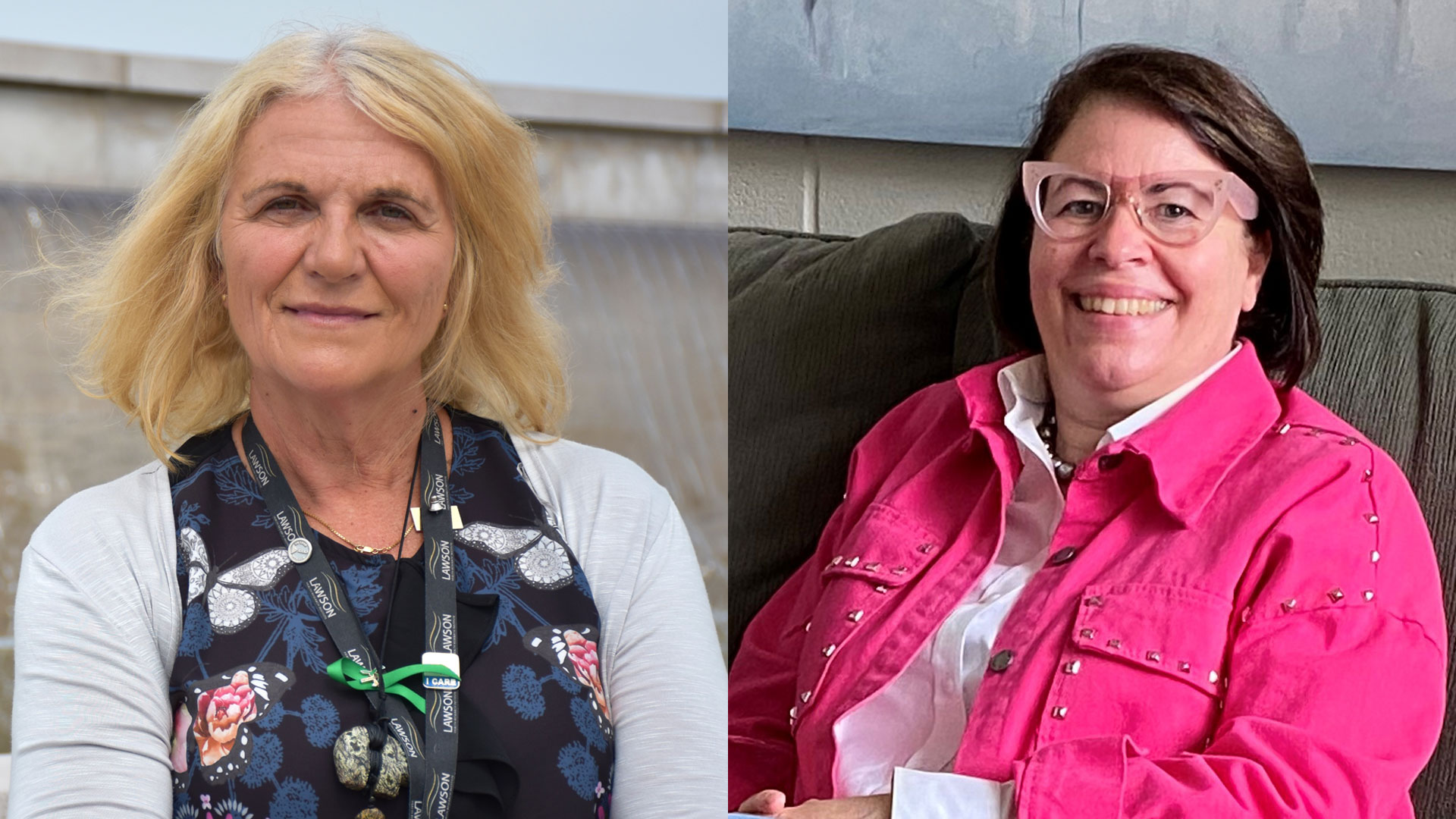
Dr. Lanius, Associate Scientist at Lawson and Psychiatrist at London Health Sciences Centre, is world-renowned for advancing the understanding and treatment of post-traumatic stress disorder (PTSD) through her research. She has been instrumental in defining different types of PTSD and combining imaging and psychiatry to develop new therapies that use neurofeedback or sensory processing to ‘train the brain.’
“Advancing knowledge is crucial to improving quality of life,” notes Dr. Lanius, who is also the Harris Woodman Chair in Mind-Body Medicine and a Professor at Western’s Schulich School of Medicine & Dentistry. “I’m very excited to be recognized with such a distinguished group of contributors to research and academics.”
RSC fellows are elected by peers for their outstanding scholarly, scientific and artistic achievement. This year’s 101 new fellows will be inducted into the RSC on November 17.