


Search
Search
2 Search Results:
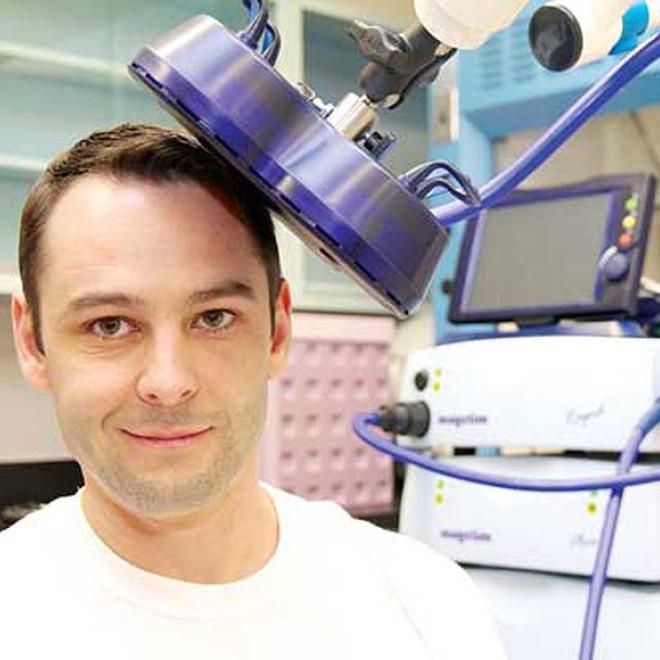
Dr. Alexandre Legros
Full Name
Dr. Alexandre Legros
Role
Location
Degrees and Qualifications
PhD
Website
Research Overview
His background mainly relates to the effects of specific electromagnetic stimuli (from DBS to power-frequency magnetic fields) on human brain processing, motor control and cognitive functions. Dr Legros is managing an international industrial and scientific collaborations through industry-partnered academic support from the Canadian Institute of Health Research (CIHR).
He has expertise in acquisition and analysis of brain electric and metabolic signals (EEG, fMRI), subtle movement quantification and characterization (e.g. physiological tremor, standing balance), cognitive performances quantification, physiological monitoring (cardiovascular parameters).
Biography
Dr. Alexandre Legros is a full time scientist in the Imaging Program at Lawson, where he is the director of Human Threshold Research Group and Testing Facility. He is also an Associate Professor in the Departments of Medical Biophysics and Medical Imaging within the Schulich School of Medicine and Dentistry, and in the School of Kinesiology from within the Faculty of Health Sciences at Western University.
He received his PhD in Kinesiology in 2004 (University of Montpellier, France) and completed a first postdoctoral fellowship in neuroscience studying the impact of Deep Brain electric Stimulation (DBS) on patients implanted with electrodes suffering from dystonic syndromes (Neurosurgical Unit, University of Montpellier, France). He started a second postdoctoral fellowship in the BEMS group at Lawson in 2005 before being recruited as a young scientist in September 2007.
Dr. Legros has expertise in the fields of neuroscience, kinesiology, biophysics, and he his currently promoting the use of mathematical neuroscience to study the interaction between time-varying magnetic fields and neuronal assemblies/networks.
Dr. Mark Chandy
Full Name
Dr. Mark Chandy
Role
Location
Degrees and Qualifications
MD PhD FRCPC
Research Area
Research Overview
Stem cell biology, induced pluripotent stem cells, cardiovascular disease.
Biography
My research employs molecular biology to understand the pathophysiology of cardiovascular disease. Early in my career, I studied the mechanisms of chromatin dynamics, which have broad implications in the influence of the environment in conditions such as diabetes and smoking. I later helped characterize how transcription factors and microRNA direct cardiovascular differentiation and how perturbations of these mechanisms are implicated in cardiovascular disease. My interest in stem cell biology attracted me to Joseph Wu, MD, Ph.D. at Stanford, to learn more about human induced pluripotent stem cell (iPSC) disease modeling endothelial dysfunction.
Advances in next-generation sequencing, bioinformatics, and gene editing make it possible to decipher SNPs contributing to cardiovascular disease and disease-specific transcriptome profiles. More precise diagnostic biomarker-based tests could be developed with a deeper appreciation of an individual’s molecular signature. Additionally, personalized medicine could emerge from iPSC disease and advance precision medicine.
As a recently appointed Assistant Professor at the University of Western Ontario, I am now an independent physician-scientist conducting research using iPSC disease modeling that I developed at Stanford University. My research focuses on cardiovascular disease modeling to 1) investigate the effects of the environment on the vasculature, 2) discover biomarkers to risk stratify cardiovascular disease, and 3) discover druggable target genes for cardiovascular disease. The overarching goal of my research is to use iPSCs to understand mechanisms underlying the relationship between inherited factors and how environmental stress, such as diabetes, e-cigarettes, and marijuana, sensitize an individual to exacerbated cardiovascular disease. The discovery of these gene and environment interactions will facilitate the identification of high-risk individuals who could benefit from therapy that alters disease trajectory. In the future, iPSC disease modeling could guide the discovery of sm! all molec ule agonists or inhibitors that could be used as personalized medical therapy for cardiovascular disease.
Partners
Aleksandra Leligdowicz