


Search
Search
1347 Search Results:
London researchers part of a federal funding boost to enhance transition in care research
How can we improve health care for Canadians experiencing “transitions in care” to ensure they don’t fall through the cracks as they move through the health care system?
That’s the question two London researchers are aiming to answer, with the support of nearly $1.5 million in federal funding announced today at Western University's Schulich School of Medicine & Dentistry.
Peter Fragiskatos, MP for London North Centre, announced the funding boost on behalf of Federal Health Minister Jean-Yves Duclos, alongside Dr. Jane Rylett, Scientific Director of the Institute of Aging with the Canadian Institutes of Health Research (CIHR).

“When a person experiences a transition in care, whether moving from surgery to rehabilitation or aging out of pediatric care, the quality of their care and their health can be at risk,” said Bryan Neff, Western’s acting vice president of research, who hosted the funding announcement. “With federal investments like this, Western will continue to lead the way in identifying how to provide the best possible care for Canadians while improving efficiency in the health-care system.”
Transitions in care happen when responsibility for a person’s care shifts between providers, institutions or sectors. Some groups, such as patients with complex medical conditions, Indigenous peoples, and new immigrants, are particularly vulnerable to poor outcomes during transitions.
People with diabetes – a complex, typically life-long condition – fall into this category, which is why London’s Primary Care Diabetes Support Program (PCDSP) was developed. The clinic, which is part of the Centre for Diabetes, Endocrinology and Metabolism at St. Joseph’s Health Care London, is based at St. Joseph’s Family Medical and Dental Centre. The program provides diabetes support and management for individuals with type 2 diabetes who don’t have a family doctor or who may have additional medical and social issues that make diabetes management particularly challenging.
Maria Mathews, PhD, and her team at Schulich Medicine will evaluate the program to determine its impact on patient health, and on health-care providers, diabetes-related complications, and health system costs.
“While this program has already been shown to deliver high-quality care, my team is examining its overall impact to determine whether this model could be expanded to other sites and to support other chronic conditions,” said Mathews, a professor in the department of family medicine. With the $895,000 investment in her research, Mathews will determine “how we can best provide high- quality care for people with chronic conditions in a way that supports their health, eases strain on family doctors, and creates efficiencies in the health care system.”
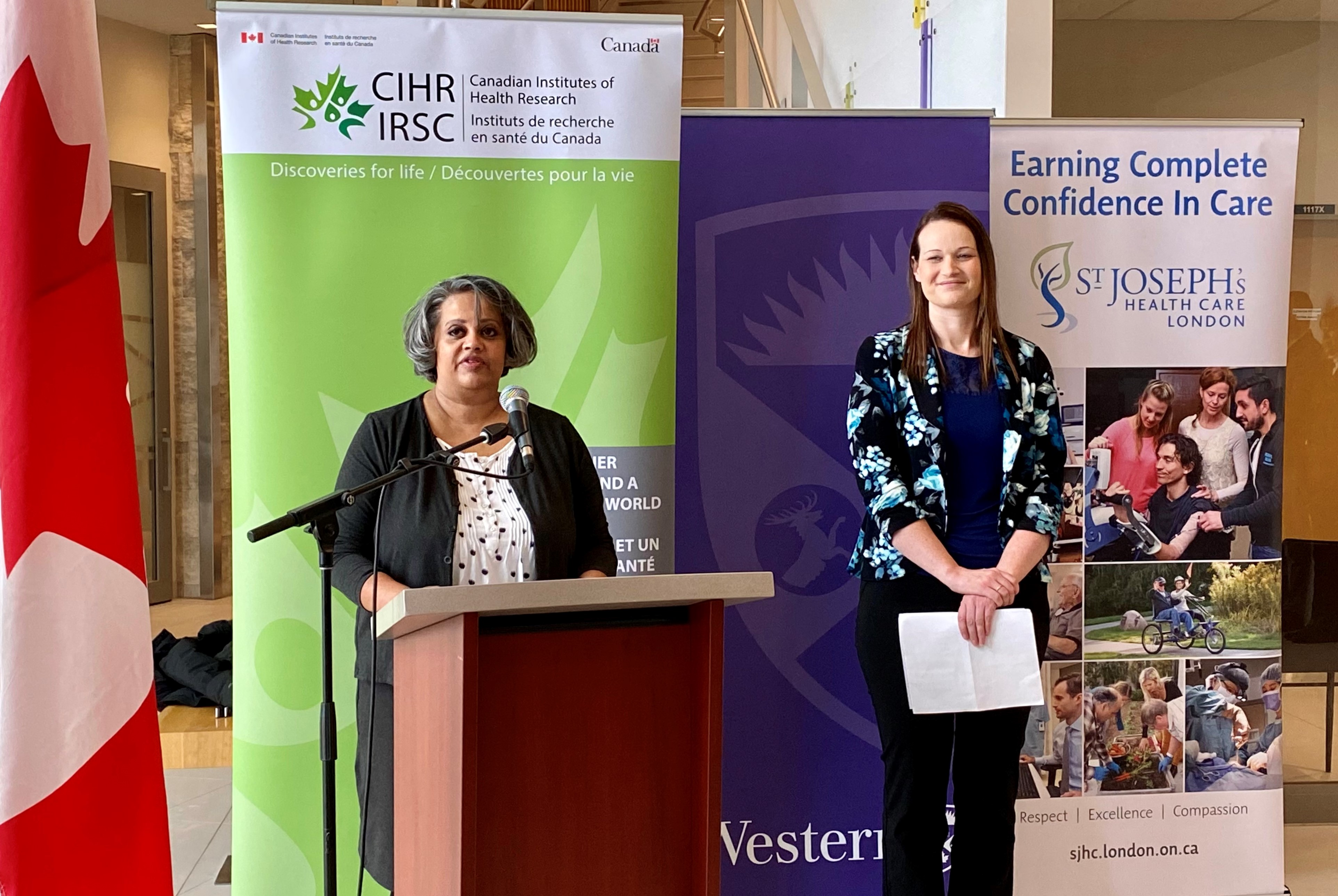
Laura Brunton, PhD, an assistant professor at the School of Physical Therapy in Western’s Faculty of Health Sciences, received more than half a million dollars in CIHR funding.
Her team will examine a local program based at St. Joseph’s Parkwood Institute – called the Transitional and Lifelong Care Program (TLC) – that supports people with childhood-onset disabilities as they transition to adult care. This includes many patients with brain-based, neurodevelopmental conditions, such as cerebral palsy, spina bifida and developmental disabilities, as they move into adult care.
“Many of these patients have experienced severe health inequities because of the gaps in care when transitioning from pediatric care to the adult sector,” said Brunton, also a physiotherapist at St. Joseph’s Health Care London and affiliate scientist at Lawson Health Research Institute. “We’re going to evaluate the TLC model as an intervention that provides transitional, lifelong care and reduces the barriers experienced.”
Roy Butler, president of St. Joseph’s Health Care London, said today’s announcement highlights the synergy and collaboration among these organizations.
“We are happy to hear that work being done by both Laura Brunton and Maria Mathews to improve patient care is being recognized through this funding announcement. The two areas these talented researchers will be studying are innovative and ground-breaking with compassionate, forward-thinking teams who provide highly acclaimed care to vulnerable patients.”

Fragiskatos emphasized the vital importance of funding this field of research, given that most Canadians will experience a ‘transition in care’ at some point.
“People living in Canada routinely experience transitions in care as they navigate the health system. The important research that will be done here in London and at institutions across the country will help develop meaningful approaches to make these transitions easier for patients and caregivers,” he said.
Local researchers were among 14 groups across Canada that received approximately $12 million in federal funding to improve continuity of care for Canadians through the “Transitions in Care” initiative, which is provided in partnership with the Azrieli Foundation, Mitacs, and the Rossy Family Foundation.
London scientists key players in national dementia strategy
LONDON, ON – Researchers in London have been awarded $1.345 million over five years through the second phase of the Canadian Consortium on Neurodegeneration in Aging (CCNA), announced today as part of Canada’s national dementia strategy. CCNA is a collaborative research program tackling the challenge of dementia and other neurodegenerative illnesses.
Dr. Manuel Montero-Odasso, Scientist at Lawson Health Research Institute, is world renowned for his findings on the relationship between cognition and mobility in the elderly, and gait as a predictor of frailty and dementia. He leads the Mobility, Exercise and Cognition (MEC) Team in London, comprised of top researchers in the areas of mobility, exercise and brain health.
“Evidence from other countries with national dementia strategies shows that coordinated, targeted efforts at the national level improves results for all aspects of dementia care and also for research,” says Dr. Montero-Odasso, also a geriatrician and Director of the Gait and Brain Lab at Parkwood Institute, a part of St. Joseph’s Health Care London.
CCNA was purpose-built to synergize dementia research within the Canadian context. Phase I saw the creation of infrastructure fostering collaboration amongst Canadian researchers, and there are now 20 teams built around important research topics.
“This kind of effective national collaboration by scientists and clinicians from many disciplines gives the CCNA a cutting edge in research, prevention, treatment and management of all forms of dementia,” explains Dr. Montero-ODasso. “We created a national network of researchers form west to east coast with a high level of expertise to deliver lifestyle interventions to improve cognition and slow down progression to dementia. I feel privileged working with such excellent investigators and leading this important endeavour locally.”
The MEC team has several projects in the works, but the majority of the new funding is to complete the SYNERGIC Trial, SYNchronizing Exercises and Remedies on Gait and Cognition.
This first-in-the-world clinical study is testing a triple intervention aimed at treating Mild Cognitive Impairment (MCI) and delaying the onset of dementia. The SYNERGIC Trial incorporates physical exercises and cognitive training, along with vitamin D supplementation to determine the best treatment for improving mobility and cognition.
“We are looking at how interventions will work together and targeting cognitive decline at its earliest stage – individuals with MIC,” explains Dr. Montero-Odasso. “Both physical and cognitive exercises have shown promising effects for maintaining cognition, while vitamin D deficiency is associated with cognitive decline.”
A professor at Western University’s Schulich Medicine & Dentistry, Dr. Montero-Odasso partners with researchers from across the city including Dr. Rob Bartha, imaging scientist at Schulich Medicine & Dentistry and Robarts Research Institute at Western University, and Dr. Kevin Schoemaker who leads the Laboratory for Brain and Heart Health.
Study participants in the SYNERGIC Trial are asked to complete an individualized and progressive routine of exercises and cognitive training three times a week for six months, with one final assessment at 12 months. The main site for the study is Parkwood Institute with the physical exercises taking place at the Labatt Health Sciences Building on the Western campus.
“Our preliminary analysis is giving us a strong indication that a multimodal approach, combining physical exercise, cognitive training and supplementation, has a synergistic effect. It seems the whole is greater than the sum of its parts,” says Dr. Montero-Odasso.
To date, 138 research patients has been recruited across multiple sites in Canada. Individuals over 60 years old with mild cognitive impairment without dementia are eligible for this clinical trial. Those interested in participating are encouraged to contact a Lawson research coordinator at 519-685-4292 ext. 42910.
Dr. Montero-Odasso adds that “as our population ages, a comprehensive strategy is vital to ensure the growing number of those living with dementia receive the care and support they deserve. Over half a million Canadians are currently living with dementia. By 2031, this number is expected to nearly double.” More than one third of dementia cases might be preventable.
'In CCNA’s Phase II, researchers are working on analyzing the overall health of every patient in a large clinical cohort study, COMPASS-ND. This information will be used to enhance understanding of how changes in the brain affect dementia severity and ways to reduce and prevent this through lifestyle changes. Lawson is the leading recruitment site for COMPASS-ND and the London team will be instrumental in the larger lifestyle interventions moving forward.
CCNA is funded by the Government of Canada, Canadian Institutes of Health Research (CIHR) and other funding partners.
-30-
About Lawson Health Research Institute
Lawson Health Research Institute is one of Canada’s top hospital-based research institutes, tackling the most pressing challenges in health care. As the research institute of London Health Sciences Centre and St. Joseph’s Health Care London, our innovation happens where care is delivered. Lawson research teams are at the leading-edge of science with the goal of improving health and the delivery of care for patients. Working in partnership with Western University, our researchers are encouraged to pursue their curiosity, collaborate often and share their discoveries widely. Research conducted through Lawson makes a difference in the lives of patients, families and communities around the world. To learn more, visit www.lawsonresearch.ca.
Media Contacts
Celine Zadorsky
Senior Media Relations Consultant
Communications & Public Engagement
T: 519-685-8500 ext. 73502
Celine.zadorsky@lhsc.on.ca
… and for greater certainty, includes the Beds and the common areas and common elements which will be used at least in … from the Minister annually. Each Mandate Letter articulates areas of focus for the LHIN, and the Minister’s expectation … providers it funds will collaborate to advance these areas of focus. To assist the HSP in its collaborative …
1/39 LONG-TERM CARE HOME SERVICE ACCOUNTABILITY AGREEMENT APRIL 1, 2019 MARCH 31, 2022 LONG-TERM CARE HOME SERVICE ACCOUNTABILITY AGREEMENT April 1, 2019 to March 31, 2022 SERVICE ACCOUNTABILITY AGREEMENT with Effective Date: April 1, 2019 Index to Agreement ARTICLE 1.0 DEFINITIONS & INTERPRETATIO...
… at present? Yes No Date of Onset: Briefly describe the areas of skin breakdown and current treatment plan: Does the … at present? Yes No Date of Onset: Briefly describe the areas of skin breakdown and current treatment plan: Does the …
Page 1 of 7 Complex Care Program Admission Application (Ventilator Dependent Client) VENTILATOR DEPENDENT CLIENT APPLICATION Parkwood Institute - Complex Care Program FAX completed form to (519) 685-4804 ------- Please ensure that you have included all pertinent patient information. In addition to ...
… to finish the interior along with renovations to existing areas at St. Joseph’s Hospital. This second phase of … construction of the North Tower and renovations to existing areas has given us the opportunity to look at further … to finish the interior along with renovations to existing areas at St. Joseph’s Hospital. This second phase of …
MEDIA RELEASE For Immediate Release: March 23, 2009 Hospital redevelopment next phase underway at St. Josephs Health Care, London and London Health Sciences Centre (LONDON, ON) London Health Sciences Centre (LHSC) and St. Josephs Health Care, London (SJHC) are now well into the next phase of redeve...
Zone Zone 4 Tunnel Access Zone A Elevators Zone 2 1 Zone Zone ZONE A ELEVATORS TUNNEL ACCESS ZONE B ELEVATORS ZONE F ELEVATORS ZONE D ELEVATORS ZONE C ELEVATORS PARKING ELEVATORS TUNNEL ACCESS GROSVENOR STREET CHEAPSIDE STREET RI CH M O N D S TR EE T W EL LI N G TO N S TR EE T N ZONE E ELEVATORS GRO...
… of CTOs. The Current Process: Positives and Grey Areas Positives There was across the board praise for the … have been used ever since I have been on the Board. Grey Areas o Inherent Contradictions Several participants talked … of CTOs. The Current Process: Positives and Grey Areas Positives There was across the board praise for the …
MARCH 2013 | VOL. 10 NO. 1 OUTCOMES, INHERENT CONTRADICTIONS AND PUZZLING ISSUES: Consent and Capacity Board (CCB) members experiences with Community Treatment Orders (CTOs) Deborah Corring, Cathy Plyley, Joe Skufca Research Insights of the Regional Mental Health Care London and St. Thomas is a peer...
Maternal diabetes impacts oxygen flow in umbilical cord, study suggests
A new Lawson Health Research Institute study published in the journal Placenta has found a unexpected difference in the impact of pre-existing diabetes versus gestational diabetes on oxygen flow in the umbilical cord during pregnancy.
Currently, tests done very close to the end of a high-risk pregnancy can’t reliably measure the full health of the placenta and baby. Women with complications like diabetes, high blood pressure and an elevated BMI (body mass index), among others, are therefore generally advised to induce labour before the 40-week mark.
“This study explored some of these high-risk pregnancies to better understand what occurs or changes in the placenta with the goal of eventually developing better tests,” says Dr. Barbra de Vrijer, High-Risk Obstetrician and Head of Maternal Fetal Medicine at London Health Sciences Centre and Scientist at Lawson.
The St. Joseph’s Health Care London Perinatal Database, containing information on nearly 70,000 births between 1990 and 2011, provided the data for the study, including birth weight, placental weight and umbilical cord oxygen levels.
The study found that the number of blood vessels in the placenta (called vascularity) likely impacts oxygen in the umbilical vein, causing a slight increase in mothers with gestational diabetes, but a decrease in those with pre-existing diabetes.
Surprisingly, this new research indicates that hyper-vascularity in diabetic placentas (too many blood vessels) may actually decrease oxygen transfer, potentially leading to more risk to the baby.
“When there is an increase in placental vascularity, crowding of the blood vessels can occur constraining their effective absorbing surface area for oxygen uptake from maternal blood within the placenta,” says Dr. Bryan Richardson, Scientist at Lawson.
Another finding of the study confirmed earlier research showing that in women with both pre-existing and gestational diabetes, who tend to have larger babies, the placentas were also disproportionately larger, which is an indicator of decreasing placental efficiency, or the birth to placental weight ratio.
While additional research is needed, Dr. de Vrijer sees hope in the development of newer tests that look at factors like metabolic markers – the results of which could help indicate if the placenta is insufficient and assist in decisions like whether and when to induce labour.
“There are new technologies that we are looking at studying moving forward,” says Dr. de Vrijer. “Our team is focused on continuing our research to better understand high-risk pregnancies with a goal of continuously improving care for pregnant individuals.”
About Lawson Health Research Institute
Lawson Health Research Institute is one of Canada’s top hospital-based research institutes, tackling the most pressing challenges in health care. As the research institute of London Health Sciences Centre and St. Joseph’s Health Care London, our innovation happens where care is delivered. Lawson research teams are at the leading-edge of science with the goal of improving health and the delivery of care for patients. Working in partnership with Western University, our researchers are encouraged to pursue their curiosity, collaborate often and share their discoveries widely. Research conducted through Lawson makes a difference in the lives of patients, families and communities around the world. To learn more, visit www.lawsonresearch.ca.
Media Contacts
Amanda Taccone
Communications Consultant & External Relations
Lawson Health Research Institute
T: 519-685-8500 ext. ext. 64059
C: 226-919-4748
@email
Maternal diabetes impacts oxygen flow in umbilical cord, study suggests
A new Lawson Health Research Institute study published in the journal Placenta has found a unexpected difference in the impact of pre-existing diabetes versus gestational diabetes on oxygen flow in the umbilical cord during pregnancy.
Currently, tests done very close to the end of a high-risk pregnancy can’t reliably measure the full health of the placenta and baby. Women with complications like diabetes, high blood pressure and an elevated BMI (body mass index), among others, are therefore generally advised to induce labour before the 40-week mark.
“This study explored some of these high-risk pregnancies to better understand what occurs or changes in the placenta with the goal of eventually developing better tests,” says Dr. Barbra de Vrijer, High-Risk Obstetrician and Head of Maternal Fetal Medicine at London Health Sciences Centre and Scientist at Lawson.
The St. Joseph’s Health Care London Perinatal Database, containing information on nearly 70,000 births between 1990 and 2011, provided the data for the study, including birth weight, placental weight and umbilical cord oxygen levels.
The study found that the number of blood vessels in the placenta (called vascularity) likely impacts oxygen in the umbilical vein, causing a slight increase in mothers with gestational diabetes, but a decrease in those with pre-existing diabetes.
Surprisingly, this new research indicates that hyper-vascularity in diabetic placentas (too many blood vessels) may actually decrease oxygen transfer, potentially leading to more risk to the baby.
“When there is an increase in placental vascularity, crowding of the blood vessels can occur constraining their effective absorbing surface area for oxygen uptake from maternal blood within the placenta,” says Dr. Bryan Richardson, Scientist at Lawson.
Another finding of the study confirmed earlier research showing that in women with both pre-existing and gestational diabetes, who tend to have larger babies, the placentas were also disproportionately larger, which is an indicator of decreasing placental efficiency, or the birth to placental weight ratio.
While additional research is needed, Dr. de Vrijer sees hope in the development of newer tests that look at factors like metabolic markers – the results of which could help indicate if the placenta is insufficient and assist in decisions like whether and when to induce labour.
“There are new technologies that we are looking at studying moving forward,” says Dr. de Vrijer. “Our team is focused on continuing our research to better understand high-risk pregnancies with a goal of continuously improving care for pregnant individuals.”
… consumer/survivors in London, Ontario and surrounding rural areas within a 200 km radius. The sample was stratified by … age of 43.70 years old. The uprooted group moved from rural areas primarily to access employment (n=64), mental health … the needs of people with mental illness living in rural areas. AB-P7 Gaining Ground, Losing Ground: The Paradoxes of …
Regional Mental Health Care London and St. Thomas 9th Annual Research Half Day, May 14, 2008 BOOK OF ABSTRACTS & RESEARCH REPORT 2007 by RMHC RESEARCH COMMITTEE 1 Book of Abstracts RMHC 9th Annual Research Half-Day May 14, 2008 and Research Report 2007 RESEARCH INSIGHTS of the Regional Mental Health...
… with a good response from both inpatient and outpatient areas across all programs of RMHC. Based on the information … of research seminars to assist staff in the following areas (1) Managing the ethic applications at UWO and the … with a good response from both inpatient and outpatient areas across all programs of RMHC. Based on the information …
Regional Mental Health Care London and St. Thomas 10th Annual Research Half Day, May 13, 2009 BOOK OF ABSTRACTS & RESEARCH REPORT 2008 by RMHC RESEARCH COMMITTEE 1 Book of Abstracts RMHC 10th Annual Research Half Day May 13, 2009 and Research Report 2008 RESEARCH INSIGHTS of the Regional Mental Heal...
… and forth along pathways between the periphery and target areas in the brain with b) an “associational” model or a … and forth along pathways between the periphery and target areas in the brain with b) an “associational” model or a …
MAY 2010 | VOL 7 No.1 BOOK OF ABSTRACTS 11TH ANNUAL RESEARCH HALF DAY MAY 12, 2010 & RESEARCH REPORT 2009 RMHC Research Committee http://www.lawsonresearch.com/v1.0/website/research_themes/Mental%20Health/HTML/our_publications.htm Regional Mental Health Care London and St. Thomas 11th Annual Researc...
… that current practice was evidence-based and to identify areas for development. During the initial meeting, nurses … systems. 2) Workshop participants identified five areas that would benefit from further research, policy and … that current practice was evidence-based and to identify areas for development. During the initial meeting, nurses …
Regional Mental Health Care London and St. Thomas 12th Annual Research Half Day, May 11, 2011 BOOK OF ABSTRACTS & RESEARCH REPORT 2010 by RMHC RESEARCH COMMITTEE 1 Book of Abstracts 2011 RESEARCH INSIGHTS of the Regional Mental Health Care London and St. Thomas Vol.8, No.1 2011 Message from the Dire...
… techniques to divert patients away from higher risk areas. Similarly, the data allowed staff to monitor the … conditions and aggression were identified in the bedroom areas that were not air conditioned. Using this information, … in Practice Strategy Falls Increased falls in bedroom areas. Non-restraint policy for nighttime care. Installation …
MAY 2012 | VOL 9 NO 2 ADVANCING CLINICAL PRACTICE IN PATIENT SAFETY: Linking Incident Reporting to Proactive Practices in a Geriatric Psychiatry Program Ed Black, Lisa VanBussel, Tom Ross, Jennifer Speziale Research Insights of the Regional Mental Health Care London and St. Thomas is a peer-reviewed...
… Meal & Grocery Delivery Services in London & Surrounding Areas Organization & Contact Information Area Served Service … Mama Earth Organics 416-850-8662 www.mamaearth.ca Only some areas of London They work directly with local organic … E-mail: info@onthemoveorganics.ca London and surrounding areas Delivers locally sourced organic foods from local …
Last Updated: October 22, 2018 Information provided is subject to change October 22, 2018 Meal & Grocery Delivery Services in London & Surrounding Areas Organization & Contact Information Area Served Service Cost and Delivery Fees Robert Graham Grocery Delivery Service 519-649-6764 London Shops at a...
… measures wounds larger than one film, and subtracts traced areas of epithelialization from overall wound size. In … the depth of the tunnel. The depth of wounds that contain areas of partial-thickness and full-thickness damage must be … remain in spite of complete healing of wounds in anatomical areas with thick subcutaneous tissues, such as the …
MEASURE: A proposed assessment framework for developing best practice recommendations for wound assessment DAVID H. KEAST, MSc, MDa; C. KEITH BOWERING, MDb; A. WAYNE EVANS, MDc; GERALD L. MACKEAN, MDd; CATHERINE BURROWS, RN, BScNe; LINCOLN DSOUZA, RN, BScNf The effective management of nonhealing wou...
Our Brains, Our Future: 50 years of CNS
12:00pm
Scientific Symposium and Gala Dinner to celebrate the 50 year anniversary of the Department of Clinical Neurological Sciences.
Friday, October 18, 2019
RBC Place (formerly London Convention Centre)
Scientific Symposium: 8:00 a.m. - 4:00 p.m.
Gala Dinner: 6:00 p.m.
The Scientific Symposium includes a series of moderated presentations by local, national and international researchers focusing on the future directions of neuroscience in relation to medical education, imaging, cognition and translational research. In addition, we are honored to have our distinguished alumnus, Dr. Greg Cairncross, Director of the Charbonneau Cancer Institute and former Head of the Department of Clinical Neurological Sciences at the University of Calgary, provide the keynote address on the treatment of oligodendroglioma.
Following the Symposium, the Gala Dinner will commence at approximately 6:00 p.m. Over the course of dinner, we will recognize the achievements of our faculty and alumni, and the Department’s contributions to health care in our region.
Please visit https://www.eventbrite.ca/e/our-brains-our-future-50-years-of-cns-registration-66463398815 to view the agenda and register your attendance.
Please contact Alexandra Bolton at @email or 519-685-8500 ext. 32306 if you have any questions.
… immediately upon receiving notice by the following areas: Department The Administrative Officer (AO) will … immediately upon receiving notice by the following areas: Department The Administrative Officer (AO) will …
2013 Exit Interview Process for Professional Staff.doc - June 2013 Page 1 of 3 Exit Process for Professional Staff Notification that a Professional Staff (PS) member is leaving could be received the following two ways: Retirement date included on the departments HR Plan Copy of a letter of resigna...
… has been identified. It is not necessary to complete areas within PART B that do not differ from PART A) … has been identified. It is not necessary to complete areas within PART B that do not differ from PARTA) RATIONALE … has been identified. It is not necessary to complete areas within PART B that do not differ from PARTA) Site MON …
2014 Position Request / Candidate Review Impact Summary Form Page 1 Position Request / Candidate Review Impact Summary Form Please retain a copy of this form when you submit for a position request so that it can be used when submitting the candidate information. PART A POSITION REQUEST INFORMATION (...
… an applicant wishes to apply for privileges in an area or areas that would generally not be thought to be within the … an applicant wishes to apply for privileges in an area or areas that would generally not be thought to be within the …
LONDON HEALTH SCIENCES CENTRE CREDENTIALED PROFESSIONAL STAFF BY-LAWS Amended and Approved: June 29, 2015 TABLE OF CONTENTS ARTICLE 1 - DEFINITIONS AND INTERPRETATION ................................................................ 2 1.1 Definitions .....................................................