


Search
Search
1347 Search Results:
… for your rehabilitation, such as central treatment areas and gyms located right on the rehabilitation unit. … for your rehabilitation, such as central treatment areas and gyms located right on the rehabilitation unit. …
4AN, Parkwood lnstitute 550 Wellington Rd. S London, ON N6C 0A7 Phone #: (519) 685-4002 (Nursing Station) Stroke/Neurological Rehabilitation Program - Welcome to Rehab What do I need to know to prepare for rehabilitation? What should I expect from rehabilitation? Inpatient Rehabilitation works with...
What is ICES Western? Q&A with Dr. Amit Garg
As ICES Western recruits a new Site Director, Dr. Amit Garg, who currently holds the position, sat down to talk about the importance of the work being done. Dr. Garg is also a Scientist at Lawson Health Research Institute, Nephrologist at London Health Sciences Centre (LHSC) and Professor at Western University’s Schulich School of Medicine & Dentistry.

What is your role with ICES Western?
Starting in 2009, I supervised the team responsible for the ICES Western build over an approximately three-year period. Since then, I have spent the last decade serving as the inaugural Site Director for ICES Western.
Can you briefly describe the work that ICES Western does?
For those people who don't know, ICES is a province-wide non-profit research institute, founded in 1992, that is focused on translating data into trusted evidence. Our community is comprised of world-class research, data and clinical experts who evaluate health care delivery and population outcomes.
ICES scientists and staff (currently about 570 in Ontario) and trainees (currently about 700) access a vast and secure array of Ontario’s demographic and administrative health-related data. ICES currently has 108 linked data holdings (with over one trillion data points), and the amount of data that ICES has available for use in research grows each year. The linked data include vital statistics, hospital services, physician claims, drug benefits, laboratory results, biosamples and immigration records. Our research, including 1,200 active investigator-initiated projects, is focused on making health policy and health care better, and people healthier.
ICES Western is physically located at LHSC’s Victoria Hospital and is one of seven ICES satellite sites across Ontario. The site’s development is an ongoing partnership between LHSC, St. Joseph’s Health Care London, Lawson, the Academic Medical Organization of Southwestern Ontario (AMOSO) and Western.
How does ICES’ work impact research being done in Ontario and across Canada?
ICES Western is a core facility that researchers use for research, training and decision support. Organizations such as our local hospitals and public health agencies make requests for decision support through a procedural mechanism called Applied Health Research Questions.
Over the last two years, our researchers have conducted a great deal of COVID-19 research. Several projects at ICES Western have examined vaccine effectiveness and spread of the virus. Investigators have used a data-driven approach to help protect people experiencing homelessness in Ontario. Another study quantified the impact of COVID infections on physicians, including how many of them became ill, were hospitalized and received care in the intensive care unit.
Research done through ICES Western has led to important changes in health care. For example, Health Canada instituted labeling requirement changes based on drug safety studies done through ICES.
Why is this work so important?
We all want better health outcomes for citizens, both in Ontario and throughout the world. Ideally, we want people to live longer, healthier lives without needing many health care resources, and we want that to be done in an equitable fashion. There is a substantial amount of research needed in multiple areas to achieve this goal. ICES provides a cutting edge infrastructure to enable this work.
What kind of researchers are involved with ICES?
At ICES Western we support a whole host of individuals and entities as they conduct research. Health care delivery organizations and health agencies including LHSC, the Ontario Renal Network and Trillium Gift of Life Network use knowledge received through reports completed at ICES. Our typical individual investigators include both basic science and clinical investigators. We also support trainees in the areas of epidemiology and statistics, as well as many other fields of study, such as computer science and geography. These are all students who have an interest in working with ‘big’ data. Finally, we have personnel that work with privacy, data, analysis, epidemiology and more.
What do you see in the future for the organization?
We've made a lot of progress in the last 10 years and I can't wait to see what's going to happen in the future. We're still just scratching the surface in terms of what's possible. While what we have done in building this site and supporting important research is impressive, in terms of the possibilities – the sky's the limit. There is so much opportunity around new research and trial methodologies, new insights and new evaluation techniques. I expect ICES Western will continue to develop, enabling a growing number of people to make a large impact. I see ICES continuing to contribute to a world where people live longer, healthier lives.
What is the most important thing people should know about ICES?
How enabling it is. It's time well spent to really understand what is and is not possible with ICES data and research expertise. Once you invest in it – really spend your time and energy to understand the potential– you start realizing all of these opportunities that would not be possible otherwise. With more than a thousand research studies underway across all ICES sites, we have great discoveries ahead to shape the future of health care in Ontario.
Media Contact
Amanda Taccone
Communications Consultant & External Relations
Lawson Health Research Institute
T: 519-685-8500 ext. ext. 64059
C: 226-919-4748
@email
1 Office Use Only St. Josephs Health Care London Appointment Date Hospital Chart No. Parkwood Seating Program PO Box 5777, STN B, London ON N6A 4V2 Page 1 of 2 (519) 685-4292, ext. 42199 FAX (519) 685-4560 Referral Source Service Avenue Parkwood Seating Program Pre-Assessment Form Date Reviewed: ___...
Wide range of research showcased at Parkwood Institute Research's 2017 Spring Update
Lawson researchers at Parkwood Institute, part of the St. Joseph’s Health Care London family, work to improve both physical and mental health care based on the understanding that conditions of the body and mind are integrally linked. From studies on mobility after brain and spinal cord injury to treatment-resistant depression, a range of different research areas were highlighted on April 21, 2017 at Parkwood Institute Research’s 2017 Spring Update Half-Day event.
Parkwood Institute Research is a Lawson program that represents inter-disciplinary clinical research. At the second annual Spring Update event celebrating this work, attendees learned about research from across Parkwood Institute’s three core research themes: Cognitive Vitality & Brain Health, Mobility & Activity, and Mental Health Care. New this year was the addition of poster presentations, which provided another opportunity for researchers and trainees to promote and share their work.
Learn more about the work Lawson scientists at Parkwood Institute presented at the event:
Cognitive Vitality & Brain Health
Dr. Stephen Pasternak was one of the presenters in the Cognitive Vitality & Brain Health theme. Dr. Pasternak and his team are conducting a phase 2 randomized controlled trial looking at whether a European over-the-counter cough medicine, Ambroxol, could also treat Parkinson’s Disease Dementia (PDD).
“There are currently no effective treatments for cognitive impairment experienced by PDD patients. Existing treatments only treat the symptoms of Parkinson’s disease, but do not stop the disease process itself,” says Dr. Pasternak.
Parkinson’s disease is believed to be caused by the buildup of a protein called alpha-synuclein in the brain. Ambroxol increases the levels of an enzyme called β-Glucocerebrosidase (GCase), which has been shown to reduce the buildup of alpha-synuclein in animal and cell cultures models, suggesting that this could be used as a treatment for PDD.
This trial is well underway and the first participants have completed the first year of treatment. If successful, this trial will be the first to demonstrate that it is possible to change the underlying cause of PDD.
Mobility & Activity
As part of the Mobility & Activity themed presentations, Dr. Dalton Wolfe discussed an initiative supported by the St. Joseph’s Health Care Foundation and Ontario Neurotrauma Foundation to help improve mobility in patients with acquired brain and spinal cord injuries.
Called the Parkwood Program for Rehabilitation Innovations in Movement Enhancement (PRIME), a key goal of this initiative is to develop and implement a clinical decision support system that integrates approaches to activity-based therapy. Clinicians, researchers, administrators and IT specialists have combined their efforts to initiate development on this system.
“PRIME will provide recommendations for treatment based on patients’ injury level and type, and clinical characteristics,” says Dr. Wolfe. “It will also have suggestions for what to monitor for each patient to challenge them to optimize recovery, as well as to reduce risk of injury or secondary complications.”
This system will also enable electronic tracking of practices and outcomes, moving away from the current paper-based model and creating a practice-based research platform.
Mental Health Care
Dr. Amer Burhan presented his research on Transcranial Magnetic Stimulation (TMS) in the Mental Health Care portion of the presentations. TMS is a non-invasive method that uses magnetic fields to stimulate nerve cells in the brain. An electromagnetic coil is held against the head and short magnetic pulses are administered, causing a change in activity level in specific targeted areas and allowing for a study of the function and interconnectivity of the brain. The method has been approved to treat depression resistant to medications and has potential to be used to treat other mental and neurological disorders.
Dr. Burhan’s talk focused on the effectiveness of a certain type of TMS, bilateral theta-burst stimulation, in treating patients with depression who are not responsive to medication. This is a new method of TMS that is designed to facilitate change in brain activity and connectivity more efficiently. He presented preliminary results on the first 60 patients treated with this method. So far the treatment has resulted in significant improvement in over half of the patients.
“More studies are planned to understand predictors of response and facilitate individualized selection of treatment for patients struggling with this very disabling illness,” says Dr. Burhan.
Scientist
July 12, 2022; Page 1 of 2 Incobotulinumtoxin A (Xeomin) for Cervical Dystonia/Spasmodic Torticollis What is cervical dystonia and how is it typically treated? Cervical dystonia is a rare neurological disorder involving involuntary muscle contractions in the neck that cause the head to twist or turn...
… fibroglandular tissue. Fibroglandular tissue refers to the areas of the breast that contain milk glands and ducts. … or deodorant/antiperspirant on the breast or underarm areas the day of your mammogram. These products may show up … to biopsy very small calcium deposits or other suspicious areas that cannot be biopsied under ultrasound. Special …
YOur guide to Breast assessment Breast Care Program St. Josephs Hospital 268 Grosvenor St. London, ON N6A 4V2 THE BEST IN BREAST CARE The Breast Care Program at St. Josephs Health Care London provides a confidential, coordinated, specialized breast assessment service. The goal of the program is to m...
Youth report improved wellbeing as result of tailored mental health services, study finds
In a new study from Lawson Health Research Institute and Western University, researchers partnered with youth receiving care at the First Episode Mood and Anxiety Program (FEMAP) at London Health Sciences Centre (LHSC) to better understand personal perspectives on care and treatment outcomes. The study found that patients experienced lasting improvements in managing their symptoms and improvements in academics, work performance and relationships, and they reported that these benefits involved being empowered by feelings of self-acceptance.
The study included 22 patients from FEMAP, a novel outpatient mental health program at LHSC that provides treatment to ‘emerging adults,’ ages 16 to 25, with emotional concerns that fall into the categories of mood and anxiety symptoms. Treatment at FEMAP takes a patient-centred approach and the research involved looking at what is meaningful and valuable to patients during their care journey.
“The transition from adolescence to adulthood is challenging. FEMAP employs an innovative model of care tailored to the needs of this complex population,” said Dr. Elizabeth Osuch, a clinician-scientist at Lawson, associate professor at Western University’s Schulich School of Medicine & Dentistry and medical director at FEMAP. “By engaging patients in a reflection of their experience, we can learn how effective the program is from the patient perspective.”
Participants shared their experiences through open-ended interviews with Dr. Osuch’s research team. Interview transcripts were collected and analyzed to determine common themes around treatment and outcomes. These themes were then presented back to the research participants for validation.
The study found that treatment led to development of coping strategies to better manage symptoms. Research participants credited these strategies for better functioning in academics, careers and personal relationships. Challenges in these areas are common among emerging adults and are often stressors that lead to youth seeking mental health care.
Participants characterized their treatment at FEMAP as an important investment in their mental health and wellbeing, and credited a collaborative partnership with their care provider for keeping them engaged in treatment. They appreciated the ease of accessing treatment at FEMAP where they could receive care from a psychiatrist, social worker, addictions counsellor, family counsellor and a psychologist, depending on their needs.
The research found that the complexities of treatment were initially frustrating to patients as they were seeking an “easy fix” to their mental health concerns, but they ultimately appreciated that mental health recovery is a journey. They valued that care providers partnered with them to set long-term treatment goals, choose the best treatment options and provide support both during and between appointments.
“Patients may prefer FEMAP over other mental health services because the care is tailored to emerging adults,” said Justin Arcaro, first author on the study and a former MSc candidate at Schulich Medicine & Dentistry and research associate at FEMAP. “There’s an important balance between recognizing emerging adults’ personal autonomy and their need for comprehensive support.”
Study results demonstrated that through treatment at FEMAP, patients realized they are not alone in their mental health journey which led to improved self-acceptance and self-compassion. Participants reported feeling empowered to create meaningful changes in their lives.
Participants also discussed the decision to seek mental health care in the first place. Many struggled with the decision of whether or not treatment was needed. “This shows a need for targeted campaigns to help emerging adults distinguish between normative feelings and those that indicate a need for help,” said Dr. Osuch.
This study also aligns with other research projects at FEMAP that suggest a need for targeted education campaigns about mental health care as a process with solutions that are not necessarily quick or easy. The research team highlights the importance of these findings in informing future funding decisions and policy around mental health care for emerging adults. The findings emphasize the need for quick engagement with a trusted care provider and an integrated treatment team that can partner with patients to support them while enhancing independent growth and self-acceptance.
The study, “Emerging adults’ evaluation of their treatment in an outpatient mood and anxiety disorders program,” is published in Emerging Adulthood.
Image
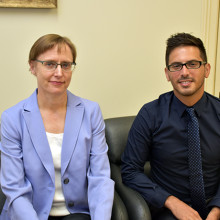
Above: Dr. Elizabeth Osuch and Justin Arcaro
Scientist