


Search
Search
505 Search Results:
2018 Scientist of the Year Award: Dr. Robert Teasell
Lawson scientist Dr. Robert Teasell is considered a global leader in neurorehabilitation research and has been instrumental in transforming clinical care in this area across Canada by ensuring that clinical practices are informed by the best available and up-to-date research evidence. In recognition of his accomplishments, he received the Scientist of the Year Award at the 2018 Lawson Impact Awards event this past spring.
Dr. Teasell leads the Collaboration of Rehabilitation Research Evidence (CORRE) research team at St. Joseph’s Health Care London’s Parkwood Institute. He is also the Medical Director of the Stroke Rehabilitation Unit at Parkwood Institute and has an active outpatient chronic pain practice.
He has led the development of three internationally renowned evidence-based reviews for stroke rehabilitation, brain injury and spinal cord injury, which are regarded as the three most comprehensive research syntheses in neurorehabilitation in the world. Dr. Teasell has advised and helped plan stroke care for all of Ontario’s 14 Local Health Integration Networks (LHINs) and six provincial healthcare systems. This is in addition to the many clinical guidelines and models of care he has helped develop and update.
Dr. Teasell also bridges the gap between research and clinical practice through collaborations between his research and clinical teams. His multidisciplinary Rehabilitation Knowledge to Action Project (REKAP) team received the 2014 Sandra Letton Quality Award for their quality improvement project designed to make Parkwood Institute a leader in stroke rehabilitation by improving care through implementation of best practices.
In addition to his neurorehabilitation research, Dr. Teasell has published extensively on chronic pain with a recent focus on the role of obsessive personality traits in determining chronic pain disability and coping abilities.
Drawing on his clinical and research expertise, Dr. Teasell has supervised many students and has been committed to developing the next generation of medical researchers.
“Dr. Teasell has been successful in a number of areas. Certainly in terms of publications and mentorship of students who have gone on and had very successful careers of their own. Despite a busy clinical schedule, he always makes a point of engaging with his research team every day. His staff and students really appreciate the opportunity to work with him,” says Dr. Cheryl Forchuk, Beryl and Richard Ivey Research Chair in Aging, Mental Health, Rehabilitation and Recovery, and Assistant Director, Lawson Health Research Institute.
Dr. Teasell has authored 335 peer-reviewed articles, as well as many other collaborative group peer-reviewed articles, book chapters, published abstracts, posters, presentations and monographs. He has also been the editor for 14 special journal editions and is on the editorial boards for Topics in Stroke Rehabilitation, Journal of Rehabilitation, and Pain Research and Management.
In 2016, he was invited to present the Ramon J. Hnatyshyn Lecture, the leading annual national stroke lecture at the Canadian Stroke Congress in Quebec City. In 2010, he received the Canadian Association of Physical Medicine and Rehabilitation Merit award for his many contributions to the field of physiatry. He was also awarded the Royal College of Physicians and Surgeons of Canada McLaughlin-Gallie Visiting Professor in 2012. This year he will be awarded the Post-Acute Stroke Award of Excellence from the American Congress of Rehabilitation Medicine and the National Stroke Association in the United States.
“I’ve received a lot of national and international awards but there’s nothing better than being recognized by your peers and particularly your peers in the city where you work. It’s been a nice acknowledgement of not just my work, but also the work by the whole research team and all the people who have supported me over the years,” says Dr. Teasell.
Scientist
… 2018-09-10 This policy applies to: All St. Joseph's Health Care London Locations Similar policy at LHSC: Policy Name: … Care London (St. Joseph’s) is committed to teaching and to offering learning experiences to individuals who are not … all programs and departments, including specific divisions/areas you wish to observe, if known: ____________ Observer …
Policy Administration https://apps.sjhc.london.on.ca/sjhc-policy/search_res.php?polid=EDU014&live=1[2018/10/31 1:52:43 PM] Policy Administration Console Policy: Observer (Medical and Non-Medical) Policy Owner: Integrated Director, Medical Affairs SLT Sponsor: Integrated Vice President, Medical Affai...
… Dr. Hassan Razvi, Surgical Services You make health care innovation possible. Just one of the reasons why YOU HELPED ENHANCE OUR OPERATING ROOMS … The Beryl and Richard Ivey Research Chair in Aging, Mental Health, Rehabilitation and Recovery (the largest and … Services You make health care innovation possible. Just one of the reasons why YOU HELPED ENHANCE OUR OPERATING ROOMS …
Back row left: Holly Bridge, Diane Davis-Miller, Barb Simmonds Front row left: Dr. Jennifer Bjazevic, Roger Blum, Leanne Summers, Dr. Hassan Razvi, Surgical Services You make health care innovation possible. Just one of the reasons why YOU HELPED ENHANCE OUR OPERATING ROOMS 20192020 Community Impact...
… Page 1 of 13 2019-20 SJHCF Grants St. Joseph’s Health Care Foundation 2019-20 Grants PATIENT CARE (In Alphabetical … for residents at Mount Hope. 18 Weighted Blankets, $9,937 - Mental Health Care Building at Parkwood Institute … Page 1 of 13 2019-20 SJHCF Grants St. Joseph’s Health Care …
Page 1 of 13 2019-20 SJHCF Grants St. Josephs Health Care Foundation 2019-20 Grants PATIENT CARE (In Alphabetical Order) 3 Complex Cataract Surgery Instruments Trays, $23,122 - St. Joseph's Hospital Equipment used in cataract surgery for the Ivey Eye Institute. 10 Blanket Warmers, $43,180 - Mount Ho...
… St. Joseph’s Health Care Foundation 268 Grosvenor Street PO Box 5777 STN B … sites MORE THAN 300 SPECIAL MEALS brightened the lives of Canada’s war veterans who make their home at Parkwood … Health serves young people across a vast range of rural areas surrounding London. YOUR SUPPORT IS MAKING A HEALTHIER …
St. Josephs Health Care Foundation 268 Grosvenor Street PO Box 5777 STN B London, ON N6A 4V2 519-646-6085 sjhc.london.on.ca/foundation CHARITABLE REGISTRATION NUMBER: BN 11918 3390 RR0001 facebook.com/stjosephslondon youtube.com/stjosephslondon twitter.com/stjosephslondon Connect with us YOUR SUPPOR...
… P a g e | 1 Meeting of the Board of Directors Monday, September 25, 2023 3:30 pm … and Chief Executive Officer a) R. Butler highlighted areas of current developments and issues from the summer … following an investigation of the Ministry of Long-Term Care’s oversight of long-term care homes through inspection …
P a g e | 1 Meeting of the Board of Directors Monday, September 25, 2023 3:30 pm start time St. Josephs Hospital Adams Boardroom A2-041 Via MS Teams video-conference MINUTES Minutes to be ratified next meeting Call to Order Nawaz Tahir Welcome and roundtable introductions occurred. The Board then ...
… Ontario are doing everything they can to limit the spread of COVID-19, including rescheduling non- urgent outpatient … has significantly impacted your usual access to healthcare. Your health care providers have likely evaluated your … Although physicians may not have expertise in these areas, our colleagues working within our pain clinic do. By …
A guide to managing your pain during COVID-19 Our services Hospitals across Ontario are doing everything they can to limit the spread of COVID-19, including rescheduling non- urgent outpatient clinic appointments for the time being. What does this mean for the Pain Management Program? For now, our g...
… on the link for the sessions on St. Joseph’s Health Care London’s website. You can attend any or all of the sessions. No registration is required for attending … as headaches, pressure in your head, neck pain and in other areas of the body. Dr. Sequeira, a specialist in Physical …
Parkwood Institute Acquired Brain Injury Survivor and Family Education Series Spring 2019 Schedule The survivor and family education series is a forum open to individuals with acquired brain injury, their family and friends. Sessions will be Tuesday evenings from 6:30 to 8:00 pm. In London, the sess...
… have access to enter and exit the building and resident care areas – no other access will be granted to students in … and identification cards to the students at the start of the shift and collecting the panic alarms and … access to enter and exit the building and resident care areas – no other access will be granted to students in …
PROCEDURES FOR CLINICAL INSTRUCTORS (CIs) TO OBTAIN IDENTIFICATION, ACCESS AND PERSONAL PANIC ALARMS FOR STUDENT GROUP PLACEMENTS CIs will receive a St. Josephs photo identification card. CIs will also receive an access card with the same access rights as staff in the area where they will be teachi...
… In fulfilling our mission and in alignment with our values of respect, compassion and excellence, St. Joseph’s Health Care London (St. Joseph’s) strives to provide accessible … with the building code and is now aiming to modify areas of the facilities to meet the specific needs of the …
St. Josephs Accessibility Plan 2016-2019 Page 1 Accessibility Plan January 2016 December 2019 Submitted to St. Josephs Accessibility Advisory Committee December 24, 2015 Submitted to St. Josephs Senior Leadership Team January 26, 2016 St. Josephs Accessibility Plan 2016-2019 Page 2 Introduction In ...
… In fulfilling our mission and in alignment with our values of respect, excellence and compassion, St. Joseph’s Health Care London (St. Joseph’s) strives to provide accessible … mode, St. Joseph’s has added additional door openers in areas where the public has encountered difficulty in …
St. Josephs Accessibility Plan 2019-2022 Page 1 Multi-year Accessibility Plan January 2019 December 2022 Submitted to St. Josephs Accessibility Advisory Committee December 12, 2019 Submitted to St. Josephs Senior Leadership Team December 17, 2019 St. Josephs Accessibility Plan 2019-2022 Page 2 In...
… In fulfilling our mission and in alignment with our values of respect, excellence and compassion, St. Joseph’s Health Care London (St. Joseph’s) strives to provide accessible … mode, St. Joseph’s has added additional door openers in areas where the public has encountered difficulty in …
Multi-year Accessibility Plan January 2019 December 2022 Submitted to St. Josephs Accessibility Advisory Committee December 12, 2019 Submitted t o St. Josephs Senior Leadership Team December 17, 2019 St. Josephs Accessibility Plan 2019-2022 Page 1 Introduction In fulfilling our mission and in ali...
… In fulfilling our mission and in alignment with our values of respect, compassion and excellence, St. Joseph’s Health Care London (St. Joseph’s) strives to provide accessible … 3rd Floor Clinics Heavy doors lead to waiting rooms in areas that are accessed by patients with upper extremity …
St. Josephs Accessibility Plan Status Report: 2014 Page 1 Accessibility Plan January 2013 December 2015 Status Report February 2014 Submitted to St. Josephs Accessibility Advisory Committee January 27, 2015 Submitted to St. Josephs Senior Leadership Team on February 12, 2015 St. Josephs Accessibili...
Advocating for health research during “H on the Hill”
HealthCareCAN held its third annual Lobby Day “H on the Hill” event on Parliament Hill in Ottawa, on Tuesday, October 30, 2018.
Canada’s hospital CEOs and vice presidents of health research joined HealthCareCAN - the national voice of Canada’s healthcare organizations, community and research hospitals - to meet with MPs, Senators and senior government staff.
Collectively, they issued a call for federal action to unlock the tremendous economic potential of the health and life sciences sector to support better health for Canadians.
Dr. David Hill, Scientific Director for Lawson and Integrated Vice President of Research for London Health Sciences Centre and St. Joseph’s Health Care London, participated in the lobby day. Dr. Hill currently sits on the Board of Directors for HealthCareCAN.
Image
Image

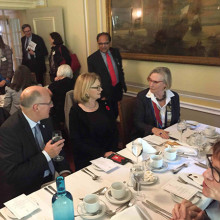
“Minister of Crown Indigenous Relations @Carolyn_Bennett, Parliamentary Secretary for Science, Sport, and Accessibility @KateYoungMP, and Dr. David Hill, catching up over lunch at #HontheHill #CDNpoli #CDNhealth”
Image

Meeting participants stressed the need for action on HealthCareCAN’s recommendations for the 2019 federal budget, specifically:
- Setting a minimum 25% funding floor for the indirect costs of research under the Research Support Fund;
- Granting eligibility to federal infrastructure funding competitions to healthcare organizations, and;
- Investing in digital health platforms to support care, training, and research in healthcare organizations.
Diverse areas of the health and life sciences sector and key health issues were discussed, including:
- Health and science research, granting councils;
- Hospital infrastructure;
- Health innovation;
- Electronic health technology;
- Opioid crisis response;
- Mental health;
- Aboriginal health; and,
- Home care.
Read Dr. Hill’s recent column in Hospital News on bridging the gap from discovery to patient care.
Image

HealthCareCAN provides high-quality policy research advocacy and leadership development services to our members while championing healthcare system transformation in Canada. Visit www.healthcarecan.ca to learn about our solutions to health and healthcare challenges. Follow us on Twitter: @HealthCareCAN
Scientist
An online approach to care
With an aging population, neurological conditions like stroke, brain injury and multiple sclerosis (MS) are on the rise in Canada. Those living with neurological conditions face many long-term challenges that can affect both their physical and cognitive functioning. They are also at an increased risk for mental health challenges such as depression and anxiety.
“While mental health challenges are common for those with neurological conditions, they often go untreated for a number of reasons,” says Dr. Swati Mehta, Scientist at Lawson Health Research Institute. “For example, those living in remote areas often do not have access to specialized services and many patients are concerned about stigma.”
Yet seeking mental health care is critically important for patients with neurological conditions. “Research suggests that depression among these patients can impair recovery, leading to decreased quality of life and increased health care costs.”
To improve patient outcomes, Dr. Mehta and a collaborative research team are developing an internet-delivered cognitive behavioural therapy (ICBT) program.
Image
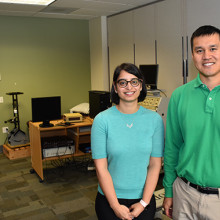
Dr. Swati Mehta (left), Lawson Scientist, and Dr. Eldon Loh (right), Lawson Associate Scientist, are working with a collaborative team to develop the specialized program.
Cognitive behavioural therapy (CBT) is a specialized type of therapy that involves patients learning strategies and skills to self-manage mental health symptoms. It’s one of the most widely used therapies for the treatment of depression and anxiety.
A panel of researchers, persons with lived experience of neurological conditions and community organizations are working collaboratively to develop an accessible ICBT program that meets the needs of persons with neurological conditions and mild cognitive impairment who are also experiencing symptoms of depression or anxiety. The program, called The Neuro Course, will be a modified version of an existing course developed in Australia by the eCentreClinic.
“Through co-development with patients and experts in the field, the ICBT program will meet the specific needs of persons with neurological conditions who are also experiencing mental health challenges,” explains Dr. Mehta. “With online delivery, it can provide personalized treatment while being flexible and easily accessible.”
The Neuro Course will be piloted with a small group of research participants, including patients from Parkwood Institute, a part of St. Joseph’s Health Care London. Eligible participants can sign up to be notified of the course’s availability at https://www.onlinetherapyuser.ca/neuro.
The free online course consists of six easy-to-understand CBT lessons and will take approximately 10 weeks to complete. In addition to the six lessons, participants will be encouraged to work through various activities during the week.
Image
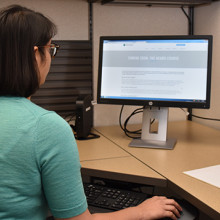
Participants will also receive regular support from a designated online guide. Guides will be health educators who are certified providers or graduate students working under the supervision of certified providers. All guides will have training in psychology or social work. The participant’s guide will review the participant’s progress and answer any questions or comments through a secure messaging system.
Participants in the study will be asked to complete brief questionnaires before they begin the course, on a weekly basis throughout the course and then again three months after treatment ends. The research team will use the questionnaires to assess patient outcomes and improve future versions of the course.
The goal of the program is to overcome barriers to face-to-face therapy, such as limited access to specialized care and concerns about stigma related to seeking care, by providing an effective online alternative. By reaching those in need, the research team hopes to improve patient outcomes and overall wellbeing.
“The long term goal would be to implement the ICBT program into clinical practice to provide increased access to mental health services among this population,” says Dr. Mehta. “The program could be used to provide care to those with mild to moderate mental health concerns or those waiting to access face-to-face programs.”
The team is being funded for this project through Lawson’s Internal Research Fund (IRF) competition. “As an early career researcher, receiving funding from Lawson’s IRF is a great honour. It’s a great opportunity to help researchers obtain funding for small feasibility studies to develop evidence for larger grants that can be used to translate knowledge across the community,” states Dr. Mehta.
Lawson’s IRF is designed to provide Lawson scientists the opportunity to obtain start-up funds for new projects with the potential to obtain larger funding, be published in a high-impact journal, or provide a clinical benefit to patients. Funding is provided by the clinical departments of London Health Sciences Centre and St. Joseph’s Health Care London, as well as the hospital foundations (London Health Sciences Foundation and St. Joseph’s Health Care Foundation).
Scientist
… Community 2000-2001 June 2001 Dr. Lauren McCurdy Director of Breast Imaging, St. Joseph’s Health Care, London Associate Professor, UWO Visit our web site: … year saw hospital restructuring accomplishments in several areas. One of the most notable and intensive activities was …
Annual Report to the Community 2000-2001 June 2001 Dr. Lauren McCurdy Director of Breast Imaging, St. Josephs Health Care, London Associate Professor, UWO Visit our web site: www.sjhc.london.on.ca For additional copies of the report, complete financial statements, salary disclosure information or ot...
… 8 SLOWING THE PROGRESSION OF MEMORY LOSS … 38 Report on Mission, Spiritual Care and Health Care Ethics … of our facilities at St. Joseph’s Hospital and Regional Mental Health Care continue on time and on budget. In fact, … featuring a single point of registration, bright, spacious areas, and improved patient privacy and amenities. …
Annual Report 2012-2013 Welcome to the 2012-2013 Annual Report Contents Annual Report 2012-2013 ......................................................................................................................... 1 Welcome to the 2012-2013 Annual Report ............................................
… 7 ENHANCING CARE FOR BREAST CARE PATIENTS … 11 THE BEST DAY OF THE WEEK … A NEW BEGINNING In June 2013, St. Joseph’s closed Regional Mental Health Care St. Thomas and celebrated the grand … downtown area encourage social interaction and community; areas in the neighborhood promote education and skill …
Annual Report 2013-2014 Welcome to our 2013-2014 Annual Report Contents Annual Report 2013-2014 ............................................................................................................................. 1 Welcome to our 2013-2014 Annual Report ........................................
… 4 WORLD DAY OF THE SICK … 6 MUCH NEEDED TLC FOR THOSE PEOPLE WITH SPECIAL HEALTH CARE NEEDS ........................................ 8 … 20 LONG AND STRONG: CELEBRATING A LEGACY OF MENTAL HEALTH CARE … encourage social interaction and a sense of community while areas in the “neighbourhood” promote education and skill …
Annual Report 2014-2015 Welcome to the 2014-2015 Annual Report Contents Annual Report 2014-2015 ............................................................................................................................. 1 Welcome to the 2014-2015 Annual Report ........................................
… 3 INNOVATIVE TRIAL AIMS TO INDUCE REMISSION OF TYPE 2 DIABETES … residents in this report and be inspired by the journeys of care, recovery and discovery taking place across St. … four teaching hospitals in Ontario that is impacted by all areas of the Ministry’s Health-Based Allocation Methodology, …
Annual Report 2015-2016 Welcome to the 2015-2016 Annual Report Contents Welcome to the 2015-2016 Annual Report .............................................................................................. 1 OPENING MESSAGE ...............................................................................