


Search
Search
505 Search Results:
… Money Management Skills Assessment, Instrumental Activities of Daily Living, Financial Assessment and Capacity Test, … Validity ____________________ 1 Regional Mental Care London, SJHC, 2 Adjunct Faculty Department of … financial capacity, the FACT has the potential to identify areas of specific difficulty such as memory, reading/writing …
A Financial Assessment & Capacity Test (FACT) For A Psychogeriatric Population: Development and Concurrent Validity Edward L. Black, PhD, CPsych1,2 , Tom J. Ross, B.A.1, Tobi Flanagan, BScOT1, Kiran Rabheru, MD, FRCPC3, Hans J. Breiter, PhD, CPsych2 Key Words: Money Management Skills Assessment, Ins...
… 2019 ■ Every day, volunteers at St. Joseph’s Health Care London (St. Joseph’s) improve the lives of patients, residents, visitors and staff by contributing … an immeasurable amount of time supporting various areas across the organization. During 2018/2019, … an immeasurable amount of time supporting various areas across the organization. During 2018/2019, …
pg 2 | JANUARY - FEBRUARY 2019 Every day, volunteers at St. Josephs Health Care London (St. Josephs) improve the lives of patients, residents, visitors and staff by contributing an immeasurable amount of time supporting various areas across the organization. During 2018/2019, approximately 908 volu...
Walking the labyrinth: A path for meaning, insight and reflection
At Southwest Centre for Forensic Mental Health Care (Southwest Centre) in Elgin County, the unique story of every individual is honoured as care practitioners assist in the journey toward recovery. Part of the St. Joseph’s Health Care London family, Southwest Centre is devoted to caring for people with a mental illness who have also come into contact with the criminal justice system.
A new study by Lawson Health Research Institute shows that the use of labyrinths contributes to recovery by promoting spiritual self-care, insight development and personal meaning-making reflection. The research was co-authored by Lawson Allied Scientist and Certified Spiritual Care Practitioner at Southwest Centre, Stephen Yeo, along with his colleagues Dr. Clark Patrick Heard and Jared Scott, both Lawson Associate Scientists and Occupational Therapists.
“Research has demonstrated that labyrinth-walking can result in increased focus and calm, along with a reduction in blood pressure and stress,” explains Yeo. “Additionally, labyrinth-walking is narrative-driven and highly constructivist in nature, which promotes the opportunity for one to critically reflect on his or her unfolding story.”
This can be done in solitude or a trained facilitator can support important narrative reflection and invite opportunities for integration.
The process of reflecting and making meaning helps individuals to think about what they observed or did, why it mattered and how they might think or act differently based on new knowledge. This allows them to set goals and use what they’ve learned from the past to inform future action, and to consider the real-life implications.
Participation supports patients as they cope with mental illness, and the impact is magnified for individuals who have come into contact with the criminal justice system. Their experience can increase existential questions along with spiritual pain and distress.
Even in the most complex and difficult circumstances, walking the labyrinth facilitates a variety of coping approaches including:
- stress reduction and mindfulness;
- understanding one’s awareness of relationship with that which is sacred to them (transcendence) and the environment;
- development of ongoing personal narrative and meaning-making; and,
- kinesthetic prayer and meditation.
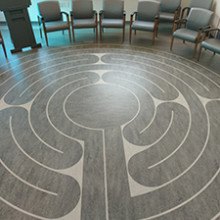
Unlike mazes that are like puzzles with many choices of path and direction, labyrinths are created using continuous lines and are easier to navigate with one route to and from the centre. There are two permanent labyrinths at Southwest Centre – one indoors and one outdoors. For the most part, the labyrinths are accessible for self-guided walking and, throughout the year, various group opportunities are scheduled for invited participation. This activity can be continued in the community, as there are labyrinths in various places across the province such as parks, faith communities and other health-care settings.
“Labyrinth participation supports themes related to hope, coping, resiliency, autonomy – all of which are significant contributors to recovery and the maintenance of well-being. Future research in this area could examine the benefits for different patient populations and also for those who reside in the community.”
Labyrinths are trans-religious and their application can be beneficial to religious and non-religious participants. They are also easy to maintain and can be installed in a variety of locations.
Along with his study co-authors, Yeo was honoured with the CASC Group Research Award from the Canadian Association for Spiritual Care. The award recognizes a CASC member who collaborates with other professionals in the research field of spirituality, religion and wellbeing. The recipient supports the core values of professional connection and interdependence, promoting positive relationship with colleagues of various professionals as well as clients.
“Given that this was my first foray into research at this level, I was very humbled to have been nominated for, and to have received, this award,” says Yeo. “I remain especially grateful to the professional guidance and support of my research colleagues.”
“Walking the Labyrinth: Considering mental health consumer experience, meaning making, and the illumination of the sacred in forensic mental health setting” was published in the December 2015 issue of the Journal of Pastoral Care and Counseling. This study is believed to be a first of its kind in a forensic mental health care facility.
Image
|
Left: Photo of the indoor labyrinth at the Southwest Centre for Forensic Mental Health Care. |
Scientist
Wide range of research showcased at Parkwood Institute Research's 2017 Spring Update
Lawson researchers at Parkwood Institute, part of the St. Joseph’s Health Care London family, work to improve both physical and mental health care based on the understanding that conditions of the body and mind are integrally linked. From studies on mobility after brain and spinal cord injury to treatment-resistant depression, a range of different research areas were highlighted on April 21, 2017 at Parkwood Institute Research’s 2017 Spring Update Half-Day event.
Parkwood Institute Research is a Lawson program that represents inter-disciplinary clinical research. At the second annual Spring Update event celebrating this work, attendees learned about research from across Parkwood Institute’s three core research themes: Cognitive Vitality & Brain Health, Mobility & Activity, and Mental Health Care. New this year was the addition of poster presentations, which provided another opportunity for researchers and trainees to promote and share their work.
Learn more about the work Lawson scientists at Parkwood Institute presented at the event:
Cognitive Vitality & Brain Health
Dr. Stephen Pasternak was one of the presenters in the Cognitive Vitality & Brain Health theme. Dr. Pasternak and his team are conducting a phase 2 randomized controlled trial looking at whether a European over-the-counter cough medicine, Ambroxol, could also treat Parkinson’s Disease Dementia (PDD).
“There are currently no effective treatments for cognitive impairment experienced by PDD patients. Existing treatments only treat the symptoms of Parkinson’s disease, but do not stop the disease process itself,” says Dr. Pasternak.
Parkinson’s disease is believed to be caused by the buildup of a protein called alpha-synuclein in the brain. Ambroxol increases the levels of an enzyme called β-Glucocerebrosidase (GCase), which has been shown to reduce the buildup of alpha-synuclein in animal and cell cultures models, suggesting that this could be used as a treatment for PDD.
This trial is well underway and the first participants have completed the first year of treatment. If successful, this trial will be the first to demonstrate that it is possible to change the underlying cause of PDD.
Mobility & Activity
As part of the Mobility & Activity themed presentations, Dr. Dalton Wolfe discussed an initiative supported by the St. Joseph’s Health Care Foundation and Ontario Neurotrauma Foundation to help improve mobility in patients with acquired brain and spinal cord injuries.
Called the Parkwood Program for Rehabilitation Innovations in Movement Enhancement (PRIME), a key goal of this initiative is to develop and implement a clinical decision support system that integrates approaches to activity-based therapy. Clinicians, researchers, administrators and IT specialists have combined their efforts to initiate development on this system.
“PRIME will provide recommendations for treatment based on patients’ injury level and type, and clinical characteristics,” says Dr. Wolfe. “It will also have suggestions for what to monitor for each patient to challenge them to optimize recovery, as well as to reduce risk of injury or secondary complications.”
This system will also enable electronic tracking of practices and outcomes, moving away from the current paper-based model and creating a practice-based research platform.
Mental Health Care
Dr. Amer Burhan presented his research on Transcranial Magnetic Stimulation (TMS) in the Mental Health Care portion of the presentations. TMS is a non-invasive method that uses magnetic fields to stimulate nerve cells in the brain. An electromagnetic coil is held against the head and short magnetic pulses are administered, causing a change in activity level in specific targeted areas and allowing for a study of the function and interconnectivity of the brain. The method has been approved to treat depression resistant to medications and has potential to be used to treat other mental and neurological disorders.
Dr. Burhan’s talk focused on the effectiveness of a certain type of TMS, bilateral theta-burst stimulation, in treating patients with depression who are not responsive to medication. This is a new method of TMS that is designed to facilitate change in brain activity and connectivity more efficiently. He presented preliminary results on the first 60 patients treated with this method. So far the treatment has resulted in significant improvement in over half of the patients.
“More studies are planned to understand predictors of response and facilitate individualized selection of treatment for patients struggling with this very disabling illness,” says Dr. Burhan.
Scientist
Youth report improved wellbeing as result of tailored mental health services, study finds
In a new study from Lawson Health Research Institute and Western University, researchers partnered with youth receiving care at the First Episode Mood and Anxiety Program (FEMAP) at London Health Sciences Centre (LHSC) to better understand personal perspectives on care and treatment outcomes. The study found that patients experienced lasting improvements in managing their symptoms and improvements in academics, work performance and relationships, and they reported that these benefits involved being empowered by feelings of self-acceptance.
The study included 22 patients from FEMAP, a novel outpatient mental health program at LHSC that provides treatment to ‘emerging adults,’ ages 16 to 25, with emotional concerns that fall into the categories of mood and anxiety symptoms. Treatment at FEMAP takes a patient-centred approach and the research involved looking at what is meaningful and valuable to patients during their care journey.
“The transition from adolescence to adulthood is challenging. FEMAP employs an innovative model of care tailored to the needs of this complex population,” said Dr. Elizabeth Osuch, a clinician-scientist at Lawson, associate professor at Western University’s Schulich School of Medicine & Dentistry and medical director at FEMAP. “By engaging patients in a reflection of their experience, we can learn how effective the program is from the patient perspective.”
Participants shared their experiences through open-ended interviews with Dr. Osuch’s research team. Interview transcripts were collected and analyzed to determine common themes around treatment and outcomes. These themes were then presented back to the research participants for validation.
The study found that treatment led to development of coping strategies to better manage symptoms. Research participants credited these strategies for better functioning in academics, careers and personal relationships. Challenges in these areas are common among emerging adults and are often stressors that lead to youth seeking mental health care.
Participants characterized their treatment at FEMAP as an important investment in their mental health and wellbeing, and credited a collaborative partnership with their care provider for keeping them engaged in treatment. They appreciated the ease of accessing treatment at FEMAP where they could receive care from a psychiatrist, social worker, addictions counsellor, family counsellor and a psychologist, depending on their needs.
The research found that the complexities of treatment were initially frustrating to patients as they were seeking an “easy fix” to their mental health concerns, but they ultimately appreciated that mental health recovery is a journey. They valued that care providers partnered with them to set long-term treatment goals, choose the best treatment options and provide support both during and between appointments.
“Patients may prefer FEMAP over other mental health services because the care is tailored to emerging adults,” said Justin Arcaro, first author on the study and a former MSc candidate at Schulich Medicine & Dentistry and research associate at FEMAP. “There’s an important balance between recognizing emerging adults’ personal autonomy and their need for comprehensive support.”
Study results demonstrated that through treatment at FEMAP, patients realized they are not alone in their mental health journey which led to improved self-acceptance and self-compassion. Participants reported feeling empowered to create meaningful changes in their lives.
Participants also discussed the decision to seek mental health care in the first place. Many struggled with the decision of whether or not treatment was needed. “This shows a need for targeted campaigns to help emerging adults distinguish between normative feelings and those that indicate a need for help,” said Dr. Osuch.
This study also aligns with other research projects at FEMAP that suggest a need for targeted education campaigns about mental health care as a process with solutions that are not necessarily quick or easy. The research team highlights the importance of these findings in informing future funding decisions and policy around mental health care for emerging adults. The findings emphasize the need for quick engagement with a trusted care provider and an integrated treatment team that can partner with patients to support them while enhancing independent growth and self-acceptance.
The study, “Emerging adults’ evaluation of their treatment in an outpatient mood and anxiety disorders program,” is published in Emerging Adulthood.
Image
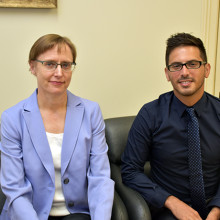
Above: Dr. Elizabeth Osuch and Justin Arcaro
Scientist