


Search
Search
570 Search Results:
… Dr. will provide 50% of the secretarial computer cost. You will be expected to lease/purchase the remaining … “A Guide to Secretarial Support Services for Professional Staff” at https://intra.lhsc.on.ca/medical-affairs/professional-staff/resources/secretarial-support for more information. …
Dr. s copy Western Schulich School of Medicine & Dentistrys copy Department of s copy Medical Affairs copy THIS LETTER OF OFFER IS ONLY TO BE ISSUED AFTER CONFIRMATION OF THREE SATISFACTORY REFERENCES FOR THE CANDIDATE. Dear Dr.
… Dr. will provide 50% of the secretarial computer cost. You will be expected to lease/purchase the remaining … “A Guide to Secretarial Support Services for Professional Staff” at https://intra.lhsc.on.ca/medical-affairs/professional-staff/resources/secretarial-support for more information. …
Dr. s copy Western Schulich School of Medicine & Dentistrys copy Department of s copy Medical Affairs copy THIS LETTER OF OFFER IS ONLY TO BE ISSUED AFTER CONFIRMATION OF THREE SATISFACTORY REFERENCES FOR THE CANDIDATE. Dear Dr.
… Dr. will provide 50% of the secretarial computer cost. You will be expected to lease/purchase the remaining … “A Guide to Secretarial Support Services for Professional Staff” at https://intra.lhsc.on.ca/medical-affairs/professional-staff/resources/secretarial-support for more information. …
Dr. s copy Western Schulich School of Medicine & Dentistrys copy Department of s copy Medical Affairs copy THIS LETTER OF OFFER IS ONLY TO BE ISSUED AFTER CONFIRMATION OF THREE SATISFACTORY REFERENCES FOR THE CANDIDATE. Dear Dr.
… Dr. will provide 50% of the secretarial computer cost. You will be expected to lease/purchase the remaining … “A Guide to Secretarial Support Services for Professional Staff” at https://intra.lhsc.on.ca/medical-affairs/professional-staff/resources/secretarial-support for more information. …
Dr. s copy Western Schulich School of Medicine & Dentistrys copy Department of s copy Medical Affairs copy THIS LETTER OF OFFER IS ONLY TO BE ISSUED AFTER CONFIRMATION OF THREE SATISFACTORY REFERENCES FOR THE CANDIDATE. Dear Dr.
… Dr. will provide 50% of the secretarial computer cost. You will be expected to lease/purchase the remaining … “A Guide to Secretarial Support Services for Professional Staff” at https://intra.lhsc.on.ca/medical-affairs/professional-staff/resources/secretarial-support for more information. …
Dr. s copy Western Schulich School of Medicine & Dentistrys copy Department of s copy Medical Affairs copy THIS LETTER OF OFFER IS ONLY TO BE ISSUED AFTER CONFIRMATION OF THREE SATISFACTORY REFERENCES FOR THE CANDIDATE. Dear Dr.
… Joint Letter of Understanding Template - Non Clinical Academic …
Dr. s copy Western Schulich School of Medicine & Dentistrys copy Department of s copy Medical Affairs copy THIS LETTER IS ONLY TO BE ISSUED TO NON CLINICAL ACADEMIC APPOINTMENTS SUCH AS TERM OR LOCUM CATEGORY. Dear Dr.
… Joint Letter of Understanding Template - non-clinical …
Dr. s copy Western Schulich School of Medicine & Dentistrys copy Department of s copy Medical Affairs copy THIS LETTER IS ONLY TO BE ISSUED TO NON CLINICAL ACADEMIC APPOINTMENTS SUCH AS TERM OR LOCUM CATEGORY. Dear Dr.
… REFERENCE FORM For The Schulich School of Medicine & Dentistry, London Health Sciences Centre, and St. Joseph’s Health Care London Instructions to the Applicant: · You are required to obtain … REFERENCE FORM For The Schulich School of Medicine & Dentistry, London Health Sciences Centre, and St. Joseph’s Health …
JOINT REFERENCE FORM For The Schulich School of Medicine & Dentistry, London Health Sciences Centre, and St. Josephs Health Care London Instructions to the Applicant: You are required to obtain three confidential references with your application for your academic appointment with Schulich School of...
… REFERENCE FORM For The Schulich School of Medicine & Dentistry, London Health Sciences Centre, and St. Joseph’s Health Care London Instructions to the Applicant: · You are required to obtain … REFERENCE FORM For The Schulich School of Medicine & Dentistry, London Health Sciences Centre, and St. Joseph’s Health …
JOINT REFERENCE FORM For The Schulich School of Medicine & Dentistry, London Health Sciences Centre, and St. Josephs Health Care London Instructions to the Applicant: You are required to obtain three confidential references with your application for your academic appointment with Schulich School of...
… Dr. will provide 50% of the secretarial computer cost. You will be expected to lease/purchase the remaining … “A Guide to Secretarial Support Services for Professional Staff” at https://intra.lhsc.on.ca/medical-affairs/professional-staff/resources/secretarial-support for more information. …
Dr. s copy Western Schulich School of Medicine & Dentistrys copy Department of s copy Medical Affairs copy THIS LETTER OF OFFER IS ONLY TO BE ISSUED AFTER CONFIRMATION OF THREE SATISFACTORY REFERENCES FOR THE CANDIDATE. Dear Dr.
… Dr. will provide 50% of the secretarial computer cost. You will be expected to lease/purchase the remaining … “A Guide to Secretarial Support Services for Professional Staff” at https://intra.lhsc.on.ca/medical-affairs/professional-staff/resources/secretarial-support for more information. …
Dr. s copy Western Schulich School of Medicine & Dentistrys copy Department of s copy Medical Affairs copy THIS LETTER OF OFFER IS ONLY TO BE ISSUED AFTER CONFIRMATION OF THREE SATISFACTORY REFERENCES FOR THE CANDIDATE. Dear Dr.
… Dr. Candidate’s copy Western Schulich School of Medicine & Dentistry’s copy Department of Oncology’s copy Medical Affairs’ copy DATE Dear Dr. Re: Letter of Understanding It gives us great pleasure to offer you a position … Dr. Candidate’s copy Western Schulich School of Medicine & Dentistry’s copy …
Dr. Candidates copy Western Schulich School of Medicine & Dentistrys copy Department of Oncologys copy Medical Affairs copy DATE Dear Dr. Re: Letter of Understanding It gives us great pleasure to offer you a position as a General Practitioner in Oncology (GPO) in the Depart...
… joint_letter_of_understanding_template_-_non_clinical_academic_-_2022-04-01.docx …
Dr. s copy Western Schulich School of Medicine & Dentistrys copy Department of s copy Medical Affairs copy THIS LETTER IS ONLY TO BE ISSUED TO NON CLINICAL ACADEMIC APPOINTMENTS SUCH AS TERM OR LOCUM CATEGORY. Dear Dr.
… REFERENCE FORM For The Schulich School of Medicine & Dentistry, London Health Sciences Centre, and St. Joseph’s Health Care London Instructions to the Applicant: · You are required to obtain … REFERENCE FORM For The Schulich School of Medicine & Dentistry, London Health Sciences Centre, and St. Joseph’s Health …
JOINT REFERENCE FORM For The Schulich School of Medicine & Dentistry, London Health Sciences Centre, and St. Josephs Health Care London Instructions to the Applicant: You are required to obtain three confidential references with your application for your academic appointment with Schulich School of...
Lawson cyclotron to produce new imaging agent that may better locate prostate cancer
Lawson Health Research Institute is the first in Canada to enter a sublicense agreement with The Centre for Probe Development and Commercialization (CPDC) to produce PSMA-1007, a new imaging agent that could help improve the detection of prostate cancer.
The radiopharmaceutical tracer can locate and bind to prostate specific membrane antigen (PSMA) – a protein on the surface of prostate cancer cells. This imaging agent makes the prostate cancer cells visible with PET/CT (positron emission tomography/computed tomography) imaging.
Dr. Glenn Bauman, a Radiation Oncologist at the London Regional Cancer Program at London Health Sciences Centre and Scientist with Lawson, has been involved in a number of research developments in PSMA PET/CT.
“Until now, a PET imaging agent called 18F-DCFPyL, was commonly used in research. More recently, we've been looking at a PET radiopharmaceutical called PSMA-1007 that may give us clearer pictures in the pelvis and the area of the prostate,” says Dr. Bauman, who is also a Professor of Oncology and Medical Biophysics at Western University’s Schulich School of Medicine and Dentistry.
Dr. Michael Kovacs, Director of the Lawson Cyclotron & PET Radiochemistry Facility at St. Joseph’s Health Care London, says the license means London will have a local supply of PSMA-1007 that is “more or less a magic bullet for prostate cancer cells.”
Radiopharmaceuticals decay quickly after production and so there is a need to produce them locally. Lawson’s cyclotron, which is housed at St. Joseph’s, is one of fewer than roughly two dozen facilities in Canada and delivers products to the GTA, Windsor and London.
“The cyclotron is a type of particle accelerator where we can accelerate particles called protons to high energy and fire them into a target that makes radioisotopes every day,” Dr. Kovacs explains. “The raw radioisotope is taken to the lab to synthesize PET radiopharmaceuticals, including PSMA imaging agents, before going through quality control.”
“Being able to produce PSMA-1007 locally is exciting, as outsourcing comes with logistical challenges if a production run fails or transportation fails,” explains says Dr. Bauman. “Having our own means of production is a real advantage to us as we conduct our research.”
CPDC, which holds the rights to produce PSMA-1007 in Canada, is already running a clinical trial in hopes of having it available in clinical settings. They expect to have study results in two to three years.
Early studies show the clearer images from PSMA-1007 may have the biggest impact in patients with a recurrence of prostate cancer who have already had treatment. The return of cancer can be very small and difficult to detect with conventional methods. In many of those cases, studies are finding a rise in PSMA levels can be an early signal of the cancer’s return, allowing for earlier diagnosis with PSMA PET.
Looking forward, PSMA-1007 has the potential to be used as a theranostic agent where by the isotope is used deliver radiation treatment directly to the cancer, but this application is likely many years away.
This is the part two of a three-part series on PSMA PET imaging research. Check out part one and three.
Lawson ranks in top ten of Canada’s research hospitals
LONDON, ON – Lawson Health Research Institute (Lawson) is ranked eighth in the country according to the 2017 edition of “Canada’s Top 40 Research Hospitals List” by Research Infosource. This strong position has been maintained by Lawson for the past four years.
The research institute of London Health Sciences Centre and St. Joseph’s Health Care London, Lawson also posted the highest research intensity (spending per researcher) among large institutions ($562,500 per researcher). “In a challenging funding environment, Lawson and our two hospital partners continue to enable our researchers in their pursuit of scientific knowledge that can be applied directly to patient care,” says Dr. David Hill, Scientific Director, Lawson.
The top 40 list analyzes hospital-based research institutes from across the country on several metrics, including total research income from the previous fiscal year. The ranking looks at funds received from all sources, including both internal and external, to support research at the organization. According to the report, Lawson received $124,304 million in research income in 2016, a 7.3 per cent increase from the previous fiscal year.
Dr. David Hill advocates for increased scientific funding nationally. “Despite our own modest increase in funding in 2016, Canada as a whole requires significant investment in scientific discovery to increase the well-being of Canadians and build a robust economy. Support for health research makes Canada healthier, wealthier and smarter.”
Lawson is a key part of London’s life sciences sector which has a rich history of medical firsts and generates significant economic benefits. At the institute there are over 1,700 people including researchers, support staff, and trainees who work at hospital sites across London. Lawson partners on over 600 research projects annually with approximately 8,000 clinical subjects enrolled in over 2,500 active clinical trials.
In the past year alone, research teams at Lawson have identified a protein that could be used to treat glaucoma; launched a second clinical trial to put type 2 diabetes into remission; demonstrated that walking and talking can be an effective predictor of dementia; and used smart technology to help patients with mental health issues. “One of Lawson’s strengths is the diversity of our research. Our research expands the continuum of life – from birth to death – and people in this region are among the first to benefit from the advances we are making across the health spectrum,” asserts Dr. Hill.
Research Infosource Inc., a division of The Impact Group, is Canada’s source of R&D Intelligence.
-30-
See all Lawson Media Releases
About Lawson Health Research Institute
Lawson Health Research Institute is one of Canada’s top hospital-based research institutes, tackling the most pressing challenges in health care. As the research institute of London Health Sciences Centre and St. Joseph’s Health Care London, our innovation happens where care is delivered. Lawson research teams are at the leading-edge of science with the goal of improving health and the delivery of care for patients. Working in partnership with Western University, our researchers are encouraged to pursue their curiosity, collaborate often and share their discoveries widely. Research conducted through Lawson makes a difference in the lives of patients, families and communities around the world. To learn more, visit www.lawsonresearch.ca.
Media Contacts
Celine Zadorsky
Senior Media Relations Consultant
Communications & Public Engagement
T: 519-685-8500 ext. 73502
Celine.zadorsky@lhsc.on.ca
Lens of compassion improves health care
Keynote speaker at joint mental health research day says compassion in action has proven benefit
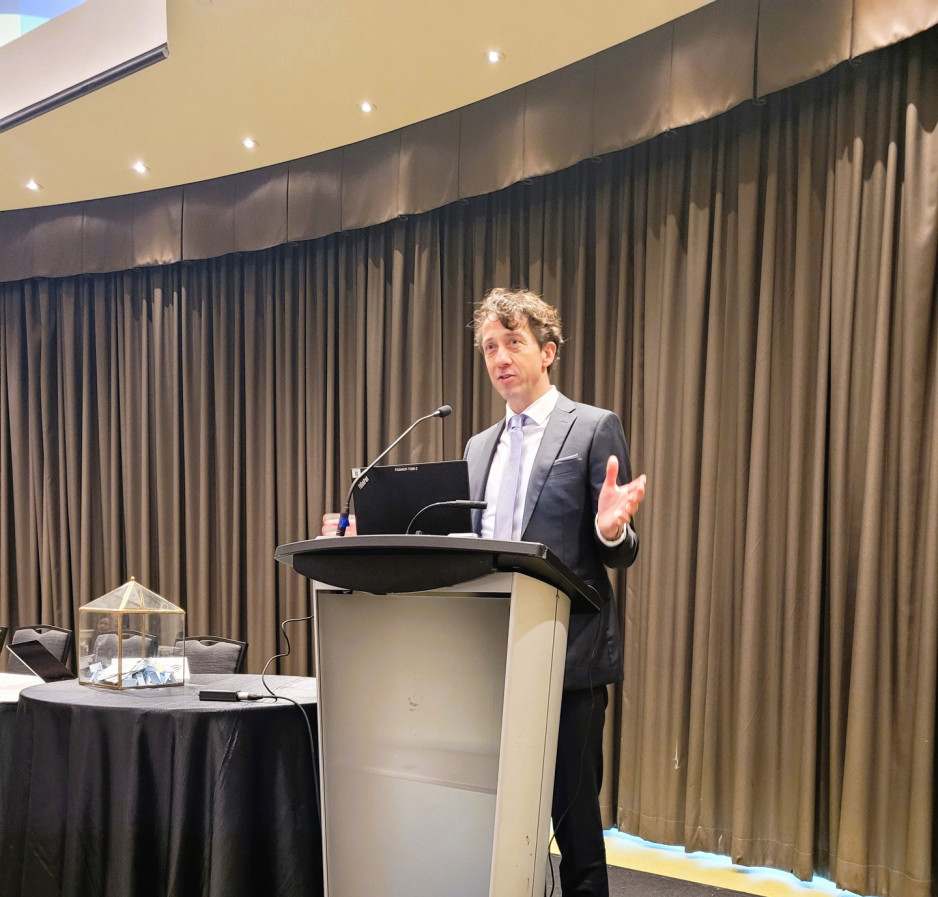
Compassion in mental health care – and in all health care – is “what separates good from really great” patient outcomes, Calgary-based researcher Shane Sinclair, PhD, told mental health researchers during a conference Oct. 30, 2024, in London.
Sinclair, who heads the Compassion Research Lab at the University of Calgary, was the invited keynote speaker at the Joint Mental Health Research and Innovation Day, attended by about 130 people.
The event was hosted by Lawson Research Institute, London Health Sciences Centre Research Institute and Schulich School of Medicine & Dentistry.
The day also featured 17 poster presentations and 17 oral presentations on different aspects of mental health research. It’s one of the premier annual education-and-development events in mental health science regionally.
This year’s event showcased how compassion could transform health policy, partnerships, systems, care, research and service delivery.
Compassion, respect and excellence are core values of St. Joseph’s Health Care London.
Sinclair noted that the key role of compassion – responding to someone’s suffering with understanding and action – is evidence-based.
“We do patient-informed and patient-targeted research. And we’ve found compassion makes a difference in how people heal.”
-Shane Sinclair, PhD, compassion researcher
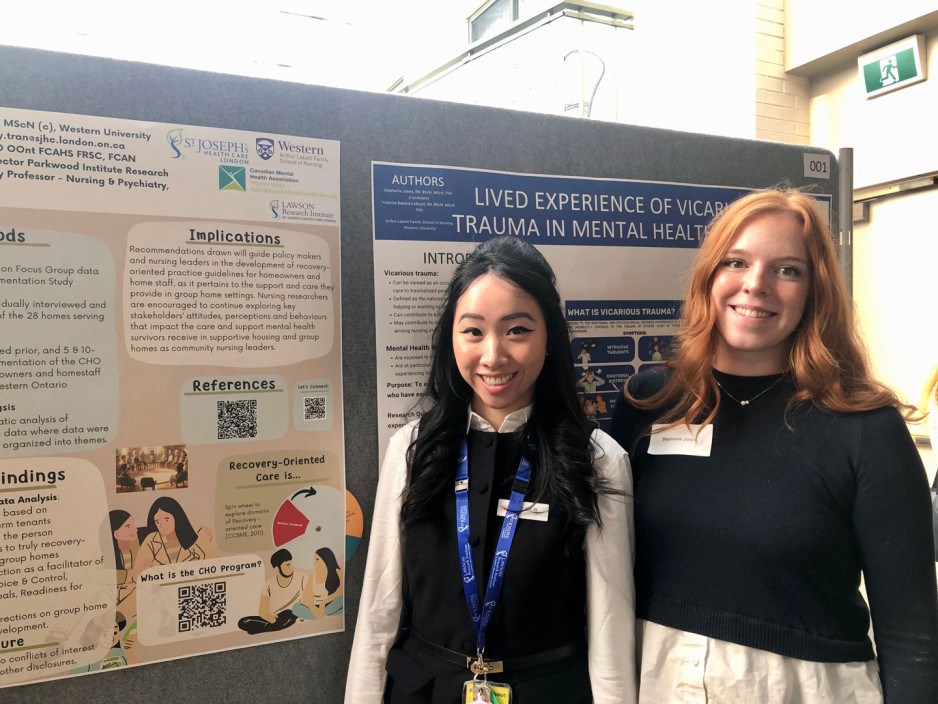
His lab examined the outcomes and satisfaction among patients at 14 emergency rooms across Alberta and found compassion to be the greatest predictor of quality care ratings.

“What separates good from really great comes down to compassion. These things matter,” Sinclair said.
“It improves their health and their quality of life. It reduces health-care costs, reduces adverse medical outcomes and helps build patients’ trust in the medical information and direction they receive,” he said.
… Dr. Candidate’s copy Western Schulich School of Medicine & Dentistry’s copy Department of Oncology’s copy Medical Affairs’ … Health Sciences Centre London Health Sciences Centre St. Josephs’ Health Care London Dr. Scott Ernst, MD, FRCPC Dr. … Dr. Candidate’s copy Western Schulich School of Medicine & Dentistry’s copy …
Dr. Candidates copy Western Schulich School of Medicine & Dentistrys copy Department of Oncologys copy Medical Affairs copy DATE Dear Dr. Re: Letter of Understanding It gives us great pleasure to offer you a position as a General Practitioner in Oncology (GPO) in the Depart...
Dr. s copy Western Schulich School of Medicine & Dentistrys copy Department of s copy Medical Affairs copy THIS LETTER OF OFFER IS ONLY TO BE ISSUED AFTER CONFIRMATION OF THREE SATISFACTORY REFERENCES FOR THE CANDIDATE. Dear Dr.
Dr. s copy Western Schulich School of Medicine & Dentistrys copy Department of s copy Medical Affairs copy THIS LETTER OF OFFER IS ONLY TO BE ISSUED AFTER CONFIRMATION OF THREE SATISFACTORY REFERENCES FOR THE CANDIDATE. Dear Dr.