


Search
Search
1863 Search Results:
… CANADA Allergan Inc. Innova Novartis Ophthalmics Pacific Medical Topcon Canada Inc Coherent-AMT Inc Labtician … of Physicians and Surgeons of Canada. The Continuing Medical Education Office, Faculty of Medicine & Dentistry, … CANADA Allergan Inc. Innova Novartis Ophthalmics Pacific Medical Topcon Canada Inc Coherent-AMT Inc Labtician …
OPHTHALMOLOGY CLINICAL DAY 2006 OCULAR TUMOURS FRIDAY, APRIL 21, 2006 Ballroom 2nd Floor London Convention Centre 300 York Street London, Ontario N6B 1P8 COURSE OBJECTIVES To augment current knowledge regarding the management of ocular tumours To update knowledge on new diagnostic and new therap...
… CANADA SILVER SPONSORS Allergan Inc. Bausch & Lomb Innova Medical Ophthalmics Novartis Ophthalmics Topcon Canada Inc BRONZE SPONSORS Advanced Medical Optics Coherent-AMT Inc Labtician Ophthalmics Inc … of Physicians and Surgeons of Canada. The Continuing Medical Education Office, Faculty of Medicine & Dentistry, …
OPHTHALMOLOGY CLINICAL DAY 2007 OCULAR INFECTIOUS DISEASES FRIDAY, APRIL 20, 2007 Salons C, D, E First Floor London Convention Centre 300 York Street London, Ontario N6B 1P8 COURSE OBJECTIVES To augment current knowledge regarding the management of ocular infectious diseases To update knowledge o...
… This program has been reviewed and approved by Continuing Medical Education, Schulich School of Medicine and … CANADA SILVER SPONSORS Allergan Inc. Coherent-AMT Innova Medical Ophthalmics Novartis Ophthalmic Pacific Medical Topcon Canada Inc BRONZE SPONSORS Bausch and Lomb …
CLINICAL DAY IN OPHTHALMOLOGY 2008 OCULAR TRAUMA London Convention Centre - Ballroom 5 / Theatre Friday, May 9, 2008 Second Floor - 300 York Street London, Ontario N6B 1P8 Generously Supported By: The Charles Dyson Lectureship in Ophthalmology The Royal College of Physicians & Surgeons of Canada ...
… Needs Assessment of Ophthalmology Teaching in Undergraduate Medical Education and Family Medicine Residency – E. Lee, C. … C. Hutnik MD Presentation of the Merck Frosst Undergraduate Medical Student Award – C. Hutnik MD Presentation to Guest … This program has been reviewed and approved by Continuing Medical Education, Schulich School of Medicine and …
OPHTHALMOLOGY RESEARCH DAY 2009 Four Points Sheraton Bristol C Ball Room Wellington Road - London, Ontario Friday, November 6, 2009 PROGRAM 8:30 a.m. Registration - Four Points Sheraton Bristol C Ball Room 9:00 a.m. Welcome - Dr. C. Hutnik Chair, Research Moderator Dr. C. Hutnik 9:10 a.m. CCTV ver...
Clinical trial will evaluate new therapy for patients with treatment-resistant depression as a result of bipolar disorder
LONDON, ON – Researchers at Lawson Health Research Institute are offering new hope to patients with treatment-resistant depression through participation in a national clinical trial. The study is the first randomized controlled trial to examine the efficacy of a new treatment called magnetic seizure therapy (MST) for patients with treatment-resistant depression as a result of bipolar disorder.
Treatment-resistant depression is a severe form of depression that does not respond to traditional therapies like medication. It is particularly common in patients with depression from bipolar disorder who are left with limited treatment options.
For years electroconvulsive therapy (ECT) has been the gold standard for patients with treatment-resistant depression. ECT uses an electric field to induce a seizure that provides a therapeutic benefit. But while ECT is effective, many patients opt out of treatment due to stigma surrounding the therapy and the potential for cognitive side effects like disorientation and amnesia.
MST has emerged as a promising alternative. MST works in a similar way to ECT but uses a focused magnetic field as opposed to electricity. As a result, MST induces a more focused seizure to reduce the risk of cognitive side effects.
“Magnetic seizure therapy has already been shown as a promising treatment for major depressive disorder or unipolar depression,” explains Dr. Amer Burhan, local site lead, researcher at Lawson and neuropsychiatrist at St. Joseph’s Health Care London. “For the first time, we’re studying how effective the treatment is for depression as a result of bipolar disorder and whether it can reduce the risk of cognitive side effects associated with electroconvulsive therapy.”
The clinical trial is being led by the Centre for Addiction and Mental Health (CAMH) and will also be offered through Lawson and University of British Columbia (UBC) Hospital. Lawson researchers will invite eligible patients with treatment-resistant depression from bipolar disorder to participate in the trial at Parkwood Institute, a part of St. Joseph’s Health Care London.
Eligible patients will be randomized to receive either ECT or MST. Patients will be offered support throughout the study with the goal of improving patient outcomes in both groups. Patient outcomes will be compared to study the efficacy of MST and whether it is associated with reduced cognitive side effects.
MST will be delivered under anesthesia in 12 to 20 sessions. Sessions will last 10 to 15 minutes each with 60 to 90 minutes of recovery time.
“Magnetic seizure therapy holds promise of one day replacing electroconvulsive therapy as the gold standard for treatment-resistant depression,” says Dr. Burhan. If proven as a viable first-line treatment, MST would be very easy to implement in existing ECT clinics. MST would therefore be readily available to patients in need.
“We are on the leading edge of the field of brain stimulation for treatment-resistant depression in collaboration with CAMH and UBC,” says Dr. Burhan. “Our goal is to continue informing the care process through clinically-relevant research that serves patients, medical professionals and the public.”
-30-
About Lawson Health Research Institute
Lawson Health Research Institute is one of Canada’s top hospital-based research institutes, tackling the most pressing challenges in health care. As the research institute of London Health Sciences Centre and St. Joseph’s Health Care London, our innovation happens where care is delivered. Lawson research teams are at the leading-edge of science with the goal of improving health and the delivery of care for patients. Working in partnership with Western University, our researchers are encouraged to pursue their curiosity, collaborate often and share their discoveries widely. Research conducted through Lawson makes a difference in the lives of patients, families and communities around the world. To learn more, visit www.lawsonresearch.ca.
Media Contacts
Celine Zadorsky
Senior Media Relations Consultant
Communications & Public Engagement
T: 519-685-8500 ext. 73502
Celine.zadorsky@lhsc.on.ca
Clinical trial will evaluate new therapy for treatment-resistant depression as a result of bipolar disorder
Treatment-resistant depression is a severe form of illness that does not respond to traditional therapies like medication and counselling. It is particularly common in patients with depression from bipolar disorder who are left with limited treatment options.
“There are some mental illnesses that can become resistant to therapy, similar to how infections, for example, can become resistant to antibiotics,” explains Dr. Amer Burhan, researcher at Lawson Health Research Institute and neuropsychiatrist at St. Joseph’s Health Care London. “Patients with those illnesses need more options.”
Brain stimulation is a field that holds promise for this patient population.
“When people are in a state of depression, research shows their brain networks are not functioning properly,” says Dr. Burhan. “Brain stimulation aims to stimulate neurons in the brain to correct activity and improve patient outcomes.”
Through involvement in a national clinical trial, Dr. Burhan and his research team at Lawson are offering new hope with a treatment called magnetic seizure therapy (MST). The study is the first randomized controlled trial to examine the efficacy of MST for patients with treatment-resistant depression as a result of bipolar disorder.
For years electroconvulsive therapy (ECT), one form of brain stimulation, has been the gold standard for patients with treatment-resistant depression. ECT uses an electric field to induce a seizure that provides a therapeutic benefit by stimulating the brain. But while ECT is effective, many patients opt out of treatment due to stigma surrounding the therapy and its potential for cognitive side effects like disorientation and amnesia.
MST has emerged as a promising alternative. MST works in a similar way to ECT but uses a focused magnetic field as opposed to electricity. As a result, MST induces a more focused seizure to reduce the risk of cognitive side effects.
Image
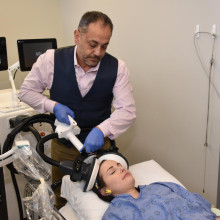
“Magnetic seizure therapy has already been shown as a promising treatment for major depressive disorder or unipolar depression,” explains Dr. Amer Burhan, local site lead for the clinical trial. “For the first time, we’re studying how effective the treatment is for depression as a result of bipolar disorder and whether it can reduce the risk of cognitive side effects associated with electroconvulsive therapy.”
The clinical trial is being led by the Centre for Addiction and Mental Health (CAMH) and will also be offered through Lawson and University of British Columbia (UBC) Hospital. Lawson researchers will invite approximately 30 eligible patients with treatment-resistant depression from bipolar disorder to participate in the trial at Parkwood Institute, a part of St. Joseph’s Health Care London.
Eligible patients will be randomized to receive either ECT or MST. Patients will be offered support throughout the study with the goal of improving patient outcomes in both groups. Patient outcomes will be compared to study the whether MST is effective and whether it is associated with reduced cognitive side effects.
MST will be delivered under anesthesia in 12 to 20 sessions. Sessions will last 10 to 15 minutes each with 60 to 90 minutes of recovery time.
“Magnetic seizure therapy holds promise of one day replacing electroconvulsive therapy as the gold standard for treatment-resistant depression, but we need to learn more about where it fits in our toolbox of potential treatments,” says Dr. Burhan.
If proven as a viable first-line treatment, MST would be very easy to implement in existing ECT clinics. MST would therefore be readily available to patients in need.
“We are on the leading edge of the field of brain stimulation for treatment-resistant depression in collaboration with CAMH and UBC,” says Dr. Burhan. “Our goal is to continue informing the care process through clinically-relevant research that serves patients, medical professionals and the public.”
Those who would like more information about the trial can email @email or @email.
Clinical use of EpiSign proven for diagnosing rare heritable disorders
LONDON, ON – A study led by researchers at Lawson Health Research Institute (Lawson) provides clinical validation of EpiSign, a molecular genomics test that diagnoses rare, heritable neurodevelopmental conditions.
Invented at Lawson by Dr. Bekim Sadikovic, the diagnostic test uses machine learning to analyze the EpiSign Knowledge Database. This database compiles information on rare genetic diseases using laboratory analyses of the epigenome from patients with suspected genetic abnormalities. The epigenome is a process that can change the expression of a gene without changing the gene sequence.
“Using 211 blood samples, we measured test performance and diagnostic yield in 207 subjects from two different cohorts,” explains Dr. Sadikovic, lead researcher at Lawson and Scientific and Clinical Director of the Verspeeten Clinical Genome Centre at London Health Sciences Centre (LHSC). The targeted cohort were subjects with previous genetic findings that were ambiguous or inconclusive. The screening cohort were those with clinical findings consistent with hereditary neurodevelopment syndromes but with no previous genetic findings.
“Of the 207 subjects tested, 57 were positive for a diagnostic episignature including 48 in the targeted cohort, and 8 in the screening cohort. Only four remained inconclusive after EpiSign analysis,” says Dr. Sadikovic. “This gives us strong evidence for the clinical use of EpiSign, as well as the ability to provide conclusive findings in the majority of subjects tested.”
While currently there are limited treatment options associated with many of these conditions,
providing a diagnosis can help physicians better predict the course of the disease, and allows for better planning and support for the patient. EpiSign is the only test in the world that has been clinically validated for testing these kinds of genetic disorders.
“Patients with rare diseases often wait years and undergo numerous exams and tests before receiving a correct diagnosis, if one is found at all,” says Matthew Tedder, PhD, staff scientist at the Greenwood Genetic Center, one of the EpiSign clinical testing laboratories. “EpiSign provides an additional high-yield diagnostic tool for clinicians to include in their evaluation of patients with undiagnosed diseases, providing better medical management for patients and hope for their families.”
The study, “Clinical epigenomics: genome-wide DNA methylation analysis for the diagnosis of Mendelian disorders", is published in February’s Genetics in Medicine and was completed in collaboration with the Greenwood Genetic Center and the University of Amsterdam.
-30-
About Lawson Health Research Institute
Lawson Health Research Institute is one of Canada’s top hospital-based research institutes, tackling the most pressing challenges in health care. As the research institute of London Health Sciences Centre and St. Joseph’s Health Care London, our innovation happens where care is delivered. Lawson research teams are at the leading-edge of science with the goal of improving health and the delivery of care for patients. Working in partnership with Western University, our researchers are encouraged to pursue their curiosity, collaborate often and share their discoveries widely. Research conducted through Lawson makes a difference in the lives of patients, families and communities around the world. To learn more, visit www.lawsonresearch.ca.
Media Contacts
Celine Zadorsky
Senior Media Relations Consultant
Communications & Public Engagement
T: 519-685-8500 ext. 73502
Celine.zadorsky@lhsc.on.ca
… DEPARTMENT DEPARTMENT CHIEFS SITE CHIEFS DIVISION CHIEFS MEDICAL DIRECTORS OTHER LEADERSHIP ROLE RESIDENCY PROGRAM … McKay Laura Lyons (Associate Chief, LHSC) Laura Lyons (Medical Director – Family Medicine Obstetrics) Anita Singh … Daniel Grushka (Assoc Post Graduate) Susan McNair (Medical Director - Regional Sexual Assault & Domestic …
DEPARTMENT DEPARTMENT CHIEFS SITE CHIEFS DIVISION CHIEFS MEDICAL DIRECTORS OTHER LEADERSHIP ROLE RESIDENCY PROGRAM DIRECTORS COMMENTS ANESTHESIA & PERIOPERATIVE MEDICINE John Fuller (Interim) Ashraf Fayad (LHSC - UH) Melissa Chin and Jon Borger Amy Rice (St. Joseph's) George Nicolaou (LHSC - VH) CLI...
… DEPARTMENT DEPARTMENT CHIEFS SITE CHIEFS DIVISION CHIEFS MEDICAL DIRECTORS OTHER LEADERSHIP ROLE RESIDENCY PROGRAM … Fellows) Laura Lyons (Associate Chief, LHSC) Laura Lyons (Medical Director – Family Medicine Obstetrics) Anita Singh … Daniel Grushka (Assoc Post Graduate) Susan McNair (Medical Director - Regional Sexual Assault & Domestic …
DEPARTMENT DEPARTMENT CHIEFS SITE CHIEFS DIVISION CHIEFS MEDICAL DIRECTORS OTHER LEADERSHIP ROLE RESIDENCY PROGRAM DIRECTORS COMMENTS Rudy Noppens (LHSC - UH) Melissa Chin and Jon Borger Amy Rice (St. Joseph's) George Nicolaou (LHSC - VH) CLINICAL NEUROLOGICAL SCIENCES David Steven NEUROLOGY - Jorge...
… While not intended to be used in the absence of specific medical and legal advice, they can help people determine … Your Life Your Choices: Planning for Future Medical Decisions: How to Prepare a Personalized Living … While not intended to be used in the absence of specific medical and legal advice, they can help people determine …
Interested in Creating an Advance Directive? (Living Will) With the attention focused on the Terri Schiavo case in the media, many people are wondering: What can I do to prevent this from happening in my family? Terri Schiavo is the severely brain-damaged woman in Florida who is at the heart of the ...
August 2, 2022; Page 1 of 3 Clonidine for Opioid Withdrawal What is clonidine and why is it prescribed? Clonidine belongs to a class of medications called centrally acting alpha-2 agonists. It works by blocking the release of chemical messengers like norepinephrine in the brain that trigger sympath...
Clonidine Suppression Test What is a clonidine suppression test? This test is performed to rule out a condition called pheochromocytoma, a non-cancerous tumor that most commonly develops in the adrenal glands and releases hormones that cause high blood pressure. How is the test performed? An appoint...
… of the person Yes No o Provided all other relevant medical information Yes No Page 2 of 4 (iJ~ SIJOSEPHs … of the person Yes No o Provided all other relevant medical information Yes No Page 2 of 4 (iJ~ SIJOSEPHs …
(iJ~ SIJOSEPHs HEALTH CARE LONDON Code Blue Drill Report Form This form must be completed after each Code Blue drill. Provide a copy of the completed form to the Emergency Management and Risk Specialist. Other building system operations are evaluated during the drill to ensure proper functionality. ...
… PROCEDURE EMC011 Procedure: Code Blue (Acute Site) – Adult Medical Emergency Owner: Director, Patient Relations, … Corporate Procedure Name: Code Blue - Cardiac Arrest/Medical Emergency Procedure Owner: Capital Redevelopment and … care for an adult (15 years of age or older) experiencing a medical emergency. The Medical Emergency Response Team …
CORPORATE PROCEDURE EMC011 Procedure: Code Blue (Acute Site) Adult Medical Emergency Owner: Director, Patient Relations, Security Services and Chief Privacy and Risk Officer Sponsor: Vice-President, Patient Care and Risk Approval by: Emergency Management Committee Date: 2023-09-07 Original Effectiv...
… EMC011 Procedure: Code Blue (Non-Acute Site) – Adult Medical Emergency Owner: Director, Patient Relations, … Corporate Procedure Name: Code Blue - Cardiac Arrest/Medical Emergency Procedure Owner: Capital Redevelopment and … care for a person in cardiac arrest or experiencing a medical emergency. PROCEDURE 1. The person discovering the …
CORPORATE PROCEDURE EMC011 Procedure: Code Blue (Non-Acute Site) Adult Medical Emergency Owner: Director, Patient Relations, Security Services and Chief Privacy and Risk Officer Sponsor: Vice President, Patient Care and Risk Approval by: Emergency Management Committee 2023-09-07 Original Effective ...
… exposed to the chemicals have access to appropriate medical assistance. Initiate Code Blue procedures if … exposed to the chemicals have access to appropriate medical assistance. Initiate Code Blue procedures if …
CORPORATE PROCEDURE EMC003 Procedure: Code Brown - Hazardous Chemical Spill Owner: Director, Patient Relations, Security Services and Chief Privacy and Risk Officer Sponsor: Vice President, Patient Care and Risk Approval by: Emergency Management Committee Date: 2023-09-07 Original Effective Date: 20...
… Healthcare Materials Management Services (HMMS) ii. Family Medical and Dental Centre iii. Building J (Former NRC … Healthcare Materials Management Services (HMMS) b. Family Medical and Dental Centre 7.2. Ensure all doors to the area … Healthcare Materials Management Services (HMMS) ii. Family Medical and Dental Centre iii. Building J (Former NRC …
CORPORATE PROCEDURE EMC001 Procedure: Code Green Evacuation Owner: Director, Patient Relations, Security Services and Chief Privacy and Risk Officer Sponsor: Vice President, Patient Care and Risk Approval by: Emergency Management Committee Date: 2023-06-22 Original Effective Date: 2018-05-15 Review...
… Service, the London Fire Department, Thames Emergency Medical Services and other relevant agencies. As an Acute … process admissions/ transfers and document discharges. Biomedical To provide additional biomedical equipment to the key areas as required. Central …
CORPORATE PROCEDURE EMC006 Procedure: Code Orange External Disaster Owner: Director, Patient Relations, Security Services and Chief Privacy and Risk Officer Sponsor: Vice President, Patient Care and Risk Approval by: Emergency Management Committee Date: 2023-06-22 Original Effective Date: 2018-05-1...
… EMC012 Procedure: Code Pink (Acute Site) – Pediatric Medical Emergency Owner: Director, Patient Relations, … Corporate Procedure Name: Code Pink-Cardiac Arrest/Medical Emergency-Infant/Child Procedure Owner: Capital … care for an infant or child (under 15 years of age) with a medical emergency. This emergency response procedure …
CORPORATE PROCEDURE EMC012 Procedure: Code Pink (Acute Site) Pediatric Medical Emergency Owner: Director, Patient Relations, Security Services and Chief Privacy and Risk Officer Sponsor: Vice-President, Patient Care and Risk Approval by: Emergency Management Committee Date: 2023-06-22 Original Effe...
… 1.1.3.3. Stay out of view. 1.1.4. Ensure those injured get medical treatment when it is safe to do so. 1.2. Initiate … 1.1.3.3. Stay out of view. 1.1.4. Ensure those injured get medical treatment when it is safe to do so. 1.2. Initiate …
~ SIJOSEPHs HEALTH CARE LONDON CORPORATE Procedure: CODE SILVER Person with a Weapon Owner of Procedure: Emergency Management and Risk Specialist and Corporate Security Leader Approval by: Emergency Management Committee Date: 2021-12-09 Original Effective Date: 2018-05-07 Reviewed Date(s): 2021-12-...