


Search
Search
1863 Search Results:
… of your start date, please update your records with Medical Affairs. Postal Code Telephone Email Address OHIP … Date College of Family Physicians of Canada Date Page 2 MEDICAL / MIDWIFERY / DENTAL EDUCATION University City … a copy of your curriculum vitae with this application. PREMEDICAL EDUCATION University City Degree Date of Graduation …
Page 1 Application for Appointment To the Credentialed Professional Staff of St. Josephs Health Care London (St. Josephs) DEMOGRAPHIC INFORMATION Last Name First Name and Init. Birth date (mm/dd/yyyy) Birthplace Citizenship Business Name/Address Postal Code Phone (Ext.) Facsimile Current Home Addres...
… President Patient Care and Risk Management Sandy Jansen - Medical Imaging - Pathology and Laboratory Medicine (PALM) - Medical & Academic Affairs - Medical/Dental Departments - Medical Quality (St. Joseph’s) … President Patient Care and Risk Management Sandy Jansen - Medical Imaging - Pathology and Laboratory Medicine (PALM) - …
St. Josephs Health Care London Corporate Organizational Chart Effective July 2022 Board of Directors St. Josephs Health Care London President & Chief Executive Officer Roy Butler Vice President Clinical Support and Chief Financial Officer Lori Higgs Integrated Vice President Research & Scientific Di...
… of this reference form. Email completed reference form to Medical Affairs at sjhc.medaffairs@sjhc.london.on.ca … No Does the applicant meet the requirements for continuing medical education? (attends conferenced, grand rounds, … questions about the collection of this information, contact Medical Affairs at sjhc.medaffairs@sjhc.london.on.ca …
June 2019 REFERENCE FORM For The Schulich School of Medicine & Dentistry, and St. Josephs Health Care London Instructions to the Applicant: You are required to obtain three confidential references with your application for your academic appointment with Schulich School of Medicine & Dentistry and/o...
Standing up to falls
By merging world class care with research and artificial intelligence, St. Joseph’s Health Care London is catching falls before they happen.
They wreak havoc on independence and well-being, making them one Canada’s most pressing health challenges: falls.
A leading cause of injury-related hospitalizations, even death, among older adults, a fall can happen anytime, anywhere – with 50 per cent occurring at home. But what if we could predict and prevent falls before they happen?
A pioneering initiative at St. Joseph’s Health Care London (St. Joseph’s) is doing just that. The 3FM Clinic, short for Falls, Fractures, Frailty and Mobility, at St. Joseph’s Parkwood Insitute is at the leading edge of falls prevention in Canada, integrating research with clinical practice to offer hope and practical solutions to older adults.
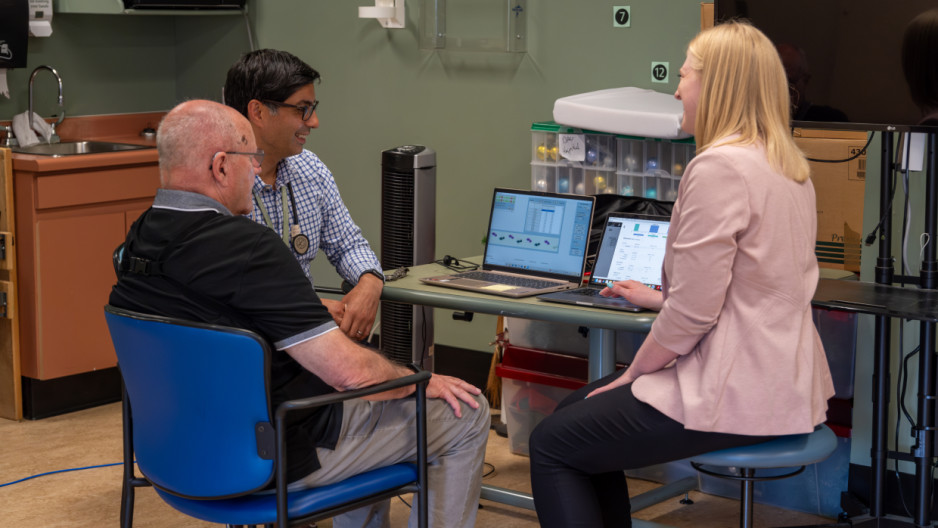
Led by St. Joseph’s geriatrician Dr. Jaspreet Bhangu and Western University rehabilitation scientist and physiotherapist Janelle Unger, PhD, the visionary 3FM Clinic is working to prevent falls before they happen.
“We know there are a number of factors that can cause an older adult to fall such as illness, medication side effects, balance and gait issues, cognitive impairment, visual changes and environmental hazards,” says Bhangu. “What we’re working to understand is how those factors together impact individual patients and their risk of falling.”
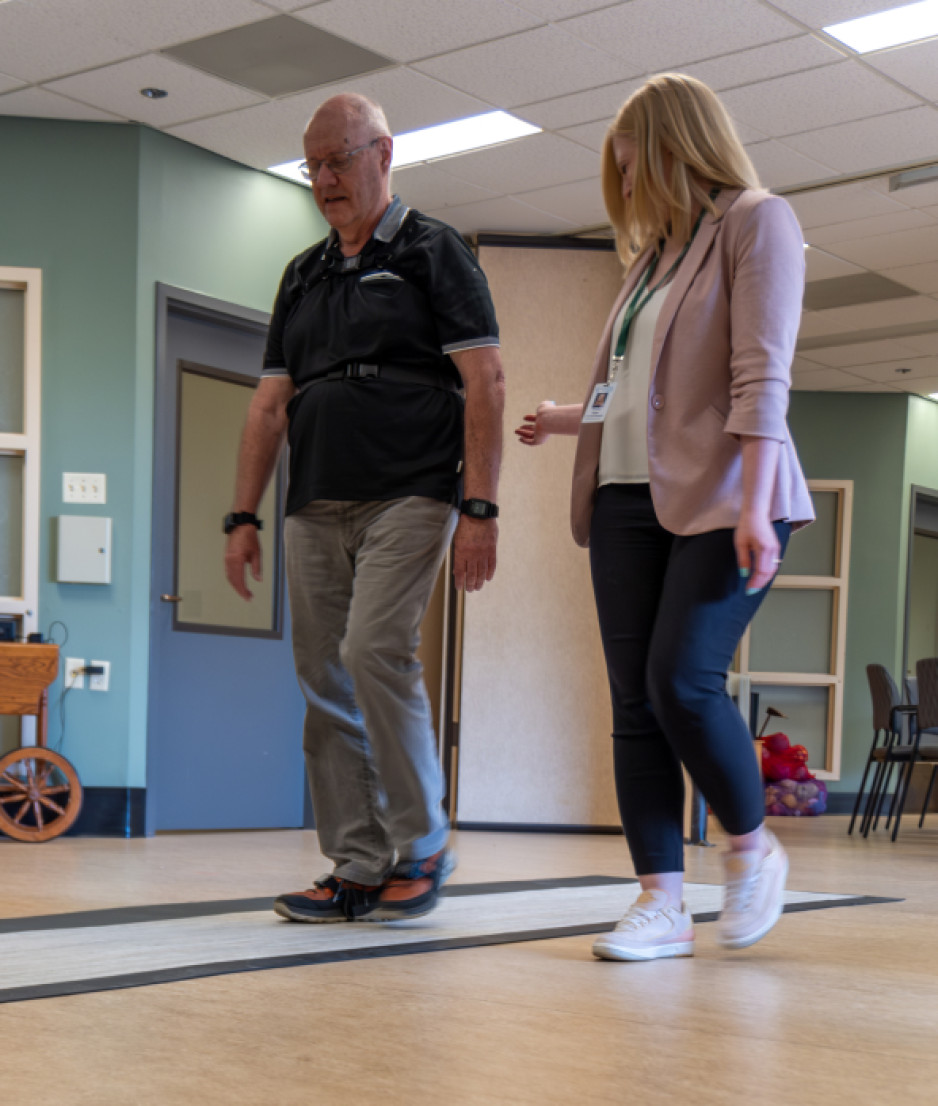
To do so, the 3FM Clinic team – one of the largest, most diverse teams of its kind in the country – completes a multi-step evaluation of patients:
- Nurses gather their medical history, current medications, functional abilities and personal goals.
- Physical therapists measure the patient’s gait (how they walk) and balance to understand their physical capabilities.
- Occupational therapists test their vision, cognitive function and identify issues that might hinder the individual’s ability to perform routine tasks safely.
- A geriatrician focuses on medical risk factors such as bone health, medications and cardiovascular health to help manage risks associated with aging. The team then creates a customized care plan that incorporates exercises, therapeutic interventions and educational strategies.
On the research side, Unger and her team in the RED Neuro Lab at St. Joseph’s Gray Centre for Mobility and Activity are leveraging artificial intelligence (AI) to predict falls more accurately.
“Traditional fall prediction models often rely on limited data and lack real-world input from clinicians and patients,” explains Unger. “By partnering with Bhangu and the clinical team, as well as the patients in the 3FM Clinic, we’re able to integrate clinical information with biomechanical data collected from wearable sensors known as inertial measurement units (IMUs).”
An IMU is a device that tracks and measures a person’s movement and orientation and provides valuable data on how that person moves and stays stable.
“We plan to use AI to analyze the data collected through the IMU’s and are working to create accurate fall prediction models,” says Unger. “This research, funded by Western’s Bone and Joint Institute, has the potential to improve care decisions, enhance preventive strategies and ultimately reduce the incidence of fall-related injuries and hospitalizations for our patients and people across the globe.”
By embracing innovative research and compassionate care, the 3FM Clinic is a model for future efforts in fall prevention and geriatric care, offering a safer, more independent future for older adults.
You can prevent falls too:
- Use assistive devices: Properly fitted walkers or canes provide essential support and stability.
- Fitted footwear: Shoes (not slippers or flip-flops) with appropriate tread and low heels help prevent slips and falls. They should also fit your feet.
- Home improvements: Improved lighting, clear walkways and assistive bathroom fixtures.
- Exercise: Participate in strength and balance exercises to enhance physical fitness.
- Medication reviews: Regularly have your medications reviewed to identify if you are at risk of falling.
… you experience shortness of breath or neck swelling, seek medical attention by contacting the pain clinic … you experience shortness of breath or neck swelling, seek medical attention by contacting the pain clinic …
June 16, 2020; Page 1 of 1 Stellate Ganglion Block What is a stellate ganglion block and why is it performed? The stellate ganglion is part of the sympathetic nervous system. Its located in the lower-front part of the neck. A stellate ganglion block is an injection of local anesthetic into these ne...
Steven Macaluso
Steven Macaluso, MD
Associate Professor, Schulich School of Medicine and Dentistry
Key Areas of Focus:
Implementation Science and Education
Phone:
519-685-4292 ext. 45062
Email:
Website:
Publications:
Accepting Grad Students:
No
About:
Dr. Steven Macaluso is a physiatrist at Parkwood Institute and an Associate Professor and the current Residency Program director in the Department of Physical Medicine and Rehabilitation in the Schulich School of Medicine and Dentistry at Western University. He completed a Bachelor of Science degree in Kinesiology prior to completing his medical degree at Western University in 2007. He went on to complete residency training in Physical Medicine and Rehabilitation at Western University in 2012.
He is currently a consultant physiatrist on the Stroke and Neuro rehabilitation unit at Parkwood Institute and has outpatient clinics at Parkwood Institute, and the Fowler Kennedy Sports Medicine Clinic. His current academic endeavors are focused on promotion of physical activity amongst individuals with impairment and disability, including formation of physical activity guidelines the design and implementation of an online evidence-based resource and clinical skills guide for the management of musculoskeletal disorders. Dr. Macaluso also has a special interest in Sports Medicine, has provided medical coverage for Team Canada at national and international levels, and is currently serving as a team physician for the Canadian Wheelchair Curling Team.

… Policy Administration Console Policy: Observer Policy (Medical and Non-Medical) Policy Owner: Director, Medical Affairs SLT Sponsor: IVP Medical Affairs and Medical … Policy Administration Console Policy: Observer Policy (Medical and Non-Medical) Policy Owner: Director, Medical …
Policy Administration Console Policy: Observer Policy (Medical and Non-Medical) Policy Owner: Director, Medical Affairs SLT Sponsor: IVP Medical Affairs and Medical Education Approval By: Medical Advisory Committee & Senior Leadersip Team Date: 2008-10-21 Effective Date: Reviewed Date: Revised Date:...
… funding to the Hospital, which was remitted to the London Medical Innovation and Commercialization Network (LMICN) and … funding to the Hospital, which was remitted to the London Medical Innovation and Commercialization Network (LMICN) and …
St. Josephs Health Care London Financial Statements Financial Statements of ST. JOSEPHS HEALTH CARE LONDON Year ended March 31, 2018 St. Josephs Health Care London Financial Statements 1 | P a g e MANAGEMENTS REPORT The accompanying financial statements of St. Josephs Health Care London have been pr...
… - $1,000) to the Hospital, which was remitted to the London Medical Innovation and Commercialization Network (LMICN). … - $1,000) to the Hospital, which was remitted to the London Medical Innovation and Commercialization Network (LMICN). …
St. Josephs Health Care London Financial Statements Financial Statements of ST. JOSEPHS HEALTH CARE LONDON Year ended March 31, 2017 St. Josephs Health Care London Financial Statements 1 | P a g e MANAGEMENTS REPORT The accompanying financial statements of St. Josephs Health Care London have been pr...
… others? Further define tiered accountability structure Yes Medical Advisory Committee (MAC) engagement and expectations … Letters reviewing quarterly results from Integrated VP Medical Affairs and Infection Prevention and Control (IPAC) … and volumes of new patients is posted and shared by the Medical Director. Reporting to all physicians of wait times …
St. Josephs Health Care London Corporate (excluding Mount Hope) Page 1 of 13 Excellent Care for All Quality Improvement Plans (QIP): Progress Report for the 2015/16 QIP St. Josephs Health Care London Corporate (excluding Mount Hope) ID Measure/Indicator from 2016/17 Org Id Current Performance as s...
… others? Further define tiered accountability structure Yes Medical Advisory Committee (MAC) engagement and expectations … Letters reviewing quarterly results from Integrated VP Medical Affairs and Infection Prevention and Control (IPAC) … and volumes of new patients is posted and shared by the Medical Director. Reporting to all physicians of wait times …
St. Josephs Health Care London Corporate (excluding Mount Hope) Page 1 of 13 Excellent Care for All Quality Improvement Plans (QIP): Progress Report for the 2016/17 QIP St. Josephs Health Care London Corporate (excluding Mount Hope) ID Measure/Indicator from 2016/17 Org Id Current Performance as s...
… indicating worsening pain and assess pain, medication, medical conditions and current practice for reducing pain … indicating worsening pain and assess pain, medication, medical conditions and current practice for reducing pain …
St. Josephs Health Care London Mount Hope Centre for Long Term Care Page 1 of 9 Excellent Care for All Quality Improvement Plans (QIP): Progress Report for the 2015/16 QIP St. Josephs Health Care London Mount Hope Centre for Long Term Care *(Please note that St. Marys and Marian Villa have the sam...
… indicating worsening pain and assess pain, medication, medical conditions and current practice for reducing pain … indicating worsening pain and assess pain, medication, medical conditions and current practice for reducing pain …
St. Josephs Health Care London Mount Hope Centre for Long Term Care Page 1 of 9 Excellent Care for All Quality Improvement Plans (QIP): Progress Report for the 2016/17 QIP St. Josephs Health Care London Mount Hope Centre for Long Term Care *(Please note that St. Marys and Marian Villa have the sam...
… Unit, providing initial examination, testing, and medical and psychological care for victims rescued by … of the survivors. It has included: assessment and care for medical and physical needs; the collection of forensic … related medications to treat acute pain. The organization’s Medical Advisory Committee (MAC) recognized the role of St. …
St. Josephs Health Care London 1 PO Box 5777, STN B London, ON N6A 4V2 Quality Improvement Plan (QIP) Narrative for Health Care Organizations in Ontario 3/29/2018 This document is intended to provide health care organizations in Ontario with guidance as to how they can develop a Quality Improvement ...
… Consult a qualified health professional regarding specific medical concerns or treatment. Toronto Rehab does not assume … Consult a qualified health professional regarding specific medical concerns or treatment. Toronto Rehab does not assume … Consult a qualified health professional regarding specific medical concerns or treatment. Toronto Rehab does not assume …
Stool Softeners and Laxatives Contact your Nurse or Doctor for more information. Created by: Sharon Ryan Updated: 2011-03-01 Disclaimer: Information is provided for educational purposes only. Consult a qualified health professional regarding specific medical concerns or treatment. Toronto Rehab does...
… is home to more than 18 ophthalmologists providing medical and surgical eye care, teaching and research. The … will • be an organization that values and recognizes staff, medical staff and leaders and provides a work environment … safety • be known as a workplace of choice for staff, medical staff and leaders where each person lives the values …
STRATEGIC PLAN 2015 | 2018ST. JOSEPHS HEALTH CARE LONDON Realizing our Vision St. Josephs Vision, Mission and Values OUR VISION OUR MISSION OUR VALUES RESPECT, EXCELLENCE, COMPASSION STRATEGIC PLAN 2015 TO 2018 Our Patients, Residents and Families GOAL GUIDED BY THEIR VOICES; EXCELLENCE ALWAYS STRA...
… is home to more than 18 ophthalmologists providing medical and surgical eye care, teaching and research. The … will • be an organization that values and recognizes staff, medical staff and leaders and provides a work environment … safety • be known as a workplace of choice for staff, medical staff and leaders where each person lives the values …
STRATEGIC PLAN 2015 | 2018ST. JOSEPHS HEALTH CARE LONDON Realizing our Vision St. Josephs Vision, Mission and Values OUR VISION OUR MISSION OUR VALUES RESPECT, EXCELLENCE, COMPASSION STRATEGIC PLAN 2015 TO 2018 Our Patients, Residents and Families GOAL GUIDED BY THEIR VOICES; EXCELLENCE ALWAYS STRA...
Strategies to manage self-isolation Isolating yourself is hard! It is lonely and stressful, and it disrupts your habits, routines, and coping strategies. Anyone who has to had self-isolate must work hard to stay happy and healthy. However, the coping strategies are similar to what we teach in our gr...
Stroke can be the first presenting symptom of younger patients with COVID-19
LONDON, ONTARIO - Since the start of the COVID-19 pandemic, researchers have been working to better understand and characterize the varied symptoms of the disease. One of the most concerning symptoms is the development of large blood clots that can cause blockages in the arteries that lead to the brain causing stroke.
Researchers at Western University and Lawson Health Research Institute led by Dr. Luciano Sposato have been investigating the relationship between COVID-19 and stroke to better understand the risk in patients and aid in treatment planning. In a new study published in the September 15, 2020 online issue of Neurology, the medical journal of the American Academy of Neurology, the research team reports that approximately two in every 100 patients admitted to hospital with COVID-19 will suffer a stroke, and 35 per cent will die as a result of both conditions.
The researchers reported that in patients under 50 years old, nearly 50 per cent had no other visible symptoms of the virus at the time of stroke onset. They also found that the interplay of older age, other chronic conditions and the severity of COVID-19 respiratory symptoms are associated with an extremely elevated risk of death.
“One of the most eye-opening findings of this study is that for patients under 50 years old, many were totally asymptomatic when they had a stroke related to COVID-19. This means that for these patients, the stroke was their first symptom of the disease,” said Dr. Sposato, Associate Professor and the Kathleen and Dr. Henry Barnett Chair in Stroke Research at Western’s Schulich School of Medicine & Dentistry, and Scientist at Lawson.
Sposato says understanding the interplay between COVID-19 and stroke is important for treatment planning, especially in areas where COVID-19 is actively circulating in the community.
“The take-home message here for health care providers is that if you are seeing a patient with a stroke, particularly in those under 50 years old with large clots, you need to think of COVID-19 as a potential cause even in the absence of respiratory symptoms,” said Dr. Sposato.
The research team completed a systemic review of published cases of COVID-19 and stroke and pooled that data with another 35 unpublished cases from Canada, the USA and Iran. In total, the team examined 160 cases, looking at both clinical characteristics and in-hospital mortality.
“COVID-19 has changed the stroke landscape worldwide. As stroke neurologists, we need a new mindset to be able to promptly diagnose and treat patients with COVID-19 related strokes,” said Dr. Sebastian Fridman, Assistant Professor, Clinical Neurological Sciences at Schulich Medicine & Dentistry, research fellow at Lawson and first author on the study.
-30-
About Lawson Health Research Institute
Lawson Health Research Institute is one of Canada’s top hospital-based research institutes, tackling the most pressing challenges in health care. As the research institute of London Health Sciences Centre and St. Joseph’s Health Care London, our innovation happens where care is delivered. Lawson research teams are at the leading-edge of science with the goal of improving health and the delivery of care for patients. Working in partnership with Western University, our researchers are encouraged to pursue their curiosity, collaborate often and share their discoveries widely. Research conducted through Lawson makes a difference in the lives of patients, families and communities around the world. To learn more, visit www.lawsonresearch.ca.
About The Schulich School of Medicine & Dentistry
The Schulich School of Medicine & Dentistry at Western University is one of Canada’s preeminent medical and dental schools. Established in 1881, it was one of the founding schools of Western University and is known for being the birthplace of family medicine in Canada. For more than 130 years, the School has demonstrated a commitment to academic excellence and a passion for scientific discovery.
Media Contacts
Celine Zadorsky
Senior Media Relations Consultant
Communications & Public Engagement
T: 519-685-8500 ext. 73502
Celine.zadorsky@lhsc.on.ca
… anything else you think we should be aware of? Relevant Medical/Psychiatric History (MRSA, Alzheimer’s, Parkinson’s, … anything else you think we should be aware of? Relevant Medical/Psychiatric History (MRSA, Alzheimer’s, Parkinson’s, …
Referral Form Office Use Only: Date Referral Received: _ ID#: CENTRAL INTAKE OFFICE 801 Commissioners Road East London, Ontario, N6C 5J1 Telephone: (519) 685-4292 ext. 45034 Fax: (519) 685-4802 Toll Free: 1-866-310-7577 Please indicate the county you are referring for: Oxford Middlesex S/W Norfolk...