


Search
Search
941 Search Results:
Bridging the gap from discovery to patient care
The following column was provided to Hospital News by Dr. David Hill, scientific director, Lawson Health Research Institute.
Dedicated health researchers across the country are working every day to make discoveries that improve patient outcomes and support a higher quality of life. Our research hospitals have a mandate to develop and test new treatments, technologies and procedures that address our most pressing health challenges.
There is a cycle of health innovation that is supposed to happen – scientific discoveries are made, they transition to clinical trials and then are adopted as an improved standard of care. This is followed by evaluations of the new method and moving along to the next cycle of refinements and improvements. But the reality in Canada is that gaps, in some cases chasms, disrupt the creation and adoption of evidence-based health innovations.
This starts with discovery. The research funding climate in Canada continues to be extremely difficult. Despite the Federal Government outlining substantial new investments in discovery research in Budget 2018 much of that money will not be available to researchers until 2020 and beyond, and the Canadian Institutes of Health Research (CIHR) continues to be limited by a low funding rate of around 14 per cent. Funding for large, definitive clinical trials is especially difficult to support with public funds. Too many good ideas are left unfunded, and in that environment researchers can feel it’s wiser to propose incremental and ‘safe’ science that avoids controversy and the risk of losing support for experienced research teams built up over many years.
Yet researchers are persistent and manage to secure funding from a range of smaller agencies. Unfortunately, many of these do not fund the indirect costs of research necessary to cover administration, infrastructure, equipment maintenance and upgrades, and the investigator’s salaries. Indirect costs are estimated to be approximately 40 per cent on top of direct study costs. In research hospitals these costs generally fall on the institutions to find funding outside of the provincial government budget that covers the costs of hospital care. This is a negative spiral whereby the more successful a hospital becomes in attracting research funds, the bigger the gap in finding the resources to support that research.
When innovative solutions to health care problems are delivered, backed by solid evidence, adoption into our hospital-based care is often far from rapid. Currently, in most provinces, there is no funding mechanism to translate health innovation to the ‘real world’ setting of our front-line care. Yet, such a mechanism is crucial to the translation of science. Clinical trials are carefully designed with strict protocols and criteria for a highly specific population of patients. Innovations that work in a clinical trial do not always work in the real world where patient populations and settings are much more complex.
Following a clinical trial, innovation needs to be tested at the point of care. Without funding to do this, research innovation hits a roadblock. Scientists are left waiting and hoping that one day their provincial government might look to incorporating their innovations into the health system funding schedule. Meanwhile, their work may be used to inform health care improvements in other nations.
An example can be found in medical imaging research. Canadian scientists, including those at Lawson Health Research Institute, are leaders in the development of positron emission tomography (PET) biomarkers to improve diagnosis and understanding of disease using PET scans. PET biomarkers are successfully created and then validated in clinical trials across our nation, but there is little funding to translate them back in a timely fashion to patient care in our hospitals. While countries like the US and Europe readily adopt these innovations, Canada lags behind.
This gap was addressed in a report to the Federal government by the Advisory Panel on Healthcare Innovation entitled “Unleashing Innovation: Excellent Healthcare for Canada” and published in 2015. The panel recommended the formation of a Healthcare Innovation Agency of Canada open to hospitals and other care providers in order to evaluate health innovations in the real-world setting of our health system. Scientists would apply by putting forward evidence from their research, including that collected from clinical trials. They would then design a new translational study to test their innovation at the point of care, with the goal of building evidence for presentation to provincial government.
Will everything tested at the point of care succeed? No; some things will fail in the real world. This is why such a fund is so important. It will show whether or not an innovation truly benefits patients and if it’s ready for wider adoption. If successful, the evidence will highlight the right time to bring innovations into the mainstream standard of care. By bridging this gap in the system, we can improve patient care and ensure a timely return on the investment in science.
Dr. David Hill is scientific director at Lawson Health Research Institute, the research institute of London Health Sciences Centre and St. Joseph’s Health Care London.
Scientist
Café Scientifique: The invisible world inside us
The human microbiome is a wonder of nature, with trillions of microbes calling our body home. They live in our gut and many other places throughout our body. They are involved in virtually every aspect of how we function and we are learning that they are essential to staying healthy. An unhealthy microbiome has been linked to many diseases from allergies to cancer and even mental health.
Most people out there have heard about probiotics and fermented foods, and chances are you’re trying to get more of them in your diet. Drinking kombucha or eating yogurt, anyone?
On November 27, 2019, Lawson Health Research Institute held the latest in its Café Scientifique event series, "The invisible world inside us: Exploring the human microbiome.”
The panel of researchers helped to unravel the mysteries about the micirobiome and how we are using that knowledge to improve health and health care. They also busted some myths and shared the important facts when it comes to probiotics, prebiotics and the microbiome.
Watch their talks:
Researchers:
Probiotics and Prebiotics - Look beyond the fake news
Dr. Gregor Reid, Lawson Scientist and Professor of Microbiology & Immunology and Surgery at Western University.
Time stamp: 10:02
Fecal Transplants: What does this crap have to do with me?
Dr. Michael Silverman, Lawson Associate Scientist, Chair of Infectious Diseases, Schulich School of Medicine & Dentistry at Western University and Chief of Infectious Diseases for St. Joseph’s Health Care London and London Health Sciences Centre.
Time stamp: 31:48
Does eating bacteria make sense?
Dr. Jeremy Burton, Lawson Scientist and Assistant Professor of Surgery (Urology) and Microbiology & Immunology at Western University.
Time stamp: 55:02
See the event photos on Facebook.
Café Scientifique is a free community event series providing an informal opportunity to get involved with science. Through an open-forum discussion in a casual setting, these events address health-related issues of popular interest to the general public. A panel of three Lawson scientists talk about what they do and why, and share their unique research perspectives. Guests can then ask questions, participate in discussion, and gain insights from the speakers and from one another.
… • • t~ STJOSEPHs HEALTH CARE LONDON Cardiac Rehabilitation and Secondary Prevention Program Patient Education Guide … their fullest by minimizing the effects of injury, disease and disability through excellence in care, teaching and … Stress / Depression / Poor Sleep Alcohol Smoking The good news is, you can take control of your modifiable risk …
t~ STJOSEPHs HEALTH CARE LONDON Cardiac Rehabilitation and Secondary Prevention Program Patient Education Guide CARING FOR THE BODY, MIND & SPIRIT SINCE 1869 Renowned for compassionate care, St. Josephs is one of the best academic health care organizations in Canada ...
… a senior is taken to the ER because of a fall. �e good news is that you can take steps to prevent this from … enjoy life’s simple moments; it’s about playing with your grandchildren and keeping up with old friends. Most of all, … a senior is taken to the ER because of a fall. �e good news is that you can take steps to prevent this from …
Take steps to prevent a fall Anyone can fall, but as you grow older, the risk increases. Falls are the leading cause of serious injuries in older adults. e facts dont lie: every six minutes, a senior is taken to the ER because of a fall. e good news is that you can take steps to prevent this from ha...
… care; Nourish Project – an update • Leading in Research and Innovation: St. Joseph’s appoints Vice President, Research and Scientific Director; Microbiome linked to kidney stones … surgical and diagnostic centres 6.0 St. Joseph’s in the News 7.0 Environmental Scan Page 2 of 10 1.0 Strategy in …
Page 1 of 10 CEO Report to the Board January 24, 2024 1.0 Strategy in Action Reaching Out to Our Community: Lower limb preservation program; A changemaker in reducing stigma; Warm jackets for cold winter months Advancing Excellence in Care Together: Improving access to geriatric care; Nourish Proj...
… interesting times” It is my pleasure on behalf of the Board and staff of CHAO to wish all CHAO members a happy, health … * * Editor’s Note: Thank you for reading the CHAO Quarterly Newsletter. If you have com- ments, suggestions, news items and/or items of interest to submit, please send …
January 2015 In this Issue Page 1: Comment from David Nash Page 2: CHAO Convention reprise Pages 3 CHAO Mission Leadership Program Pages 4-9 Around the Province Page 9 Editors Note May we live in interesting times It is my pleasure on behalf of the Board and staff of CHAO to wish all CHAO members a ...
… April 2015 In this Issue Page 1: Comment from David and Ron. Page 2:-5 Around the Province Pages 6-CHAO Mission Leadership Program Page 7– People in the News and Editor’s Note Physician-Assisted Suicide The … Marr at chao@bellnet.ca or 905 8151955. 7 7 People in the News CHAO and Sponsors representatives meet with Assembly of …
April 2015 In this Issue Page 1: Comment from David and Ron. Page 2:-5 Around the Province Pages 6-CHAO Mission Leadership Program Page 7 People in the News and Editors Note Physician-Assisted Suicide The Supreme Court decision that would seem to open the door to physician-assisted suicide brings in...
… Object Owner of Procedure: Emergency Management and Risk Specialist and Corporate Security Leader Approval by: Emergency … and visitors. 8.3.2. Arrange media interviews. 8.3.3. Send news releases, as required. 8.3.4. Coordinate/support … and visitors. 8.3.2. Arrange media interviews. 8.3.3. Send news releases, as required. 8.3.4. Coordinate/support …
~ SIJOSEPHs HEALTH CARE LONDON CORPORATE Procedure: CODE BLACK Bomb Threat/Suspicious Object Owner of Procedure: Emergency Management and Risk Specialist and Corporate Security Leader Approval by: Emergency Management Committee Date: 2021-12-09 Original Effective Date: 2018-12-18 Reviewed Date(s): ...
… Spill Owner: Director, Patient Relations, Security Services and Chief Privacy and Risk Officer Sponsor: Vice President, Patient Care and … Plan. 8.3.1. Arrange media interviews. 8.3.2. Send news releases, as required. 8.3.3. Coordinate/support … Plan. 8.3.1. Arrange media interviews. 8.3.2. Send news releases, as required. 8.3.3. Coordinate/support …
CORPORATE PROCEDURE EMC003 Procedure: Code Brown - Hazardous Chemical Spill Owner: Director, Patient Relations, Security Services and Chief Privacy and Risk Officer Sponsor: Vice President, Patient Care and Risk Approval by: Emergency Management Committee Date: 2023-09-07 Original Effective Date: 20...
… CRITICAL INCIDENT Owner of Procedure: Emergency Management and Risk Specialist Approval by: Emergency Management … to ensuring the safety of all staff, patients, visitors and affiliates and will activate a CODE CRITICAL INCIDENT … and visitors. 4.3.2. Arrange media interviews. 4.3.3. Send news releases, as required. 4.3.4. Coordinate/support …
~ SIJOSEPHs HEALTH CARE LONDON CORPORATE Procedure: CODE CRITICAL INCIDENT Owner of Procedure: Emergency Management and Risk Specialist Approval by: Emergency Management Committee Date: 2021-12-09 Original Effective Date: 2017-11-24 Reviewed Date(s): 2021-12-03 Revised Date(s): 2021-12-03 PURPOSE St...
… Owner: Director, Patient Relations, Security Services and Chief Privacy and Risk Officer Sponsor: Vice President, Patient Care and … Plan. 4.4.1. Arrange media interviews. 4.4.2. Send news releases, as required. 4.4.3. Coordinate/support … Plan. 4.4.1. Arrange media interviews. 4.4.2. Send news releases, as required. 4.4.3. Coordinate/support …
CORPORATE PROCEDURE EMC001 Procedure: Code Green Evacuation Owner: Director, Patient Relations, Security Services and Chief Privacy and Risk Officer Sponsor: Vice President, Patient Care and Risk Approval by: Emergency Management Committee Date: 2023-06-22 Original Effective Date: 2018-05-15 Review...
… Owner: Director, Patient Relations, Security Services and Chief Privacy and Risk Officer Sponsor: Vice President, Patient Care and … and visitors. 9.3.2. Arrange media interviews. 9.3.3. Send news releases, as required. 9.3.4. Coordinate/support … and visitors. 9.3.2. Arrange media interviews. 9.3.3. Send news releases, as required. 9.3.4. Coordinate/support …
CORPORATE PROCEDURE EMC005 Procedure: Code Grey Critical Infrastructure Failure Owner: Director, Patient Relations, Security Services and Chief Privacy and Risk Officer Sponsor: Vice President, Patient Care and Risk Approval by: Emergency Management Committee Date: 2023-06-22 Original Effective Dat...
… – Hostage Taking Owner of Procedure: Emergency Management and Risk Specialist and Corporate Security Leader Approval by: Emergency … and visitors. 8.3.2. Arrange media interviews. 8.3.3. Send news releases, as required. 8.3.4. Coordinate/support … and visitors. 8.3.2. Arrange media interviews. 8.3.3. Send news releases, as required. 8.3.4. Coordinate/support …
~ SIJOSEPHs HEALTH CARE LONDON CORPORATE Procedure: CODE PURPLE Hostage Taking Owner of Procedure: Emergency Management and Risk Specialist and Corporate Security Leader Approval by: Emergency Management Committee Date: 2021-12-09 Original Effective Date: 2018-05-07 Reviewed Date(s): 2021-12-03 Rev...
… Fire Owner: Director, Patient Relations, Security Services and Chief Privacy and Risk Officer Sponsor: Vice President, Patient Care and … and visitors. 9.3.2. Arrange media interviews. 9.3.3. Send news releases, as required. 9.3.4. Coordinate/support … and visitors. 9.3.2. Arrange media interviews. 9.3.3. Send news releases, as required. 9.3.4. Coordinate/support …
CORPORATE PROCEDURE EMC002 Procedure: Code Red Fire Owner: Director, Patient Relations, Security Services and Chief Privacy and Risk Officer Sponsor: Vice President, Patient Care and Risk Approval by: Emergency Management Committee Date: 2023-06-22 Original Effective Date: 2018-10-04 Reviewed Date(...
… with a Weapon Owner of Procedure: Emergency Management and Risk Specialist and Corporate Security Leader Approval by: Emergency … and visitors. 7.3.2. Arrange media interviews. 7.3.3. Send news releases, as required. 7.3.4. Coordinate/support … and visitors. 7.3.2. Arrange media interviews. 7.3.3. Send news releases, as required. 7.3.4. Coordinate/support …
~ SIJOSEPHs HEALTH CARE LONDON CORPORATE Procedure: CODE SILVER Person with a Weapon Owner of Procedure: Emergency Management and Risk Specialist and Corporate Security Leader Approval by: Emergency Management Committee Date: 2021-12-09 Original Effective Date: 2018-05-07 Reviewed Date(s): 2021-12-...
… Owner: Director, Patient Relations, Security Services and Chief Privacy and Risk Officer Sponsor: Vice-President, Patient Care and … and visitors. 8.3.2. Arrange media interviews. 8.3.3. Send news releases, as required. 8.3.4. Coordinate/support … and visitors. 8.3.2. Arrange media interviews. 8.3.3. Send news releases, as required. 8.3.4. Coordinate/support …
CORPORATE PROCEDURE EMC008 Procedure: Code White Violent Person Owner: Director, Patient Relations, Security Services and Chief Privacy and Risk Officer Sponsor: Vice-President, Patient Care and Risk Approval by: Emergency Management Committee Date: 2023-09-07 Original Effective Date: 2018-03-19 Re...
… Owner: Director, Patient Relations, Security Services and Chief Privacy and Risk Officer Sponsor: Vice President, Patient Care and … and visitors. 8.3.2. Arrange media interviews. 8.3.3. Send news releases, as required. 8.3.4. Coordinate/support … and visitors. 8.3.2. Arrange media interviews. 8.3.3. Send news releases, as required. 8.3.4. Coordinate/support …
CORPORATE PROCEDURE EMC007 Procedure: Code Yellow Missing Person Owner: Director, Patient Relations, Security Services and Chief Privacy and Risk Officer Sponsor: Vice President, Patient Care and Risk Approval by: Emergency Management Committee Date: 2023-06-22 Original Effective Date: 2018-09-18 R...
… our aging population is doubling. Rates of persistent and lifelong illnesses continue to rise, including diseases like diabetes, mental illness and cancers. Because you invest in the work of St. Joseph’s, … the stars, from TV host and comedian Howie Mandel and CBC News Network morning host Heather Hiscox to London’s local …
Community Impact Report 2015 2016 Today, health care is more important than ever. In Canada, our aging population is doubling. Rates of persistent and lifelong illnesses continue to rise, including diseases like diabetes, mental illness and cancers. Because you invest in the work of St. Josephs, we ...
… - Marian Delight - MVDR 6:10pm - Movie Night - RH 10:00am - News and Views - RH 1:30pm - Classic Games - RH 6:30pm - Carton … 6:30pm - Pub Night - RH 9:45am - Blossoming - WC 10:00am - News and Views - RH 1:30pm - Classic Games - RH 6:30pm - … - Marian Delight - MVDR 6:10pm - Movie Night - RH 10:00am - News and Views - RH 1:30pm - Classic Games - RH 6:30pm - …
AS - Art Studio CH - Chapel CL - Computer Lab CY - Courtyard MVDR - Marian Villa Dining Room RH - Rec Hall TS - Town Square WC - Wellness Centre Community Hub July 2019 Sunday Monday Tuesday Wednesday Thursday Friday Saturday 1 2 3 4 5 6 7 8 9 10 11 12 13 14 15 16 17 18 19 20 21 22 23 24 25 26 27 28...
Could microorganisms in poop help treat the deadliest form of skin cancer?
A multidisciplinary team at Lawson Health Research Institute is exploring whether fecal transplants can improve outcomes in melanoma patients treated with immunotherapy.
Immunotherapy drugs stimulate a person’s immune system to attack and destroy cancer. While they can significantly improve survival outcomes in those with melanoma, they are only effective in 40 to 50 per cent of patients. Preliminary research has suggested that the human microbiome – the diverse collection of microbes in our body – may play a role in whether or not a patient responds.
“The gut microbiome helps establish immunity from an early age. It makes sense that a healthy gut could improve response to immunotherapy,” explains Dr. Jeremy Burton, a Lawson Scientist who specializes in human microbiome research. “This led us to consider the potential of fecal transplants.”
Fecal transplants involve collecting stool from a healthy donor, preparing it in a lab and transplanting it to the patient. The goal is to transplant the donor’s microbiome so that healthy bacteria will colonize in the patient’s gut.
Image
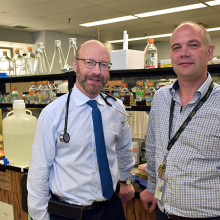
Above (from left): Drs. Michael Silverman and Jeremy Burton
In a phase I clinical trial, the research team is the first in Canada to study the use of fecal transplants to alter a cancer patient’s microbiome and improve their response to anti-PD1 immunotherapy drugs.
Research participants will be 20 melanoma patients recruited from the London Regional Cancer Program (LRCP) at London Health Sciences Centre (LHSC). They will undergo a fecal transplant at St. Joseph’s Hospital, a part of St. Joseph’s Health Care London, followed by immunotherapy at LRCP. The transplant will consist of taking a number of specially-prepared oral capsules.
Patients will be assessed over time for any changes to their cancer, microbiome, immune system and overall health. The primary goal of the study is to evaluate safety of the novel treatment combination, but researchers will also evaluate patient outcomes.
“Melanoma is the least common skin cancer but it is the most deadly and rates are going up,” says Dr. John Lenehan, Associate Scientist at Lawson and Oncologist at LHSC. “Anti-PD1 immunotherapy drugs can be extremely effective but we want to help more patients respond. That’s our goal.”
Image
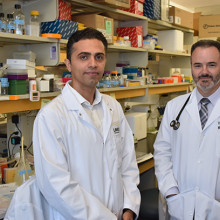
Above (from left): Drs. Saman Maleki and John Lenehan
While the team is studying the combination of fecal transplants and immunotherapy for melanoma, they see potential for other cancers as well.
“We’re one of the first in the world to study fecal transplants in cancer patients. This study is as cutting-edge as it gets with potential applications for multiple disease sites,” notes Dr. Saman Maleki, a Lawson Associate Scientist who specializes in cancer immunology. “With experts in microbiology, infectious disease, cancer and immunology, our institute is well-positioned to carry this forward.”
Image
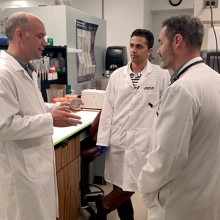
Dr. Michael Silverman, Lawson Associate Scientist and Chief of Infectious Disease at St. Joseph’s and LHSC, is a pioneer in the field of fecal transplants. St. Joseph’s is a leading centre for the procedure, performing them for Clostridium difficile (C. diff) patients across the province.
“Fecal transplants have saved the lives of countless patients with recurrent C. diff,” says Dr. Silverman. “We’re now starting to see its potential for the treatment of other diseases.”
Lawson researchers are planning fecal transplant studies for multiple other conditions including non-alcoholic fatty liver disease, multiple sclerosis (MS) and cancer treatment toxicity.“But in order to conduct this research, we need stool donors,” notes Dr. Silverman.
The team is in need of young, healthy stool donors for fecal transplants. All donors are required to go through a screening process. Those interested in becoming a stool donor can contact Dr. Seema Nair Parvathy, Research Coordinator, Fecal Transplant Program, at 519-646-6100 ext. 61726.
Check out media coverage of this research:
- CTV News: Why fecal transplants could be the next frontier in fighting skin cancer
- Forbes: Could poop be the next treatment for cancer?
- London Free Press: Researchers seeking poop donors for skin cancer treatment study
- Daily Mirror: How human poo 'transplants' could help doctors treat deadliest form of skin cancer
- CBC: London cancer researchers make number 2 their number 1 priority
Scientist