


Search
Search
1883 Search Results:
Scientists
Our scientists
Lawson leads research, with more than 250 principal investigators, technicians, support staff and trainees making health discoveries every day. As award-winning leaders and emerging experts in their fields, they share their innovations with doctors, patients, peers and the world.
They are engaged in more than 800 clinical studies and receive about 600 funded grants totalling more than $39.4 million in grant funding.
Search or browse the directory below to find scientist profiles and contact information.
Scientists studying carbon monoxide as a possible treatment for sepsis
Sepsis is the leading cause of death worldwide with limited treatment options
MEDIA RELEASE
For immediate release
LONDON, ON – Sepsis is a life-threatening condition that occurs when the body’s response to an infection triggers excessive inflammation. The inflammatory response can cause damage to organs such as the heart, liver, lungs and brain. While there are currently limited treatments for sepsis, researchers at Lawson Health Research Institute are working to change that by examining the use of carbon monoxide-releasing molecules to treat patients. “This is an unusual approach that is looking at using carbon monoxide which is the infamous gas molecule,” says Dr. Gediminas Cepinskas, Scientist and Director of the Centre for Critical Illness Research at Lawson. “If administered and used in small non-toxic concentrations, carbon monoxide can offer very potent protective and anti-inflammatory effects.”
In studies on the subject, including the most recent one published in the journal of Experimental Biology and Medicine, the research team was able to demonstrate efficacy in using carbon monoxide-releasing molecules to protect individual cells in the liver and lungs of sepsis induced inflammation in preclinical models. “We have been working on isolated organs and organ specific cells to test carbon monoxide-releasing molecules to narrow down which specific cells are more sensitive to treatment and which biochemical pathways are involved,” Says Dr. Cepinskas. “We are making great progress in our work and have had success in addressing the efficacy of carbon monoxide-releasing molecules in preclinical models.”
Dr. Cepinskas is one of just a few scientists worldwide studying carbon monoxide-releasing molecules to treat inflammatory conditions such as sepsis. While carbon monoxide is commonly known as dangerous, using it in a controlled manner does not pose a danger and may have therapeutic potential. “Our immune system is usually our defense system, but with sepsis it becomes so activated it starts to attack our own cell tissues, resulting in injury and dysfunction of the affected organs,” explains Dr. Cepinskas. “Almost each and every cell in our body naturally produces carbon monoxide which is used in defense against harmful and injured stimuli. We are taking advantage of this knowledge and currently we are the only lab in Canada working on this potential carbon monoxide-based therapy.”
Dr. Cepinskas is also collaborating with clinicians at London Health Sciences Centre (LHSC) to study the use of carbon monoxide-releasing molecules to treat limb compartment syndrome and to improve organ transplantation.
The research team, which has patents in the area of carbon monoxide-releasing molecules, is now working with the pharmaceutical industry to move this potential therapy into human clinical trials in the future.
-30-
About Lawson Health Research Institute
Lawson Health Research Institute is one of Canada’s top hospital-based research institutes, tackling the most pressing challenges in health care. As the research institute of London Health Sciences Centre and St. Joseph’s Health Care London, our innovation happens where care is delivered. Lawson research teams are at the leading-edge of science with the goal of improving health and the delivery of care for patients. Working in partnership with Western University, our researchers are encouraged to pursue their curiosity, collaborate often and share their discoveries widely. Research conducted through Lawson makes a difference in the lives of patients, families and communities around the world. To learn more, visit www.lawsonresearch.ca.
Media Contacts
Celine Zadorsky
Senior Media Relations Consultant
Communications & Public Engagement
T: 519-685-8500 ext. 73502
Celine.zadorsky@lhsc.on.ca
Season's Greetings from Lawson Health Research Institute
On behalf of everyone at Lawson Health Research Institute, we wish you a wonderful holiday season and a New Year of health and happiness.
See what our talented researchers have helped create in 2019.
David Hill, Scientific Director
Stacey Larizza, Chief Operating Officer, Research
… the Working Group recommends addressing the following four barriers: 1. No central process for raising and … placed and confusing signs. 4. Lack of accessibility within our existing facilities. Annual Accessibility Plan September … long term and community-based settings. We work with our partners to create a better health care system. …
Annual Accessibility Plan regarding ONTARIANS WITH DISABILITIES ACT for the St. Josephs Health Care, London September 2003 - August 2004 Submitted to Cliff Nordal Chief Executive Officer 30 September 2003 Prepared by Nick Kokkoros Facilitator Accessibility Working Group This publication is available...
… The most significant findings were accessibility of our facilities and the need to increase awareness of … long term and community-based settings. We work with our partners to create a better health care system. VISION...WHAT WE'LL BE A respected source of excellent health service ... guided by the people …
Annual Accessibility Plan for the St. Joseph Health Care, London September 2004 - August 2005 Submitted to Cliff Nordal Chief Executive Officer 30 September 2004 Prepared by SJHC Accessibility Working Group Co-ordinator, Derek Lall This publication is available on the hospitals website and in altern...
… notifications of severe weather events from one of many sources. These sources may include but not limited to cellular device … will make efforts to add additional notifications within our hospital in the form of overhead announcements for … notifications of severe weather events from one of many sources. These sources may include but not limited to …
~ SIJOSEPHs HEALTH CARE LONDON CORPORATE Procedure: SEVERE WEATHER Owner of Procedure: Emergency Management and Risk Specialist Approval by: Emergency Management Committee Date: 2022-06-02 Original Effective Date: 2021-05-03 Reviewed Date(s): 2022-05-27 Revised Date(s): 2022-05-27 PURPOSE Adverse or...
Sharing the gift of hope through research
Community members and those in the field of health research attended a special open house and interactive tour by research groups at Lawson Health Research Institute – celebrating the holiday spirit and the gift of hope that is made possible through hospital-based research.
A part of St. Joseph’s Health Care London, Parkwood Institute represents the next era in care, recovery and rehabilitation. Across the site, clinical and research teams in different disciplines and specialties are collaborating in new ways.
The teams that make up Parkwood Institute Research, a Lawson program, are conducting clinical studies with the goal of understanding disease and improving care for a wide range of patients.
“Many people in the community know the high-quality and compassionate care that is supported by the various clinical teams at Parkwood Institute,” says Dr. Cheryl Forchuk, Beryl and Richard Ivey Research Chair in Aging, Mental Health, Rehabilitation and Recovery, and Assistant Scientific Director at Lawson. “What most don’t know is that we have research teams working across these sites, with each other and research patients.
Researchers tackle the most important challenges and provide access to highly innovative and meaningful solutions that improve the lives of patients and their families, added Dr. Forchuk.
Image

At the open house on November 30, there were 11 interactive displays in the areas of cognitive vitality and brain health, mobility and activity and mental health. This included the Gait and Brain Laboratory, the Operational Stress Injury Clinic, wound care, the Mental Health Nursing Research Alliance and more:
- The Mental Health INcubator for Disruptive Solutions (MINDS) of London Middlesex is a social innovation lab focused on developing, testing, implementing and evaluating disruptive solutions that promote the mental and emotional wellbeing of Transition-Aged Youth in our London-Middlesex community.
- The Canadian Consortium on Neurodegeneration in Aging (CCNA), supported by CIHR and many partners, is the premier research hub for all aspects of research involving neurodegenerative diseases that affect cognition in aging – including Alzheimer's disease.
- A dynamic lab with the top neurorehabilitation evidence-based reviews in stroke, brain injury, spinal cord injury and multiple sclerosis, or insight into clinical trials of stroke rehabilitation using exoskeletons, exercise paradigms, pharmaceuticals, and clinical studies of psychosocial factors that influence chronic pain in brain injury and spinal cord injury populations.
The open house had a festive theme and each of the exhibits involved a problem solving element to encourage learning and foster teamwork.
Image
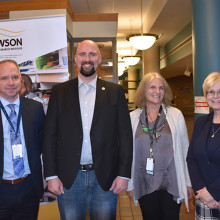
Peggy Sattler, Member of Provincial Parliament for London West, and Terence Kernaghan, Member of Provincial Parliament for London North Centre, were among the over 300 people in attendance.
“This special open house opportunity is meant to be a fun experience where you were also learning about research,” explains Dr. Forchuk. “During this holiday season, we wanted to share our own gift of hope in the form of collaborative research that is making a real difference.”
See photos from the open house on Facebook.
Scientist
Shocking number of heart attack patients suffer dangerous hemorrhage following lifesaving treatment, study shows
MEDIA RELEASE
For immediate release
February 10th, 2022
LONDON- A heart attack can be deadly, but there are effective lifesaving procedures if treated in time. The most common procedure is called reperfusion therapy, which is when the blocked coronary artery causing the heart attack is opened up and a stent is placed inside to let blood flow freely again.
In a recent published study by a multi-center research team at Lawson Health Research Institute, St. Joseph’s Health Care London and a number of other institutions across the globe, scientists examine a condition called reperfusion injury, a problem that can take place following reperfusion therapy.
“When you open up the coronary artery in someone experiencing a heart attack the blood starts to flow. However, we found there are a number of factors that lead to other injuries due to opening up the vessel,” explains Dr. Rohan Dharmakumar, Executive Director of the Krannert Cardiovascular Research Center at Indiana University. “Opening up the coronary artery, although lifesaving and necessary, can at times cause significant reperfusion injury which is a concept that had yet to be scientifically proven until now.”
For example, when the blocked coronary artery is opened up with reperfusion therapy the blood flowing into narrower vessels can cause the smaller vessels to burst and cause internal bleeding within the heart muscle, which is called myocardial hemorrhage.
“Those who experience a myocardial hemorrhage have a much larger piece of their heart muscle die than those who don’t have hemorrhage,” says Dr. Frank Prato, Program Lead of Lawson’s Imaging Research Program and Assistant Scientific Director at Lawson. “We have been able to show that if there is hemorrhage due to reperfusion injury, the size of the dead tissue within the heart grows, which then can ultimately lead to heart failure.”
After studying 70 patients with heart attacks, the research team was able to show reperfusion injury led to hemorrhage in excess of 50 per cent of patients who were being treated for a heart attack.
“The outcome isn’t immediate death, but heart failure that can start a few years after the heart attack,” says Dr. Dharmakumar. “So even though we are saving people initially from a heart attack, we are still losing a lot of people to heart failure within the first five years.”
This discovery was made possible through the use of Lawson’s cyclotron, a machine used to make isotopes for advanced PET/MRI scans at St. Joseph’s Health Care London.
“To validate the study with a PET/MRI we needed a specific radioactive isotope called nitrogen 13 ammonia,” explains Dr. Mike Kovacs, Scientist and Director of Lawson’s Cyclotron Facility. “We were able to create this isotope and went through Health Canada approval, so now we can use this not only in preclinical models but with human patients as well.”
The study has been published in the Journal of American College of Cardiology. The findings will now allow the research team to examine different forms of therapies that can be used in combination with reperfusion therapy to improve patient outcomes.
-30-
ABOUT LAWSON HEALTH RESEARCH INSTITUTE
Lawson Health Research Institute is one of Canada’s top hospital-based research institutes, tackling the most pressing challenges in health care. As the research institute of London Health Sciences Centre and St. Joseph’s Health Care London, our innovation happens where care is delivered. Lawson research teams are at the leading-edge of science with the goal of improving health and the delivery of care for patients. Working in partnership with Western University, our researchers are encouraged to pursue their curiosity, collaborate often and share their discoveries widely. Research conducted through Lawson makes a difference in the lives of patients, families and communities around the world. To learn more, visit www.lawsonresearch.ca.
For more information, please contact:
Celine Zadorsky
Communications Consultant & External Relations
Lawson Health Research Institute
T: 519-685-8500 ext. 75664
C. 519-619-3872
@email
www.lawsonresearch.ca/news-events
Media Contacts
Celine Zadorsky
Senior Media Relations Consultant
Communications & Public Engagement
T: 519-685-8500 ext. 73502
Celine.zadorsky@lhsc.on.ca
… Microwaving for 90 seconds was found to be optimal. WATER SOURCE You may have read news reports of patients dying from … appropriate caution should be used when selecting a water source for irrigation. Boiled, distilled, or appropriately … to work the best. Both the irrigation device and the water source have the potential for contamination. Proper …
SINONASAL IRRIGATIONS INTRODUCTION In medical terms, to irrigate means to wash. Nasal irrigation is an ancient technique based on early homeopathic and yogic practices. A salt water solution (saline) is prepared and used to wash the nasal cavity. Recently, doctors have begun to study the technique. ...
… of London, Southwestern Ontario, and well beyond. The journey from their beginnings in Lepuy, France, to North … the Sisters of St. Joseph were sent to St. Louis, Missouri in 18�6, and then to Philadelphia in 18�7 to establish … and the aged. The Sisters of St. Joseph began their journey of healing in Southwestern Ontario. •5 Less than a …
S i S t e r the hiStory of the SiSterS of St. JoSeph of London Special thanks to Lori Perrie and Sister Mary Zimmer of the Sisters of St. Joseph of the Diocese of London for their knowledge, expertise and keen attention to detail. cover: The caring hands of Sister Norita Keenan, who worked at St. J...
… of London, Southwestern Ontario, and well beyond. The journey from their beginnings in Lepuy, France, to North … the Sisters of St. Joseph were sent to St. Louis, Missouri in 1836, and then to Philadelphia in 18�7 to establish … and the aged. The Sisters of St. Joseph began their journey of healing in Southwestern Ontario. •5 Less than a …
s i s t e r tHe History of tHe sisters of st. JosepH of london 2 Special thanks to Lori Perrie and Sister Mary Zimmer of the Sisters of St. Joseph of the Diocese of London for their knowledge, expertise and keen attention to detail. cover: The caring hands of Sister Norita Keenan, who worked at St. ...
… PLAN 2015 | 2018ST. JOSEPH’S HEALTH CARE LONDON Realizing our Vision St. Joseph’s Vision, Mission and Values OUR VISION OUR MISSION OUR VALUES – RESPECT, EXCELLENCE, COMPASSION … PLAN 2015 | 2018ST. JOSEPH’S HEALTH CARE LONDON Realizing our Vision St. Joseph’s Vision, Mission and Values OUR …
STRATEGIC PLAN 2015 | 2018ST. JOSEPHS HEALTH CARE LONDON Realizing our Vision St. Josephs Vision, Mission and Values OUR VISION OUR MISSION OUR VALUES RESPECT, EXCELLENCE, COMPASSION STRATEGIC PLAN 2015 TO 2018 Our Patients, Residents and Families GOAL GUIDED BY THEIR VOICES; EXCELLENCE ALWAYS STRA...
… (Hereinafter referred to as the “financial statements”). In our opinion, the accompanying financial statements, present … organizations. Basis for Opinion We conducted our audit in accordance with Canadian generally accepted auditing standards. Our responsibilities under those standards are further …
Financial Statements of ST. JOSEPH'S HEALTH CARE FOUNDATION OF LONDON And Independent Auditors' Report thereon Year ended March 31, 2022 KPMG LLP 140 Fullarton Street, Suite 1400 London ON N6A 5P2 Canada Tel 519-672-4880 Fax 519-672-5684 INDEPENDENT AUDITORS' REPORT To the Board of Directors of St. ...
… B B B 0060421*001AMD14**001AMD14* *00* About Your Recent Procedure... Please fill in the circle that best describes your experience during your recent outpatient surgery or other procedure. Please … B B B 0060421*001AMD14**001AMD14* *00* About Your Recent Procedure... Please fill in the circle that best …
B B B 0060421*001AMD14**001AMD14* *00* About Your Recent Procedure... Please fill in the circle that best describes your experience during your recent outpatient surgery or other procedure. Please think only of your visit on date, year. BEFORE YOUR PROCEDURE... Once you knew you needed your procedur...
… the Board at St. Joseph's Health Care, London, I ask for your assistance in evaluating the care and service that you received during your visit to our Urgent Care Centre. Your opinions are valuable to us. At … the Board at St. Joseph's Health Care, London, I ask for your assistance in evaluating the care and service that you …
*00* Dr. Gillian Kernaghan President & Chief Executive Officer Dear Christopher Johnson: On behalf of the Board at St. Joseph's Health Care, London, I ask for your assistance in evaluating the care and service that you received during your visit to our Urgent Care Centre. Your opinions are valuable ...
… the Board at St. Joseph's Health Care, London, I ask for your assistance in evaluating the care and service that you received during your visit to our Urgent Care Centre. Your opinions are valuable to us. At … the Board at St. Joseph's Health Care, London, I ask for your assistance in evaluating the care and service that you …
*00* Dr. Gillian Kernaghan President & Chief Executive Officer Dear Christopher Johnson: On behalf of the Board at St. Joseph's Health Care, London, I ask for your assistance in evaluating the care and service that you received during your visit to our Urgent Care Centre. Your opinions are valuable ...
… B B B 0060421*001AMD14**001AMD14* *00* Your Hospital/Facility Stay... Please fill in the circle that best describes your experience during your hospital/facility stay ending on date, year. Thank You! … B B B 0060421*001AMD14**001AMD14* *00* Your Hospital/Facility Stay... Please fill in the circle that …
B B B 0060421*001AMD14**001AMD14* *00* Your Hospital/Facility Stay... Please fill in the circle that best describes your experience during your hospital/facility stay ending on date, year. Thank You! ADMISSION... Were you:1. E E E E E Admitted through the Emergency Department Admitted through a plan...
… B B B 0060421*001AMD14**001AMD14* *00* Your Visit to the Urgent Care Centre... Please fill in the circle that best describes your experience during your Urgent Care Centre visit at St. Joseph's Health Care, … B B B 0060421*001AMD14**001AMD14* *00* Your Visit to the Urgent Care Centre... Please fill in the …
B B B 0060421*001AMD14**001AMD14* *00* Your Visit to the Urgent Care Centre... Please fill in the circle that best describes your experience during your Urgent Care Centre visit at St. Joseph's Health Care, London ending on date, year. Thank You! ARRIVAL IN THE URGENT CARE CENTRE... Please note that...
… describes how you feel about the care and services that your family member receives at Mount Hope Centre for Long … ask about the facility's living environment. Does your family member's room meet his/her specific needs?1. E E … know Not Applicable Does the layout of the facility meet your family member's needs?2. E E E E EYes Somewhat No Don't …
B B B 0060421*001AMD14**001AMD14* *00* Please fill in the circle that best describes how you feel about the care and services that your family member receives at Mount Hope Centre for Long Term Care. LIVING ENVIRONMENT The following questions ask about the facility's living environment. Does your fa...
… describes how you feel about the care and services that your family member receives at the Main Building or the … questions ask about the facility's living enviroment. Does your family member's room meet his/her specific needs?1. E E … know Not Applicable Does the layout of the facility meet your family member's needs?2. E E E E EYes Somewhat No Don't …
B B B 0060421*001AMD14**001AMD14* *00* Please fill in the circle that best describes how you feel about the care and services that your family member receives at the Main Building or the Western Counties Wing at Parkwood Institute, St. Joseph's Health Care London. LIVING ENVIRONMENT The following qu...