


Search
Search
1663 Search Results:
Clinical Research
Research at Lawson spans the continuum of life and mirrors the clinical areas of across St. Joseph’s Health Care London. Lawson is involved in all types and phases of clinical trials. Ethical clinical research and participant safety are our utmost priority.
Where does clinical research happen?
Depending on the research being done, it can take place in many different locations, including:
- Doctor’s offices
- Hospitals
- Medical centres
- Community nusing stations
- Academic centres, such as universities and medical schools
- Clinics
- At your home
Frequently Asked Questions
- What is a clinical trial?
- Participating in clinical trials
- Regulations and guidelines
- Considerations for participants and questions to ask
- Clinical Trials Ontario
- It Starts With Me
- Where can I find open clinical trials?
Contact
If you have questions, please call 519-667-6649 or email @email.
… I DAY, APR I L 16, 2004 London Convention Centre 300 York Street London, Ontario N6B 1P8 COUR SE OBJECT I VES • T o augment current knowledge … Recognition Award. Each physician should claim only those hours of credit that he/she actually spent in the educational …
OPHT HALMOLOGY CL I NI CAL DAY 2004 GLAUCOMA FR I DAY, APR I L 16, 2004 London Convention Centre 300 York Street London, Ontario N6B 1P8 COUR SE OBJECT I VES T o augment current knowledge regarding the management of glaucoma T o update knowledge on new diagnostic and new therapeutic techniques T ...
… OPHTHALMOLOGY CLINICAL DAY 2006 – OCULAR TUMOURS FRIDAY, APRIL 21, 2006 Ballroom – 2nd Floor London Convention Centre 300 York Street London, Ontario N6B 1P8 COURSE OBJECTIVES • To augment current knowledge regarding … OPHTHALMOLOGY CLINICAL DAY 2006 – OCULAR TUMOURS FRIDAY, APRIL 21, 2006 Ballroom – 2nd Floor London …
OPHTHALMOLOGY CLINICAL DAY 2006 OCULAR TUMOURS FRIDAY, APRIL 21, 2006 Ballroom 2nd Floor London Convention Centre 300 York Street London, Ontario N6B 1P8 COURSE OBJECTIVES To augment current knowledge regarding the management of ocular tumours To update knowledge on new diagnostic and new therap...
… DISEASES FRIDAY, APRIL 20, 2007 Salons C, D, E – First Floor London Convention Centre 300 York Street London, Ontario N6B 1P8 COURSE OBJECTIVES • To augment current knowledge regarding … Recognition Award. Each physician should claim only those hours of credit that he/she actually spent in the educational …
OPHTHALMOLOGY CLINICAL DAY 2007 OCULAR INFECTIOUS DISEASES FRIDAY, APRIL 20, 2007 Salons C, D, E First Floor London Convention Centre 300 York Street London, Ontario N6B 1P8 COURSE OBJECTIVES To augment current knowledge regarding the management of ocular infectious diseases To update knowledge o...
… 5 / Theatre Friday, May 9, 2008 Second Floor - 300 York Street London, Ontario N6B 1P8 Generously Supported By: • … The Hughes Lectureship Fund in Ophthalmic Plastic Surgery COURSE OBJECTIVES • To augment current knowledge regarding … Recognition Award. Each physician should claim only those hours of credit that he/she actually spent in the educational …
CLINICAL DAY IN OPHTHALMOLOGY 2008 OCULAR TRAUMA London Convention Centre - Ballroom 5 / Theatre Friday, May 9, 2008 Second Floor - 300 York Street London, Ontario N6B 1P8 Generously Supported By: The Charles Dyson Lectureship in Ophthalmology The Royal College of Physicians & Surgeons of Canada ...
Clinical trial will evaluate new therapy for patients with treatment-resistant depression as a result of bipolar disorder
LONDON, ON – Researchers at Lawson Health Research Institute are offering new hope to patients with treatment-resistant depression through participation in a national clinical trial. The study is the first randomized controlled trial to examine the efficacy of a new treatment called magnetic seizure therapy (MST) for patients with treatment-resistant depression as a result of bipolar disorder.
Treatment-resistant depression is a severe form of depression that does not respond to traditional therapies like medication. It is particularly common in patients with depression from bipolar disorder who are left with limited treatment options.
For years electroconvulsive therapy (ECT) has been the gold standard for patients with treatment-resistant depression. ECT uses an electric field to induce a seizure that provides a therapeutic benefit. But while ECT is effective, many patients opt out of treatment due to stigma surrounding the therapy and the potential for cognitive side effects like disorientation and amnesia.
MST has emerged as a promising alternative. MST works in a similar way to ECT but uses a focused magnetic field as opposed to electricity. As a result, MST induces a more focused seizure to reduce the risk of cognitive side effects.
“Magnetic seizure therapy has already been shown as a promising treatment for major depressive disorder or unipolar depression,” explains Dr. Amer Burhan, local site lead, researcher at Lawson and neuropsychiatrist at St. Joseph’s Health Care London. “For the first time, we’re studying how effective the treatment is for depression as a result of bipolar disorder and whether it can reduce the risk of cognitive side effects associated with electroconvulsive therapy.”
The clinical trial is being led by the Centre for Addiction and Mental Health (CAMH) and will also be offered through Lawson and University of British Columbia (UBC) Hospital. Lawson researchers will invite eligible patients with treatment-resistant depression from bipolar disorder to participate in the trial at Parkwood Institute, a part of St. Joseph’s Health Care London.
Eligible patients will be randomized to receive either ECT or MST. Patients will be offered support throughout the study with the goal of improving patient outcomes in both groups. Patient outcomes will be compared to study the efficacy of MST and whether it is associated with reduced cognitive side effects.
MST will be delivered under anesthesia in 12 to 20 sessions. Sessions will last 10 to 15 minutes each with 60 to 90 minutes of recovery time.
“Magnetic seizure therapy holds promise of one day replacing electroconvulsive therapy as the gold standard for treatment-resistant depression,” says Dr. Burhan. If proven as a viable first-line treatment, MST would be very easy to implement in existing ECT clinics. MST would therefore be readily available to patients in need.
“We are on the leading edge of the field of brain stimulation for treatment-resistant depression in collaboration with CAMH and UBC,” says Dr. Burhan. “Our goal is to continue informing the care process through clinically-relevant research that serves patients, medical professionals and the public.”
-30-
About Lawson Health Research Institute
Lawson Health Research Institute is one of Canada’s top hospital-based research institutes, tackling the most pressing challenges in health care. As the research institute of London Health Sciences Centre and St. Joseph’s Health Care London, our innovation happens where care is delivered. Lawson research teams are at the leading-edge of science with the goal of improving health and the delivery of care for patients. Working in partnership with Western University, our researchers are encouraged to pursue their curiosity, collaborate often and share their discoveries widely. Research conducted through Lawson makes a difference in the lives of patients, families and communities around the world. To learn more, visit www.lawsonresearch.ca.
Media Contacts
Celine Zadorsky
Senior Media Relations Consultant
Communications & Public Engagement
T: 519-685-8500 ext. 73502
Celine.zadorsky@lhsc.on.ca
Clinical trial will evaluate new therapy for treatment-resistant depression as a result of bipolar disorder
Treatment-resistant depression is a severe form of illness that does not respond to traditional therapies like medication and counselling. It is particularly common in patients with depression from bipolar disorder who are left with limited treatment options.
“There are some mental illnesses that can become resistant to therapy, similar to how infections, for example, can become resistant to antibiotics,” explains Dr. Amer Burhan, researcher at Lawson Health Research Institute and neuropsychiatrist at St. Joseph’s Health Care London. “Patients with those illnesses need more options.”
Brain stimulation is a field that holds promise for this patient population.
“When people are in a state of depression, research shows their brain networks are not functioning properly,” says Dr. Burhan. “Brain stimulation aims to stimulate neurons in the brain to correct activity and improve patient outcomes.”
Through involvement in a national clinical trial, Dr. Burhan and his research team at Lawson are offering new hope with a treatment called magnetic seizure therapy (MST). The study is the first randomized controlled trial to examine the efficacy of MST for patients with treatment-resistant depression as a result of bipolar disorder.
For years electroconvulsive therapy (ECT), one form of brain stimulation, has been the gold standard for patients with treatment-resistant depression. ECT uses an electric field to induce a seizure that provides a therapeutic benefit by stimulating the brain. But while ECT is effective, many patients opt out of treatment due to stigma surrounding the therapy and its potential for cognitive side effects like disorientation and amnesia.
MST has emerged as a promising alternative. MST works in a similar way to ECT but uses a focused magnetic field as opposed to electricity. As a result, MST induces a more focused seizure to reduce the risk of cognitive side effects.
Image
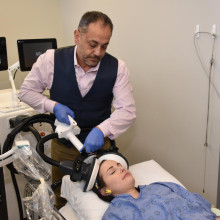
“Magnetic seizure therapy has already been shown as a promising treatment for major depressive disorder or unipolar depression,” explains Dr. Amer Burhan, local site lead for the clinical trial. “For the first time, we’re studying how effective the treatment is for depression as a result of bipolar disorder and whether it can reduce the risk of cognitive side effects associated with electroconvulsive therapy.”
The clinical trial is being led by the Centre for Addiction and Mental Health (CAMH) and will also be offered through Lawson and University of British Columbia (UBC) Hospital. Lawson researchers will invite approximately 30 eligible patients with treatment-resistant depression from bipolar disorder to participate in the trial at Parkwood Institute, a part of St. Joseph’s Health Care London.
Eligible patients will be randomized to receive either ECT or MST. Patients will be offered support throughout the study with the goal of improving patient outcomes in both groups. Patient outcomes will be compared to study the whether MST is effective and whether it is associated with reduced cognitive side effects.
MST will be delivered under anesthesia in 12 to 20 sessions. Sessions will last 10 to 15 minutes each with 60 to 90 minutes of recovery time.
“Magnetic seizure therapy holds promise of one day replacing electroconvulsive therapy as the gold standard for treatment-resistant depression, but we need to learn more about where it fits in our toolbox of potential treatments,” says Dr. Burhan.
If proven as a viable first-line treatment, MST would be very easy to implement in existing ECT clinics. MST would therefore be readily available to patients in need.
“We are on the leading edge of the field of brain stimulation for treatment-resistant depression in collaboration with CAMH and UBC,” says Dr. Burhan. “Our goal is to continue informing the care process through clinically-relevant research that serves patients, medical professionals and the public.”
Those who would like more information about the trial can email @email or @email.
… Interested in Creating an Advance Directive? (Living Will) With … best way to avoid a similar acrimonious battle is to put your wishes in writing, and then to have a heart-to-heart talk with your loved ones about what you would like to happen and what … best way to avoid a similar acrimonious battle is to put your wishes in writing, and then to have a heart-to-heart …
Interested in Creating an Advance Directive? (Living Will) With the attention focused on the Terri Schiavo case in the media, many people are wondering: What can I do to prevent this from happening in my family? Terri Schiavo is the severely brain-damaged woman in Florida who is at the heart of the ...
… Subject: Ethics Policy No.: #500-18 Section: General Administration Date(s) Board Approved: March 27, 2019 June 17, … and should be consulted? iii. What is in the best for our organization and our key stakeholders in the long run – what options are … and should be consulted? iii. What is in the best for our organization and our key stakeholders in the long run – …
Policy #500-18/Ethics DRAFT Jan 2019 Page 1 of 3 Board Policy Subject: Ethics Policy No.: #500-18 Section: General Administration Date(s) Board Approved: March 27, 2019 June 17, 2015 Reviewed by: Governance Committee Date(s) Committee February 1, 2019 Recommended: June 11, 2015 Date of Next Review: ...
… Your donation matters here. Community Event Toolkit St. Joseph’s Health Care Foundation would like to thank you for your generous support and interest in hosting a community … Your donation matters here. Community Event Toolkit St. Joseph’s Health Care Foundation would like to thank you …
Your donation matters here. Community Event Toolkit St. Josephs Health Care Foundation would like to thank you for your generous support and interest in hosting a community event. We are here to help make your fundraising efforts fun and easy and are very fortunate to have enthusiastic, caring peopl...
… Community Stewardship Report 2014 2015 An average day at St. Joseph’s … cancer outcomes. For St. Joseph’s, it is the generosity of our donors that makes these possibilities a reality. In this, our 2014-15 Community Stewardship Report, we celebrate what … cancer outcomes. For St. Joseph’s, it is the generosity of our donors that makes these possibilities a reality. In …
Community Stewardship Report 2014 2015 An average day at St. Josephs is filled with possibilities, whether its through innovative approaches to treatment or the potential offered by new medical technologies. Each day, these seemingly endless possibilities can be measured in the way people recovering...
… Today, health care is more important than ever. In Canada, our aging population is doubling. Rates of persistent and lifelong illnesses continue to rise, including … injury. We can all agree, health care is a treasured resource – one worthy of support and one that produces viable …
Community Impact Report 2015 2016 Today, health care is more important than ever. In Canada, our aging population is doubling. Rates of persistent and lifelong illnesses continue to rise, including diseases like diabetes, mental illness and cancers. Because you invest in the work of St. Josephs, we ...
… Services You make health care innovation possible. Just one of the reasons why YOU HELPED ENHANCE OUR OPERATING ROOMS 2019–2020 Community Impact Report Your donation matters here. YOUR DONATION MATTERS HERE YOU … possible. Just one of the reasons why YOU HELPED ENHANCE OUR OPERATING ROOMS 2019–2020 Community Impact Report Your …
Back row left: Holly Bridge, Diane Davis-Miller, Barb Simmonds Front row left: Dr. Jennifer Bjazevic, Roger Blum, Leanne Summers, Dr. Hassan Razvi, Surgical Services You make health care innovation possible. Just one of the reasons why YOU HELPED ENHANCE OUR OPERATING ROOMS 20192020 Community Impact...
… In response to COVID-19, care providers across St. Joseph’s quickly and expertly pivoted to meet challenges … the difference on pg. 3. 2020–2021 Community Impact Report Your donation matters here. THANK YOU FOR HELPING US RESPOND TO THE PANDEMIC. Just one of the reasons why YOUR DONATIONS FUELED OUR FIGHT AGAINST COVID-19 UNEXPECTED …
In response to COVID-19, care providers across St. Josephs quickly and expertly pivoted to meet challenges during the pandemic. Seen here, team members from the Urgent Care Centre at St. Josephs Hospital. Learn how donors made all the difference on pg. 3. 20202021 Community Impact Report Your donati...
… REFERRAL FORM PHONE: 519-685-4046 ADDRESS: Parkwood Institute Main Building FAX: 519-685-4020 London Hospitals … to patient Phone number #1 Phone number #2 Has your patient been involved with our services previously: Yes (Specify) _________________ No … to patient Phone number #1 Phone number #2 Has your patient been involved with our services previously: Yes …
G:\SGS General\GAAT\GERIATRIC ASSESSMENT REFERRAL FORM Revised December 15.2020 P a g e | 1 GERIATRIC AMBULATORY ACCESS TEAM (GAAT) REFERRAL FORM PHONE: 519-685-4046 ADDRESS: Parkwood Institute Main Building FAX: 519-685-4020 London Hospitals #44020 St. Josephs Health Care London EMAIL: GeriatricAmb...
… Condensed Statement of Financial Position Condensed Statement of … Cash and investments, end of year 54,140$ 44,879$ Where our money comes from to operate the organization. The primary source of operational funding comes from MOHLTC, and Veterans … Cash and investments, end of year 54,140$ 44,879$ Where our money comes from to operate the organization. The …
Condensed Statement of Financial Position Condensed Statement of Operations Year ended March 31 2012 2011 (000's) (000's) Assets Current assets 77,048$ 70,983$ Restricted investments 184,588 186,461 Capital assets and other 336,591 343,931 598,227 601,375 Liabilities, Deferred Contributions and Net ...
… we have a records of those who book meeting rooms within our buildings. Legal Authority for PIB: Public Hospitals Act … Individuals in Bank: Individuals who book meeting rooms at St. Joseph’s. Retention Period: As long as individual continues to use meeting rooms at St. Joseph’s. /media/1649 …
Personal Information Bank (PIB) Details Title: Conference Services Booking Form Location of Files: Communication and Public Affairs Description: To ensure we have a records of those who book meeting rooms within our buildings. Legal Authority for PIB: Public Hospitals Act R.S.0 1990, c. P.40. Types ...
… Act, c. provides one or more forms of support or assistance to meet the needs of the resident, including … a parent or legal guardian is required. • A maximum of four essential caregivers may be designated per resident at a … a caregiver even if this means the resident has more than four designated essential caregivers.) • Only one essential …
~~ SIJOSEPHs HEALTH CARE LONDON Appendix A Mount Hope Centre f or Long Term Care Consideration for Designated Essential Caregiver Caregiver A caregiver is defined in the Fixing Long-Term Care Act, 2021, O. Reg 246/22 section(4) as follows: a. is a family member or friend of a resident or a person of...
Contact Lawson Research Institute
Contact us

For general information or Lawson-specific questions:
Phone: 519 646-6005
Email: @email
To reach a member of the Lawson/St. Joseph’s Communications team with a story idea or a media-related inquiry, contact:
Communication and Public Affairs
Phone: 519 646-6100 ext. 66034
Fax: 519 646-6215
Email: comdept@sjhc.london.on.ca
If you need to contact a communicator after office hours (Mon to Fri, 8:30 am to 4:30 pm), call Switchboard at 519 646-6100 and ask them to page the communicator on-call.
Directions and parking
The main office of Lawson Research Institute is located within St. Joseph's Hospital. You can find a map to St. Joseph's Hospital along with Parking information below.
Lawson Research Institute inside St. Joseph's Hospital
268 Grosvenor Street
London, Ontario, N6A 4V2
Parking options
For those planning to park at or near St. Joseph’s Hospital, please ensure you leave extra time to do so. Due to the high number of people coming for care at St. Joseph’s Hospital, our two parking garages located on Grosvenor Street and on Cheapside Street are often at capacity Monday to Thursday between 9:30 a.m. and 2 p.m. ‘Lot full’ signs are posted when the parking garage(s) are full. Metered parking is available on the streets around the hospital.
As parking availability isn’t guaranteed at or nearby the hospital, St. Joseph’s encourages patients and family caregivers to consider making alternate travel arrangements when coming to the hospital, such as using public transit, taxi or being dropped off and picked up. Drop off areas are available at Entrance 1 and 2 on Grosvenor Street and Entrance 4 on Cheapside Street.
St. Joseph’s recognizes the frustration the lack of parking availability may cause and apologizes for any inconvenience. Thank you for your patience and understanding while we seek solutions to this issue.
Grosvenor parking garage
Daily rate: Minimum rate of $4 for the first hour and then $2 increments every half hour to a maximum of $8.75 after 2 hours.
Monthly rate: $60.75
There are 989 parking spaces in the Grosvenor Street parking garage.
View a printable map of parking spaces at St. Joseph's Hospital, Grosvenor Street Parking Garage (including accessible spaces).
The parking garage entrance is located on Grosvenor Street, across the street from Grosvenor Entrance 1. The garage is connected to Mount Hope Centre for Long Term Care through the underground tunnel (take elevators at northwest corner of the garage, see below).
Tunnel access at St. Joseph's Hospital
When visiting St. Joseph's Hospital and parking in the parking garage on Grosvenor Street the safest and most accessible route is through the tunnel. You can access the tunnel from the west end of the parking garage (closest to Richmond Street) by taking the elevators or stairs to level "B". When returning to your vehicle from Zone A you will need to push "T" (for tunnel) in the elevator.
Parking pay stations
Parking pay stations are located on the ground floor of both elevator lobbies located at the north-west and north-centre area of garage.
Pay stations only accept coins and credit cards. To purchase a monthly pass visit the Parking Garage office on the Wellington Street side of the Grosvenor Street Parking Garage, ground floor.
For further information, please call the parking office at 519 646-6100 ext. 65113.
Parking office hours are 8 am to 4 pm, Monday to Friday. Outside those hours, calls are directed to Precise ParkLink Inc. at 1-888-783 PARK (7275). The call centre can also be reached by intercom available on the parking pay machines in the garage's elevator lobby.
Accessible parking spaces
Accessible parking is available on each floor of the Grosvenor Street parking garage at the west end of the garage (closest to the Richmond and Grosvenor Street corner.) These parking spots are located close to the elevator that will take you to the wheelchair-accessible ramp on street level (level 1) or the underground tunnel that connects to both Mount Hope Centre for Long Term Care and St. Joseph’s Hospital.
Limited spots for accessible parking is also available on Wellington Street and on Grosvenor Street across from the Urgent Care Centre entrance (Entrance 2).
Cheapside parking garage
There are 132 parking spaces in the Cheapside Street parking garage.
View a printable map to parking spaces at St. Joseph's Hospital, Cheapside Street Parking Garage (including accessible spaces).
This is the closest lot for outpatients with appointments in Zones C and D of the hospital (Medical Imaging, Roth McFarlane Hand and Upper Limb Centre, Hand Therapy, Breast Care Centre, Rheumatology Centre, Physiotherapy Therapy, Occupational Therapy, WSIB Specialty Clinic, Shuttleworth Auditorium).
The entrance to the lot is on Cheapside Street just east of Richmond. It is open from 5:30 am to 5:30 pm, Monday to Friday, and closed on weekends. The elevator in the garage connects directly with the Francis and Madeleine Saul Medical Imaging Centre (Level 0) and the G. A. Huot Surgical Centre (Level 1). For appointments in Zone D, exit the parking garage elevator on Level 0 and walk across the lobby to the west side.
The parking pay station is located by the main elevators next to the gift shop in the Zone C lobby.
Parking meters at St. Joseph's Hospital
There are many city parking meters located within walking distance to St. Joseph's Hospital.
Rates are posted on the meters.
Street parking at St. Joseph's Hospital
Some of the residential streets that are within walking distance to the health centre offer one or two hour parking. Overnight parking is not permitted.
Please be courteous and do not block driveways.
Courteous parking to ensure maximum lot capacity
Please be aware that the City of London enforces parking regulations across all of St. Joseph’s sites to ensure patients, visitors, staff and physicians have adequate parking. All users of our parking facilities are asked to pay attention to parking regulations and how you park your vehicle.
As well, those who park for more than 10 minutes in patient drop-off designated areas, in handicapped parking without a permit, at loading docks, and other restricted areas will also find their vehicles being ticketed.
Thank you for respecting our parking regulations. If you have any parking questions please contact Precise ParkLink Inc.
Email: @email
Phone: 1-888-783 PARK (7275)
Public transit to St. Joseph's Hospital
St. Joseph's Hospital is conveniently located in a central location, with easy access to public transportation. Bus stops are located along Richmond Street and close to the Cheapside Street entrances. Contact the London Transit Commission at 519 451-1347 for rates and times.
The following London Transit bus routes will drop you off near entrances to St. Joseph's, see the London Transit trip planner and route schedules and real time LTC bus route tracking for more information:
- 6 Richmond
- 13 Wellington
- 1 Kipps Lane
- 21 Huron Heights
St. Joseph's is also just a few blocks north of Oxford Street, providing easy access from the Oxford St. bus routes.