


Search
Search
1081 Search Results:
New robotic 3D ultrasound may improve accuracy of liver cancer ablation therapy
LONDON, ON – A new system that turns ultrasounds into a 3D image could make treatment of liver cancer using thermal ablation more accurate, a new simulated study from Lawson Health Research Institute and Western University has found.
Liver cancer is the fourth leading cause of cancer death globally. While surgery is one treatment option, thermal ablation, using heat to destroy the cancerous tumour, can have fewer complications and a shorter recovery time. It can also be used for patients who are not surgical candidates.
Thermal ablation requires precise needle placement to treat the cancer without damaging the vital organs and blood vessels around it.
“It's very important that we get the needle right in the centre of the tumour,” says Dr. Derek Cool, Associate Scientist at Lawson, Assistant Professor at Western University’s Schulich School of Medicine & Dentistry and Interventional Radiologist at London Health Sciences Centre (LHSC). “If the treatment area doesn't fully cover the tumour, patients are left with a small amount of residual cancer, risking recurrence and the need for additional treatment.”
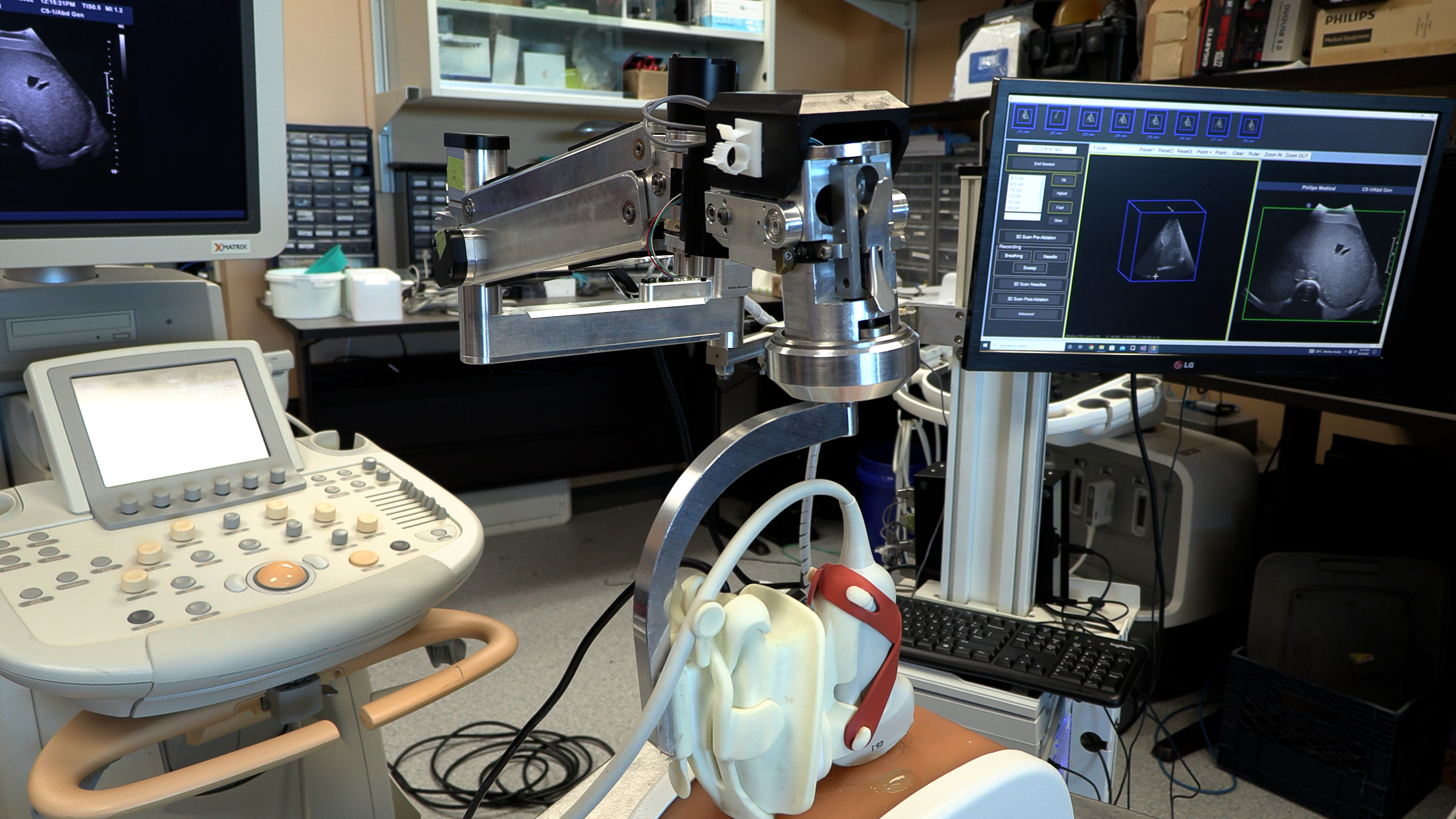
Ultrasound or CT (computerized tomography) imaging is normally used to guide needle placement, but both are limited. Ultrasound is widely available and can be done in real-time, but only delivers a 2D image. While a CT scan provides a 3D image, it isn’t in real-time and can be a lengthy process.
“We developed a new 3D ultrasound method that shows promise in analyzing whether the complete liver tumour will be ablated by the procedure,” explains Dr. Aaron Fenster, a Professor at Schulich and Scientist at Robarts Research Institute. “And we're now using the same system to guide the needle directly into the centre of the tumor.”
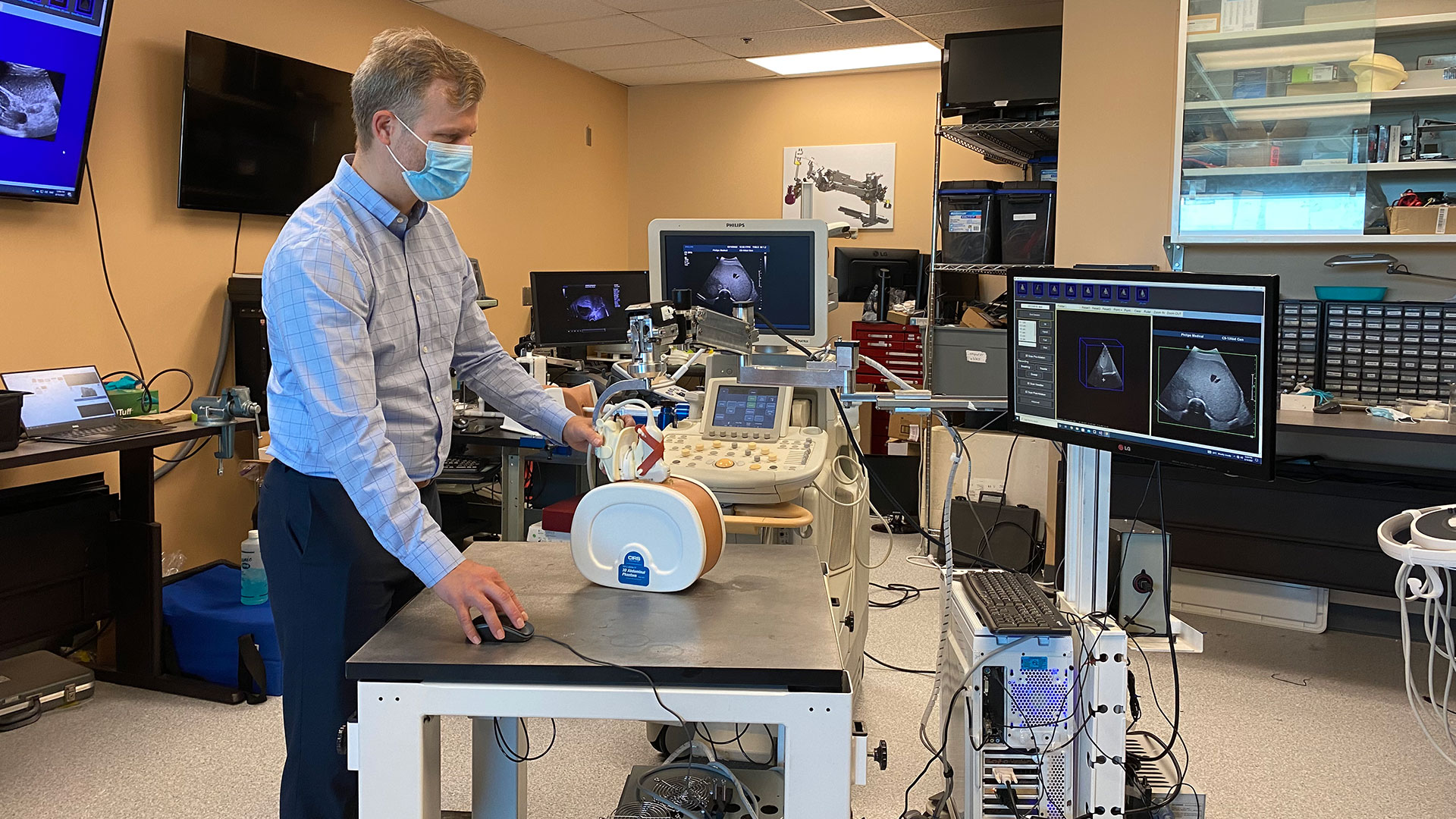
To create the 3D ultrasound images, a robotic cradle moves a standard ultrasound probe, collecting images and stacking them like puzzle pieces.
The simulated study, published in IEEE Transactions on Medical Imaging, used data from 14 patient cases at LHSC to analyze accuracy of the technology. It found that while 64.3 per cent of cases showed complete tumour coverage with standard imaging methods, the new system could result in complete coverage for 92.9 per cent of cases (13 of 14 cases). The researchers found that the remaining case could benefit from increasing the ablation time or intensity.
“Our next step is to move from simulation studies to a clinical trial,” says Dr. Cool.
If proven effective, the robotic ultrasound system’s portability could potentially allow for more widespread use of 3D ultrasound imaging, including in smaller health care centres. By eliminating the need for CT scans, it could also help to reduce imaging wait times.
“If a clinical trial shows the approach is more accurate and more precise than conventional techniques, there would be a direct impact on patient care,” says Dr. Fenster. “We hope to explore commercialization to license the technology and distribute it worldwide.”

About Lawson Health Research Institute
Lawson Health Research Institute is one of Canada’s top hospital-based research institutes, tackling the most pressing challenges in health care. As the research institute of London Health Sciences Centre and St. Joseph’s Health Care London, our innovation happens where care is delivered. Lawson research teams are at the leading-edge of science with the goal of improving health and the delivery of care for patients. Working in partnership with Western University, our researchers are encouraged to pursue their curiosity, collaborate often and share their discoveries widely. Research conducted through Lawson makes a difference in the lives of patients, families and communities around the world. To learn more, visit www.lawsonresearch.ca.
About Western
Western delivers an academic experience second to none. Since 1878, The Western Experience has combined academic excellence with life-long opportunities for intellectual, social and cultural growth in order to better serve our communities. Our research excellence expands knowledge and drives discovery with real-world application. Western attracts individuals with a broad worldview, seeking to study, influence and lead in the international community.
About The Schulich School of Medicine & Dentistry
The Schulich School of Medicine & Dentistry at Western University is one of Canada’s preeminent medical and dental schools. Established in 1881, it was one of the founding schools of Western University and is known for being the birthplace of family medicine in Canada. For more than 130 years, the School has demonstrated a commitment to academic excellence and a passion for scientific discovery.
Media Contacts
Amanda Taccone
Communications Consultant & External Relations
Lawson Health Research Institute
T: 519-685-8500 ext. ext. 64059
C: 226-919-4748
@email
New study aims to understand team-based care for chronic disease management
Chronic diseases, such as chronic obstructive pulmonary disease (COPD), are complex and require thorough care to help manage the condition. Patients often need support from an integrated team of health care professionals who work in different settings.
Dr. Shannon Sibbald, associate scientist at Lawson Health Research Institute, is leading a study to better understand integrated health care teams for chronic disease management and factors that help successful implementation.
Integrated team-based models of care include multiple health care providers working together to support patients with complex needs, such as those with chronic disease. There are many benefits to integrated team-based models of care. Patient outcomes are improved, health care providers feel more supported in their work and services are less likely to be duplicated.
Dr. Sibbald’s research focuses on chronic obstructive pulmonary disease (COPD), a devastating chronic disease affecting normal lung function in over 1.5 million Canadians. COPD is one example of a chronic disease where patients can benefit from team-based care. COPD is often underdiagnosed, and patients with COPD and other chronic diseases may not be receiving the ideal care for their condition.
While integrated team-based care is important, there are currently few studies to guide implementation. In this study, Dr. Sibbald’s research team will engage health care providers and patients to gain a rich understanding of successful integrated approaches to chronic disease management, including how team-based models of care are implemented. The team will also work to better understand how patients with chronic diseases view such models, and what their hopes and expectations are for their care.
“We want to explore innovative and successful approaches to implementing team-based models of care,” explains Dr. Sibbald. “We’re looking to learn how these methods can support practice, improve patient outcomes and spread innovation.”
The team will look at high performing integrated care teams that support current best practices at a family health team in London, Ontario.
When models are applied to practice, context is an important part to consider. For chronic diseases, context is often broad and elaborate. They hope to gain insight into what works well and what does not in dynamic contexts, and gain a better understanding of implementation facilitators and barriers.
The ultimate goal is to build knowledge that will support implementation and sustainability of high-performing integrated health teams across our health system.
“While motivation and momentum to use integrated teams is high, there is little guidance on how to do this well,” says Dr. Sibbald. “This research will provide insight into what works and what does not, reducing our gap in knowledge.”
Dr. Sibbald received a Lawson Internal Research Fund (IRF) grant to conduct this pilot study. Once complete, Dr. Sibbald’s team hopes to expand the study to look at integrated care models at other sites across the province.
"The IRF grant enables our team to validate our methods of evaluating the implementation of interprofessional team-based care in complex settings," adds Dr. Sibbald. "By examining the impact team-based care for patients with COPD, we hope to demonstrate the relevance of our findings, to support grant proposals."
The IRF is designed to provide Lawson scientists the opportunity to obtain start-up funds for new projects with the potential to obtain larger funding, be published in a high-impact journal, or provide a clinical benefit to patients. Funding is provided by the clinical departments of London Health Sciences Centre and St. Joseph’s Health Care London, as well as the hospital foundations (London Health Sciences Foundation and St. Joseph’s Health Care Foundation).
… tal application package, within the “Checklist of Mandatory Requirements”, which was sent to you by Medical Affairs. The … tal application package, within the “Checklist of Mandatory Requirements”, which was sent to you by Medical Affairs. The …
myHR New Hire Documentation Instruction Manual for Residents GENERAL NOTES The completion of all steps will take you approximately one hour You can complete the steps in any order You can exit and come back as often as you need until you have completed all of the steps We recommend that you use ...
… with the candidate to complete all hospital credentialing requirements, which includes the Health Review, and all … with the candidate to complete all hospital credentialing requirements, which includes the Health Review, and all …
Non-Canadian Trained Professional Staff in an Academic Appointment New positions requires that Part A of the Position/Candidate Impact Summary Form be completed and request form submitted by Department to Medical Affairs for the Joint Professional Staff Human Resource Committee (JPSHRC) to Review. T...
EPISTAXIS (NOSEBLEEDS) INTRODUCTION Epistaxis is bleeding from the nose. Nosebleeds are caused by the bursting of a blood vessel within the nostril, nasal cavity or nasopharynx. Nosebleeds are rarely life threatening and usually stop on their own. Epistaxis is divided into two categories by the site...
Notification of Intent to Retire Planning Form for Credentialed Professional Staff Members Credentialed Professional Staff may be asked to complete the Notification of Intent to Retire Planning Form at the discretion of the Division/Department Chair/Chief. This process is a component of the Career D...
… the specialty. Category Privileges Educational/Experience Requirements A-OBS All activities and procedures generally … 2016 GYNAECOLOGY Category Privileges Educational/Experience Requirements A-GYN All activities and procedures generally … the specialty. Category Privileges Educational/Experience Requirements A-OBS All activities and procedures generally …
London Health Sciences Centre And St. Josephs Health Care London July 2016 Delineation of Procedural Privileges Department of Obstetrics and Gynaecology OBSTETRICS Physicians applying for an appointment in Obstetrics in the Department of Obstetrics and Gynaecology must be certified in the specialty....
… Training (Appendix D). 1.2.3. Forward all documentation requirements to the Sponsor at least one week prior to the … information, i.e. credentialing or certification requirements are obtained, if necessary. 2.1.3. Facilitate … Training (Appendix D). 1.2.3. Forward all documentation requirements to the Sponsor at least one week prior to the …
Observer (Medical and Non-Medical) | Policy Management https://policy.lhsc.on.ca/policy/observer-medical-and-non-medical[2018/10/17 12:56:39 PM] Policy Number: EDU003 Policy Owners: Director, Medical Affairs Policy Sponsors: IVP, Medical Affairs & Medical Education Policy Approvers: Director's Counc...
… Training (Appendix D) 1.2.3. Forward all documentation requirements to the Sponsor at least one week prior to the … information, i.e. credentialing or certification requirements are obtained, if necessary. 2.1.3. Facilitate … or more persons who are described above and who meet the requirements disagree about whether to give or refuse …
Policy Administration https://apps.sjhc.london.on.ca/sjhc-policy/search_res.php?polid=EDU014&live=1[2018/10/31 1:52:43 PM] Policy Administration Console Policy: Observer (Medical and Non-Medical) Policy Owner: Integrated Director, Medical Affairs SLT Sponsor: Integrated Vice President, Medical Affai...
… Training (Appendix D). 1.2.3. Forward all documentation requirements to the Sponsor at least one week prior to the … information, i.e. credentialing or certification requirements are obtained, if necessary. 2.1.3. Facilitate … Training (Appendix D). 1.2.3. Forward all documentation requirements to the Sponsor at least one week prior to the …
Observer (Medical and Non-Medical) | Policy Management https://policy.lhsc.on.ca/policy/observer-medical-and-non-medical[2017/01/23 9:57:09 AM] Policy Number: EDU003 Policy Owners: Director, Medical Affairs Policy Sponsors: IVP, Medical Affairs & Medical Education Policy Approvers: Director's Counci...
… Delineation Privileges Educational and Experience Requirements A‐OBS … Delineation Privileges Educational and Experience Requirements A‐GYN … Delineation Privileges Educational and Experience Requirements A‐OBS … Delineation Privileges Educational and Experience Requirements A‐GYN …
ApprovedbyDepartmentChief,CWCCandMACJanuary2019 Delineation of Procedural Privileges Department of Obstetrics and Gynaecology Obstetrics Delineation Privileges Educational and Experience Requirements AOBS Allactivitiesandproceduresgenerallyperformed byphysicianscertifiedinthespecialty. SpecialtyC...
… with practicing privileges) occupational health & safety requirements to support and maintain a safe and healthy … with practicing privileges) occupational health & safety requirements to support and maintain a safe and healthy …
Personal Information Bank (PIB) Details Title: Occupational Health Record Location of Records: Occupational Health and Safety Services Office Description: Records relating to hospital staffs (employees, volunteers and persons with practicing privileges) occupational health & safety requirements to s...
Ontario Chronic Pain Network Chronic Pain Self-Management Adult Resource Booklet 2020 The coordination, development, and design of these resources was led by Dr. Rachael Bosma, Toronto Academic Pain Medicine Institute. INTRO This resource booklet was developed alongside a webinar series. Each topic ...
… late 2008; however it reconvened in June 2009 to meet the requirements of the Act. While some members of the working … Integrated Accessibility Regulation which prescribes requirements in the following areas; 1. general 2. … the Ministry is apparently attempting to incorporate the requirements of the Built Environment into the building …
Annual Accessibility Plan April 2011 March 31, 2012 Submitted to the St. Josephs Accessibility Steering Committee, February 15, 2011, St. Josephs Senior Leadership Team, February 25, 2011; and St. Josephs Board of Directors, March 22, 2011 Prepared and Submitted by St. Josephs Accessibility Working...
… the two systems: (a) different educational and experiential requirements to work in the two fields (Ridgley et al., … discrete government departments have unique confidentiality requirements and enabling legislation that prevents … Programs need to recognize and attend to the unique requirements of the populations they serve in order to …
Diversion for People with Concurrent Disorders Kathleen Hartford RN, PhD And the Investigative Team of the Diversion-Concurrent Disorders Project Editors Note: This is an edited version of a report commissioned by the Ministry of Health and Long Term Care and submitted on March 30,2007. Minor altera...
… of Oncology Category Privileges Educational/Experience Requirements A All activities and procedures generally … of Oncology Category Privileges Educational/Experience Requirements A All activities and procedures generally …
London Health Sciences Centre And St. Josephs Health Care London April 2016 Delineation of Procedural Privileges Department of Oncology Category Privileges Educational/Experience Requirements A All activities and procedures generally performed by physicians trained and certified in the specialty of ...
… Delineation Privileges Educational and Experience Requirements A … Delineation Privileges Educational and Experience Requirements A …
ApprovedbyDepartmentChief,CWCCandMACJanuary2019 Delineation of Procedural Privileges Department of Oncology Delineation Privileges Educational and Experience Requirements A Allactivitiesandproceduresgenerallyperformed byphysicianscertifiedinthespecialtyofRadiation OncologyorsubspecialtiesofHaema...
… Ophthalmology Category Privileges Educational / Experience Requirements A All activities and procedures generally … Ophthalmology Category Privileges Educational / Experience Requirements A All activities and procedures generally …
London Health Sciences Centre And St. Josephs Health Care London April 2016 Delineation of Procedural Privileges Department of Ophthalmology Category Privileges Educational / Experience Requirements A All activities and procedures generally performed by surgeons who are certified in Ophthalmology. P...
… Ophthalmology Category Privileges Educational / Experience Requirements A All activities and procedures generally … Ophthalmology Category Privileges Educational / Experience Requirements A All activities and procedures generally …
London Health Sciences Centre And St. Josephs Health Care London April 2016 Delineation of Procedural Privileges Department of Ophthalmology Category Privileges Educational / Experience Requirements A All activities and procedures generally performed by surgeons who are certified in Ophthalmology. P...
… Delineation Privileges Educational and Experience Requirements A … Delineation Privileges Educational and Experience Requirements A …
ApprovedbyDepartmentChief,CWCCandMACJanuary2019 Delineation of Procedural Privileges Department of Ophthalmology Delineation Privileges Educational and Experience Requirements A Allactivitiesandproceduresgenerallyperformed byphysicianscertifiedinthespecialtywith proceduresrequiringtheuseoflasers...