


Search
Search
1081 Search Results:
… Rehabilitation Category Privileges Educational/Experience Requirements A All activities and procedures generally … Rehabilitation Category Privileges Educational/Experience Requirements A All activities and procedures generally …
London Health Sciences Centre And St. Josephs Health Care London April 2016 Delineation of Procedural Privileges Department of Physical Medicine and Rehabilitation Category Privileges Educational/Experience Requirements A All activities and procedures generally performed by physicians who are certif...
… Delineation Privileges Educational and Experience Requirements A … Delineation Privileges Educational and Experience Requirements A …
ApprovedbyDepartmentChief,CWCCandMACDecember2018 Delineation of Procedural Privileges Department of Physical Medicine and Rehabilitation Delineation Privileges Educational and Experience Requirements A Allactivitiesandproceduresgenerallyperformed byphysicianscertifiedinthespecialty. SpecialtyCer...
… PPE Requirements per Setting and Activity Setting Activity Type … PPE Requirements per Setting and Activity Setting Activity Type …
Point of Care Risk Assessment for COVID-19 A risk assessment must be performed with every patient interaction to determine appropriate infection control measures. Risk Assessment with every patient/resident interaction includes: contamination of skin or clothing by microorganisms in the patient/res...
Poop in a pill helping advance cancer care
Lawson Research Institute scientists have perfected the delivery of fecal transplants via patient-friendly capsules now central in ground-breaking cancer treatment studies.
It’s one of the most exciting areas of research in cancer care.
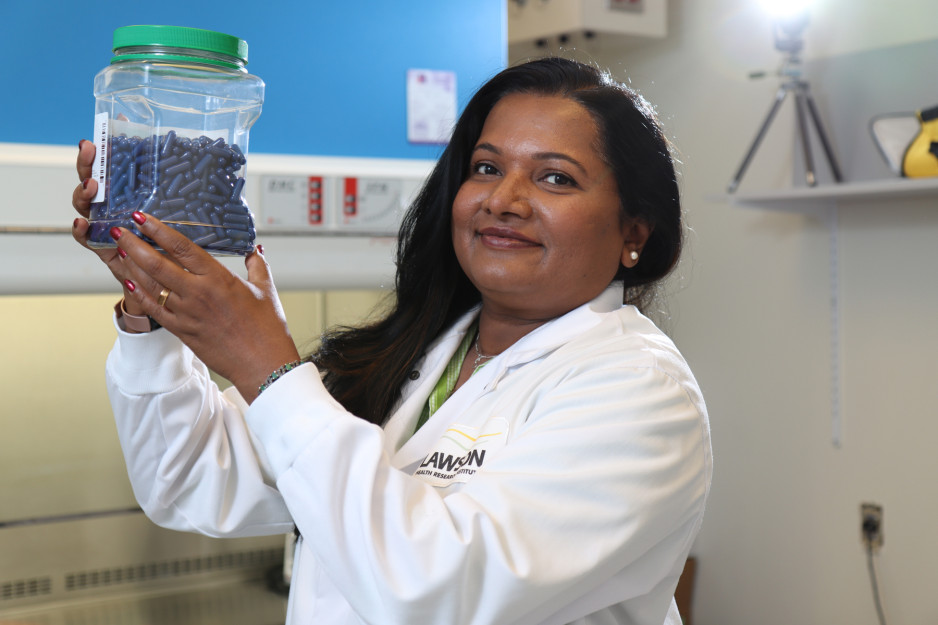
Description
Making waves in scientific and health care circles worldwide, it holds the potent potential to “jazz up” cells that attack cancer and boost the body’s response to treatment.
So what is this powerful ally? It’s poop in a pill – home-grown right here at St. Joseph’s Health Care London and Lawson Research Institute.
In fact, Lawson scientists Dr. Michael Silverman, Seema Nair Parvathy, PhD and their team are considered poop pill pioneers, having perfected the delivery of fecal transplantation by way of patient-friendly capsules that can be easily swallowed. These capsules contain healthy gut microbes that have become pivotal in many landmark cancer treatment studies.
Triggering an immune response
Understanding the role of poop in cancer treatment requires grasping the wonders of the human microbiome and its key role in influencing health and well-being.
The human microbiome consists of trillions of microorganisms that live inside and outside of the body, including bacteria, viruses and yeasts. While some bacteria are associated with disease, others are vital to the human immune system – the body’s main protective and disease-fighting tool – and many other aspects of health. Over the past decade, microbiome research has led to a revolution in medicine as scientists unravel just how an imbalance of these microorganisms interferes with many aspects of good health.
"(Fecal microbial transplants) allows us to harness the immune system to mount a stronger defence." Dr. Michael Silverman
The goal of fecal microbiota transplants (FMT) is to transfer healthy gut microbes from donors into patients with cancer and other diseases so that healthy bacteria will colonize in the patient’s gut and improve the microbiome, explains Silverman, Medical Director of St. Joseph’s Infectious Diseases Care Program and citywide Chief of Infectious Diseases for London’s hospitals.
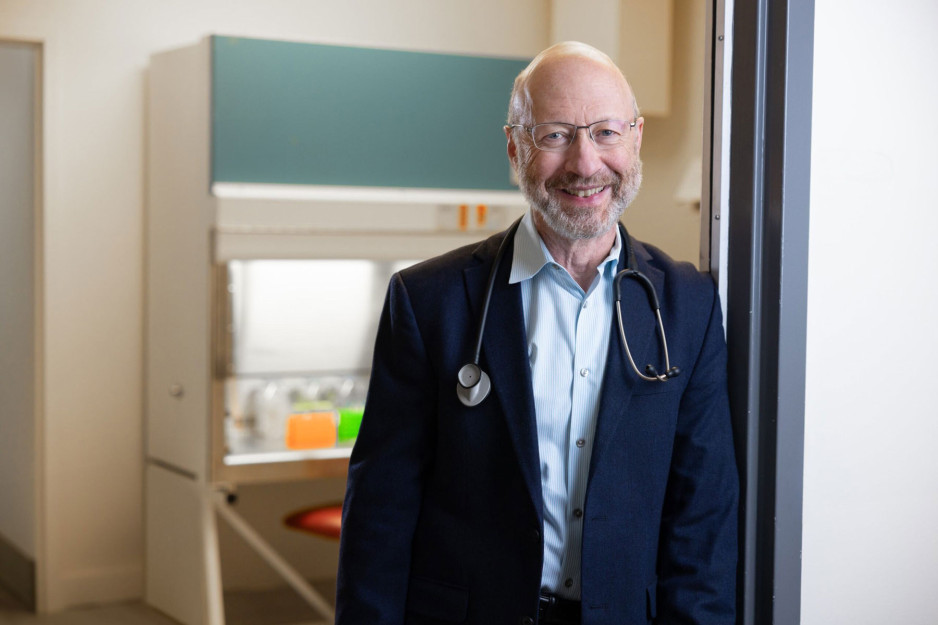
To do so, stools are collected from carefully screened healthy donors, prepared in a lab into capsule format, and introduced into a patient’s gastrointestinal tract.
“What is so exciting when it comes to cancer treatment is the evidence we now have showing how a healthy microbiome activates the immune response to tumours to make the treatment more effective,” Silverman adds. “It allows us to harness the immune system to mount a stronger defense.”
St. Joseph’s capsules are central to several significant studies currently underway aimed at improving treatment for lung, kidney, breast, renal, pancreatic and other cancers.
Among the most notable is the London team’s lead role in a ground-breaking national study – one of the world’s largest randomized controlled clinical trials using FMT to improve the effectiveness of the standard of care for advanced melanoma, a type of skin cancer.
Improving melanoma survival rates
About 11,300 Canadians will be diagnosed with melanoma in 2024 and, even with standard treatment, about half that number will experience disease progression and die.
The 16-site Canadian trial builds off the work of Silverman, Parvathy and their team, in partnership with Saman Maleki, PhD, and Dr. John Lenehan at London Health Sciences Centre. Together, they were the first to demonstrate the safety and therapeutic potential of using the capsules produced at St Joseph’s to influence a patient’s gut microbiota to enhance immunotherapy and increase the odds of surviving advanced melanoma.
“London is seen as having the most expertise in use of FMT in cancer care in the world and is a driving force in moving this forward,” says Silverman. “Immunotherapy is rapidly expanding the number of treatable cancers and our FMT therapy is helping to accelerate this progress.”
… Asst. Are you able to meet all of the research space requirements of this position within your program’s existing … space? Are you able to meet all of the research space requirements of this position within your program’s existing … Educator or Scientist, does the candidate meet the specific requirements of that category: Yes No Clinical Service …
Position Request / Candidate Review Impact Summary Form Please retain a copy of this form when you submit for a position request so that it can be used when submitting the candidate information. PART A POSITION REQUEST INFORMATION (Complete PART A when submitting a request for a position) PART B CAN...
… Asst. Are you able to meet all of the research space requirements of this position within your program’s existing … space? Are you able to meet all of the research space requirements of this position within your program’s existing … Educator or Scientist, does the candidate meet the specific requirements of that category: Yes No Clinical Service …
Position Request / Candidate Review Impact Summary Form Please retain a copy of this form when you submit for a position request so that it can be used when submitting the candidate information. PART A POSITION REQUEST INFORMATION (Complete PART A when submitting a request for a position) PART B CAN...
… Asst. Are you able to meet all of the research space requirements of this position within your program’s existing … space? Are you able to meet all of the research space requirements of this position within your program’s existing … Educator or Scientist, does the candidate meet the specific requirements of that category: Yes No Clinical Service …
Position Request / Candidate Review Impact Summary Form Please retain a copy of this form when you submit for a position request so that it can be used when submitting the candidate information. PART A POSITION REQUEST INFORMATION (Complete PART A when submitting a request for a position) PART B CAN...
… Asst. Are you able to meet all of the research space requirements of this position within your program’s existing … space? Are you able to meet all of the research space requirements of this position within your program’s existing … Educator or Scientist, does the candidate meet the specific requirements of that category: Yes No Clinical Service …
Position Request / Candidate Review Impact Summary Form Please retain a copy of this form when you submit for a position request so that it can be used when submitting the candidate information. PART A POSITION REQUEST INFORMATION (Complete PART A when submitting a request for a position) PART B CAN...
… Asst. Are you able to meet all of the research space requirements of this position within your program’s existing … space? Are you able to meet all of the research space requirements of this position within your program’s existing … Educator or Scientist, does the candidate meet the specific requirements of that category: Yes No Clinical Service …
Position Request / Candidate Review Impact Summary Form Please retain a copy of this form when you submit for a position request so that it can be used when submitting the candidate information. PART A POSITION REQUEST INFORMATION (Complete PART A when submitting a request for a position) PART B CAN...
… Asst. Are you able to meet all of the research space requirements of this position within your program’s existing … space? Are you able to meet all of the research space requirements of this position within your program’s existing … Educator or Scientist, does the candidate meet the specific requirements of that category: Yes No Clinical Service …
Position Request / Candidate Review Impact Summary Form Please retain a copy of this form when you submit for a position request so that it can be used when submitting the candidate information. PART A POSITION REQUEST INFORMATION (Complete PART A when submitting a request for a position) PART B CAN...
… Asst. Are you able to meet all of the research space requirements of this position within your program’s existing … space? Are you able to meet all of the research space requirements of this position within your program’s existing … Educator or Scientist, does the candidate meet the specific requirements of that category: Yes No Clinical Service …
Position Request / Candidate Review Impact Summary Form Please retain a copy of this form when you submit for a position request so that it can be used when submitting the candidate information. PART A POSITION REQUEST INFORMATION (Complete PART A when submitting a request for a position) PART B CAN...
… Asst. Are you able to meet all of the research space requirements of this position within your program’s existing … space? Are you able to meet all of the research space requirements of this position within your program’s existing … Educator or Scientist, does the candidate meet the specific requirements of that category: Yes No Clinical Service …
Position Request / Candidate Review Impact Summary Form Page 1 April 2019 Position Request / Candidate Review Impact Summary Form Please retain a copy of this form when you submit for a position request so that it can be used when submitting the candidate information. PART A POSITION REQUEST INFORMA...
… Asst. Are you able to meet all of the research space requirements of this position within your program’s existing … space? Are you able to meet all of the research space requirements of this position within your program’s existing … Educator or Scientist, does the candidate meet the specific requirements of that category: Yes No Clinical Service …
Position Request / Candidate Review Impact Summary Form Please retain a copy of this form when you submit for a position request so that it can be used when submitting the candidate information. PART A POSITION REQUEST INFORMATION (Complete PART A when submitting a request for a position) PART B CAN...
… Listed under public events by date System requirements include: Hardware Requirements: • Pentium III, or higher-level computer, at … (strongly recommended - clearly audible) Software Requirements: Windows Operating System - • Vista, XP - with … Listed under public events by date System requirements include: Hardware Requirements: • Pentium III, …
Geriatric Interdisciplinary Grand Rounds Date: Thursday, April 6, 2017 Location: Parkwood Auditorium, Time: 8:00 a.m. 9:00 a.m. Parkwood Institute Topic: Factors associated with the care transition of older adults discharged from the inpatient Geriatric Rehabilitation Unit and the Musculoskeletal U...
CARING FOR THE BODY, MIND & SPIRIT SINCE 1869 Renowned for compassionate care, St. Josephs is one of the best academic health care organizations in Canada dedicated to helping people live to their fullest by minimizing the effects of injury, disease and disability through excellence in care, teachin...
… those described above. If you had placements and / or requirements that were negatively impacted by the COVID-19 … consideration on a case-by-case basis. However, the minimum requirements described above and for each Track (please see … referees directly for further information. As per APPIC requirements, all letters of reference are to use the …
CPA Accredited Member of APPIC & CCPPP Clinical Psychology Residency CONSORTIUM Predoctoral Residency in Clinical Psychology 20222023 Your guide to predoctoral training in clinical psychology within one of Canadas leading CPA accredited residency programs Clinical Psychology Residency CONSORTIUM Lon...
… judgement |_| |_| 10.0 Satisfaction of the College’s requirements for continuing medical education |_| |_| 11.0 … judgement |_| |_| 10.0 Satisfaction of the College’s requirements for continuing medical education |_| |_| 11.0 …
PRELIMINARY PROBATIONARY EVALUATION FORM PROFESSIONAL STAFF ASSOCIATE MEMBERS Probationary Staff Member: Department: Probationary Start Date: Supervisor: Satisfactory Unsatisfactory 1.0 Clinical competence |_| |_| 2.0 Appropriate use of Hospital resources |_| |_| 3.0 Ability to work and relate t...
Prevention and Awareness: Delirium
8:00pm - 9:00pm
You are invited to the first in a series of Research Bites,. These informative and interactive talks will focus on specific illnesses, their prevention and related research being conducted by researchers in London, Ontario.
Topic: Prevention and Awareness: Delirium
Image

Dr. O'Regan will share about delirium and what it means, and provide highlights of her ongoing research happening locally. She will also be speaking about how to recognize delirium in a loved one and what to do in this scenario, as well as the steps you can take to help prevent it.
Date: Thursday, January 24, 2019
Time: 4 - 5 pm
Location: Parkwood Institute, Mental Health Building, Auditorium (F2-235)
550 Wellington Road South
London, Ontario N6C 0A7
Maps and Directions for Parkwood Institute.
Parking: The lot rate is $4.00 when you enter. $1 and $2 coins and credit card accepted (press the start button then insert payment)
Registration is required and spots will fill up quickly.
Click here to register.
These talks are hosted by Parkwood Institute Research, a program of Lawson Health Research Institute.
Primary Care Diabetes Support Program: What health care professionals can expect Effective diabetes management requires that patients have access to an ongoing course of self- care support, which is critical to enable them to effectively manage their disease and prevent its devastating complications...
Prime Minister announces support for health research
Health researchers in London and across Canada welcomed news that the federal government will provide urgently-needed financial support for research teams whose work has been largely shut down by the COVID-19 pandemic.
Prime Minister Justin Trudeau has announced $450 million in new funding to help Canada’s academic research community during the COVID-19 pandemic.
“Research staff in Canada are the source of new innovations and ideas that help keep us healthy, protect our environment, and drive our economy. We are fortunate to have some of the world’s brightest minds. We are making sure Canadian universities and health research institutes have the support they need to sustain their research capacity through this difficult situation, and continue to attract and retain talent, for the benefit of all Canadians,” says The Rt. Hon. Justin Trudeau, Prime Minister of Canada.
The investment will:
- Provide wage supports to universities and health research institutes, so they can retain their research staff who are funded from industry or philanthropic sources and are unable to access some of the government’s existing COVID-19 support measures. This would apply even if their work has been temporarily suspended. The government will provide up to 75 per cent per individual, with a maximum of $847 per week.
- Support universities and health research institutes to maintain essential research-related activities during the crisis, and to ramp back up to full research operations once physical distancing measures are lifted. This will cover up to 75 per cent of total eligible costs, and will support activities such as the safe storage of dangerous substances and restarting data sets that were interrupted during the pandemic.
“Research personnel in our universities and health research institutes are significant drivers of science, discovery, and innovation in Canada. By providing these institutions with immediate support, we continue to nurture Canada’s talent pipeline and sustain our innovation capacity, while helping to mitigate the negative impacts of COVID-19 on the research community,” says The Hon. Navdeep Bains, Minister of Innovation, Science and Industry.
This announcement follows a tremendous effort by organizations and individuals across Canada over the course of this pandemic to secure support for hospital-based research. From outreach and meetings to letters and media interviews, many advocacy-based initiatives were undertaken to bring this important issue to the attention of key decision-makers. HealthCareCAN spearheaded these efforts, working tirelessly on behalf of the national health research community.
Lawson is extremely thankful to the federal government for recognizing the critical importance of protecting Canada’s research enterprise and providing urgently-needed financial support. “While we know financial pressure remains, this will help to keep research teams intact while research has been interrupted and provide assistance for when research activities gradually resume,” says Dr. David Hill, Lawson Scientific Director.
A special thank you to local MP Peter Fragiskatos for London North Centre who took up this issue in Ottawa. His strong leadership and representation made the key difference in successfully securing this new funding.
“Tackling the COVID-19 crisis in Canada has required an all-hands on deck approach and Canada’s health researchers have answered the call by suspending all other crucial hospital-based research to meet the challenge,” adds Dr. David Hill. “With this federal support we can now work to ensure that we can maintain other critically needed research on other diseases even as we pursue what promises to be a lengthy battle against COVID-19.”
Background:
- Canadian healthcare-based research is a $3 billion annual sector of the economy and employs 50,000 highly skilled researchers and other staff across the country.
- Health research is one of Canada’s great national achievements and biomedical research conducted in Canada is at the forefront of current essential research and clinical trials around COVID-19.
- This work is fundamental to life in a society and a key driver for progress, innovation and the economy. Canada’s health researchers are global leaders in driving improvements in disease prevention, diagnosis, treatment and care.
- Ontario’s research hospitals have long been the engines of health invention and discovery in provincial and national innovation. From Ottawa, London, Toronto, Kingston, Sudbury and Thunder bay, the more than 20,000 researchers and staff at these hospitals are driven by their passion to improve health.
See also:
- Prime Minister announces support for research staff in Canada – Government news release
- Canada’s health research enterprise welcomes federal support – HealthCareCAN media release
- OHA Media Statement re: Federal Government Supporting Ontario’s Hospital-Based Research Enterprise
Scientist