


Search
Search
2527 Search Results:
When connections break down
In Ontario alone, an estimated 285,000 individuals currently live with some form of neurodegenerative disorder. This includes Alzheimer’s Disease, Parkinson’s Disease, mild cognitive impairment, dementia and movement disorders.
The experiences and symptoms for each person vary, but they share a progressive decline in their cognitive and motor function. It can affect their ability to work, socialize and live independently.
As our population ages, there is an urgent need to understand markers that will predict decline and identify targets for therapy that might improve long-term function and outcomes.
This is where hospital-based research can make a real difference.
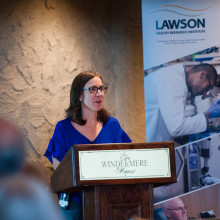
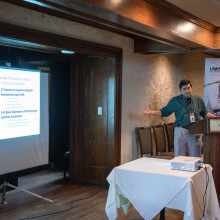
On June 21, 2018, Lawson Health Research Institute hosted Café Scientifique, a community event highlighting the groundbreaking and specialized research on neurodegenerative diseases happening right here in London.
Moderated by Lawson researcher Dr. Arlene MacDougall, a panel of three expert Lawson scientists shared their unique perspectives as both clinicians and researchers, and how the knowledge we are gaining is being applied to improve health and health care for people here and around the world.
Watch the video from the event featuring the three talks from our experts.
Café Talks
Back to the beginning: Targeting early markers for Alzheimer’s Disease
By Dr. Jennie Wells
Time stamp: 5 minutes
Dr. Wells is the Medical Care Coordinator for Geriatric Rehabilitation at St. Joseph's Health Care London's Parkwood Institute, and Chair of the Division of Geriatric Medicine and associate professor in the Department of Medicine at Western Univeristy’s Schulich School of Medicine. Her clinical and research interests are Alzheimer’s Disease and Geriatric Rehabilitation. She has particular interest in Mild Cognitive Impairment (MCI) and the potential for non-drug interventions, such as exercise and nutrition to slow progression of dementia. She is a principal site investigator in randomized controlled trials of new drugs to treat dementia, MCI, and Subjective Cognitive Impairment (SCI).
Highlights:
- What causes dementia?
- How early do changes happen in the brain before symptoms even appear?
- What is the single best diet approach for a healthy body and mind?
- How does exercise keep your brain healthy?
Image

Neuroinflammation and dementia: The old and the new
By Dr. Elizabeth Finger
Time stamp: 24 minutes
Dr. Finger, a neurologist at St. Joseph's Parkwood Institute, received her MD from Cornell University. She completed an internship in Internal Medicine at Massachusetts General Hospital, followed by residency in Neurology at Massachusetts General Hospital and Brigham and Women's Hospital in Boston. Her research focuses on understanding the cognitive, neural, and genetic substrates of abnormal decision-making, emotion and social behavior. Using a variety of different diagnostic techniques and modalities, the research program investigates the cognitive and neural systems affected in patients with Frontotemporal Dementia, related disorders and their at-risk family members.
Highlights:
- Do anti-inflammatory medications reduce the risk of dementia or slow the rate of decline?
- How do genes related to the immune system increase the risk of developing dementia and Alzheimer’s Disease?
- What about the effects from dysfunction of the brain’s own immune system?
- Do conditions or events causing systematic inflammation (surgery, infection, auto-immune diseases) also increase neuroinflammation which can lead to dementia?
Image
New Frontiers in the Treatment of Parkinson’s Disease: Addressing the unmet needs
By Dr. Mandar Jog
Time stamp: 45 minutes
Dr. Jog is a Lawson researcher, Director of the National Parkinson Foundation Centre of Excellence at LHSC, Director of the Movement Disorders Centre in London and Professor of Neurology at Western University. His research interests include topics such as motor control, neurophysiology and computational modeling, multichannel recording and web-based teaching of movement disorders. Dr. Jog has a passion for clinical and scientific innovation and holds numerous patents that are reaching commercialization with strong collaboration with university technology transfer and industry partners.
Highlights:
- How do clinician researchers take questions from the bedside and solve them at the bench using technology in order to treat movement disorders?
- How can wearable technology be used to detect movement disorders and monitor for optimized treatment – remotely from anywhere in the world?
- How can we use machine-guided sensors for personal diagnostics and therapy for essential tremors and Parkinson’s Disease?
- How can spinal cord stimulators improve movement and gait for patients, including those previously using wheelchairs and scooters?
Image
Did you miss the event? Add your email address to our Café Scientifique invite list so that you’ll be the first to know when the next event takes place.
Sign up here.
Go to Lawson’s Facebook page to see photos from the event.
Scientist
Wide range of research showcased at Parkwood Institute Research's 2017 Spring Update
Lawson researchers at Parkwood Institute, part of the St. Joseph’s Health Care London family, work to improve both physical and mental health care based on the understanding that conditions of the body and mind are integrally linked. From studies on mobility after brain and spinal cord injury to treatment-resistant depression, a range of different research areas were highlighted on April 21, 2017 at Parkwood Institute Research’s 2017 Spring Update Half-Day event.
Parkwood Institute Research is a Lawson program that represents inter-disciplinary clinical research. At the second annual Spring Update event celebrating this work, attendees learned about research from across Parkwood Institute’s three core research themes: Cognitive Vitality & Brain Health, Mobility & Activity, and Mental Health Care. New this year was the addition of poster presentations, which provided another opportunity for researchers and trainees to promote and share their work.
Learn more about the work Lawson scientists at Parkwood Institute presented at the event:
Cognitive Vitality & Brain Health
Dr. Stephen Pasternak was one of the presenters in the Cognitive Vitality & Brain Health theme. Dr. Pasternak and his team are conducting a phase 2 randomized controlled trial looking at whether a European over-the-counter cough medicine, Ambroxol, could also treat Parkinson’s Disease Dementia (PDD).
“There are currently no effective treatments for cognitive impairment experienced by PDD patients. Existing treatments only treat the symptoms of Parkinson’s disease, but do not stop the disease process itself,” says Dr. Pasternak.
Parkinson’s disease is believed to be caused by the buildup of a protein called alpha-synuclein in the brain. Ambroxol increases the levels of an enzyme called β-Glucocerebrosidase (GCase), which has been shown to reduce the buildup of alpha-synuclein in animal and cell cultures models, suggesting that this could be used as a treatment for PDD.
This trial is well underway and the first participants have completed the first year of treatment. If successful, this trial will be the first to demonstrate that it is possible to change the underlying cause of PDD.
Mobility & Activity
As part of the Mobility & Activity themed presentations, Dr. Dalton Wolfe discussed an initiative supported by the St. Joseph’s Health Care Foundation and Ontario Neurotrauma Foundation to help improve mobility in patients with acquired brain and spinal cord injuries.
Called the Parkwood Program for Rehabilitation Innovations in Movement Enhancement (PRIME), a key goal of this initiative is to develop and implement a clinical decision support system that integrates approaches to activity-based therapy. Clinicians, researchers, administrators and IT specialists have combined their efforts to initiate development on this system.
“PRIME will provide recommendations for treatment based on patients’ injury level and type, and clinical characteristics,” says Dr. Wolfe. “It will also have suggestions for what to monitor for each patient to challenge them to optimize recovery, as well as to reduce risk of injury or secondary complications.”
This system will also enable electronic tracking of practices and outcomes, moving away from the current paper-based model and creating a practice-based research platform.
Mental Health Care
Dr. Amer Burhan presented his research on Transcranial Magnetic Stimulation (TMS) in the Mental Health Care portion of the presentations. TMS is a non-invasive method that uses magnetic fields to stimulate nerve cells in the brain. An electromagnetic coil is held against the head and short magnetic pulses are administered, causing a change in activity level in specific targeted areas and allowing for a study of the function and interconnectivity of the brain. The method has been approved to treat depression resistant to medications and has potential to be used to treat other mental and neurological disorders.
Dr. Burhan’s talk focused on the effectiveness of a certain type of TMS, bilateral theta-burst stimulation, in treating patients with depression who are not responsive to medication. This is a new method of TMS that is designed to facilitate change in brain activity and connectivity more efficiently. He presented preliminary results on the first 60 patients treated with this method. So far the treatment has resulted in significant improvement in over half of the patients.
“More studies are planned to understand predictors of response and facilitate individualized selection of treatment for patients struggling with this very disabling illness,” says Dr. Burhan.
Scientist
Women with complications after pelvic mesh implants at increased risk of depression and suicide
Dr. Blayne Welk, a urologist at St. Joseph’s Health Care London, noticed that some of his patients were experiencing depression and other issues following complications related to pelvic mesh-based slings.
“A lot of patients were very emotional telling their story,” notes Dr. Welk.
“They told me about a lot of frustrations related to treatment options for complications. A lot of patients manage for years with problems and didn’t know the source of the issue, or that there is something that can be done to address it. Unfortunately, there are some cases where we can’t fix all the complications, but there are things that we can do to improve the situation. I think a lot of women get frustrated along the journey of finding that solution.”
Image

Dr. Welk is also an adjunct scientist with ICES, associate scientist at Lawson Health Research Institute and assistant professor at Western University’s Schulich School of Medicine & Dentistry. Following his observations in the clinic, he led a research project to study the impact of the complications some women were facing.
“There have been regulatory warnings and lawsuits related to significant transvaginal mesh complications. We wanted to quantify the serious psychological complications that can occur in women as a result of complications from transvaginal midurethral slings,” said Dr. Welk.
Complications are rare but when they happen they can be difficult and challenging to fix, as well as quite impactful for patient lives. They can experience chronic pain, new or changing urinary symptoms and erosions where some of the mesh becomes exposed in surrounding tissue.
To determine whether women who experience midurethral sling mesh complications requiring surgical intervention have an increased risk of depression or self-harm behaviour, Welk's team tracked the number of Ontario women who needed a follow-up surgery to remove or fix a mesh implant and if they received treatment for depression or self-harm. The study, published in the journal JAMA Surgery, included almost 60,000 women who had the procedure January 2004 through December 2015.
The researchers found that 2. 8 per cent (1586 women) underwent a surgical procedure for a mesh complication. Of those women, 11 per cent (175 women) were treated for depression compared to eight per cent of women (4,470) who didn’t have corrective surgery. Of the women who needed corrective surgery, 2.77 per cent of women suffered from self-harm behaviour compared to only 1.15 per cent of women who did not need corrective surgery. These risks were highest in younger women, in particular those 46 years old and younger.
“Younger women are the ones who are most at risk of these mental health complications. We suspect that’s because of a stronger negative association between the complications and intimacy among this age group. They are also more likely to still be working full-time and raising children.”
The study reinforces some of the consequences that can occur from slings, and that those can be quite serious.
“It is important to note that a lot of women are going into these operations to improve their quality of life. It’s not necessarily a dangerous condition when you have stress incontinence. There is a decision made to treat it. I think that in those rare cases when someone does experience severe complications, it can lead to decisional regret.”
There is often not an easy solution, with patients often requiring multiple different therapies to address the complications. This can include pain management, surgery, consultations with pain specialists and psychological support along the way. In some cases, removing the mesh does not resolve the pain and it can be very difficult to identify which individuals will benefit from what therapy, including surgery, notes Dr. Welk.
The researchers add that when women experience midurethral sling complications, both they and their surgeons should be aware of the potential serious psychological impact of these complications.
Author block: Blayne Welk, Jennifer Reid, Erin Kelly, You (Maria) Wu.
Scientist
Work with Us: Scientist Opportunities
Current Scientist Opportunities
Find other career opportunities with Lawson Research Institute posted in St. Joseph's Careers portal.
… World Day of the Sick February 11, 2022 St. Joseph’s Health Care London Theme: “Be merciful, even as your Father is merciful”. (Luke 6:36) Standing beside those who suffer on a path of charity. Gathering Hymn Healer of Our Every Ill - Instrumental Welcome Richard Corneil CEO, St. Joseph’s Health …
World Day of the Sick February 11, 2022 St. Josephs Health Care London Theme: Be merciful, even as your Father is merciful. (Luke 6:36) Standing beside those who suffer on a path of charity. Gathering Hymn Healer of Our Every Ill - Instrumental Welcome Richard Corneil CEO, St. Josephs Health Care So...
World Labyrinth Days highlight how this form of ‘walking meditation’ can benefit everyone
Following a labyrinth is a spiritual practice that’s good for body, mind and spirit.
It leads to increased calm, reduced blood pressure and stress, and improved mental health and well-being, say researchers and patient care experts at St. Joseph’s Southwest Centre for Forensic Mental Health Care (Southwest Centre).
On World Labyrinth Days - May 3 and May 4, staff, patients and residents at St. Joseph’s are invited to join thousands across the globe who “walk as one at 1 pm.”
While books and movie culture often show labyrinths as places where people get hopelessly lost, ground-breaking studies conducted through Lawson Health Research Institute show labyrinths can be just the opposite: they’re places people can find hope and find themselves.
Unlike mazes that are puzzles with many choices and many dead ends, labyrinths have continuous lines that lead to and from the centre.
“Walking a labyrinth is a form of walking mediation,” says Rev. Stephen Yeo, spiritual care practitioner at Southwest Centre and a Lawson researcher. “It is a wonderful way to look after one’s body, mind and spirit. It is a very inclusive practice, regardless of how you engage the sacred in your life and in the world.”
There are two permanent labyrinths at Southwest Centre – one indoors and one outdoors. In addition, this spiritual tradition is available at all St. Joseph’s sites. The Parkwood Institute Mental Health Care Building has an indoor labyrinth in the Multifaith Room and an outdoor labyrinth as well—all of them suitable for people who walk or wheel.
In addition, Mount Hope and St. Joseph’s Hospital each have finger labyrinths available for meditation in their multifaith rooms. Other labyrinth opportunities exist across sites including an opportunity to walk a portable labyrinth at the Parkwood Institute Main Building in the Multifaith Room every Friday at noon.
Southwest Centre in Elgin County also has a portable labyrinth, with lines painted on canvas, that’s often used at other locations. “Have labyrinth, will travel,” Stephen quips.
For nearly a decade, he has facilitated walking labyrinths at Southwest Centre with larger groups during seasonal times of solstice and equinox, as a purposeful step that’s also part of truth and reconciliation practices with Indigenous peoples.
“While it may be world labyrinth day this weekend, it’s labyrinth day here at Southwest Centre regularly as something that’s incorporated into our care and practice,” Stephen says.
The research team’s work examining the benefits of labyrinth-walking in a forensic mental health care setting has been cited globally.
Says principal investigator Clark Heard, “I see significant benefit in labyrinth-walking in settings such as mental health care facilities, although I would stress that these benefits could also be generalized to any participant in a community setting.”
“Walking a labyrinth is a regenerative and restorative experience that helps people connect with the personally sacred,” says Clark, who is an occupational therapist at Southwest Centre and is an Associate Scientist at Lawson.
They promote self-care, hope, resilience and coping. They help connect people to the spiritual side of themselves and to relationships sacred to ourselves and the environment.
“Our team’s work identified that labyrinth participation can support meaning-making in the most difficult of circumstances, while at the same time making room for important aspects of mental wellness such as the quest for hope and search for meaning,” Clark says.
Stephen first walked a labyrinth three decades ago during a retreat at a monastery in Winnipeg. It became part of his regular practice of engaging the sacred in his life, and he is now a certified labyrinth facilitator.
“A labyrinth is so simple that you don’t need someone to lead you through. Whether it's facilitated or not, a person inevitably benefits from walking one,” he says.
… YOur guide to Breast assessment Breast Care Program St. Joseph’s Hospital 268 Grosvenor St. London, ON N6A 4V2 … YOur guide to Breast assessment Breast Care Program St. Joseph’s Hospital 268 Grosvenor St. … Your Guide to Breast Assessment …
YOur guide to Breast assessment Breast Care Program St. Josephs Hospital 268 Grosvenor St. London, ON N6A 4V2 THE BEST IN BREAST CARE The Breast Care Program at St. Josephs Health Care London provides a confidential, coordinated, specialized breast assessment service. The goal of the program is to m...