


First a name, then a story
Image
Image
Artifacts once used by health care workers at St. Joseph’s Hospital are being brought back into the spotlight. Today, they are part of an exhibit offering a glimpse into the people, places and experiences that shaped the hospital’s history.
Sometimes, something as simple as a name can lead to a much bigger story.
For Western University history student Ella Hopkins, this happened when she began researching Helen Janet Woolson for a university paper. While looking at primary sources, Hopkins came across a St. Joseph’s article about Woolson and reached out to retired St. Joseph’s eLearning developer and graphic designer Noelle Tangredi, who now volunteers with St. Joseph’s Hospital and School of Nursing Artifact Collection.
“I didn’t even know volunteering with Noelle was an option until she approached me with the opportunity, which I accepted immediately,” says Hopkins. “I’m a history major – my research interests are women’s history and medical history. The collection at St. Joseph’s combines both my interests.”
For Tangredi, having a new person involved marks a new chapter in work she has been completing for the past 10 years. During that time, she has researched, catalogued and cared for the collection, uncovering the stories behind the items preserved over the years.
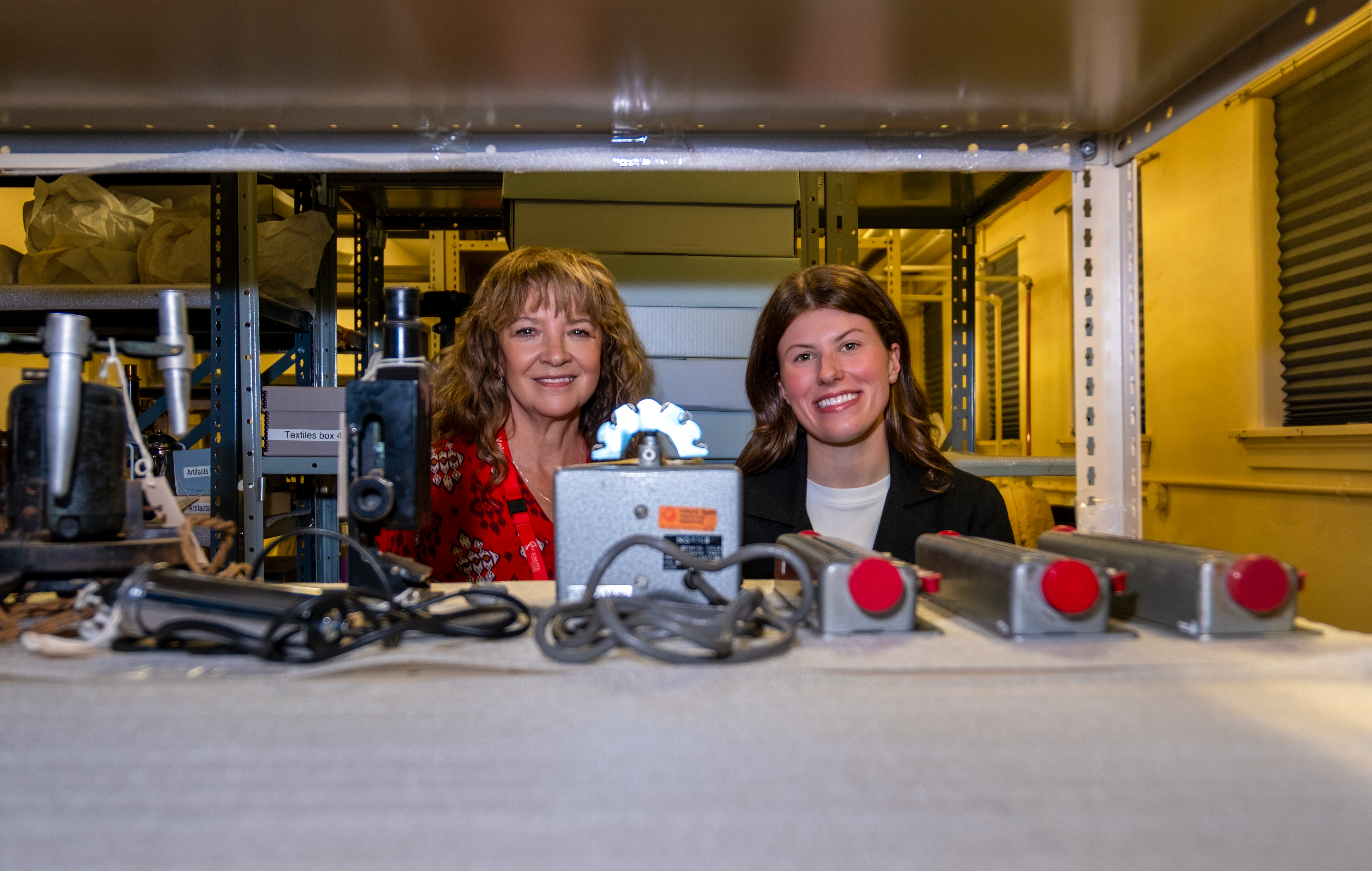
“The Sisters of St. Joseph entrusted us with much of the collection and former staff and nursing graduates have added their own treasured pieces over the years,” says Tangredi. “Continuing to volunteer with the collection feels like a way to honour that trust and continue sharing our history with staff and the wider community.”
Much of Tangredi’s research has taken her beyond the history of medical care and into the lives of the people who provided it. Recent research into nurses has connected St. Joseph’s with those who worked during the First and Second World Wars, including women who served overseas, in preparation for an upcoming exhibit.
Their contributions can be overlooked when wartime history is told through the better-known stories of soldiers, political leaders and major events. By finding their names, tracing their careers and learning more about their lives, Tangredi and Hopkins are helping bring these nurses back into the story.
“Personally, the most surprising part of working with artifacts is how much time you spend with each item,” says Hopkins. “I’ve had the chance to read through old textbooks for as long as I would like. I love getting to physically interact with items, figure out how they work, what they were used for and all the smaller details you don’t always pick up when viewing an exhibit.”
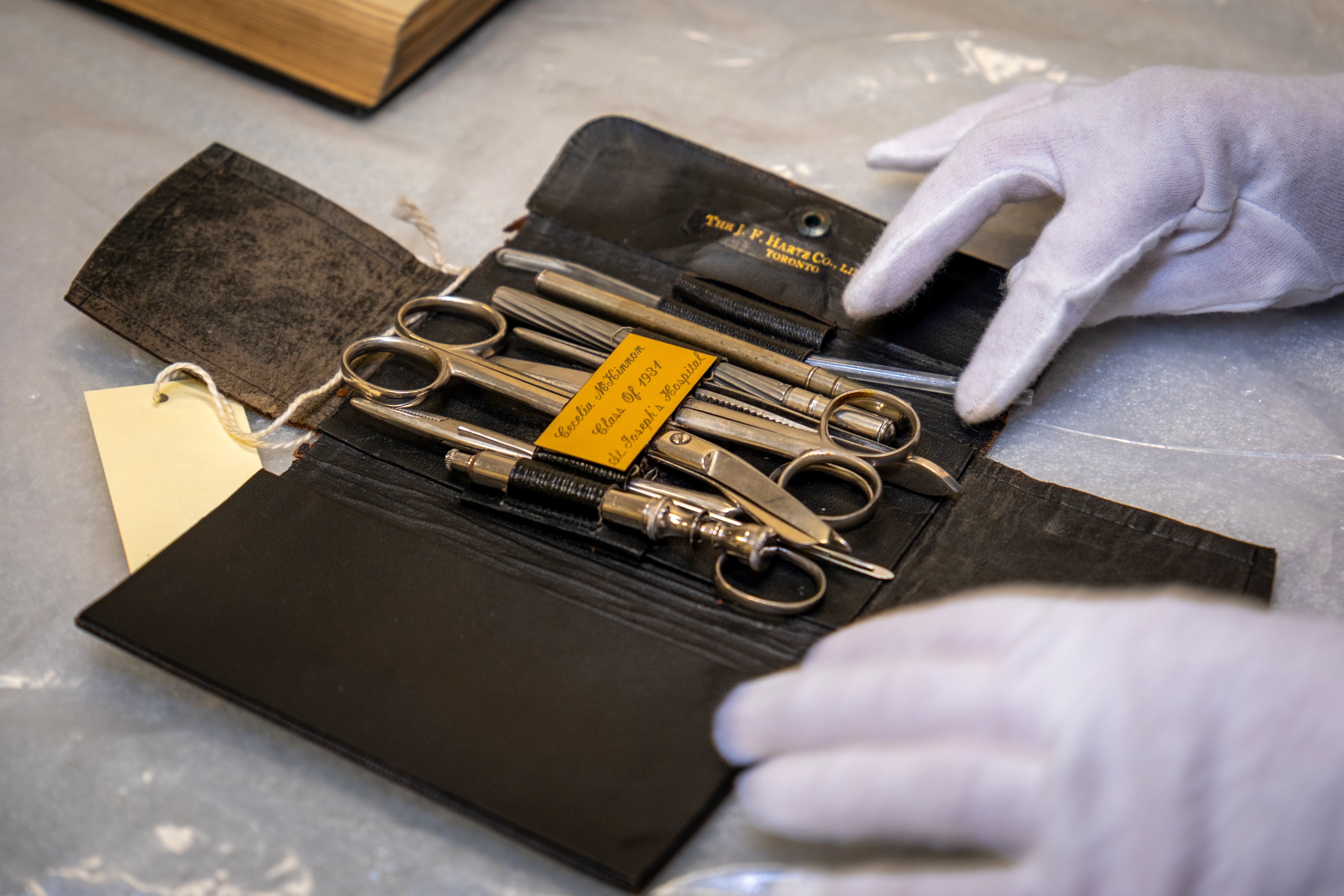
The first artifact Hopkins worked on was a home nursing kit belonging to Cecelia McKinnon, a member of the School of Nursing Class of 1931. Despite its name, the kits were used in hospital by graduate nurses and contained a standard set of commonly used instruments. Nurses were responsible for providing their own tools, with the expectation that the set would last throughout their careers.
“This was the item that made me so excited to keep volunteering, and I told anyone who would listen about it for weeks,” says Hopkins. “I’ve been able to practice skills I’ve learned in school, particularly primary research skills, and apply the knowledge I’ve gained through my degree.”
The current exhibit curated by Tangredi and Hopkins turns the collection’s focus toward the 1950s – a decade of significant growth and change at St. Joseph’s. As London’s population expanded following the Second World War and the baby boom, the hospital responded with major building projects, modernized facilities and a growing School of Nursing. The next exhibit, St. Joseph’s During Wartime, is coming mid-October.
“Those stories aren’t always just about who owned or used an object,” says Tangredi. “They can reveal moments of medical innovation, connections to London’s history, or even the unexpected journey of how an item found its way into our collection.”
The partnership between Hopkins and Tangredi has also given Hopkins the chance to learn from someone who has spent years with the collection, and reinforced the value of simply reaching out.
“Noelle is wonderful, she’s been so encouraging and patient with me as I’m learning, and accommodating of my work and school schedule,” says Hopkins. “It can be hard to find bridging opportunities from the classroom to the workplace. Volunteering gives students the chance to apply their knowledge in a professional setting while also learning from others already in their desired position.”
For the women whose names appear throughout the collection, that same work has another meaning. Research gives their stories a place in the history of St. Joseph’s and gives future generations the chance to know who they were.
Those coming to St. Joseph’s Hospital are welcome to view the history of St. Joseph’s while they are in the building. The exhibit space can be found in Zone A, Level 1, off the main corridor closest to the Richmond St. entrance.