

Helping the planet, one inhaler at a time
Prescription inhalers can be lifesavers for people with chronic breathing conditions such as
asthma and chronic obstructive pulmonary disease (COPD).
Ironically, though, many of these devices are not as healthy for the planet as they are for patients.
A recent study shows that metered-dose inhalers containing propellants called hydrofluoroalkanes (HFAs) contribute significantly to climate-changing pollution.
Now St. Joseph’s Health Care London, along with London Health Sciences Centre, is leading an initiative to help change that.
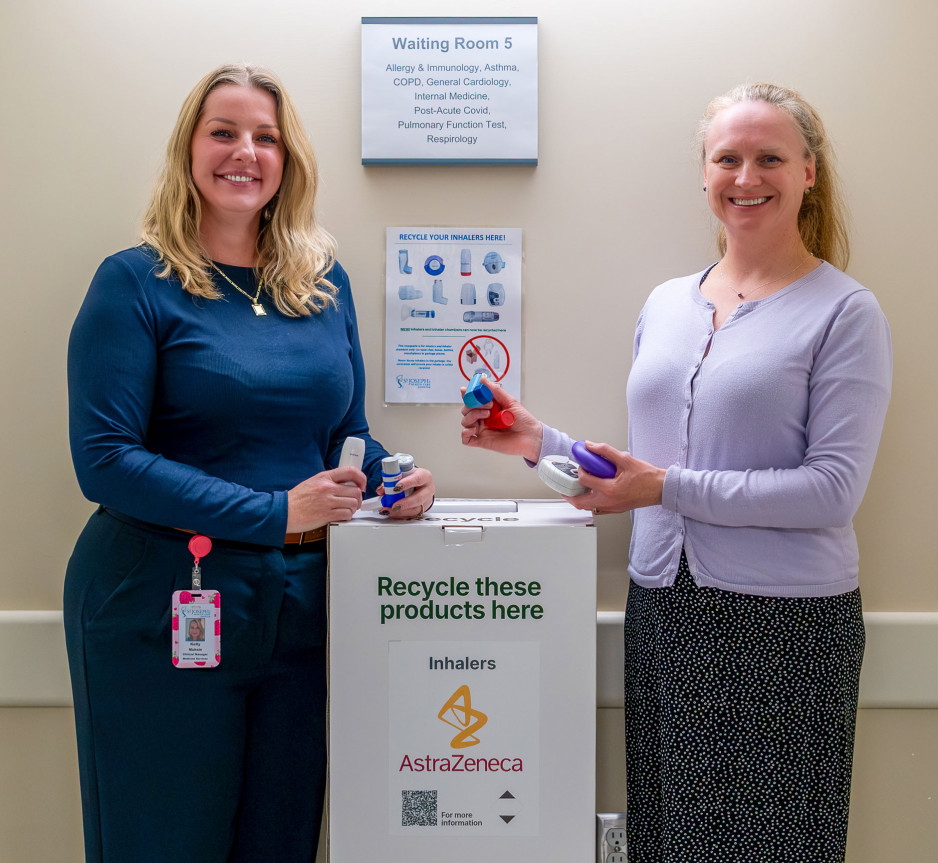
The Go Zero Recycle program (supported by pharmaceutical company AstraZeneca) collects and recyclesall types of inhalers and aerochambers, including recapturing the problematic propellant.
Drop-off boxes for used inhalers of all types are located at St. Joseph’s outpatient clinics.
“In 2024, St. Joseph’s and London Health Sciences Centre dispensed more than 53,000 inhalers, and close to 70 per cent of these are MDIs,” says St. Joseph’s respirologist Dr. Constance Mackenzie, who spearheaded the initiative locally.
These inhalers alone released carbon dioxide equivalents (CO2e) equal to a gas-powered car circling the Earth 96 times, she says.
“We’re not telling people to stop what’s working for them, and we definitely don’t want people to stop using their inhalers without an alternate treatment plan in place. At the same time, we want patients to know there might be other options that work as well or better for them and have a gentler environmental impact,” says respirologist Dr. Constance Mackenzie, who spearheaded the initiative locally.
Put another way, one 120-dose inhaler using HFAs can have the same environmental impact as a car trip from London to Toronto.
“Someone with asthma or COPD might need one or two of these inhalers each month,” Mackenzie notes. “Most people don’t know what to do with the inhalers once they are empty or left over after a change in prescription.”
These cartridges can still release greenhouse gases after they are discarded, so they should never be placed in household garbage or regular recycling. While they can be returned to a pharmacy for eventual incineration, this new recycling program offers a better alternative.
One study estimates two-thirds of inhaler medications prescribed globally use HFAs as a propellant. A US-based study published in the prestigious JAMA medical journal says 1.6 billion inhalers were dispensed in the US, from 2014 to 2024 alone, generating almost 25 million tonnes of CO2e -- equivalent to the annual greenhouse-gas impact from electrification of five million homes, the report says.
Non-propellant inhaler options
St. Joseph’s is taking an approach to reduce and recycle – and replace where appropriate.
“We’re not telling people to stop what’s working for them, and we definitely don’t want people to stop using their inhalers without an alternate treatment plan in place.” Mackenzie emphasizes.
“At the same time, we want patients to know there might be other options that work as well or better for them and have a gentler environmental impact.
Non-propellant options include types of inhalers containing dry powdered medicine or a mist released as tiny breathable particles when inhaled through the mouth.
The Canadian Thoracic Society supports sustainable inhaler prescribing, she notes. It also recommends shared education and decision-making about the best inhaler for patients, along with a co-ordinated systems approach by clinicians, patients, health organizations, regulators and manufacturers.
“We want to ensure sustainability and planetary health while we also improve patient health,” Mackenzie says.
“The recycling bin and posters have sparked a lot of conversation among the patients. I’ve also shared information with my colleagues about the amount of waste and greenhouse gases produced by inhalers, and it’s been a real eye-opener for everyone,” says St. Joseph’s clinical manager Kelly Muhsin. “I’m so pleased that we’ve included this initiative in our program – and that we have such a passionate champion in Dr. Mackenzie.”
-
St. Joseph's Lung Diseases Program
St. Joseph’s Lung Diseases Program provides a full spectrum of assessment, care and education for patients who have a respiratory disease.
With a focus on optimal function, wellness and prevention, our team of specialists helps everyone breathe a little easier for improved quality of life.