


The journey to where you’re meant to be
For Cassandra Fisher, identifying and addressing gaps in the health care system has shaped her entire career. Her current role as Clinical Manager of the Trauma and Violence Specialized Primary Care Program (TVSPCP) at St. Joseph’s Health Care London (St. Joseph’s) represents the realization of a long-held vision shared with colleagues. What is now a growing program serving more than 100 individuals began as an idea to better support some of London’s most vulnerable communities.
A mental health professional by training, Fisher has spent her career focused on improving care for marginalized populations. She spent nearly 15 years at London InterCommunity Health Centre, where she became deeply aware of the daily barriers people face in accessing care.
“The resiliency within this population is truly inspiring, and it should motivate us as providers to go the extra mile,” says Fisher. “That’s where my interest in systemic change really began.”
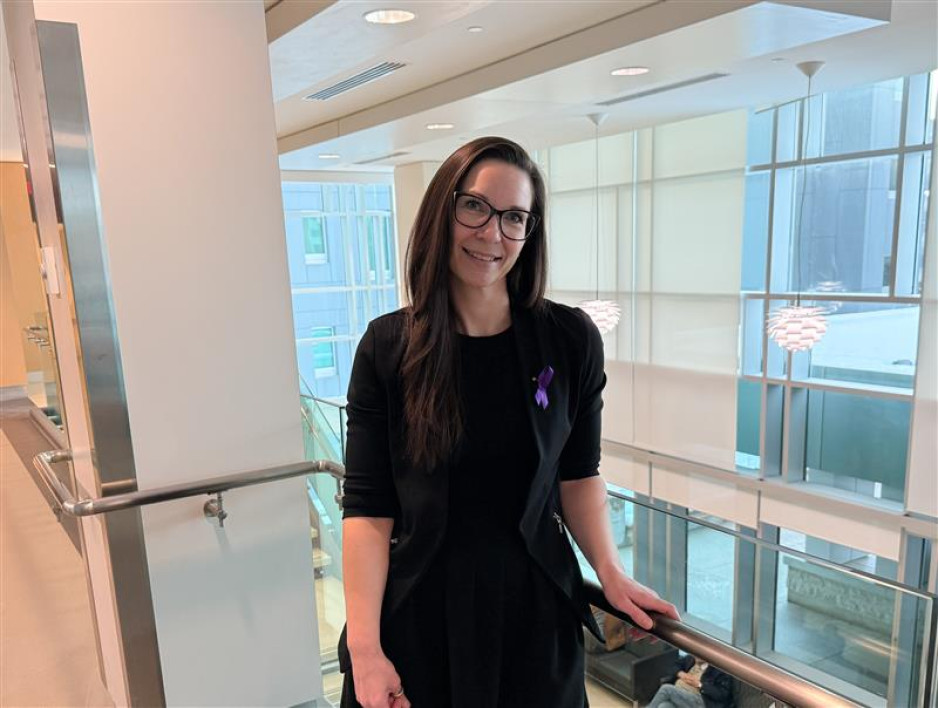
When Fisher joined St. Joseph’s in 2016 as a clinical manager, she quickly formed a strong connection with Dr. Susan McNair, Medical Director of St. Joseph’s Regional Sexual Assault and Domestic Violence Treatment Program (SADVTP), the TVSPCP, and a family physician at St. Joseph’s Family Medical and Dental Centre.
“When I met Dr. McNair, it was one of those moments where two souls from different universes meet,” says Fisher.
Their early conversations revealed a shared concern: patients with complex trauma were struggling to access consistent primary care. McNair saw an unmet clinical need, while Fisher had witnessed how under-resourced community clinics were unable to meet rising demand.
As Fisher’s work at St. Joseph’s evolved, she noticed many patients cycling repeatedly through hospital programs, often while remaining on waitlists.
“I started asking why this was happening,” she says. “It became clear that many simply didn’t have access to primary care.”
Data reinforced her observations. In 2024, 51 per cent of patients presenting to the SADVTP did not have a primary care provider. The same was true for 26 per cent of the 300 most frequent users of St. Joseph’s Urgent Care Centre, and more than half of patients in the Infectious Diseases Care Program.
Looking closer, Fisher identified a troubling pattern.
“These patients were often labeled as non-adherent or having behavioural problems,” she says. “But when I dug deeper, I realized every single one of them had experienced trauma.”
Two types of trauma commonly appeared: early childhood trauma, such as abuse or neglect, and significant adult trauma, including sexual assault, domestic violence, or war. Many patients experienced both.
In response, Fisher and McNair piloted what would become the TVSPCP—initially an unnamed clinic operating one day a week out of the SADVTP. After three years, demand far exceeded capacity, prompting the search for sustainable funding. Support came from the Ministry of Children, Community and Social Services, which invested $3.82 million through Ontario’s action plan to end gender-based violence.
“When Dr. McNair called to share the news, we were both crying,” says Fisher. “I remember thinking, ‘This could actually change the system.’”
The TVSPCP officially launched in early October 2025 and has since rostered 120 patients through internal referral streams. The program provides comprehensive primary care and wraparound supports for individuals who have experienced trauma, including sexual assault, intimate partner violence, childhood abuse, exploitation, or community violence.
“We need to start seeing the human behind the patient and asking ‘why,’” says Fisher. “So often it comes down to fear and a life shaped by survival. We failed them as a system when they were young, and now it’s our responsibility—and privilege—to support them as adults.”
Referrals to the program have been introduced gradually. Given the overwhelming need both within St. Joseph’s and across the London community, Fisher says a phased approach helps ensure sustainability and avoid burnout.
For Fisher, success ultimately means being “worked out of a job.”
“There will always be a need for specialized care like this,” she says. “But the level of need we’re seeing right now shouldn’t exist.”
Central to that vision is integrating research and education into the TVSPCP. By training nursing and medical students in trauma-informed care, Fisher hopes they will carry those lessons into future practices, spreading understanding beyond the program itself.
She also envisions patients eventually transitioning back into traditional primary care, supported by providers who understand trauma and by patients who feel empowered to manage their own triggers.
“We’re honoured to be the starting point of healing,” she says. “Life is hard for some, and a nightmare for others. How lucky are we to help people know they aren’t alone—to say, ‘We’re here, and we’ll hold hope for you until you can hold it yourself.’”
As a leader, Fisher is acutely aware of the emotional toll this work can take on staff. She prioritizes acknowledging vicarious trauma and creating space for vulnerability and support.
“There are moments where you just have to be human,” she says. “Staff will only feel safe doing that if their leader models it.”
Reflecting just months into a program she hopes will transform both lives and systems, Fisher shares her guiding belief:
“Love really does supersede all. If we do this work, it will create change.”