


More than a Medal: Mark Ideson’s journey to his fourth Paralympics
When Mark Ideson takes the ice at his fourth Paralympic Winter Games in Italy this March, Canada will see a seasoned competitor, a national team leader and a dedicated athlete.
What they don’t see is the years of dedication, specialized rehabilitation and ongoing support that help make these moments possible.
As the skip of Team Canada since 2018, Ideson has helped keep the country among the world’s wheelchair curling powerhouses. Under his leadership, the team has earned bronze medals at the 2018 and 2022 Paralympic Winter Games.
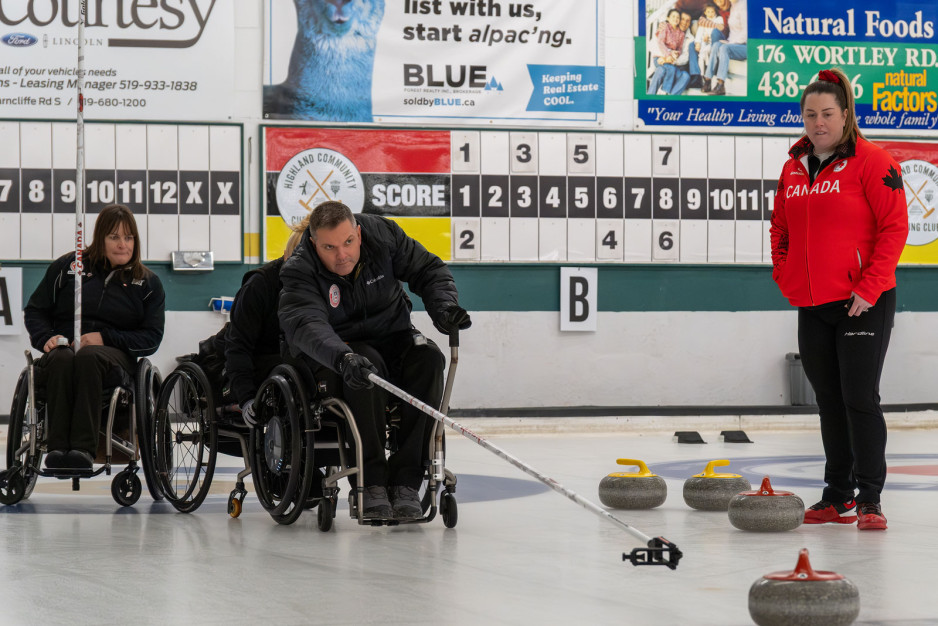
But before the medals, there was recovery and a lot of strength.
In 2007, a helicopter Ideson was piloting crashed near Cambridge, Ontario, leaving him with multiple fractures and a spinal cord injury resulting in quadriplegia. The months that followed were focused not on sports, but on healing, rehabilitation and redefining what life could look like at Parkwood Institute’s Spinal Cord Injury Clinic.
“Mark has always taken his rehabilitation extremely seriously. He was dedicated and always put in the work,” shares Doris Dwyer, a registered nurse at Parkwood Institute, who has worked with Ideson since 2007.
Before his injury, sports had shaped Ideson’s identity. During his recovery he missed the sense of community and competition that sports would bring him.

During the 2010 Winter Olympics, Ideson watched an interview with Canadian Skelton Racer Jon Montgomery and current host of Amazing Race Canada. When Montgomery spoke about finding a sport where he could excel and represent Canada on the world stage, something clicked in Ideson’s brain.
“In that moment, I knew I needed to find my sport,” he said.
For Ideson curling became that sport. Within four years, he was representing Canada at the 2014 Paralympic Winter Games in Sochi, securing the gold medal.
“It’s extraordinary,” says Dr. Steven Macaluso, a physiatrist and sports medicine specialist at Parkwood Institute. “He has all the qualities that Canadians should be proud of in someone representing them at the Paralympics. He's a very caring, thoughtful guy and a leader in all aspects.”
Dr. Macaluso has worked with Ideson for years and has travelled internationally with the national team since 2018. His expertise spans physical medicine and rehabilitation and sports medicine — a combination that becomes critical in Paralympic competition.
“These athletes are high-performance competitors,” he says. “But they may also have complex medical needs. My role is to remove barriers so they can perform at their best, while always protecting their long-term health.”
Travel adds another layer of complexity.
“The team appreciates when I'm traveling with them, because they don't have to tell me about all the various things that could go with a spinal cord injury or an amputation.”
Hotel rooms advertised as accessible may not be. International flights can increase health risks. Even common cold medications must be carefully reviewed under international anti-doping regulations. Dr. Macaluso describes being the travel doctor with the team as a role requiring multiple hats to ensure the athletes are safe.
Dr. Macaluso travels with a fully stocked medical kit, including emergency equipment. He consults on treatment timelines ahead of major competitions, and ensures medications comply with global sport regulations. And sometimes, he simply helps navigate an airport or tighten a loose bolt on a wheelchair.
“When you travel with the team, you’re part of the team,” he says. “Whether it’s medical care or practical support, you do what needs to be done so the athletes can focus on competing.”
For Ideson, that partnership is foundational.
“Dr. Macaluso helps put my mind at ease when I’m dealing with physical setbacks,” he says. “Knowing I have someone who understands both my injury and my sport allows me to compete with a higher level of confidence.”
Resilience, for Ideson, is not theoretical.
“It’s rare to pursue excellence without facing self-doubt or setbacks,” he says. “Proving to myself that I can overcome those challenges has been transformative.”
For Dr. Macaluso, Ideson’s journey reinforces something he sees every day in rehabilitation medicine.
“Our responsibility is to support patients wherever their goals take them,” he says. “For some, that means returning to work or family life. For others, it means competing on the world stage.”
Today, Ideson measures success in more than medals. As a father, he hopes his children see deeper lessons.