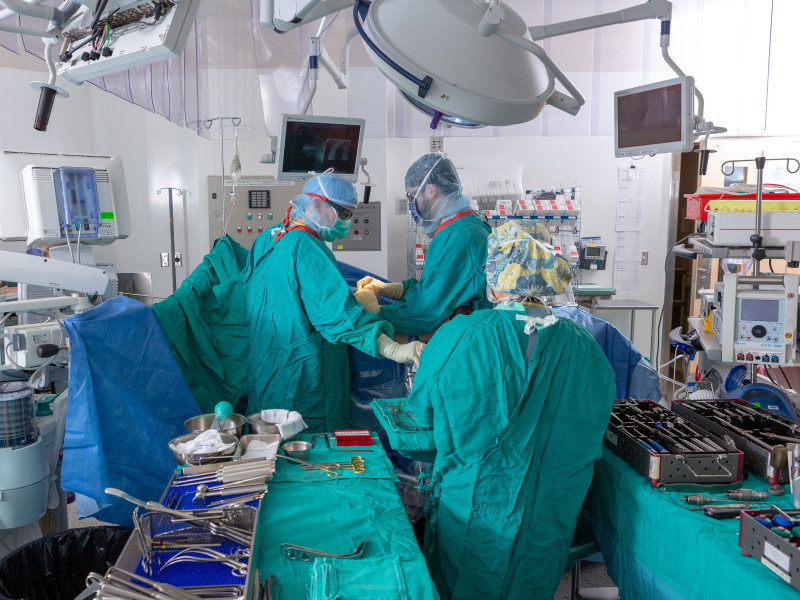


St. Joseph’s leads innovative hernia repair using da Vinci Xi surgical robot
Image
Image
St. Joseph's leads innovative hernia repair using da Vinci Xi surgical robot
His fingertips flit across the controls with a careful, deliberate touch while his right foot lightly taps two pedals on the floor. Like an organist at his console, each movement is so practiced as to seem effortless.
Surgeon Dr. Ahmad Elnahas agrees there are parallels between musicianship and robotic surgery. “Everything has to be in harmony. Fingers, feet, focus – they all have to work together to make the surgery successful.”
This year, Elnahas, a specialist in minimally invasive surgery, pioneered the use of using da Vinci Xi surgical robot at St. Joseph’s Health Care London (St. Joseph’s) to perform hernia repairs and he has done about 20 so far.
The innovation makes St. Joseph’s a pioneer in this procedure among Canadian ambulatory hospitals and provides an innovative, effective use for a surgical robot that’s more often used here to aid in urology surgery.
“We believe St. Joseph’s is one of Canada’s early-adopter hospitals to use this procedure for hernia repair,” Elnahas says, noting that patients with complex hernias have experienced less pain, less scarring and faster recovery time than in conventional or laparoscopic hernia surgery, he says.
What is a hernia?
A hernia happens when part of the bowel protrudes through a weakness in muscle or muscle lining.
Repairing it requires a surgical procedure – either conventional, open surgery or minimally invasive surgery – to put the tissue back into place and reinforce the tissue around it.
Conventional, open surgery usually takes place with the patient under local, regional or general anesthesia.
In the laparoscopic option, the abdominal area is illuminated with one thin camera-equipped tool through one small incision, while the surgeon operates another long inflexible surgical tool to repair the tissue through a different small hole.
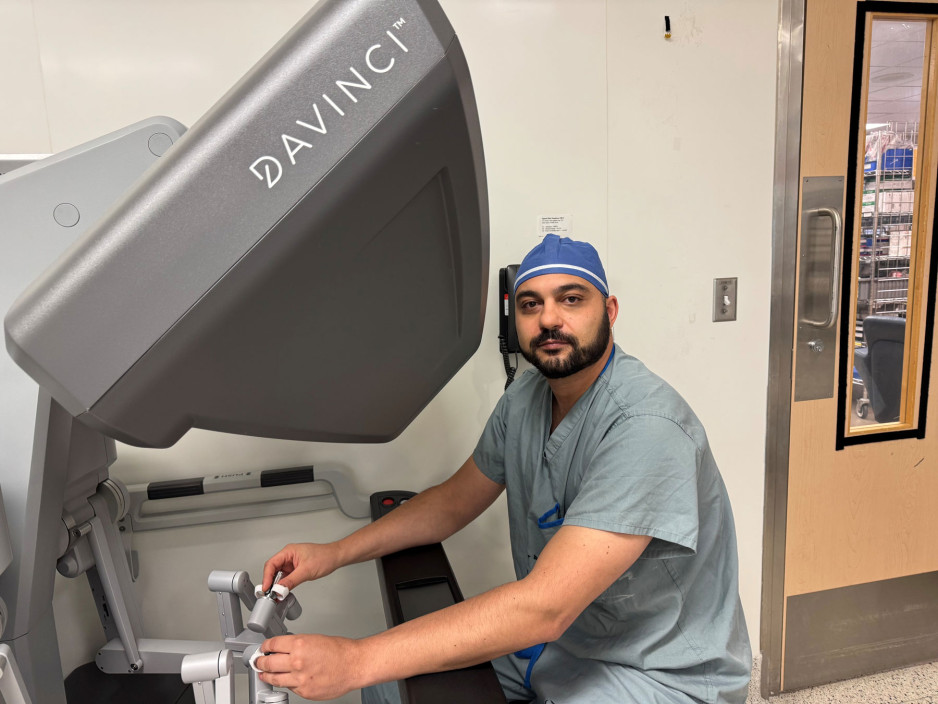
But the da Vinci Xi surgical system, manufactured by Intuitive Surgical, enables even more precision since it offers a three-dimensional look at the patient’s tissue and better control of instruments.
When the robot’s command console is docked to a four-armed patient-side cart with surgical instruments, Elnahas uses his pincer-grasp and foot pedals to direct the machine on where and how to cut, move, stitch and cauterize.
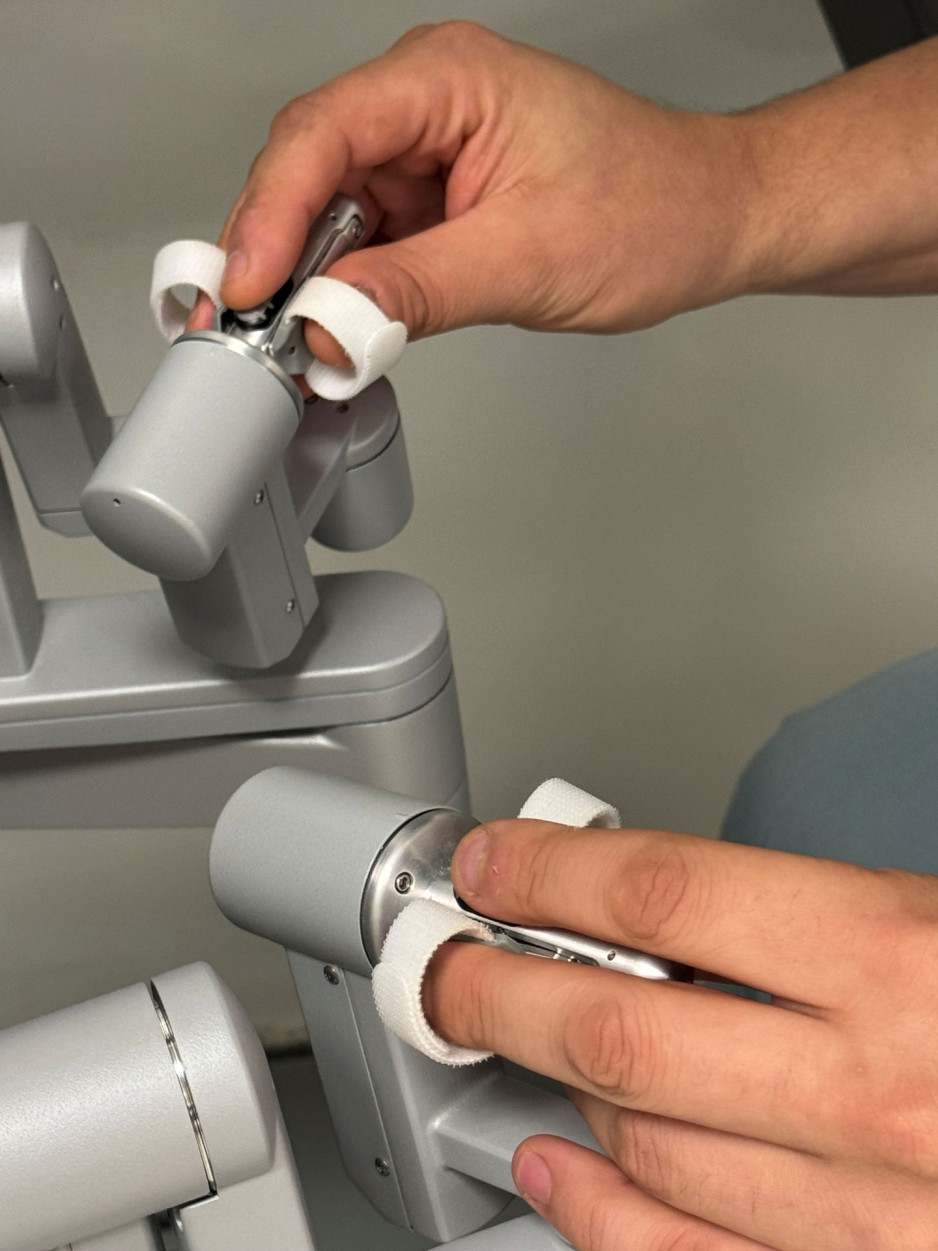
While the robot does that work, Elnahas is in control of the procedure at all times.
He received extensive training including hours of simulation and hands-on instruction, from experts in the field.
“The transition felt easier for me because I was taking the principles I knew from laparoscopic surgery and applying it to robotic surgery,” says Elnahas, who performs this surgery at St. Joseph’s but ordinarily works from London Health Sciences Centre.
Improved patient experience
The community donated more than $1.25 million through the St. Joseph’s Health Care Foundation towards the purchase of this da Vinci Xi robot system (and, almost 20 years earlier, donors fully funded the da Vinci Si system that preceded this version).
The da Vinci Xi is generally used at St. Joseph’s in urology, in prostate, kidney and bladder surgeries.
Its use in hernia repair not yet considered standard of care in Canada, although his team is preparing to present a paper at an upcoming conference, comparing results of robotic and laparoscopic hernia procedures.
Elna has found that patients undergoing robotic surgery benefit from similar operative times to laparoscopic hernia repair, have less post-operative pain and faster return to work; particularly when compared with patients having open hernia repair surgery.
Robotic tools also allow the surgeon greater movement of their instruments in certain areas of the body, or in patients with some body shapes where laparoscopic tools are challenging and might otherwise cause the patient to have to undergo a standard open hernia repair.
Having expertise in robotic hernia surgery in London allows surgeons here to lead the country in training surgical residents in robotic surgery and in building specialized skills for the next generation of surgeons.
It allows surgeons to tailor the type of surgery to what is best for each individual patient: whether conventional open surgery, laparoscopic surgery or robotic surgery. No single approach is best for all patients.
For example, people who don’t do well with general anesthesia may be better suited to conventional open surgery under local or regional anesthesia, he says.
“As an ambulatory-care centre and a teaching hospital with a state-of-the art da Vinci surgical robot, St. Joseph’s is the ideal place for this hernia procedure,” he says.
Expanding use of an important hospital resource
Beyond its direct benefit in patient care, the procedure is a stewardly use of limited hospital resources: it fills in gaps when the da Vinci isn’t otherwise being used for urology procedures such as prostate removals.
“It’s exciting to see St. Joseph’s leading the country in robotic surgery being performed in ambulatory hospitals,” says Dr. Muriel Brackstone, a St. Joseph’s surgeon and Lawson Research Institute Scientist, who leads the initiative with Elnahas.
“While currently there is very limited access to the robot for surgeons to perform these procedures in London, we hope this will increase in the future to allow surgeons the ability to offer all types of surgical access and make those decisions based on which approach is best for each individual patient,” she says.
“This expertise builds on St. Joseph’s leadership in ambulatory care and as an institution known for its innovation and clinical excellence,” Brackstone adds.
“Robotically assisted surgery is gaining traction across Canada and eventually will become just another skill set taught in Canadian medical schools, as it is at Western’s Schulich School of Medicine & Dentistry,” says Elnahas, who is also an associate professor of general surgery at Schulich.
“If we want to be leaders in the field, we have to continue to grow programs and procedures like these,” Elnahas says.
One patient’s story
Samuel Arango first felt a twinge in his abdominal area in mid-2024. By December, it had escalated to full-on pain, followed by a doctor’s urgent recommendation that Arango undergo a hernia-repair surgery.
For the dirt-bike enthusiast and extreme-sports participant, it was a nerve-wracking time – he couldn’t imagine being sidelined for a month, like one of his friends who’d had conventional hernia surgery.

In February 2025, Arango became one of the first patients at St. Joseph’s Hospital to receive a robot-assisted hernia repair – a procedure that makes St. Joseph’s a pioneer among Canadian ambulatory-care hospitals.
“Dr. Elnahas took the time to explain the procedure to me. He didn’t rush me through it. And once he explained how the robot worked, I felt more comfortable because I knew it was more precise and less invasive than conventional surgery.”
The procedure took place as day surgery under general anesthesia. A few days later, the pain was gone and he was soon able to return to work.
“It was a very smooth and quick recovery. The whole process was positive, the nurses were super-super-great and follow-up has been really comprehensive.”
-
Surgical Services
St. Joseph’s Hospital is a unique ambulatory hospital that specializes in minimally invasive, same day and short stay surgery. We also provide our patients with comprehensive assessment, diagnosis and follow- up care. Our state-of-the art operating rooms are supported by expert teams ensuring effective pre-screening, admission, post-surgery care and, when necessary, inpatient care.