


Unique North American resource touts health benefits of fermented foods
Image
Image
New network feeds into trusted information about ‘ferment-ceuticals for consumers, researchers and food industry
Break out the sourdough bread and spoon up a side of sauerkraut – there’s growing evidence that fermented foods can be as good for your gut health as for your palate.
And now, a unique-in-North-America resource called the Canadian Fermented Foods Initiative (CFFI) is bringing together consumers, researchers, health practitioners and industry to share trusted information about ‘ferment-ceuticals’.
“Across all countries and cultures and centuries, people have longstanding traditions of fermenting food to preserve their harvest and add some zip to their meals,” says microbiologist Jeremy Burton, PhD, who is leading the initiative and is Chair in Human Microbiome and Probiotics, located at Lawson Research Institute, the innovation arm of St. Joseph’s Health Care London.
“And while taste and budget are great motivators for fermented food consumption, the health boost appears to be equally compelling.”
Large population-based studies show people who eat fermented foods are generally healthier. Their blood pressure and cholesterol are lower, they have fewer digestive issues and appear to be at lower risk of chronic diseases.
“How, exactly, does that work – and why? Well, that’s the big question we’re trying to solve,” Burton says.
Burton is working to understand how microbes involved in fermentation could be key to restoring or improving a healthy gut microbiome; and how that, in turn, could strengthen our immune systems and prevent diseases such as Type 2 diabetes and colon cancer.
Unique one-stop resource
CFFI is funded by the Weston Family Foundation, flowing through St. Joseph’s Health Care Foundation, to explore and advance the role of fermented foods in health, science and food systems across Canada.
CFFI’s aims are both simple and visionary:
provide researchers access to emerging science and interdisciplinary collaboration about the health impact of fermented foods;
help health professionals integrate findings into daily nutritional practice;
encourage Canadians to make healthier food choices; and
guide industry in product innovation.
“All these aims feed into each other and, ultimately, into healthier people and populations,” says Burton, who is also Miriam Burnett Chair in Urological Sciences funded through St. Joseph’s Health Care Foundation.
“We know that in very large human studies, people who consume fermented foods have less cancer, less heart disease. We know from small, food-specific studies – in yogurt, for example – people have a more diverse gut microbiome, which is often associated with beneficial health outcomes,” says Burton.
“What we’re missing is that middle spectrum of studies, where we need a whole lot more information to generate health insights.”
There’s no specific formula or “magic sauce” for determining and maximizing the gut-health effects of fermented foods.
That’s part of CFFI’s exploration: whether grandma’s homemade yogurt offers more or less benefit than store-bought, for example; or what kombucha formulation can capture maximum flavour and still create an environment where “good” bacteria can thrive.
It’s what makes the “old” habits of traditional diets new and important again, says Burton, who laments the blandification of many of today’s menu options. “When we give up these important parts of our diet, we’re also losing that diversity of gut microbes necessary to good health.”
St. Joseph's is a leader in the field. A paper authored by the team and published this week in Advances in Nutrition represents the most comprehensive synthesis to date of research on fermented foods and human health.
From research to kitchen to tabletop
While the science of fermented foods drives Burton and his team, the kitchen-table side of the equation fuels chef Connor Flynn.
Flynn is a certified master food preserver, high school culinary arts teacher with the London District Catholic School Board and entrepreneur who teaches community classes as The Preserving Chef.
Burton’s and Flynn’s paths connected through social media and helped launch a collaboration through the CFFI.
“When I teach a class, the students can’t get enough of fermented foods,” Flynn notes. “They’re an easy and tasty way to transform bland foods into something exciting.”
“Fermenting foods is an old, old practice that’s never fallen out of flavour, but has sometimes fallen out of favour to North Americans. Now it has become popular again for a lot of reasons,” Flynn says.
“The people who are driving the fermented-foods revolution – and it is a revolution in North America and Europe even though there’s a long history of it around the world – are drawn to it for so many good reasons.”
They include sustainability, practicality and a push to reduce food waste.
And, of course, there’s the palate.
“Chefs are always looking for new flavours, and they’re discovering the unique tastes these foods bring to the table,” Flynn says. The CFFI site includes Flynn’s video recipes for sauerkraut, fermented dill pickles and krautchi (a variation on Korean kimchi).
‘Hungry for knowledge’
The launch of CFFI is an important next step in research that leads to improved human health, says Burton. “We’re bridging the gap between science, food and people.”
That’s why collaborations and partnerships are key elements of the new collective.
Co-CFFI founders and researchers are Raylene Reimer, PhD, RD, a professor of nutrition and registered dietitian at the University of Calgary; and Ben Willing, PhD, professor at the University of Alberta and former Canada Research Chair in Microbiology of Nutrigenomics.
Willing recently gave a presentation to more than 300 Alberta dieticians who are keen to see and use this resource.
"Dietitians are acutely aware of the role that a healthy gut microbiome plays in overall health, so they are hungry for knowledge with regards to the benefits of fermented foods,” Willing says.
“Educating consumers about the variety of gut microbiome-friendly foods is a great way to promote health. With exciting research on the horizon, fermented foods may one day be prominently featured in national dietary guidelines," says Reimer.
Burton maintains that the gut microbiome is the biggest unexplored frontier in good health, and fermented foods will play an important role. “One day, I believe, ‘ferment-ceuticals’ will be engrained in our diets and in our health vocabulary."
How it works:
Microbes such as bacteria, yeast and fungi are either naturally present or are introduced to fresh food products
These microbes work together to produce biochemical reactions that convert sugars and other compounds into acids, gases, alcohol and other metabolites.
The resulting fermentation process preserves the food from spoilage and creates a taste different from the sum of its food ingredients
Fermentation helps your body get more out of the food you eat. It makes nutrients easier to digest, boosts the absorption of vitamins and minerals, reduces compounds that block nutrient use, and supports a healthy gut and immune system.
Want to feast on fermented foods? Try these:
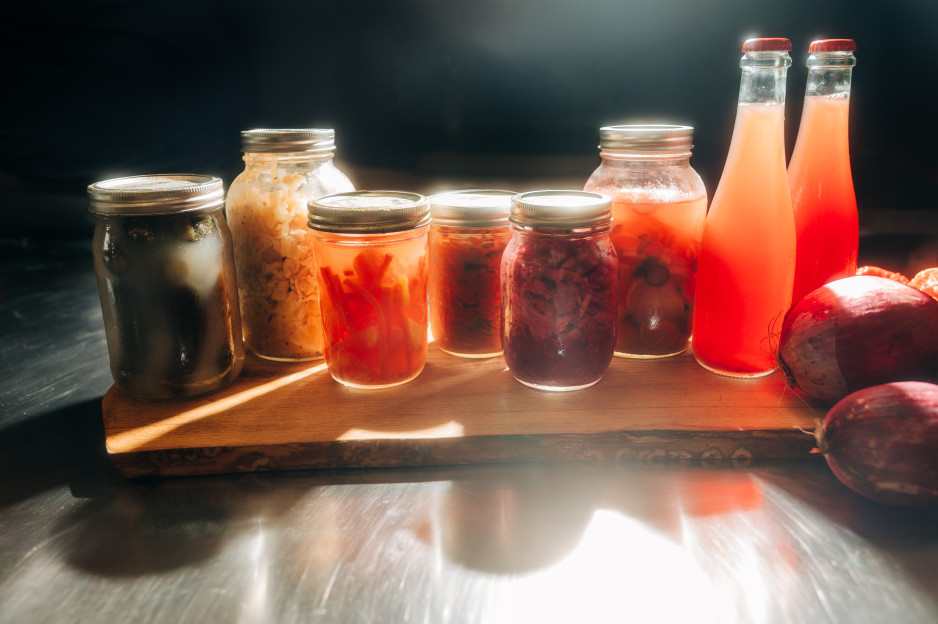
Cheese, escaliche, gochujang, kefir, kimchi, kombucha, miso, fermented herring, fermented cucumbers or dill pickles, prosciutto, tempeh, vinegar, sausage, sour cream, sauerkraut, sourdough bread, soy sauce, vinegar, yogurt and more.
Check out Fermented Foods Recipes | Canadian Fermented Foods Initiative for easy recipes, menu tips and step-by-step videos!
CFFI and donor support
The Weston Family Foundation has been a long-time supporter of St. Joseph’s as part of its commitment to support research in food health, diet and nutrition. Their philanthropy includes local and national research investments in the human microbiome (including Lawson Scientist Dr. Gregor Reid’s groundbreaking work in the field).
“Without the Weston Family Foundation’s support, Canada would be very far behind in this work. With their tremendous support, we have become national and North American leaders,” Burton says.