


Search
Search
1376 Search Results:
First Contrast Enhanced Spectral Mammography (CESM) guided biopsy in North America
LONDON, ON – Researchers at Lawson Health Research Institute (Lawson) are the first in North America to perform a breast biopsy guided by Contrast Enhanced Spectral Mammography (CESM).
CESM is a novel diagnostic imaging tool that is able to detect cancerous lesions at a greater rate than standard mammography, and at close rate to MRI. Patients who undergo CESM receive an intravenous iodinated contrast liquid. This liquid acts as a dye that enhances the visibility of certain tissues during a radiographic imaging procedure, such as mammography or x-ray.
Currently, when a suspicious lesion is detected by CESM and not detected by standard mammography or ultrasound, the patient must return later for an MRI biopsy. Wait times for MRI can be lengthy, and the procedure itself is often long and uncomfortable.
CESM guided biopsy offers the ability to perform biopsy of the lesion of concern using mammography, after iodinated contrast injection. The procedure is faster and more accurate, comfortable and cost effective than an MRI biopsy.
The first CESM guided biopsy in North America was performed on June 12, 2020, at St. Joseph’s Health Care London (St. Joseph’s). Dr. Anat Kornecki, Lawson Associate Scientist and Radiologist at St. Joseph’s explains, “this new approach has the potential to provide rapid and accurate access for patients and reduce costs. With CESM biopsy technology we are also able to perform biopsy of lesions that are located in areas that MRI guided biopsy cannot reach.”
“Our initial experience has been very successful, and we hope to see an impact on patient care as well as breast cancer outcomes,” says Dr. Kornecki.
The study will recruit 50 patients who have a suspect finding detected using CESM.
-30-
About Lawson Health Research Institute
Lawson Health Research Institute is one of Canada’s top hospital-based research institutes, tackling the most pressing challenges in health care. As the research institute of London Health Sciences Centre and St. Joseph’s Health Care London, our innovation happens where care is delivered. Lawson research teams are at the leading-edge of science with the goal of improving health and the delivery of care for patients. Working in partnership with Western University, our researchers are encouraged to pursue their curiosity, collaborate often and share their discoveries widely. Research conducted through Lawson makes a difference in the lives of patients, families and communities around the world. To learn more, visit www.lawsonresearch.ca.
Media Contacts
Celine Zadorsky
Senior Media Relations Consultant
Communications & Public Engagement
T: 519-685-8500 ext. 73502
Celine.zadorsky@lhsc.on.ca
First Contrast Enhanced Spectral Mammography guided biopsy in North America
Researchers at Lawson Health Research Institute (Lawson) performed the first breast biopsy guided by Contrast Enhanced Spectral Mammography (CESM) in North America on June 12, 2020.
CESM is a novel diagnostic imaging tool that is able to detect cancerous lesions at a greater rate than standard mammography, and at close rate to MRI. Patients who undergo CESM receive an intravenous iodinated contrast liquid. This liquid acts as a dye that enhances the visibility of certain tissues during a radiographic imaging procedure, such as mammography or x-ray.
Currently, when a suspicious lesion is detected by CESM and not detected by standard mammography or ultrasound, the patient must return later for an MRI biopsy. Wait times for MRI can be lengthy, and the procedure itself is often long and uncomfortable.
CESM guided biopsy offers the ability to perform biopsy of the lesion of concern using mammography, after iodinated contrast injection. The procedure is faster and more accurate, comfortable and cost effective than an MRI biopsy.
The study will recruit 50 patients who have a suspect finding detected using CESM.
Dr. Anat Kornecki, Lawson Associate Scientist and Radiologist at St. Joseph’s Health Care London explains, “this new approach has the potential to provide rapid and accurate access for patients and reduce costs. With CESM biopsy technology we are also able to perform biopsy of lesions that are located in areas that MRI guided biopsy cannot reach.”
“Our initial experience has been very successful, and we hope to see an impact on patient care as well as breast cancer outcomes,” says Dr. Kornecki.
Scientist
… impact framework, the Strategy has also chosen to draw on tools and practices from quality improvement and … the development of five strategic priority areas that will drive the South West Frail Senior Strategy work for the next … of the health care system from a research and data-driven position linking related social determinants of …
STRATEGIC PRIORITIES 2019 2022 Together, we are improving the health care system for older adults with frailty. SOUTH WEST FRAIL SENIOR STRATEGY 2019-2022 The purpose is to improve outcomes and experiences of the health care system for older adults with frailty and their caregivers. Patients and fam...
Funding for unique strategy to prevent homelessness after hospital discharge
In Canada, about 235,000 people experience homelessness each year. The number of homeless people, and the length of time they spend homeless, continues to rise. Homelessness is not a choice and anyone can become homeless.
Although the root cause is poverty, some underlying issues are poor physical or mental health; violence or abuse in the home; lack of employment or income; and, a shortage of affordable housing.
A group of researchers at Lawson Health Research Institute (Lawson), working at both London Health Sciences (LHSC) and St. Joseph’s Health Care London (St. Joseph’s), are committed to tackling the issue of homelessness from within hospital walls, where some patients face the risk of being discharged into homelessness.
“Many of our patients with lived experience of homelessness were saying that their journey started with a hospital discharge,” says Lawson clinician researcher Dr. Cheryl Forchuk. “Often, they were experiencing major transitions in their lives and then experienced a hospital stay. Normally a relatively short visit, they aren’t able to gather the information and make a plan to be able to leave the hospital with somewhere to stay.”
On September 10, Adam Vaughan, Canadian MP and Parliamentary Secretary (Housing and Urban Affairs), on behalf of the Honourable Jean-Yves Duclos, Minister of Families, Children and Social Development, announced that Lawson will receive $223,572 from the Homelessness Partnering Strategy’s (HPS) Innovative Solutions to Homelessness funding stream to support the project “No Fixed Address Version 2 Expansion” research project.
Image

“This is a brilliant approach. It supports an augmented duty of care where hospitals have the means to transfer people into stable settings where they can continue to heal and move towards self-sufficiency,” says Parliamentary Secretary Vaughan.
Taking place at London Health Sciences Centre, this research will further refine the No Fixed Address strategy for reaching and supporting patients during the crucial transitional period when they are being discharged from the hospital and re-integrated into the community.
“Lawson’s expanded No Fixed Address research project is the first evaluation anywhere of a strategy to reduce the number of patients being discharged into homelessness. There is almost no literature on any aspect of this troublesome issue,” explains Dr. Forchuk who is the study’s Principal Investigator. Dr. Forchuk is also the Beryl and Richard Ivey Research Chair in Aging, Mental Health, Rehabilitation and Recovery and Assistant Director at Lawson.
Image

This project is an extension of three previous studies conducted by Dr. Forchuk’s research team, which developed and tested this novel approach. They demonstrated the efficacy, feasibility and cost-effectiveness of using the No Fixed Address strategy in acute and tertiary psychiatric care in the London region, at both LHSC and St. Joseph’s. In the first phase, they found that the interventions used prevented homelessness in 95 per cent of cases.
The researchers are now taking a solution proven to have worked in the mental health units and applying it in selected medical departments at LHSC. Through the study, the services will be available to all patients in those units who are at risk of homelessness. There have already been 17 patients who have accessed this support since the project got underway this summer.
Three community partners from London are supporting implementation of the strategy - Canadian Mental Health Association Middlesex, Ontario Works in the City of London and the Salvation Army’s Housing Stability Bank. They will provide assistance in areas like securing appropriate private-sector housing, provision of income and employment supports, and financial assistance.
“In many ways London, Ontario is the high water mark of solving and tackling homelessness. This community has a lot of be proud of given the way that the municipality is stepping up to the plate and how many different organizations are working together towards a common goal,” says Parliamentary Secretary Vaughan.
This kind of collaboration showcases the important partnership between the Canadian Government, research-intensive hospitals and community organizations to translate innovative solutions from the research stage to the front line of care.
“The hope is that the findings will be even more robust, leading to the development of a best-practice model of hospital discharge that can be adopted throughout Canada. This will reinforce the need for a systemic change in the way hospital discharges occur and ensuring the person is transitioning to a secure housing arrangement,” says Dr. Forchuk.
Learn more about the Government of Canada’s Homelessness Partnering Strategy.
News Coverage
- CBC London - Helping medical patients in London avoid homelessness when they leave hospital
- CTV London - Expanded research hopes to break the cycle of homelessness that psychiatric patients sometimes face when discharged
- Global News, AM 980 - Program that finds housing for homeless patients in hospital gets $223K in federal funding
- London Free Press - 'Brilliant approach' to homelessness gets federal grant
Scientist
Gait and Brain Seminar Series with international guest speaker Dr. Ervin Sejdic, PhD
6:30pm - 8:30pm
11th Gait and Brain Seminar Series
With international guest speaker Dr. Ervin Sejdic, PhD from The University of Pittsburgh’s Electrical and Computer Engineering, Bioengineering, and Biomedical Informatics Departments.
- Date: Tuesday October 17, 2017
- Time: 2:30-4:30 p.m.
- Location: Parkwood Institute, Main Building Room # F2-235
- Topic: Engineering Human Gait
View event poster for more details.
OTN Event #72728466
Ensure your OTN equipment is up and running by 2:30 p.m. If you connect after 2:30 p.m. call OTN at 1.866.454.6861 and have your event site number, I.D. and camera number available.
Webcast Link: If you would like to participate via webcast, email @email and she will send you the link closer to the event.
… gait_brain_seminar_2019_poster_-_special_topic_dr_masud.pdf …
Generation Vape: The new era of lung injury
11:00pm - 12:30am
One in four high school students have tried vaping in the past 30 days. Some believe that it’s a safe alternative to smoking, but is that true? Do we know enough about the risks? Hear the latest from a panel of experts and join the conversation about the health effects of vaping.
Presented in partnership with Western University's Schulich School of Medicine & Dentistry, this community event includes a series of small presentations followed by a panel discussion. This includes the team that published the first reported case of vaping-related lung injury in Canada.
Speakers include:
- Dr. Karen Bosma, Critical Care Specialist, London Health Sciences Centre, Associate Scientist, Lawson Health Research Institute and Associate Professor, Department of Medicine, Schulich Medicine & Dentistry, Western University
- Grace Parraga, PhD, Scientist, Robarts Research Institute and Professor, Medical Biophysics, Schulich Medicine & Dentistry, Western University
- Carly Weeks, Health Reporter, The Globe and Mail
- Suraj Paul, Aliana Manji, and Eleanor Park, Human Environments Analysis Laboratory Youth Advisory Council (HEALYAC)
Event Details
- Date: Tuesday, March 10, 2020
- Time: 7:00 - 8:30 p.m. (Doors open at 6:00 p.m.)
- Location: Lecture Theatre, Museum London (421 Ridout St N)
- Registration: This event is free for all to attend, but registration is required.
Register today at
westernconnect.ca/generationvape.
Generation Vape: The new era of lung injury
On March 10, 2020, Lawson Health Research Institute and Western University’s Schulich School of Medicine & Dentistry hosted a community event to discuss the latest on vaping research with a panel of experts.
The event, moderated by Carly Weeks, Health Reporter for The Globe and Mail, was held at Museum London.
Image

Panelist Dr. Karen Bosma, Associate Scientist at Lawson, spoke about Canada’s first published case report of vaping-related lung injury. She emphasized the need for more research on the effects of flavoring agents.
As highlighted in the case report, there has been a recent dramatic rise in vaping-related lung injuries among youth. One in four high school students have tried vaping in the past 30 days.
“We need to push back on the idea that vaping is all about harm reduction. We’re seeing mounting evidence in the scientific literature about the inherent risks,” stated Dr. Bosma, who is also a Critical Care Specialist at London Health Sciences Centre (LHSC) and an Associate Professor at Schulich Medicine & Dentistry. “The Generation Vape event, with a specific focus on the issues of youth vaping, was an opportunity to provide information to our community."
Dr. Grace Parraga, Professor at Schulich Medicine & Dentistry, presented 3D images demonstrating the damage to the lung that is caused by vaping. “This is not like anything we’ve seen before in the lab,” she said. “These are new diseases. We don’t know why some people get ill and others do not.”
Image

Also invited to present were members of the Human Environments Analysis Laboratory’s Youth Advisory Council (HEAL-YAC). Aliana Manji, Suraj Paul, and Morgan Seabrook shared their personal experiences and called for stricter marketing and purchasing rules of vaping products. Seabrook, a high school student, shared how friends under the age of 19 were able to buy vaping products without showing ID.
Dr. Constance Mackenzie, Respirologist and Toxicologist at St. Joseph’s Health Care London and Ontario/Manitoba/Nunavut Poison Centre, and Dr. April Price, Associate Scientist at Lawson and Paediatric Respirologist at LHSC, also shared their perspectives. Dr. Price believes the solution to getting through to youth about the dangers of vaping will lie with youth advocates like the HEAL-YAC members.
Image

Genetic testing could personalize care for patients with Crohn’s disease, particularly women
LONDON, ON - In a study involving 542 Crohn’s disease patients, researchers at Lawson Health Research Institute examined whether a patient’s DNA can be used to identify their risk of severe disease. They found that patients with a genetic variant in a gene called FXR (farnesoid X-receptor) are much more likely to need surgery and to need it earlier in their care journey. Surprisingly, they found that women with the genetic variant are at an even higher risk than men.
Crohn’s disease is an often debilitating condition that affects one in every 150 Canadians. The condition is characterized by intestinal inflammation caused by unnecessary attacks from the body’s immune system. It’s a disease that can behave and progress differently from one person to the next, with some requiring surgery to remove affected parts of the intestine.
“While medications are prescribed to manage Crohn’s disease, physicians have to balance the risk of side effects with the risk of undertreating severe cases of the disease,” explains Dr. Aze Wilson, Associate Scientist at Lawson Health Research Institute and Gastroenterologist at London Health Sciences Centre (LHSC). “In order to personalize treatment, it would be great to have a tool for identifying which patients will have the most severe cases of illness.”
Dr. Wilson and her colleagues became interested in the FXR gene because of its role in intestinal health. The FXR gene is a part of human DNA that controls how we process drugs and has also been linked to how well our intestines work. The research team suspected that variation in the gene could lead to poorer outcomes in Crohn’s disease patients.
“Given the importance of FXR to intestinal health, we wanted to see whether it plays a role in disease severity and we discovered that it does,” says Dr. Wilson. “Our findings suggest that genetic testing could be used to identify patients at a high risk of poor outcomes. This would allow physicians to tailor treatments to give patients the best chance at success.”
The team also discovered that women who carried the genetic variant were at the highest risk of needing surgery and the highest risk of early surgery, even when compared to men with the genetic variant. Struck by this finding, they conducted further testing using laboratory-based cell models. They found that estrogen (a female sex hormone) in combination with the genetic variant reduced the function of FXR even further.
“Differences between men and women with Crohn’s disease are not often considered in research or clinical practice. We apply treatments in the same way to both sexes, which may not be the best approach,” explains Dr. Wilson. “We identified a group of women who may benefit from a different approach to care. The study highlights the need for evaluating the effect of biological sex on disease and the interaction it may have with our DNA.”
Looking forward, the team hopes to further explore the effect of this genetic variant on intestinal health using laboratory-based cell models. They also hope to assess the value of genetic testing as a tool for informing treatment decisions made by patients and their physicians.
“One of our larger goals as a research group is to develop a personalized care plan for patients with Crohn’s disease and ulcerative colitis – one that integrates genetic information and other biomarkers to improve how care is delivered to these patient populations,” notes Dr. Wilson.
The study, “Genetic variation in the farnesoid X-receptor predicts Crohn’s disease severity in female patients,” is published in Nature’s Scientific Reports.
-30-
DOWNLOADABLE MEDIA
Image

About Lawson Health Research Institute
Lawson Health Research Institute is one of Canada’s top hospital-based research institutes, tackling the most pressing challenges in health care. As the research institute of London Health Sciences Centre and St. Joseph’s Health Care London, our innovation happens where care is delivered. Lawson research teams are at the leading-edge of science with the goal of improving health and the delivery of care for patients. Working in partnership with Western University, our researchers are encouraged to pursue their curiosity, collaborate often and share their discoveries widely. Research conducted through Lawson makes a difference in the lives of patients, families and communities around the world. To learn more, visit www.lawsonresearch.ca.
Media Contacts
Celine Zadorsky
Senior Media Relations Consultant
Communications & Public Engagement
T: 519-685-8500 ext. 73502
Celine.zadorsky@lhsc.on.ca
… Understanding Insomnia and Current Management Strategies – Dr. Jennifer Barr Trauma Informed Care: Empowering Your Choices and Living Safely with Them- Dr. Stephanie Dubois PART 1 - DELIVERING QUALITY DEMENTIA … Ontario Standard for Behavioural Symptoms of Dementia – Dr. Iris Gutmanis (***these two workshops are complementary, …
17 th Annual Geriatric Psychiatry Symposium AGING IN A CHANGING WORLD: PROMOTING LIVES THAT THRIVE Wednesday, November 6, 2019 8:25 am - 4:20 pm Best Western Lamplighter Inn 591 Wellington Road, London, Ontario N6C 4R3 To Register: Please register online at www.schulich.uwo.ca/psychiatry/about_us/e...
… 5, 2008 For Immediate Release International expert to address conference on complexity of mental illness in … focusing on mental health issues affecting the elderly. Dr. Lisa Van Bussel, conference chair and physician leader … to care for people with these disorders. Keynote speaker Dr. Benoit Mulsant, MD, professor and vice-chair, Department …
November 5, 2008 For Immediate Release International expert to address conference on complexity of mental illness in geriatric population London ON - The Division of Geriatric Psychiatry, in conjunction with the Geriatric Psychiatry programs at St. Josephs Health Care, London and London Health Scien...
Getting the data on homelessness
LONDON, ON – A team at Lawson Health Research Institute is hosting forums for communities across the country to better understand homelessness in Canada, including the number of people experiencing it. The first six forums have been scheduled in communities across Ontario, including Thunder Bay, North Bay, Kingston, Chatham-Kent, London and Brantford. These will be followed by future forums in various locations across Canada.
With funding from the Government of Canada, the Homelessness Counts research project is collecting data surrounding the homelessness situation in Canada.
The forums will allow an opportunity for members of the community to come together to discuss issues surrounding homelessness and provide feedback to the research team.
“The homelessness experience varies significantly across Canada, especially within different rural and remote regions of the country,” says Dr. Cheryl Forchuk, Assistant Scientific Director at Lawson. “Developing more accurate sources of data related to homelessness helps ensure the proper supports and services are available.”
This project builds on past work looking at how existing databases, such as provincial health data, could be better integrated and used as a more accurate, accessible and cost-effective way to determine rates of homelessness. This can allow a more accurate picture as numbers continue to rise.
This project has been made possible through funding from the Public Health Agency of Canada and Reaching Home, a community based federal program aimed at preventing and reducing homelessness across Canada.
“Homelessness has a direct impact on the health and wellbeing of every Canadian community and further marginalizes vulnerable Canadians. We value the importance of the data collection by Lawson Health Research Institute, as it helps give us a better understanding of the homelessness situation in Canada,” says The Honourable Ahmed Hussen, Minister of Housing and Diversity and Inclusion. “Our government is committed to helping Canadians who are experiencing or at risk of homelessness which is why we are pleased to support this initiative. By working with other orders of government, non-governmental organizations, Indigenous partners and communities, we can increase the availability of safe, inclusive housing options and work towards reducing chronic homelessness in Canada.”
Since January 2021, the team has collected data from 28 distinct communities with homelessness challenges. They have visited a variety of community shelters and organizations to meet with those with lived experience, as well as service providers.
“We have been to every province and territory in Canada to collect data. We have interviewed more than 400 people experiencing homelessness in each community and have had focus groups with 190 service providers,” says Dr. Forchuk.
Preliminary data being presented at the forums will highlight issues by community, however nationally the research team has found that the extent of homelessness is a growing problem and has been elevated during the pandemic. The team has also noted a number of regional differences when it comes to homelessness in respect to urban versus rural communities.
“Our ultimate goal is to gather the most accurate numbers of people experiencing homelessness across the country so we can collectively work together towards solutions, “adds Dr. Forchuk. “Solutions such as an increase of services that are targeted to address specific concerns and vulnerable populations in each unique community.”
About Lawson Health Research Institute
Lawson Health Research Institute is one of Canada’s top hospital-based research institutes, tackling the most pressing challenges in health care. As the research institute of London Health Sciences Centre and St. Joseph’s Health Care London, our innovation happens where care is delivered. Lawson research teams are at the leading-edge of science with the goal of improving health and the delivery of care for patients. Working in partnership with Western University, our researchers are encouraged to pursue their curiosity, collaborate often and share their discoveries widely. Research conducted through Lawson makes a difference in the lives of patients, families and communities around the world. To learn more, visit www.lawsonresearch.ca.
Media Contacts
Celine Zadorsky
Senior Media Relations Consultant
Communications & Public Engagement
T: 519-685-8500 ext. 73502
Celine.zadorsky@lhsc.on.ca
Getting the data on homelessness
At a virtual event, a research team led by Lawson Health Research Institute announced details of a new project aimed at better understanding how many people in Canada are homeless and who they are. Developing more accurate sources of data related to homelessness helps ensure the proper supports and services are available.
“The homeless experience varies significantly across Canada, especially within different rural and remote regions of the country,” says Dr. Cheryl Forchuk, Assistant Scientific Director at Lawson and Distinguished University Professor at Western University.
With funding from the Public Health Agency of Canada, the Homelessness Counts research project builds on past work looking at how existing databases, such as provincial health data, could be better integrated and used as a more accurate, accessible and cost-effective way to determine homelessness.
Many communities rely on shelter data, but not all regions have shelters and not all people who are experiencing homelessness use shelters even when available. There is also a standard “point in time” method that requires potentially hundreds of volunteers to go out and actually count the people in that area who are homeless.
“Generally, these methods will still miss people who are temporarily staying with others or living in rough or abandoned areas, and is limited to a single point in time – often just one day of counting. It’s often not feasible for smaller communities to do this due to the effort required and it’s a population often missed in our census data,” explains Dr. Richard Booth, Scientist at Lawson and Associate Professor at Western.
In the initial stages of the project, the team is holding focus groups with several representative communities across Canada to learn more about how data is tracked and accessed. They will consult with groups providing services such as homeless serving agencies, mental health and addiction agencies, hospitals, emergency services and municipal governments. Individual interviews will also be held with people with lived experience of homelessness.
“To offer effective and efficient services, we need to know how many people are experiencing homelessness, along with their characteristics, location and needs. Right now, it’s difficult to track if things are getting better or worse, or simply changing, and if efforts to reduce the homeless population are making a difference. We don’t fully know the unique challenges of the ‘invisible homeless’ or if different subgroups are emerging,” says Dr. Booth.
More demographics could be regularly included in the data, for example gender, ethnicity, sexual orientation, involvement in the criminal justice system, psychiatric diagnoses, physical diagnoses and housing status.
The team will bring together this information with existing datasets to improve the performance of an algorithm previously developed through a provincial research study, as well as insights gleaned from a rapid report on COVID-19 and homelessness. Machine learning will be used to generate enhanced risk and burden modeling.
Dr. Forchuk adds that “homelessness is a complex social problem that touches on many different systems. It is made even more difficult to tackle when we have big gaps in the data. Our hope is to prototype a centralized surveillance system that can be scaled up across Canada to help make the right services available in the right places.”
Scientist
Getting the data on homelessness
A team at Lawson Health Research Institute is hosting forums for communities across the country to better understand homelessness in Canada, including the number of people experiencing it. The first six forums have been scheduled in communities across Ontario, including Thunder Bay, North Bay, Kingston, Chatham-Kent, London and Brantford. These will be followed by future forums in various locations across Canada.
With funding from the Government of Canada, the Homelessness Counts research project is collecting data surrounding the homelessness situation in Canada.
The forums will allow an opportunity for members of the community to come together to discuss issues surrounding homelessness and provide feedback to the research team.
“The homelessness experience varies significantly across Canada, especially within different rural and remote regions of the country,” says Dr. Cheryl Forchuk, Assistant Scientific Director at Lawson. “Developing more accurate sources of data related to homelessness helps ensure the proper supports and services are available.”
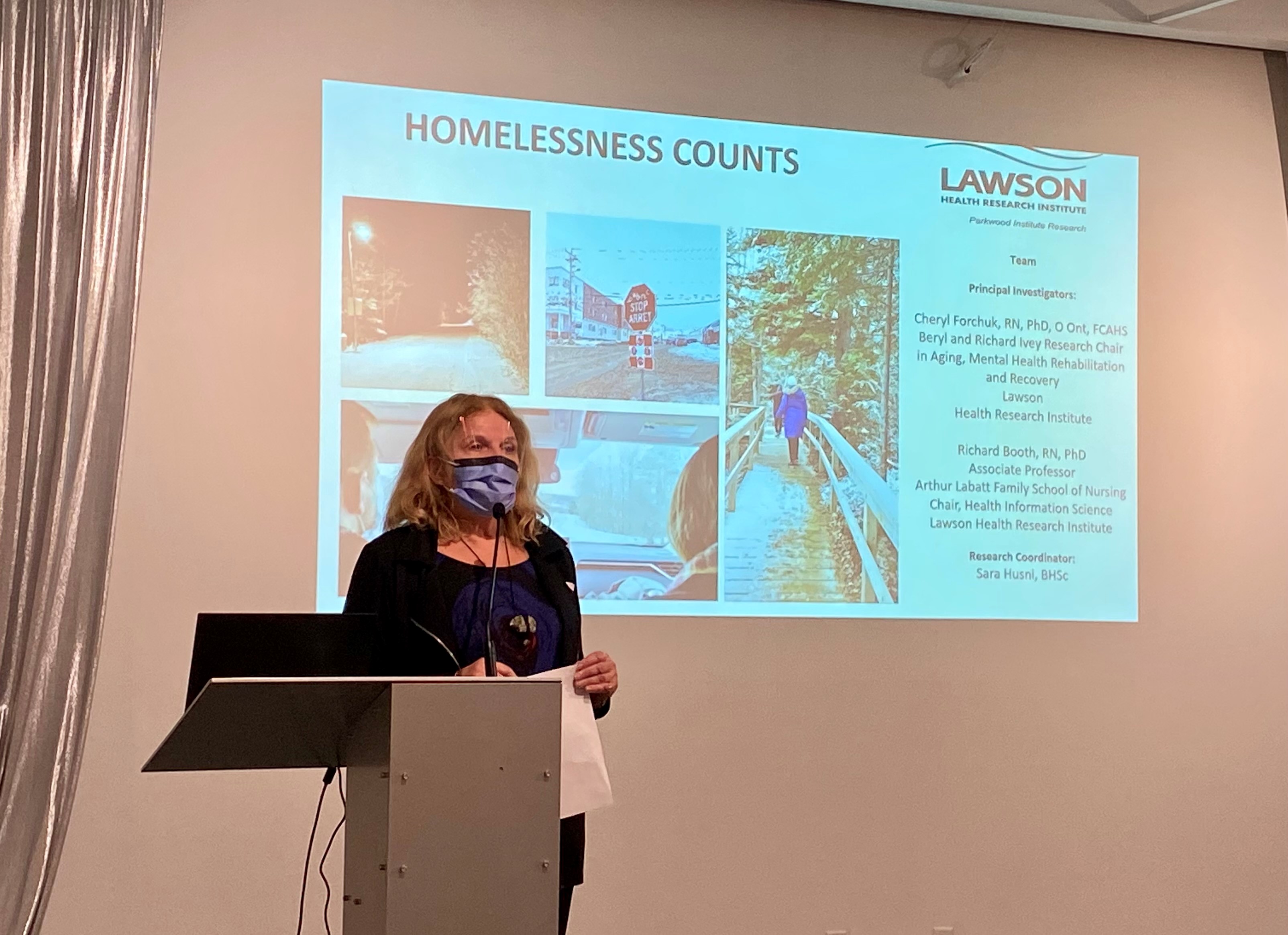
This project builds on past work looking at how existing databases, such as provincial health data, could be better integrated and used as a more accurate, accessible and cost-effective way to determine rates of homelessness. This can allow a more accurate picture as numbers continue to rise.
This project has been made possible through funding from the Public Health Agency of Canada and Reaching Home, a community based federal program aimed at preventing and reducing homelessness across Canada.
“Homelessness has a direct impact on the health and wellbeing of every Canadian community and further marginalizes vulnerable Canadians. We value the importance of the data collection by Lawson Health Research Institute, as it helps give us a better understanding of the homelessness situation in Canada,” says The Honourable Ahmed Hussen, Minister of Housing and Diversity and Inclusion. “Our government is committed to helping Canadians who are experiencing or at risk of homelessness which is why we are pleased to support this initiative. By working with other orders of government, non-governmental organizations, Indigenous partners and communities, we can increase the availability of safe, inclusive housing options and work towards reducing chronic homelessness in Canada.”
Since January 2021, the team has collected data from 28 distinct communities with homelessness challenges. They have visited a variety of community shelters and organizations to meet with those with lived experience, as well as service providers.
“We have been to every province and territory in Canada to collect data. We have interviewed more than 400 people experiencing homelessness in each community and have had focus groups with 190 service providers,” says Dr. Forchuk.
Preliminary data being presented at the forums will highlight issues by community, however nationally the research team has found that the extent of homelessness is a growing problem and has been elevated during the pandemic. The team has also noted a number of regional differences when it comes to homelessness in respect to urban versus rural communities.
“Our ultimate goal is to gather the most accurate numbers of people experiencing homelessness across the country so we can collectively work together towards solutions, “adds Dr. Forchuk. “Solutions such as an increase of services that are targeted to address specific concerns and vulnerable populations in each unique community.”
Scientist
Media Contact
Celine Zadorsky
Senior Media Relations Consultant
Communications & Public Engagement
T: 519-685-8500 ext. 73502
Celine.zadorsky@lhsc.on.ca
Getting the data on homelessness
LONDON, ON – At a virtual event today, a research team led by Lawson Health Research Institute announced details of a new project aimed at better understanding how many people in Canada are homeless and who they are. Developing more accurate sources of data related to homelessness helps ensure the proper supports and services are available.
“The homeless experience varies significantly across Canada, especially within different rural and remote regions of the country,” says Dr. Cheryl Forchuk, Assistant Scientific Director at Lawson and Distinguished University Professor at Western University.
With funding from the Public Health Agency of Canada, the Homelessness Counts research project builds on past work looking at how existing databases, such as provincial health data, could be better integrated and used as a more accurate, accessible and cost-effective way to determine homelessness.
Many communities rely on shelter data, but not all regions have shelters and not all people who are experiencing homelessness use shelters even when available. There is also a standard “point in time” method that requires potentially hundreds of volunteers to go out and actually count the people in that area who are homeless. “Generally, these methods will still miss people who are temporarily staying with others or living in rough or abandoned areas, and is limited to a single point in time – often just one day of counting. It’s often not feasible for smaller communities to do this due to the effort required and it’s a population often missed in our census data,” explains Dr. Richard Booth, Scientist at Lawson and Associate Professor at Western.
In the initial stages of the project, the team is holding focus groups with several representative communities across Canada to learn more about how data is tracked and accessed. They will consult with groups providing services such as homeless serving agencies, mental health and addiction agencies, hospitals, emergency services and municipal governments. Individual interviews will also be held with people with lived experience of homelessness.
“To offer effective and efficient services, we need to know how many people are experiencing homelessness, along with their characteristics, location and needs. Right now, it’s difficult to track if things are getting better or worse, or simply changing, and if efforts to reduce the homeless population are making a difference. We don’t fully know the unique challenges of the ‘invisible homeless’ or if different subgroups are emerging,” says Dr. Booth.
More demographics could be regularly included in the data, for example gender, ethnicity, sexual orientation, involvement in the criminal justice system, psychiatric diagnoses, physical diagnoses and housing status.
The team will bring together this information with existing datasets to improve the performance of an algorithm previously developed through a provincial research study, as well as insights gleaned from a rapid report on COVID-19 and homelessness. Machine learning will be used to generate enhanced risk and burden modeling.
Dr. Forchuk adds that “homelessness is a complex social problem that touches on many different systems. It is made even more difficult to tackle when we have big gaps in the data. Our hope is to prototype a centralized surveillance system that can be scaled up across Canada to help make the right services available in the right places.”
-30-
About Lawson Health Research Institute
Lawson Health Research Institute is one of Canada’s top hospital-based research institutes, tackling the most pressing challenges in health care. As the research institute of London Health Sciences Centre and St. Joseph’s Health Care London, our innovation happens where care is delivered. Lawson research teams are at the leading-edge of science with the goal of improving health and the delivery of care for patients. Working in partnership with Western University, our researchers are encouraged to pursue their curiosity, collaborate often and share their discoveries widely. Research conducted through Lawson makes a difference in the lives of patients, families and communities around the world. To learn more, visit www.lawsonresearch.ca.
Media Contacts
Celine Zadorsky
Senior Media Relations Consultant
Communications & Public Engagement
T: 519-685-8500 ext. 73502
Celine.zadorsky@lhsc.on.ca
Global initiative aims to prevent falls in older adults
Chaired by Dr. Manuel Montero-Odasso, Scientist at Lawson Health Research Institute, a group of 96 experts from 39 countries and 36 societies and agencies in Geriatric Medicine and Aging have come together to develop the “World Guidelines for Falls Prevention and Management for Older Adults: A Global Initiative.”
Published in Age and Ageing, the official journal of the British Geriatric Society, the guidelines provide recommendations to clinicians working with older adults to identify and assess fall risks.
“The global population is aging. Thanks to social and medical advances, some chronic conditions are diminishing proportionally. This is not the case for falls,” says Dr. Montero-Odasso, who is also a Geriatrician at St. Joseph’s Health Care London’s Parkwood Institute and a Professor at Western University’s Schulich School of Medicine & Dentistry. “Unfortunately, falls and related injuries among older adults are increasing and there is no sign of future decline.”
With new evidence and studies released since previous guidelines were published more than a decade ago, experts felt it was the right time for an update and an opportunity to incorporate a worldwide perspective
“Besides the rigorous methodology that 11 international working groups followed to provide new meta-analyses, including several new Cochrane collaborations, this World Falls Guidelines are, to the best of our knowledge, the first clinical practice guidelines in fall prevention to include a panel of older adults with lived experience in falls and mobility problems,” says Dr. Montero-Odasso. “They provided feedback, comments and opinions on our recommendations, making them considerably better and with wider applicability.”
Some key themes in the recommendations include:
- Falls can be prevented, but it requires multidisciplinary management.
- Preventing falls has wider benefits for quality of life.
- Fall risk can be assessed by trained clinicians with simple resources.
- A combination of interventions, including specific exercises to improve balance and strength, when delivered correctly, can effectively reduce fall risk in older adults.
Dr. Montero-Odasso says there was enough evidence to suggest that a global approach is needed to prevent falls in older adults and that “low risk does not mean no risk.” Even active older adults who are low risk should work on preventing loss of mobility and falls.
The next steps are for the guidelines to continue obtaining formalized endorsement of all the groups involved in the initiative and then for the guidelines to be fully implemented.
You can read the full guidelines here.
Scientist
Media Contact
Amanda Taccone
Communications Consultant & External Relations
Lawson Health Research Institute
T: 519-685-8500 ext. ext. 64059
C: 226-919-4748
@email
Global study on heart valve repair surgery will improve patient outcomes around the world
Leaking valves are a common condition amongst cardiac patients
MEDIA RELEASE
For immediate release
LONDON, ON- Researchers at Lawson Health Research Institute and Western University had a leading role in a new global study that will change the way surgeons repair leaky valves in the heart. It’s one of the most common heart valve conditions, where many patients don’t even realize they have a leaky valve and are asymptomatic, often presenting to doctors once they are late stage into the disease.
“If the leak in the mitral valve is not repaired, a patient will have problems with fluid retention, shortness of breath and heart failure,” Says Dr. Michael Chu, Lawson Scientist and Chair/Chief of the Division of Cardiac Surgery at Western’s Schulich School of Medicine & Dentistry. “That will then lead to complications requiring hospitalization and eventually an increased risk of death.” Dr. Chu is also a cardiac surgeon at London Health Sciences Centre (LHSC).
There are two related valves in the heart that can potentially leak and lead to further complications, the mitral valve and the tricuspid valve. Traditionally, the mitral valve is surgically repaired first, with the belief that it will lead to improvements in the tricuspid valve, however, scientists have discovered that isn’t always the case. “What we were concerned with was, if we repair the mitral valve only, will the tricuspid valve still leak?”
To answer that question, the Division of Cardiac Surgery research team engaged in a multicenter, randomized trial run by the Cardiothoracic Surgical Trials Network, an important clinical trials network from the National Heart, Lung, and Blood Institute in the United States. The study took place in 39 hospital sites across the world with more than 400 cardiac patients. Dr. Chu and his team in London worked with patients through LHSC to be the top recruiting hospital and research team in this study. Patients were randomized in the trial, half receiving mitral valve repair alone, and half receiving mitral and tricuspid repair surgery at the same time.
“What we found two years after the operations was that the group that had both mitral and tricuspid repair had significantly less severe residual leak of the tricuspid valve,” explains Dr. Chu. “These findings suggest that concomitant tricuspid repair is extremely effective and those patients who present with a tricuspid leak, should have both valves repaired at the same time.”
The study findings have been published in the New England Journal of Medicine, which has a high impact worldwide within the medical community, especially when it comes to medical practices. Dr. Chu, joint first author in the paper, believes these findings will have an important impact worldwide to how surgical teams repair leaking heart valves, and is extremely proud that this top tier, practice-changing research is being performed at Western’s Schulich School of Medicine and LHSC.
Moving forward, the next steps will be to follow these patients for five years and further investigate various aspects of the study, with the ultimate goal of improving long term outcomes for patients.
-30-
About Lawson Health Research Institute
Lawson Health Research Institute is one of Canada’s top hospital-based research institutes, tackling the most pressing challenges in health care. As the research institute of London Health Sciences Centre and St. Joseph’s Health Care London, our innovation happens where care is delivered. Lawson research teams are at the leading-edge of science with the goal of improving health and the delivery of care for patients. Working in partnership with Western University, our researchers are encouraged to pursue their curiosity, collaborate often and share their discoveries widely. Research conducted through Lawson makes a difference in the lives of patients, families and communities around the world. To learn more, visit www.lawsonresearch.ca.
About Western
Western delivers an academic experience second to none. Since 1878, The Western Experience has combined academic excellence with life-long opportunities for intellectual, social and cultural growth in order to better serve our communities. Our research excellence expands knowledge and drives discovery with real-world application. Western attracts individuals with a broad worldview, seeking to study, influence and lead in the international community.
About The Schulich School of Medicine & Dentistry
The Schulich School of Medicine & Dentistry at Western University is one of Canada’s preeminent medical and dental schools. Established in 1881, it was one of the founding schools of Western University and is known for being the birthplace of family medicine in Canada. For more than 130 years, the School has demonstrated a commitment to academic excellence and a passion for scientific discovery.
Media Contacts
Celine Zadorsky
Senior Media Relations Consultant
Communications & Public Engagement
T: 519-685-8500 ext. 73502
Celine.zadorsky@lhsc.on.ca
… - Complex Care, Parkwood Institute Mental Health Services Drop-in Centre, $885 - Parkwood Institute Celebration of … Institute Brain FX: For Patients with Post-Concussion Syndrome, $19,897 - Acquired Brain Injury, Parkwood Institute … Joseph’s Health Care 2014-2015 Grant Listing EDUCATION The Dr. F. Luney Fund, $1,397 – Library, St. Joseph’s Hospital …
Thanks to donors who entrust us with their gifts, we are able to invest in critical health care needs in our community. 2014-2015 Grant Listing Over the year, St. Josephs Health Care Foundation granted $4.9 million to St. Josephs Health Care London and Lawson Health Research Institute, the research ...
… | P a g e 2015/16 LIST OF GRANTS PAID Patient Care Grants Hydrocollator, $2,955 - Mount Hope Centre for Long Term Care Physiotherapists will use a hydrocollator to provide therapeutic heat that will help to … and use the learned skills and knowledge to mentor others. Dragon Naturally Speech Recognition Technology, $2,453 - …
1 | P a g e 2015/16 LIST OF GRANTS PAID Patient Care Grants Hydrocollator, $2,955 - Mount Hope Centre for Long Term Care Physiotherapists will use a hydrocollator to provide therapeutic heat that will help to treat residents for various conditions, including arthritis, soft tissue injury, musculoske...
… Group for Individuals Living with Post-Concussion Syndrome, $991 - Parkwood Institute Christmas Gifts for … Term Care Enhancing the Mount Hope Courtyard enjoyed by hundreds of residents and their family members. Recreation … Health Care Foundation – 2016/17 Allocations EDUCATION The Dr. David B. and Zivia Anne Meltzer Fund for Nursing …
St. Josephs Health Care Foundation 2016-17 Allocations MEDICAL COLLABORATION London Medical Innovation and Commercialization Network City Innovation Grant, $4,013,287 PATIENT CARE Chapel Refurbishment, $195,000 - St. Joseph's Hospital The 100-year-old chapel at St. Josephs Hospital received upgrades...