


Search
Search
1347 Search Results:
… robot, enabling minimally invasive surgery in our specialty areas of care. We continue to develop our specialized role … care. After 75 years of care to London and surrounding areas, the emergency department at St. Joseph’s Hospital … of chronic diseases through two new PRIISME programs in the areas of asthma and diabetes. PRIISME, sponsored by …
S T. J O S E P H S H E A LT H C A R E , LO N D O N 2 0 0 4 / 2 0 0 5 care is at our core STAND TALL AND PROUD SINK YOUR ROOTS DEEPLY INTO THE EARTH REFLECT THE LIGHT OF A GREATER SOURCE THINK LONG TERM GO OUT ON A LIMB REMEMBER YOUR PLACE AMONG ALL LIVING BEINGS EMBRACE WITH JOY THE CHANGING SEASON...
Publications and Reports
Lawson Link
Healthier lives start with remarkable ideas
Lawson Link magazine showcases the quality and impact of Lawson research, the breadth of areas where we are making a difference in patient care, and the contributions we are making to London’s knowledge economy.
Readers will also learn about the different aspects of a research enterprise, such as the translation of discovery from the lab to clinical trials and eventually patient care, as well as facilities and technology expertise.
These stories are proof that the discovery of innovative new treatments leads to improved health outcomes and a higher quality of life for patients, highlighting the importance of investment in health research.
Read the latest issue of Lawson Link.
Lawson Facts & Stats
Annual Reports - From Our Hospitals and Partners
Pulmonary Rehabilitation Program Lifestyle Change and Self-Management Workbook Page | 1 Pulmonary Rehabilitation Program Dr. Michael Nicholson, Medical Director Tajana Jokic, Program Coordinator Authors Megan Graat, R. Kin, MPH Karen Unsworth, MSc Lia Kutzscher, RN (EC) MScN CRE Andraena Tilgner, RR...
… Mount Hope Centre for Long Term Care continues to identify areas where we can improve the care and service we provide … abnormal or unusual skin conditions such as red or open areas, blisters, bruises, tears or scratches. When PCPs inspect residents regularly, looking for reddened areas, especially around risk areas they will use this new …
1 Quality Improvement Plan (QIP) Narrative for St. Josephs Health Care London Mount Hope Centre for Long Term Care Marian Villa 9/3/2015 This document is intended to provide health care organizations in Ontario with guidance as to how they can develop a Quality Improvement Plan. While much effort ...
… Out with revised plan Roll out to all IP and Ambulatory areas No The patient story tool has been partially rolled … the inpatient units at both mental health sites. In these areas it has been successful in creating patient centred … strategies to part of routine practices in ambulatory care areas address barriers to hand hygiene compliance specific …
Excellent Care for All Quality Improvement Plans (QIP): Progress Report for the 2015/16 QIP St. Josephs Health Care London Corporate (excluding Mount Hope) ID Measure/Indicator from 2015/16 Org Id Current Performance as stated on QIP2015/16 Target as stated on QIP 2015/16 Current Performance 2016 C...
… Out with revised plan Roll out to all IP and Ambulatory areas No The patient story tool has been partially rolled … the inpatient units at both mental health sites. In these areas it has been successful in creating patient centred … strategies to part of routine practices in ambulatory care areas address barriers to hand hygiene compliance specific …
Excellent Care for All Quality Improvement Plans (QIP): Progress Report for the 2015/16 QIP St. Josephs Health Care London Corporate (excluding Mount Hope) ID Measure/Indicator from 2015/16 Org Id Current Performance as stated on QIP2015/16 Target as stated on QIP 2015/16 Current Performance 2016 C...
… Out with revised plan Roll out to all IP and Ambulatory areas No The patient story tool has been partially rolled … the inpatient units at both mental health sites. In these areas it has been successful in creating patient centred … strategies to part of routine practices in ambulatory care areas address barriers to hand hygiene compliance specific …
Excellent Care for All Quality Improvement Plans (QIP): Progress Report for the 2015/16 QIP St. Josephs Health Care London Corporate (excluding Mount Hope) ID Measure/Indicator from 2015/16 Org Id Current Performance as stated on QIP2015/16 Target as stated on QIP 2015/16 Current Performance 2016 C...
… Out with revised plan Roll out to all IP and Ambulatory areas No The patient story tool has been partially rolled … the inpatient units at both mental health sites. In these areas it has been successful in creating patient centred … strategies to part of routine practices in ambulatory care areas address barriers to hand hygiene compliance specific …
Excellent Care for All Quality Improvement Plans (QIP): Progress Report for the 2015/16 QIP St. Josephs Health Care London Corporate (excluding Mount Hope) ID Measure/Indicator from 2015/16 Org Id Current Performance as stated on QIP2015/16 Target as stated on QIP 2015/16 Current Performance 2016 C...
… Out with revised plan Roll out to all IP and Ambulatory areas No The patient story tool has been partially rolled … the inpatient units at both mental health sites. In these areas it has been successful in creating patient centred … strategies to part of routine practices in ambulatory care areas address barriers to hand hygiene compliance specific …
Excellent Care for All Quality Improvement Plans (QIP): Progress Report for the 2015/16 QIP St. Josephs Health Care London Corporate (excluding Mount Hope) ID Measure/Indicator from 2015/16 Org Id Current Performance as stated on QIP2015/16 Target as stated on QIP 2015/16 Current Performance 2016 C...
… 2015 Resident satisfaction surveys indicated that priority areas for focused improvement efforts, based on lower satisfaction areas that are highly correlated to overall satisfaction, … 2015 Resident satisfaction surveys indicated that priority areas for focused improvement efforts, based on lower …
Excellent Care for All Quality Improvement Plans (QIP): Progress Report for the 2015/16 QIP St. Josephs Health Care London Mount Hope Centre for Long Term Care *(Please note that St. Marys and Marian Villa have the same indicators, however are reported separately) ID Measure/Indicator from 2015/16 ...
… 2015 Resident satisfaction surveys indicated that priority areas for focused improvement efforts, based on lower satisfaction areas that are highly correlated to overall satisfaction, … 2015 Resident satisfaction surveys indicated that priority areas for focused improvement efforts, based on lower …
Excellent Care for All Quality Improvement Plans (QIP): Progress Report for the 2015/16 QIP St. Josephs Health Care London Mount Hope Centre for Long Term Care *(Please note that St. Marys and Marian Villa have the same indicators, however are reported separately) ID Measure/Indicator from 2015/16 ...
… of these strategic priorities, St. Joseph’s identifies areas where we can improve the care and service we provide … on earlier plans to further improve our performance in the areas of patient safety, patient experience, optimizing … will focus on specific goals in 2016-17 to identify areas of focus to improve clinical outcomes, in alignment …
1 Quality Improvement Plan (QIP) Narrative for St. Josephs Health Care London 04/01/2016 2 Overview St. Josephs Health Care Londons (St. Josephs) Strategic Plan for 2015-2018 has three strategic priorities related to enhancing the quality and safety of the care we provide to our patients, residents ...
REQUEST FOR RADIATION BADGE NS7407 (Rev. 2021/08/17) SECTION A: Applicant Information Applicants Surname: First Name: Middle Name: Date of Birth (YYYY/MM/DD): Sex: Female Male Social Insurance Number: Country of Birth: Province of Birth: Phone or Email: Employed by: Facility / Department: Job Titl...
REQUEST FOR RADIATION BADGE NS7407 (Rev. 2021/08/17) SECTION A: Applicant Information Applicants Surname: First Name: Middle Name: Date of Birth (YYYY/MM/DD): Sex: Female Male Social Insurance Number: Country of Birth: Province of Birth: Phone or Email: Employed by: Facility / Department: Job Titl...
June 16, 2020; Page 1 of 1 Radiofrequency Ablation What is it? Radiofrequency ablation (RFA) is a procedure used to manage certain types of chronic pain. It uses electrical energy to create heat. The heat damages a small area of nerve tissue causing the pain signals coming from a specific nerve are...
… has been mounted on plaques and posted on all units and areas frequented by patients and family members. It has been … extensively and completely/comprehensively trained in such areas such as early recognition of signs of (early) suicide … plans to modernize the model within the province ON-GOING AREAS OF ADVOCACY Meaningful activities in the hospital …
The Family Advisory Council (FAC) of St- Josephs Mental Health Care Program is pleased to share our fourth report. It highlights some of our successes, accomplishments and the continued advocacy objectives that are important for the well-being of our loved one and families in the mental health care ...
Recent Advances in Clinical Dementia Research
8:00pm - 9:00pm
Hear Dr. Michael Borrie, one of the world’s foremost leaders in Dementia research, talk about non-drug approaches to maintain brain health and ongoing research for cognitive impairment.
Research Bites is a series presented by Parkwood Institute Research (PIR). These informative and interactive talks focus on specific illnesses, their prevention and related health research being conducted by researchers in London and area. PIR is a program of Lawson, the research institute of London Health Sciences Centre and St. Joseph’s Health Care London.
This is a free learning series open to the community.
Register today before spots fill up!
About this event:
Image

Date: Tuesday, January 21, 2020
Time: 4 - 5 p.m.
Location:
Parkwood Institute, Main Building
WCW Auditorium (Room E1-130)
550 Wellington Road, London, ON N6A 4V2
Maps and Directions for Parkwood Institute.
Parking: The lot rate is $5.00 when you enter. $1 and $2 coins and credit card accepted (press the start button then insert payment)
Register Today
Reducing social isolation with new community resource
Researchers in London are sharing a new resource that can help municipalities and other organizations better understand social isolation and implement solutions proven to be effective. With input from over 35 community partners and people with lived experience, the research team hopes this tool can be used to support community-based initiatives that counteract poverty and homelessness while promoting mental health and social inclusion.
“The pandemic has highlighted the issues of isolation and homelessness, and we know there is a connection between mental health and poverty. Unfortunately, right now, many people don’t see solutions in sight,” explains Dr. Cheryl Forchuk, Assistant Scientific Director at Lawson Health Research Institute.
“Our new resource offers an expanded understanding of isolation and homelessness based on a very broad view and many different perspectives. We have taken it a step further and given examples of solutions that are working.” She is the lead researcher for CURA (Community-University Research Alliance): Poverty, Mental Health and Social Inclusion.
Today during a virtual book launch, the team from the CURA discussed details of a new publication from Canadian Scholars: Poverty, Mental Health, and Social Inclusion, edited by Drs. Forchuk and Rick Csiernik. Community partners from Connect for Mental Health (peer support), Impact Junk Solutions from CMHA Elgin-Middlesex, and Goodwill Industries shared more about their successful programs.
The book brings together research, real stories and information about programs from the London and area community that are working to address these issues. Most of the chapters includes a wide range of co-authors, including psychiatric consumer-survivors, academics, students, front-line service providers and leadership from community partners.
“In order to find real solutions, the voices of people using the services must be at the centre. Their stories and experiences have been a very important part of producing this book,” says Betty Edwards, Executive Director at Can-Voice, a consumer-survivor group, and Community Director for CURA. "For us to move the needle, we need collaboration across different sectors, for example health, income support, housing and social services. No one sector can solve these issues on their own.”
The book summarizes the foundational work by the CURA to better understand the inter-relationships between poverty and social inclusion for psychiatric survivors. Social inclusion involves the full participation of marginalized groups in the social and economic benefits of society which can be difficult to achieve for people with the “double jeopardy” of poverty and mental illness.
“After five years of funding and several published research papers, we wanted to pull the findings together as a whole so that it would be more easily accessed and implemented by a wide range of people and organizations,” adds Dr. Forchuk. “Our hope is that other cities and service providers can pick up this book to see what we’re doing in London, and consider ways that they may reach out to their citizens to address social exclusion. It is also an academic tool to prepare the next generation as they continue to tackle the wicked problem of homelessness.”
“I reflect back on the past 15 months of the pandemic and know how isolated I have felt at times. Imagine the feelings of isolation or being forgotten that would come with experiencing homelessness? And for some, it’s been most of their adult lives,” shares Dr. Csiernik, Professor at King’s University College at Western University. “We know that many people during the pandemic have lost homes, jobs and food security. Some may have new or worsening mental health disorders. The learnings and solutions like the ones presented in the book are needed now more than ever.”
Poverty, Mental Health, and Social Inclusion is available for purchase from Canadian Scholars with print and digital options.
Social Inclusion Art
Incorporating an arts-based approach, the book also features photographs taken by photographer Justin Langille who would spend about a month with each of the programs offering solutions and partnered with consumer survivors to capture accurate depictions of what they considered important messages.
Image

Impact Junk Solutions employee Allan is reflected in a mirror attached to a dresser being taken away from the home of an individual who recently passed away in the northwest end of London, Ontario in March 2014. (Photo credit: Justin Langille Photography)
Image

A supported housing unit rendered uninhabitable by an individual suffering from mental illness, which was a challenge for Impact Junk Solutions to de-clutter. (Photo credit: Justin Langille Photography)
Image
Diane assembles parts on the floor of the Goodwill’s RMHC Social Enterprise program in St.Thomas in April 2014. (Photo credit: Justin Langille Photography)
Image

A participant pauses for a moment during a Connect group sharing session in October 2014. Connect facilitates peer sessions where individuals experiencing mental illness can learn and share strategies to help their recovery. (Photo credit: Justin Langille Photography)
Image

Steve helps a co-worker navigate a couch out from a basement in the Blackfriars neighbourhood in London, Ontario in April 2014. Returning to work has been essential for Steve’s successful recovery from mental illness and substance abuse. (Photo credit: Justin Langille Photography)
Image

Connect member Tammy makes breakfast at home in her kitchen. If there is one thing she can do habitually to set herself up for success in her mental health recovery, Tammy says it’s having a good breakfast. (Photo credit: Justin Langille Photography)
Image

Goodwill RMHC Social Enterprise program employee Donald applies reflective tape to a stack of pylons in March 2014. (Photo credit: Justin Langille Photography)
Image

The Goodwill Social Enterprise program includes a successful toy-recycling component that bags and re-sells used toys at a low-cost for low-income families. (Photo credit: Justin Langille Photography)
Scientist
Reducing social isolation with new community resource
LONDON, ON – Researchers in London are sharing a new resource that can help municipalities and other organizations better understand social isolation and implement solutions proven to be effective. With input from over 35 community partners and people with lived experience, the research team hopes this tool can be used to support community-based initiatives that counteract poverty and homelessness while promoting mental health and social inclusion.
“The pandemic has highlighted the issues of isolation and homelessness, and we know there is a connection between mental health and poverty. Unfortunately, right now, many people don’t see solutions in sight,” explains Dr. Cheryl Forchuk, Assistant Scientific Director at Lawson Health Research Institute. “Our new resource offers an expanded understanding of isolation and homelessness based on a very broad view and many different perspectives. We have taken it a step further and given examples of solutions that are working.” She is the lead researcher for CURA (Community-University Research Alliance): Poverty, Mental Health and Social Inclusion.
Today during a virtual book launch, the team from the CURA discussed details of a new publication from Canadian Scholars: Poverty, Mental Health, and Social Inclusion, edited by Drs. Forchuk and Rick Csiernik. Community partners from Connect for Mental Health (peer support), Impact Junk Solutions from CMHA Elgin-Middlesex, and Goodwill Industries shared more about their successful programs.
The book brings together research, real stories and information about programs from the London and area community that are working to address these issues. Most of the chapters includes a wide range of co-authors, including psychiatric consumer-survivors, academics, students, front-line service providers and leadership from community partners.
“In order to find real solutions, the voices of people using the services must be at the centre. Their stories and experiences have been a very important part of producing this book,” says Betty Edwards, Executive Director at Can-Voice, a consumer-survivor group, and Community Director for CURA. “For us to move the needle, we need collaboration across different sectors, for example health, income support, housing and social services. No one sector can solve these issues on their own.”
The book summarizes the foundational work by the CURA to better understand the inter-relationships between poverty and social inclusion for psychiatric survivors. Social inclusion involves the full participation of marginalized groups in the social and economic benefits of society which can be difficult to achieve for people with the “double jeopardy” of poverty and mental illness.
“After five years of funding and several published research papers, we wanted to pull the findings together as a whole so that it would be more easily accessed and implemented by a wide range of people and organizations,” adds Dr. Forchuk. “Our hope is that other cities and service providers can pick up this book to see what we’re doing in London, and consider ways that they may reach out to their citizens to address social exclusion. It is also an academic tool to prepare the next generation as they continue to tackle the wicked problem of homelessness.”
Incorporating an arts-based approach, the book also features photographs taken by photographer Justin Langille who would spend about a month with each of the programs offering solutions and partnered with consumer survivors to capture accurate depictions of what they considered important messages.
“I reflect back on the past 15 months of the pandemic and know how isolated I have felt at times. Imagine the feelings of isolation or being forgotten that would come with experiencing homelessness? And for some, it’s been most of their adult lives,” shares Dr. Csiernik, Professor at King’s University College at Western University. “We know that many people during the pandemic have lost homes, jobs and food security. Some may have new or worsening mental health disorders. The learnings and solutions like the ones presented in the book are needed now more than ever.”
A central focus of the CURA team has been understanding homelessness – what lead someone to experience homelessness and how do we as a society respond? By bringing together different perspectives, the CURA team uncovered the issue of hospital discharge to homelessness, leading to research projects at London Health Sciences Centre and St. Joseph’s Health Care London that integrates the City of London’s housing and homeless approach. They have been better able to tailor youth specific homeless interventions after more awareness of the unique challenges of homeless youth. Driven by an information gap identified by the CURA, Dr. Forchuk’s team recently announced a research project testing data algorithms to track and identify who is homeless and where they are located.
-30-
DOWNLOADABLE MEDIA
Photo credit for all images: Justin Langille Photography
Image

A supported housing unit rendered uninhabitable by an individual suffering from mental illness, which was a challenge for Impact Junk Solutions to de-clutter. (Photo credit: Justin Langille Photography)
Image
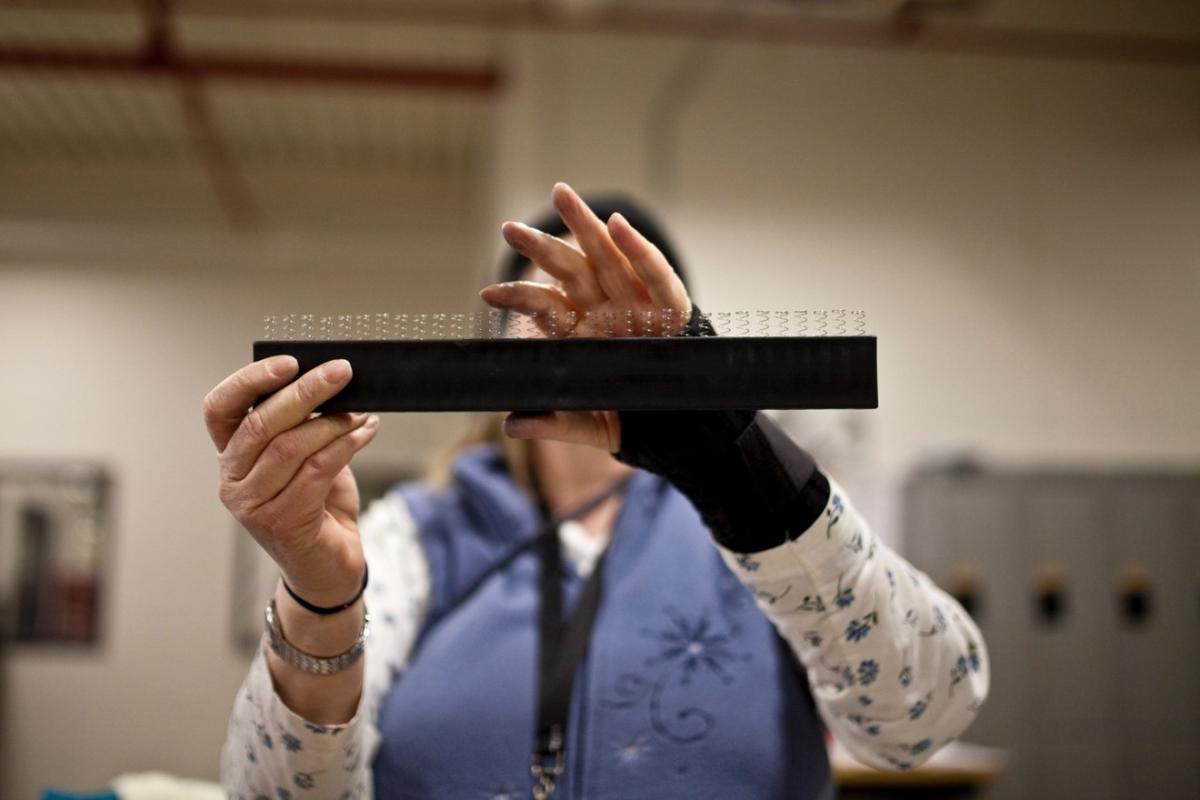
Diane assembles parts on the floor of the Goodwill’s RMHC Social Enterprise program in St.Thomas in April 2014. (Photo credit: Justin Langille Photography)
Image

Steve helps a co-worker navigate a couch out from a basement in the Blackfriars neighbourhood in London, Ontario in April 2014. Returning to work has been essential for Steve’s successful recovery from mental illness and substance abuse. (Photo credit: Justin Langille Photography)
Image

Goodwill RMHC Social Enterprise program employee Donald applies reflective tape to a stack of pylons in March 2014. (Photo credit: Justin Langille Photography)
About Lawson Health Research Institute
Lawson Health Research Institute is one of Canada’s top hospital-based research institutes, tackling the most pressing challenges in health care. As the research institute of London Health Sciences Centre and St. Joseph’s Health Care London, our innovation happens where care is delivered. Lawson research teams are at the leading-edge of science with the goal of improving health and the delivery of care for patients. Working in partnership with Western University, our researchers are encouraged to pursue their curiosity, collaborate often and share their discoveries widely. Research conducted through Lawson makes a difference in the lives of patients, families and communities around the world. To learn more, visit www.lawsonresearch.ca.
Media Contacts
Celine Zadorsky
Senior Media Relations Consultant
Communications & Public Engagement
T: 519-685-8500 ext. 73502
Celine.zadorsky@lhsc.on.ca
Relieving the pain: Current research on pain and its management
11:00pm - 1:00am
There has been an explosion of scientific knowledge that is helping us to uncover the changes that happen when an individual develops pain, giving millions of people the hope that they will be better able to manage their own pain.
Pain is one of the most common reasons people seek medical attention. In Canada, 25 per cent of adults are affected by chronic pain and that statistic moves up to 50 per cent in the elderly.
Acute and ongoing pain have traditionally been hard to understand and there has isn’t always a clear answer for tackling these issues. We do know that ongoing pain can have significant impacts on one’s wellbeing.
Join Lawson Health Research Institute for our next Café Scientifique to hear a panel of experts share more about local research in the areas of:
- The role of opioid and cannabis analgesics in the management of pain.
- The impact of pain for individuals and families, including children experiencing pain, and some of the barriers to its management.
- The growing understanding of the mechanisms of pain to create the best long-term results for patients.
- Educational tools for patients and caregivers.
Speakers
Image

- Dr. Dwight Moulin, Clinical Neurological Sciences and Oncology
- Dr. Naveen Poonai, Paediatric Emergency Medicine
- Dr. Dave Walton, School of Physical Therapy
- MODERATOR – Dr. Kathy Speechley, Epidemiology & Biostatistics
Event Details
Date: Tuesday, November 20, 2018
Time: 7-9 pm (doors open at 6:30 pm)
Location: Best Western Plus Lamplighter Inn & Conference Centre, 591 Wellington Rd, London, ON N6C 4R3
Map and directions
Parking: Ample free parking on-site