


Search
Search
3187 Search Results:
… ~~ SIJOSEPHs HEALTH CARE LONDON Hand Hygiene “Just Ask Us” Did you know? Most … nurse, or visitors touch you, or any items used in your care, ask “Did you clean your hands?” Everyone should clean … BODY, MIND & SPIRIT SINCE 1869 Renowned for compassionate care, St. Joseph’s is one of the best academic health care …
~~ SIJOSEPHs HEALTH CARE LONDON Hand Hygiene Just Ask Us Did you know? Most germs in hospitals are spread by unclean hands. Each time a person touches an object or another person, germs go along for the ride. An infection could prolong your hospital stay. What can you do to decrease the chance of ge...
… BODY, MIND & SPIRIT SINCE 1869 Renowned for compassionate care, St. Joseph’s is one of the best academic health care organizations in Canada dedicated to helping people … of injury, disease and disability through excellence in care, teaching and research. sjhc.london.on.ca Roth …
CARING FOR THE BODY, MIND & SPIRIT SINCE 1869 Renowned for compassionate care, St. Josephs is one of the best academic health care organizations in Canada dedicated to helping people live to their fullest by minimizing the effects of injury, disease and disability through excellence in care, teachin...
… Devices Program? The Ministry of Health and Long-Term Care, through the Assistive Devices Program (ADP), funds the … Devices Program? The Ministry of Health and Long-Term Care, through the Assistive Devices Program (ADP), funds the …
Funding for Pump and/or Supplies Ontarios Assistive Devices Program What is the Assistive Devices Program? The Ministry of Health and Long-Term Care, through the Assistive Devices Program (ADP), funds the purchase of insulin pumps for adults in Ontario. Replacements of previously funded pumps are co...
… letter with medication list and contact numbers for health care team For more information about diabetes and travel … letter with medication list and contact numbers for health care team For more information about diabetes and travel …
Travel with an insulin pump Carry everything that you need on board the airplane. See list below. Additional items may also be packed in checked luggage, but all insulin should be carried with you because it may be exposed to extreme temperatures in transit. Write down your current basal rates and c...
… BODY, MIND & SPIRIT SINCE 1869 Renowned for compassionate care, St. Joseph’s is one of the best academic health care organizations in Canada dedicated to helping people … of injury, disease and disability through excellence in care, teaching and research. sjhc.london.on.ca The following …
CARING FOR THE BODY, MIND & SPIRIT SINCE 1869 Renowned for compassionate care, St. Josephs is one of the best academic health care organizations in Canada dedicated to helping people live to their fullest by minimizing the effects of injury, disease and disability through excellence in care, teachin...
Happy Holidays from Lawson Health Research Institute
As the research institute of London Health Sciences Centre and St. Joseph’s Health Care London, Lawson Health Research Institute excels in rapid response research. We are uniquely positioned to tackle health challenges from within hospital walls.
With the COVID-19 pandemic proving to be one of the most pressing health challenges of our time, 2020 has shone a light on the critical importance of hospital-based research.
We would like to acknowledge the tremendous efforts of Lawson staff, researchers, learners and volunteers during a difficult year. Their remarkable knowledge, creativity and dedication never fails to astound. We also thank those who support health research in many different ways, including donations, study funding, and participation in clinical research.
This year, Lawson has again ranked eighth in the country according to the 2020 edition of “Canada’s Top 40 Research Hospitals List” by Re$earch Infosource, keeping us within the top five in Ontario. We have maintained this position for the past seven years. Here you will find a compilation of Lawson’s top 12 research stories from the past year. We encourage you to share this with your friends and families as there is still much to celebrate in our community.
We wish you all the very best this holiday season.
Harm reduction research is improving care for patients who use substances
Research from Lawson Health Research Institute is helping to advance harm reduction strategies in hospitals for people who use substances. In an announcement today, Arielle Kayabaga, Member of Parliament for London West, on behalf of the Honourable Ya’ara Saks, Canada’s Minister of Mental Health and Addictions, announced how $72,768 in funding from Health Canada’s Substance Use and Addictions Program is supporting this ongoing work at London Health Sciences Centre (LHSC) and St. Joseph’s Health Care London (St. Joseph’s).
“Here in London, just like many other cities across Canada, we’re seeing substance use harms continue to take a tragic toll on our families and friends,” says MP Kayabaga. “We are committed to supporting organizations who are on the ground in communities, helping to keep people who use substances safe.”
Research from Lawson has found patients who use methamphetamine reported stigma and a lack of understanding about addiction among health-care providers and hospital staff. This can sometimes result in patients not seeking care, experiencing withdrawal while receiving care or leaving a hospital against medical advice.
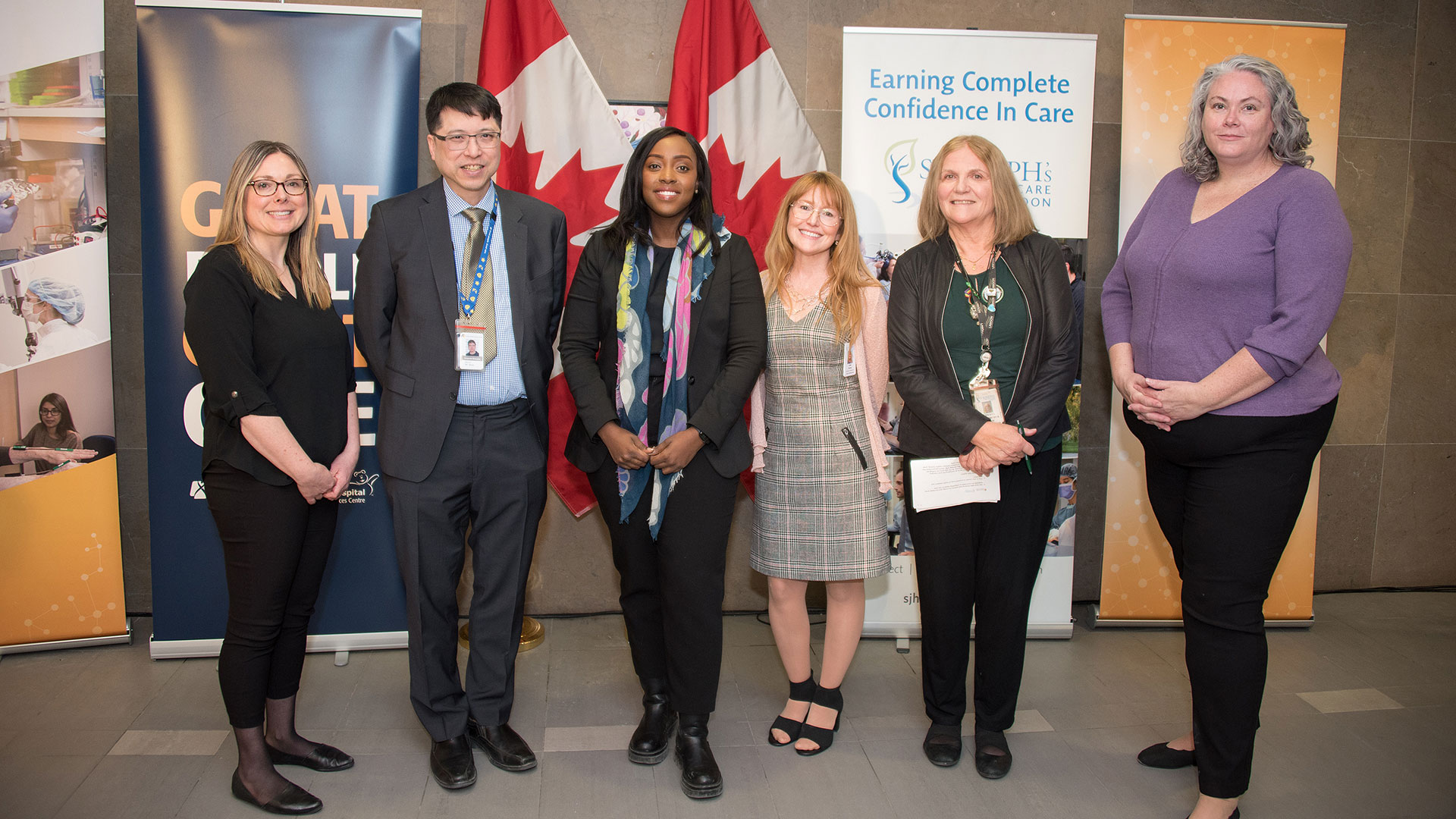
Building on those findings, a team led by Lawson researchers, Drs. Cheryl Forchuk and Michael Silverman, has been working to implement and study harm reduction strategies at LHSC and St. Joseph’s, including those aimed at facilitating changes in attitude, knowledge, organizational support and safety approaches.
“There’s a lot of stigma and misunderstanding about substance use,” says Dr. Forchuk, Scientist and Assistant Scientific Director at Lawson. “This project aims to embed education on substance use and harm reduction as a foundational way to improve care and outcomes.”

As part of the research project, Darren Scott, a Peer Harm Reduction Worker with Regional HIV/AIDS Connection who has lived experience with substance use, and Tammy Fischer, a Clinical Nursing Educator in LHSC’s Mental Health and Addictions Program, have been working to educate health-care workers about harm reduction practices.
“I am able to share with patient caregivers how I was treated while I was in active addiction,” shares Scott. “I can let them know what people are going through from the other side and provide advice on how to care for them. The health-care teams have been fantastic and very open-minded throughout this project. I have received feedback that it is vital to include people with lived experience in this education.”
One area of focus from this study has been education around sharps boxes in inpatient hospital rooms. Sharps boxes allow for the safe disposal of sharps like needles to protect the health and safety of patients and health-care teams. Through this study, the research team identified that when sharps boxes are removed from the rooms of patients suspected of using substances to discourage substance use it leads to harm.
“About half of patients who use substances are still using in-hospital, since suddenly stopping use is often not feasible nor safe. Access to sharps boxes decreases the risk of injury to health-care teams and patients,” Fischer explains. “People who use any injection must have safe means to dispose of used equipment.”
The team launched a campaign to educate health-care teams on the importance of keeping sharps boxes in patient rooms. Preliminary data from interviews with patients who use substances found they noticed a difference after this education. Patients felt more comfortable speaking to health-care teams and noted they could be more open about discussing their addiction.
Government of Canada funding is critically important to this work and builds on just over $1 million in previously announced funding. The project is one of several harm reduction research initiatives being explored collaboratively through LHSC and St. Joseph’s to ensure people who use substances receive the highest quality of equitable care.
“This investment is part of our comprehensive and compassionate approach to reducing harms as a result of substance use. We will continue to use every tool at our disposal to build a safer, healthier and more caring future for all Canadians,” says Minister Saks. “Supporting local organizations who have deep roots in their communities and have the trust of their patients is making a real difference in people’s lives in the community of London, Ontario.”
… For non-sinus headaches you should consult your primary care physician or a neurologist (preferably a headache … can understand and participate in their own medical care Accessibility Report Filename: … For non-sinus headaches you should consult your primary care physician or a neurologist (preferably a headache …
HEADACHES AND SINUS DISEASE INTRODUCTION Headache is very common and affects millions of adults in the US. Headaches have many causes and can present in a variety of ways. Most headaches are not related to sinus disease. Among patients who have sinus disease, some patients have headaches related to,...
Health research in London receives millions in funding from federal government
Lawson Health Research Institute was awarded over $1.2 million in the Canadian Institutes of Health Research’s Fall 2019 Project Grant competition, for three projects including one Priority Announcement.
“This is a great accomplishment for the successful researchers at Lawson and those working across the city,” says Dr. David Hill, Lawson Scientific Director. “At Lawson, our scientists target rapid response research that can be quickly incorporated into improved care for patients and families. Our research happens within hospital walls, where care is delivered, with innovations that improve lives every day.”
Western University received more than $11.9 million in research funding through the project grant competition for 17 projects. A special congratulation to Lawson researchers Drs. Samuel Asfaha, Thomas Appleton, Neil Duggal, David Spence and Zhu-Xu Zhang, as well as Dr. Subrata Chakrabarti, recipient of the CIHR Priority Announcement for “Novel mechanisms in diabetic cardiomyopathy.”
Selective Brain Hypothermia via Intranasal Cooling to Limit Brain Injury Post Cardiac Arrest
Dr. Ting-Yim Lee
There are 40,000 cardiac arrests per year in Canada. Within the body, it triggers a complex cascade of dysfunction resulting in cell death, even after successful cardiopulmonary resuscitation, with only three to seven per cent of survivors returning to normal function.
To reduce the high incidence of brain damage and the burden on families, the American Heart Association has recommended hypothermia for neuroprotection in post cardiac arrest care.
However, current clinical hyperthermia cools the whole body instead of just the brain. Simple, effective and non-invasive methods to selectively cool the brain that can be readily used in and out of hospitals are not available.
Image

“The grant is allowing us to collect validative data on the protective effect of brain cooling in limiting brain injury from cardiac arrest,” explains Dr. Lee. “The device is very convenient to use. It is compact and can be set up right by the bedside of patients in intensive care units.”
Dr. Lee sees the device as having the potential to be used widely to limit brain injury following stroke, head trauma and sepsis.
“This kind of investment in hospital-based research allows us to identify important clinical problems and find ways to solve them, working closely with research patients along the way.”
Multi-centre diagnostic performance of dynamic CT perfusion for functional assessment of multi-vessel coronary artery disease with dense coronary calcification
Dr. Aaron So
Coronary artery disease (CAD) occurs when plaque forms in one or more coronary arteries of the heart. It is one of the leading causes of mortality and morbidity in the world.
Patients with CAD can go to a cardiac catheterization laboratory where the narrowed coronary artery can be reopened using a catheter-based technique. However, this approach is invasive for the patient and costly for the system. Studies have shown that for various reasons not all patients benefit from this treatment.
Image

With the funding, they are testing the technique at several hospitals and national cardiovascular centres in Canada, China, Germany and Japan. With larger clinical studies in the future, they could determine the optimal diagnostic strategy for patient triage and reduce unnecessary procedures.
“Health research has been and will continue to be very important, with the commitment of patients and clinicians playing a crucial role in the success of medical research and advancement,” says Dr. So. “It’s important for the Canadian government to continue to support research in academic hospitals.”
He adds that the success of the CIHR grant application shows that Canadian researchers can be leaders in health research that benefits people around the world.
Filling Knowledge Gaps for the Success of Ontario Renal Plan 3
Dr. Matthew Weir
The Ontario Renal Network (ORN) is the agency responsible for distribution of funding for kidney care in Ontario. They have released three policy statements outlining strategic objectives for kidney care, with the most recent being the recently released Ontario Renal Plan 3 (ORP3).
“Within the strategic objective, gaps in our understanding of kidney disease have been identified as barriers to successful implementation,” explains Dr. Weir. “We have proposed a suite of 32 related retrospective cohort analyses designed using integrated knowledge translation to address those gaps.”
The Priority funding will help get the first projects underway and build momentum. “The ORP3 had extensive consultation with patients, families and other stakeholders. By supporting its successful implementation, our findings will have a direct and immediate effect on patients in areas that are a priority to them.”
Image
Scientist
Health researchers in London bring in over $11 million of national funding
The Canadian Institutes of Health Research (CIHR) announced more than $11.3 million in funding through their project grants program for 17 health research projects across Lawson Health Research Institute and Western University.
“The funded projects represent a wide range of research and expertise from London’s health research community, with real impacts for health and health care,” says Dr. David Hill, Lawson Scientific Director. “Congratulations to those successful applicants who have secured this funding on a very tough competition.”
Projects include a national study on transgender health; a community-based family treatment program for children with epilepsy; imaging of blood clots in the brain; equity in mental health care for children and youth; and, a smartphone intervention focused on diet and food literacy.
See the full list of successful applicants.
Cooling the Brain after Resuscitated Cardiac Arrest to Prevent Brain Injury
There are 40,000 cardiac arrests each year in Canada. A high number of patients won’t survive the event and nearly half of the survivors suffer from brain damage that can have a huge impact on their ability to live independently. The current guidelines recommend cooling of the whole body to protect the brain against the damaging effects of cardiac arrest. However, in the clinic there are several hurdles for this treatment that can create complications. Enhanced brain protection may be achieved by selectively cooling the brain but a simple, effective and non-invasive method to do so is needed.
Dr. Ting-Yim Lee and his research team are studying a simple means to cool down the brain by blowing compressed air into the nostrils which would essentially chill the warm blood coming through the nasal cavity on its way to the brain. Using an animal model, their aim is to show that the method can be used safely and is able to protect the brain after cardiac arrest.
Image

Image

The DECIPHER Study
Shoulder fractures are becoming increasingly common for older adults and cause considerable limitations and impacts for their daily life. While different approaches are taken to treat shoulder fractures, there is a lack of knowledge and evidence to show which of those methods are the most effective and for which patients.
Dr. Emil Schemitsch and his research team are proposing the first nation-wide, multi-centre observational study with over 600 patients with the ultimate goal of determining what specific factors influence important outcomes for patients. The DECIPHER study will seek to answer important questions about which treatment and rehabilitation strategies are best for different patients, strengthening the clinical strategy for managing these difficult and prevalent injuries. It will also provide an economic analysis to understand the impact for healthcare system costs.
Image

Congratulations to all of the successful applicants:
- Greta Bauer and Ayden Scheim - Trans PULSE Canada: A National Study of Transgender Health
- Maria Drangova - Characterizing cerebral thrombus composition with Phase‐based MRI
- David Edgell, Bogumil Karas, and Gregory Gloor - ConCRISPR: Conjugative delivery of a hybrid CRISPR/Tev nuclease system for specific microbiota modulation in the mammalian gut
- Jason Gilliland - Evaluation of a Smartphone Based Intervention for Improving Food Literacy, Food Purchasing, and Diet Quality Among Youth in Urban, Suburban, and Rural Environments
- Douglas Hamilton - Novel Biomaterials‐Based Strategies to Stimulate Periodontal Tissue Regeneration
- David Haniford - Regulation of Salmonella pathogenesis by transposon‐encoded small regulatory RNAs
- Steven Laviolette - Effects of Neurodevelopmental Exposure to Cannabinoids on Prefrontal Cortical Function: Implications for Neuropsychiatric Disorders
- Ting-Yim Lee - Selective Brain Hypothermia via Intranasal Cooling to Limit Brain Injury Post Cardiac Arrest (Funded through Lawson Health Research Institute)
- Stephen Lomber - Cortical Plasticity Following Deafness
- Vania Prado - Cholinergic influence in aging and brain pathology
- Graham Reid and William Gardner - Equity in Mental Health Care for Children and Youth
- Jason Roberts - The Role of Electrophysiology Testing in Survivors of Unexplained Cardiac Arrest: The EPS ARREST Study
- Emil Schemitsch - The DECIPHER Study: DEterminants of Function and Clinically Important outcomes in Proximal Humerus Fractures in the Elder Population: A National CohoRt (Funded through Lawson Health Research Institute)
- Walter Siqueira and Elizabeth Gillies - Novel Drug Delivery System for the Combat of Dental Caries by using Salivary Peptides
- Kathy Speechley and Karen Bax - A Community-Based Family Treatment Program for Children with Epilepsy: A Randomized Controlled Trial
- Andrew Watson - Understanding and Treating Obesity Related loss of Embryo Developmental Competence
- Donald Welsh - Kir Channel Regulation by Membrane Lipids: An Enabler of Hemodynamic Sensing in the Cerebral Circulation
… Institute Main Building ☐ Parkwood Institute Mental Health Care ☐ Southwest Centre To fulfill the terms and conditions … to Occupational Health and Safety at St Joseph’s Health Care London. ☐ Provide proof of COVID-19 vaccine. ☐ Receive … Public Health recommendations and St. Joseph's Health Care London policies and processes related to COVID …
August 2021 HEALTH REVIEW FORM Paid Staff Private Hire St. Josephs Mt. Hope Parkwood Institute Main Building Parkwood Institute Mental Health Care Southwest Centre To fulfill the terms and conditions of your employment offer, the following information must be provided to Occupational Health a...
… Institute Main Building ☐ Finch Family Mental Health Care ☐ Southwest Centre ☐HMMS ☐Family Medical Centre … to Occupational Health and Safety at St Joseph’s Health Care London. Provide proof of COVID-19 vaccine. ☐ … Institute Main Building ☐ Finch Family Mental Health Care ☐ Southwest Centre ☐HMMS ☐Family Medical Centre …
HEALTH REVIEW FORM Volunteer Co-Op Student Post-Secondary Student Sponsored Student Proof of immunization is required and includes any of the following: Vaccination records from yellow immunization cards, immigration records, notes from a physicians office, copies of laboratory reports (titre le...
… may be obtained at your family physician/primary care office, local health unit, or community clinic. … Email: OHSS-medicalaffairs@lhsc.on.ca St. Joseph’s Health Care London Occupational Health and Safety Services P.O. Box … via local COVID-19 Vaccination Clinic Sites and primary care settings. Important information about COVID-19 …
1 CITY-WIDE HEALTH SCREEN FOR PROFESSIONAL STAFF/RESIDENTS/CLINICAL FELLOWS Anticipated Start Date of Clinical Placement (YYYY/MM/DD): Anticipated End Date of Clinical Placement (YYYY/MM/DD): First Name: Last Name: Gender: Date of Birth (YYYY/MM/DD): Family Physician: CPSO #: Phone: Email: Emergency...
… may be obtained at your family physician/primary care office, local health unit, or community clinic. … Email: OHSS-medicalaffairs@lhsc.on.ca St. Joseph’s Health Care London Occupational Health and Safety Services P.O. Box … VACCINATIONS Hepatitis B It is recommended that all health care workers receive a course of Hepatitis B vaccine. For …
CITY-WIDE HEALTH SCREEN FOR PROFESSIONAL STAFF/RESIDENTS/CLINICAL FELLOWS Anticipated Start Date of Clinical Placement (YYYY/MM/DD): Anticipated End Date of Clinical Placement (YYYY/MM/DD): First Name: Last Name: Gender: Date of Birth (YYYY/MM/DD): Family Physician: CPSO #: Phone: Email: Emergency C...
… may be obtained at your family physician/primary care office, local health unit, or community clinic. … Email: OHSS-medicalaffairs@lhsc.on.ca St. Joseph’s Health Care London Occupational Health and Safety Services P.O. Box … VACCINATIONS Hepatitis B It is recommended that all health care workers receive a course of Hepatitis B vaccine. For …
CITY-WIDE HEALTH SCREEN FOR PROFESSIONAL STAFF/RESIDENTS/CLINICAL FELLOWS Anticipated Start Date of Clinical Placement (YYYY/MM/DD): Anticipated End Date of Clinical Placement (YYYY/MM/DD): First Name: Last Name: Gender: Date of Birth (YYYY/MM/DD): Family Physician: CPSO #: Phone: Email: Emergency C...
… may be obtained at your family physician/primary care office, local health unit, or community clinic. … Email: OHSS-medicalaffairs@lhsc.on.ca St. Joseph’s Health Care London Occupational Health and Safety Services P.O. Box … via local COVID-19 Vaccination Clinic Sites and primary care settings. Important information about COVID-19 …
1 CITY-WIDE HEALTH SCREEN FOR PROFESSIONAL STAFF/RESIDENTS/CLINICAL FELLOWS Anticipated Start Date of Clinical Placement (YYYY/MM/DD): Anticipated End Date of Clinical Placement (YYYY/MM/DD): First Name: Last Name: Gender: Date of Birth (YYYY/MM/DD): Family Physician: CPSO #: Phone: Email: Emergency...
… TB testing may be obtained at your family physician/primary care office, local health unit, or community clinic. … via local COVID-19 Vaccination Clinic Sites and primary care offices. Important information about COVID-19 … VACCINATIONS Hepatitis B It is recommended that all health care workers receive a course of Hepatitis B vaccine. For …
1 CITY-WIDE HEALTH SCREEN FOR VISITING ELECTIVES Anticipated Start Date of Clinical Placement (YYYY/MM/DD): Anticipated End Date of Clinical Placement (YYYY/MM/DD): First Name: Last Name: Gender: Date of Birth (YYYY/MM/DD): Family Physician: CPSO #: Phone: Email: Emergency Contact Person: Contacts P...
… may be obtained at your family physician/primary care office, local health unit, or community clinic. … VACCINATIONS Hepatitis B It is recommended that all health care workers receive a course of Hepatitis B vaccine. For … Tetanus/Diphtheria vaccination. Those who are providing care to pregnant women and/or children should receive a Tdap …
1 CITY-WIDE HEALTH SCREEN FOR VISITING ELECTIVES Anticipated Start Date of Clinical Placement (YYYY/MM/DD): Anticipated End Date of Clinical Placement (YYYY/MM/DD): First Name: Last Name: Gender: Date of Birth (YYYY/MM/DD): Family Physician: CPSO #: Phone: Email: Emergency Contact Person: Contacts P...
… may be obtained at your family physician/primary care office, local health unit, or community clinic. … VACCINATIONS Hepatitis B It is recommended that all health care workers receive a course of Hepatitis B vaccine. For … Tetanus/Diphtheria vaccination. Those who are providing care to pregnant women and/or children should receive a Tdap …
1 CITY-WIDE HEALTH SCREEN FOR VISITING ELECTIVES Anticipated Start Date of Clinical Placement (YYYY/MM/DD): Anticipated End Date of Clinical Placement (YYYY/MM/DD): First Name: Last Name: Gender: Date of Birth (YYYY/MM/DD): Family Physician: CPSO #: Phone: Email: Emergency Contact Person: Contacts P...