


Search
Search
3187 Search Results:
Dr. s copy ( Western Schulich School of Medicine & Dentistrys copy ( Department of s copy ( Medical Affairs copy ( THIS LETTER OF OFFER IS ONLY TO BE ISSUED AFTER CONFIRMATION OF THREE SATISFACTORY REFERENCES FOR THE CANDIDATE. Dea...
Dr. s copy Western Schulich School of Medicine & Dentistrys copy Department of s copy Medical Affairs copy THIS LETTER OF OFFER IS ONLY TO BE ISSUED AFTER CONFIRMATION OF THREE SATISFACTORY REFERENCES FOR THE CANDIDATE. Dear Dr.
Dr. s copy ( Western Schulich School of Medicine & Dentistrys copy ( Department of s copy ( Medical Affairs copy ( THIS LETTER OF OFFER IS ONLY TO BE ISSUED AFTER CONFIRMATION OF THREE SATISFACTORY REFERENCES FOR THE CANDIDATE. Dea...
Dr. s copy Western Schulich School of Medicine & Dentistrys copy Department of s copy Medical Affairs copy THIS LETTER OF OFFER IS ONLY TO BE ISSUED AFTER CONFIRMATION OF THREE SATISFACTORY REFERENCES FOR THE CANDIDATE. Dear Dr.
Dr. s copy ( Western Schulich School of Medicine & Dentistrys copy ( Department of s copy ( Medical Affairs copy ( THIS LETTER OF OFFER IS ONLY TO BE ISSUED AFTER CONFIRMATION OF THREE SATISFACTORY REFERENCES FOR THE CANDIDATE. Dea...
Dr. s copy Western Schulich School of Medicine & Dentistrys copy Department of s copy Medical Affairs copy THIS LETTER OF OFFER IS ONLY TO BE ISSUED AFTER CONFIRMATION OF THREE SATISFACTORY REFERENCES FOR THE CANDIDATE. Dear Dr.
Dr. s copy ( Western Schulich School of Medicine & Dentistrys copy ( Department of s copy ( Medical Affairs copy ( THIS LETTER OF OFFER IS ONLY TO BE ISSUED AFTER CONFIRMATION OF THREE SATISFACTORY REFERENCES FOR THE CANDIDATE. Dea...
Dr. s copy ( Western Schulich School of Medicine & Dentistrys copy ( Department of s copy ( Medical Affairs copy ( THIS LETTER OF OFFER IS ONLY TO BE ISSUED AFTER CONFIRMATION OF THREE SATISFACTORY REFERENCES FOR THE CANDIDATE. Dea...
Dr. s copy ( Western Schulich School of Medicine & Dentistrys copy ( Department of s copy ( Medical Affairs copy ( THIS LETTER OF OFFER IS ONLY TO BE ISSUED AFTER CONFIRMATION OF THREE SATISFACTORY REFERENCES FOR THE CANDIDATE. Dea...
Dr. s copy ( Western Schulich School of Medicine & Dentistrys copy ( Department of s copy ( Medical Affairs copy ( THIS LETTER OF OFFER IS ONLY TO BE ISSUED AFTER CONFIRMATION OF THREE SATISFACTORY REFERENCES FOR THE CANDIDATE. Dea...
Dr. s copy ( Western Schulich School of Medicine & Dentistrys copy ( Department of s copy ( Medical Affairs copy ( THIS LETTER OF OFFER IS ONLY TO BE ISSUED AFTER CONFIRMATION OF THREE SATISFACTORY REFERENCES FOR THE CANDIDATE. Dea...
Dr. s copy ( Western Schulich School of Medicine & Dentistrys copy ( Department of s copy ( Medical Affairs copy ( THIS LETTER OF OFFER IS ONLY TO BE ISSUED AFTER CONFIRMATION OF THREE SATISFACTORY REFERENCES FOR THE CANDIDATE. Dea...
Dr. s copy ( Western Schulich School of Medicine & Dentistrys copy ( Department of s copy ( Medical Affairs copy ( THIS LETTER OF OFFER IS ONLY TO BE ISSUED AFTER CONFIRMATION OF THREE SATISFACTORY REFERENCES FOR THE CANDIDATE. Dea...
Dr. s copy Western Schulich School of Medicine & Dentistrys copy Department of s copy Medical Affairs copy THIS LETTER OF OFFER IS ONLY TO BE ISSUED AFTER CONFIRMATION OF THREE SATISFACTORY REFERENCES FOR THE CANDIDATE. Dear Dr.
Dr. s copy ( Western Schulich School of Medicine & Dentistrys copy ( Department of s copy ( Medical Affairs copy ( THIS LETTER OF OFFER IS ONLY TO BE ISSUED AFTER CONFIRMATION OF THREE SATISFACTORY REFERENCES FOR THE CANDIDATE. Dea...
Dr. s copy Western Schulich School of Medicine & Dentistrys copy Department of s copy Medical Affairs copy THIS LETTER OF OFFER IS ONLY TO BE ISSUED AFTER CONFIRMATION OF THREE SATISFACTORY REFERENCES FOR THE CANDIDATE. Dear Dr.
Dr. s copy ( Western Schulich School of Medicine & Dentistrys copy ( Department of s copy ( Medical Affairs copy ( THIS LETTER OF OFFER IS ONLY TO BE ISSUED AFTER CONFIRMATION OF THREE SATISFACTORY REFERENCES FOR THE CANDIDATE. Dea...
… Questions Break 10:00-12:00 Objective DIGNITY IN DYING & CAREGIVING Helen Butlin-Battler, M. Div., Specialist in Spiritual Care, London Regional Cancer Centre Discover approaches that will promote dignity- conserving care 12:00-12:15 12:15-1:00 Questions Lunch 1:00-2:00 …
ADVANCED REGISTRATION ONLY REGISTER BY OCTOBER 17, 2014 (NO EXCEPTIONS) For Complete Conference Details and Registration: www.sjhc.london.on.ca/HPCRD For registration questions or concerns please contact Betty Tucker at 519-685-4086 or by email: betty.tucker@sjhc.london.on.ca This program meets the ...
Hospital-based research delivers high quality and efficient patient care
On January 10, 2020, the Honourable Jeff Yurek, Minister of Environment, Conservation and Parks and MPP for Elgin-Middlesex-London, joined London Health Sciences Centre (LHSC), Lawson Health Research Institute and the Ontario Hospital Association for a research tour at LHSC’s University Hospital.
This tour was organized to afford the Minister the ability to see first-hand how research-intensive hospitals like those in London are helping to deliver high quality and efficient patient care to people across the province and beyond.
At University Hospital, Drs. Matthew Teeter and Brent Lanting are leading clinical research in hip and knee replacement that is reducing the time patients are in hospital following surgery. They are utilizing wearable technology to better assess how patients are doing, flag issues and predict outcomes, while partnering with industry to develop the next generation of implants.
Image
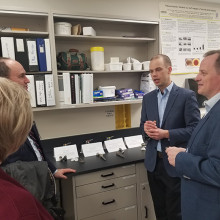
Dr. Teeter leads one of Canada’s only Implant Retrieval Labs, which stores thousands of failed hip, knee and shoulder implants retrieved from patients. Surgeons and scientists from all over the world send implant specimens to London to be imaged and studied.
As the research institute of LHSC and St. Joseph’s Health Care London, Lawson’s researchers and their teams are helping people live their life to the fullest by minimizing the effects of injury, disease and disability. Research is done within hospital walls and can be directly implemented into patient care.
This includes ground breaking work in minimally invasive and robotic cardiac surgeries let by Dr. Michael Chu and the cardiac surgery team. They have helped patients like Maria Bruno who shared her experience as a patient, and the impact on her own life and that of her family.
Image
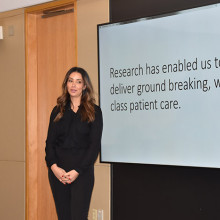
“Today, my heart is in perfect condition,” shares Maria. “The ability to perform this procedure is unique in Canada. I’m forever grateful to this hospital and Dr. Chu for being able to repair it. I’m a huge advocate for continued research because there are many, many patients who could benefit.”
As an active clinician researcher, Dr. Chu also investigates augmented reality image guidance in minimally invasive valve surgery, experimental transcatheter technology and complex aortic reconstruction. In 2019, Dr. Chu along with colleagues from University Health Network published a high-impact finding that women are more likely to experience poorer outcomes following aortic surgery.
Dr. Mandar Jog is a world leader in his field, revolutionizing treatment for people with movement disorders including Parkinson’s disease and essential tremor. Last year, his work on spinal cord stimulation was covered by BBC World News.
Patients Real Beaulieu and Guy Alden who have been involved with the team’s clinical trials told the Minister about the dramatic improvements in their quality of life
Image
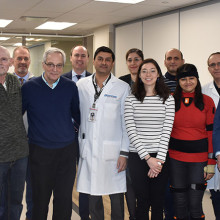
“With the tremor, I was at the point where I couldn’t write, I couldn’t get a key in the key hole. I couldn’t function normally in life and it was embarrassing for me,” remembers Real. “After the treatment with Dr. Jog, it was a huge turnaround for me and how I could live my life.”
Hospital-based research is critical to supporting health care in Ontario. “Health research is a necessity in order to provide the best care for patients and ensure the health system is sustainable. Researchers, clinicians, staff and trainees working at hospital sites across the city are driving important discoveries that continually improve patient care,” says Dr. David Hill, Lawson Scientific Director and Integrated VP, Research for LHSC and St. Joseph’s Health Care London.
Scientist
Hospital-based research in London ranked in the top 10 for Canada
Lawson Health Research Institute is ranked eighth in the country according to the 2018 edition of “Canada’s Top 40 Research Hospitals List” by Re$earch Infosource. This strong position has been maintained by Lawson for the past five years and also keeps the institute within the top five institutions in Ontario.
The research institute of London Health Sciences Centre (LHSC) and St. Joseph’s Health Care London (St. Joseph’s), Lawson has also maintained the top ranking for research intensity among the large tier institutions, with $616,300 of research spending per researcher.
“As a hospital-based research institute, our innovation happens where care is delivered,” says Dr. David Hill, Lawson Scientific Director. “Every day, teams of researchers are working directly with clinicians and patients to improve treatments, or create entirely new ones. They find innovative methods of delivering services that drive efficiency and reduce costs.”
The top 40 list analyzes hospital-based research institutes from across the country on several metrics, including total research income from the previous fiscal year. The ranking looks at funds received from all sources, including both internal and external, to support research at the organization. According to the report, Lawson received $123,255 million in research income in 2017, which was a 0.8 per cent drop from the previous fiscal year.
Dr. David Hill advocates for increased scientific funding nationally. “We held our position despite the modest decrease in funding. Canada as a whole requires significant investment in scientific discovery to increase the well-being of Canadians and build a robust economy.”
This year, a special spotlight on intellectual property (IP) is showcasing the top Canadian organizations – universities, corporations, hospitals and government departments/agencies – patenting at the US Patent and Trademark Office.
Lawson, as the research institute of LHSC and St. Joseph’s, is featured in the top 10 list for Hospital Patent Leaders as measured by ownership of patents granted between 2013-2017. Lawson has ranked in the sixth spot with 13 patents owned.
Commercialization opportunities are managed through WORLDiscoveries®, the business development arm of London’s extensive research network. Born out of a partnership between Lawson, Robarts Research Institute and Western University, WORLDiscoveries® draws upon a mix of industry connections, sector-specific market knowledge, and business development expertise to help researchers and local inventors commercialize their discoveries through licensing and new company spin-offs.
“We support technology development and licensing agreements by taking local knowledge and discoveries to industry partners worldwide,” explains Dr. Hill. “Research-intensive hospitals are improving health care, creating jobs and contributing to the country’s growing knowledge economy.”
Featured Innovations
A Stroke of Genius
Image

Based at St. Joseph’s Hospital in London, Dr. Ting-Yim Lee specializes in computed tomography (CT) imaging, a type of x-ray technology that captures images of slices of the body. As a young scientist, he dreamed of using CT imaging to measure how blood flows in the human body. The idea was to develop software that could be installed on existing CT scanners to make quick, easy work of a very complex algorithm. If a patient came to the emergency room suffering from a stroke, it would allow the doctor to quickly analyze and address the damage.
Thanks to decades of public and private sector support, Dr. Lee’s idea has evolved from concept to prototype to clinically-approved product. Through a licensing deal with GE Healthcare, his software is now installed on 70 per cent of the company’s new CT scanners on the market. It’s currently in use in more than 8,000 hospital imaging departments around the world.
Stroke is a situation where every minute of delay in treatment has grave consequences on the recovery of the patient, and this software allows physicians to quickly decide on the best treatment for the patient. Dr. Lee is extending his technology to measure blood flow in whole organs, including predicting and monitoring how cancer and heart attacks respond to treatment. The royalties from the licenses enabled Lawson to install Canada’s first PET/CT scanner to complement CT Perfusion with metabolic information from PET scanning.
Novel discovery in the field of Parkinson’s Disease
Image

In addition to a busy neurosurgery practice, Dr. Matthew Hebb maintains a highly productive research program. Dr. Hebb is creating tools to advance Parkinson’s Disease research and therapeutics across the globe. Parkinson’s Disease is characterized by progressive neurological impairment caused by the death of cells in the nervous system. Dr. Hebb’s team provided a novel description of brain-derived progenitor cells (BDPCs) that could protect and stimulate re-growth of disease-affected neurons. This discovery may offer critical insight into the disease process and provide a new personalized source of brain-derived cells for delivering therapy back into the same individual.
By using a patient’s own BDPCs, Dr. Hebb hopes to slow or halt disease progression and stimulate regeneration of damaged brain circuitry. BDPCs may further advance drug, genetic and functional screening across broad patient populations. This work also resulted in a patent and partnership with STEMCELL Technologies to develop innovative research tools for Parkinson’s Disease and other incurable neurological diseases.
Computer assisted surgical techniques and technologies
Image
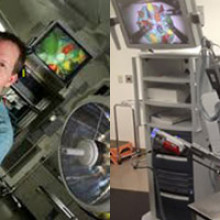
Dr. Christopher Schlachta is Medical Director of CSTAR, the Canadian Surgical Technologies & Advanced Robotics, at LHSC. His current research interests are focused on development of computer-assisted surgical techniques and technologies to enhance care and training. Along with his team, he has demonstrated how computer-assisted technologies in the operating room can enhance communication among surgeons and trainees to produce better outcomes for patients. He is currently partnering with industry to commercialize operating room technology developed with engineers at CSTAR.
His Wireless Hands-free Surgical Pointer system incorporates infrared and inertial tracking technologies to address the need for hands-free pointing during minimally invasive surgery. The combination of these technologies allows for optimal movement of the pointer and excellent accuracy while the user is located at a realistic distance from the surgical monitor.
Smart tech, smart treatment for movement disorders
Image
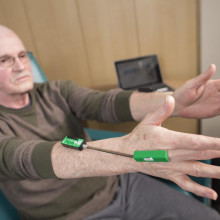
Dr. Mandar Jog operates the London Movement Disorders Centre and has driven the development of TremorTek, a wearable sensor technology that has already successfully treated hundreds of research patients who suffer from tremors in their arms and hands. These tremors, typically caused by Parkinson’s disease or essential tremor, are a common movement disorder symptom yet there is no effective treatment. Neurotoxin therapy has been identified as a possible treatment for tremors; however, an injection in the wrong place or at the wrong dose can cause negative side effects. Everyone experiences tremors in different ways – the location and strength of the movements, and how often they occur varies widely.
Using commercially available sensor technology, Dr. Jog and his team were able to isolate independent muscle movements. They created a system that matched the muscle activity pinpointed by the sensors with the correct amount of toxin to administer. This kinematic technology can be applied to the pre-treatment assessment of patients and the information generated can guide the placement of botulinum toxin. The technology has been taken by a spinoff company MDDT Inc. that has been working with numerous stakeholders interested in its applications.
Scientist