


Search
Search
121 Search Results:
… recommended changes that emanate from this strategic directions process. As always, I appreciate and will rely on … the opening St. Joseph’s Mental Health Care Building at Parkwood Institute “This building is designed with the belief that … recommended changes that emanate from this strategic directions process. As always, I appreciate and will rely on …
January 2015 In this Issue Page 1: Comment from David Nash Page 2: CHAO Convention reprise Pages 3 CHAO Mission Leadership Program Pages 4-9 Around the Province Page 9 Editors Note May we live in interesting times It is my pleasure on behalf of the Board and staff of CHAO to wish all CHAO members a ...
… their ID badge and security items on their first day. ☐ Directions and Parking Information: Please visit the Student … your training needs with the coordinator or delegate. ☐ Parkwood Main and Mount Hope Sites Only: The … placement. Exception: Clinical groups learning at Parkwood Institute Mental Health Care Building or Southwest Centre …
Package Clinical Instructor Orientation Name: School: Clinical Placement Term: St; Josephs Employee Yes No Prior to the START of Placement Check each of the below boxes, once completed/discussed Indicate /A for 'not applicable' Corporate Network Login: You will receive your corporate hospital log...
… Health Care London Or Mount Hope Centre for Long-Term Care Parkwood Institute Main Building Parkwood Institute Mental Health … the reporting caller. 2.2.3. Remain on the line for further directions from the AOC. 2.3. When authorized by the AOC, … the reporting caller. 2.2.3. Remain on the line for further directions from the AOC. 2.3. When authorized by the AOC, …
CORPORATE PROCEDURE EMC006 Procedure: Code Orange External Disaster Owner: Director, Patient Relations, Security Services and Chief Privacy and Risk Officer Sponsor: Vice President, Patient Care and Risk Approval by: Emergency Management Committee Date: 2023-06-22 Original Effective Date: 2018-05-1...
… FEEL YOUNG AT HEART On Valentine’s Day, Veterans at Parkwood Institute shined up their dancing shoes for a seniors prom. … with corsages for the ladies, a photo booth, live band, ballroom dancing demonstrations and the gift of feeling young … FEEL YOUNG AT HEART On Valentine’s Day, Veterans at Parkwood Institute shined up their dancing shoes for a …
Back row left: Holly Bridge, Diane Davis-Miller, Barb Simmonds Front row left: Dr. Jennifer Bjazevic, Roger Blum, Leanne Summers, Dr. Hassan Razvi, Surgical Services You make health care innovation possible. Just one of the reasons why YOU HELPED ENHANCE OUR OPERATING ROOMS 20192020 Community Impact...
… across St. Joseph’s quickly and expertly pivoted to meet challenges during the pandemic. Seen here, team members from … cases began emerging in London, Lawson Health Research Institute’s (Lawson) health scientists quickly responded by … and minds were kept active in the Dual Diagnosis Program at Parkwood Institute with indoor and outdoor sensory and …
In response to COVID-19, care providers across St. Josephs quickly and expertly pivoted to meet challenges during the pandemic. Seen here, team members from the Urgent Care Centre at St. Josephs Hospital. Learn how donors made all the difference on pg. 3. 20202021 Community Impact Report Your donati...
… Health Care London or Mount Hope Centre for Long-Term Care Parkwood Institute Main Building Parkwood Institute Mental Health … for Forensic Mental Health Care (If this policy applies to all sites, please check St. Joseph’s Health Care London … Health Care London or Mount Hope Centre for Long-Term Care Parkwood Institute Main Building Parkwood Institute Mental …
~ SIJOSEPHs HEALTH CARE LONDON ~ CORPORATE STF063 Policy: COVID-19 Vaccination Owner: Director, Occupational Health and Infection Control Integrated Director, Medical Affairs Sponsor: Vice President, Human Resources and Facilities Integrated Vice President, Medical and Academic Affairs Approval...
… means St. Joseph’s Health Care, London, where its programs and services reflect the Catholic tradition and … means a member of the Board; (u) “Excellent Care for All Act” means the Excellent Care for All Act, 2010 … of Mount Hope Centre for Long Term Care or Veterans Care at Parkwood Main; (hh) “Physician” means a medical practitioner …
ST. JOSEPHS HEALTH CARE, LONDON CREDENTIALED PROFESSIONAL STAFF BY-LAW EFFECTIVE APRIL 1, 2024 AMENDED AND APPROVED BY THE: ST. JOSEPHS BOARD OF DIRECTORS - January 29, 2024 ST. JOSEPHS HEALTH CARE SOCIETY - March 27, 2024 Contents Article 1 Definitions and Interpretation 0 ...........................
Easing the pressure for patients with chronic wounds
Chronic wounds represent a significant burden in Canada. Between four and 30 per cent of patients develop a chronic wound, depending on the health care setting. Over 85 per cent of all Spinal Cord Injury (SCI) survivors will experience health complications related to pressure ulcers, injuries to the skin and underlying tissue resulting from prolonged pressure. These types of wounds can significantly reduce participation in meaningful activities and overall quality of life.
Research from around the world shows that electrical stimulation can help speed the healing of pressure ulcers. This therapy is currently done by a trained health care provider and is not readily available for people across Canada.Electrical stimulation therapy (E-Stim) is a wound treatment that involves applying low levels of electrical current to the wound bed and surrounding tissues. It stimulates several healing processes, promotes local circulation and prevents infections.
The E-Stim Collaboration: A Best Practice Implementation Project for Better Pressure Ulcer Care aims to improve the coordination of pressure ulcer care and promote the use of evidence-informed wound treatments for people living with SCI. In particular, the research project is studying how to best provide E-Stim to people with pressure ulcers, in their own communities.
“Over the years I’ve seen the serious impact pressure ulcers have on the lives of people with spinal cord injury and other health challenges. This is what drives my commitment to not only develop best practice guidelines, but also to ensure they are put into action,” says Dr. Pamela Houghton, Associate Scientist, Lawson and Professor, School of Physical Therapy at Western University. “Advances in technology make it possible for more people with care needs to live at home.”
The pilot project in the South West LHIN has a unique model that builds capacity in the community and taps into the lived experience of people with pressure ulcers and SCI. It brings together the expertise of researchers, clinicians and managers from academia, hospital centres and community care.
Partners include the Parkwood Institute Research program at Lawson Health Research Institute, Western University, Saint Elizabeth’s Health Care Research Centre, Sunnybrook Health Sciences Centre and the South West Community Care Access Centre. An interdisciplinary specialized team, called SCIPUT, has been established within the Spinal Cord Injury Rehabilitation program provided at Parkwood Institute, St. Joseph’s Health Care London.
“Our collaborative team is using the PLAN-DO-STUDY-ACT quality improvement model. This allows us to learn from each cycle and make adjustments as we go,” says Dr. Houghton. “We have just completed the first cycle and are reporting on lessons learned.” Funded by the Rick Hansen Foundation, the team hopes this will set the stage for a larger cross-country initiative.
Those interested in participating can contact phoughto@uwo.ca. The study is open to:
- Individuals with an open pressure ulcer and with a condition that causes limited mobility and/or requires a wheelchair;
- Those who are able and willing to participate in treatment plan, and communicate feedback; and,
- People who are eligible to receive services from South West CCAC.
|
Image
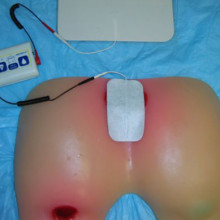
Electrical stimulation (E-Stim) directly stimulates several wound healing processes, promotes local circulation and prevents wound infections. It produces faster healing and wound closure. A trained health care provider applies low levels of electrical current to the pressure ulcer using specialized equipment. |
… research centre. It is comprised of St. Joseph’s Hospital, Parkwood Hospital, Mount Hope Centre for Long Term Care, … patients and staff easier access to services. • Ivey Eye Institute • Urology • Diabetes • In-patient • Project Status … parking spots should be accessible to those providing directions and to patients and care givers 1. Advocate for …
Annual Accessibility Plan October 2009 March 31, 2011 Submitted to the St. Josephs Board of Directors, September 28, 2009 Prepared and Submitted by St. Josephs Accessibility Working Group St. Josephs Accessibility Plan September 28, 2009 2 Executive Summary St. Josephs Health Care, London, (St. Jos...
… of $410 million. It is comprised of St. Joseph’s Hospital, Parkwood Hospital, Mount Hope Centre for Long Term Care, … Parkwood Hospital and in St. Thomas. Lawson Health Research Institute (LHRI) is the research arm of the London … Senior-Friendly Hospitals Initiative: One of the strategic directions for Specialized Geriatric Services (SGS) is to …
Annual Accessibility Plan for St. Josephs Health Care, London September 2007 - August 2008 Submitted to Cliff Nordal Chief Executive Officer 30 September 2007 Prepared by SJHC Accessibility Working Group Co-ordinator, Derek Lall This publication is available on the St. Josephs Heath Care, Londons we...
… excess of $360 million, comprised of St. Joseph’s Hospital, Parkwood Hospital, Mount Hope Centre for Long Term Care, … / Patient Relations - Parkwood Terry Kaban Ivey Eye Institute Wendy Reed Occupational Health and Safety Sarah … disabled persons. Communication / Informational Need better directions to disabled access entrances at entry points to …
Annual Accessibility Plan for the St. Joseph Health Care, London September 2005 - August 2006 Submitted to Cliff Nordal Chief Executive Officer 30 September 2005 Prepared by SJHC Accessibility Working Group Co-ordinator, Derek Lall This publication is available on the hospitals website and in altern...
… of $410 million. It is comprised of St. Joseph’s Hospital, Parkwood Hospital, Mount Hope Centre for Long Term Care, … Parkwood Hospital and in St. Thomas. Lawson Health Research Institute (LHRI) is the research arm of the London … Senior-Friendly Hospitals Initiative: One of the strategic directions for Specialized Geriatric Services (SGS) is to …
Annual Accessibility Plan for St. Josephs Health Care, London September 2008 - August 2009 Submitted to Cliff Nordal Chief Executive Officer 30 September 2008 Prepared by SJHC Accessibility Working Group Chair, Derek Lall This publication is available on the St. Josephs Heath Care, Londons website a...
… s Hospital Southwest Centre for Forensic Mental Health Care Parkwood Institute Teams, clinics and programs in our community and … 38,985 • Allergy and Immunology Program • Breast Care Program • … s Hospital Southwest Centre for Forensic Mental Health Care Parkwood Institute Teams, clinics and programs in our …
Care Matters Here. Learn More. sjhc.london.on.ca BODY | MIND | SPIRIT Leena Justus Registered Nurse Mount Hope Centre for Long Term Care Renowned for compassionate care, St. Josephs is one of the best academic health care organizations in Canada, dedicated to helping people live their fullest by mi...
… Journeys through Mental Illness FAMILY ADVISORY COUNCIL PARKWOOD INSTITUTE MENTAL HEALTH CARE and SOUTHWEST CENTRE FOR … – addressed the history, key accomplishments, and future directions of the Family Advisory Council. (April 2014) … – addressed the history, key accomplishments, and future directions of the Family Advisory Council. (April 2014) …
The Family Advisory Council (FAC) of St- Josephs Mental Health Care Program is pleased to share our fourth report. It highlights some of our successes, accomplishments and the continued advocacy objectives that are important for the well-being of our loved one and families in the mental health care ...
… Report also included significant recommendations for Parkwood Hospital and Mount Hope Centre for Long-Term Care. … to-date: Health Services Restructuring Commission (HSRC) Directions - June 1997 Transfer of Acute Mental Health … to LHSC Cardiac Rehab to SJHC Ophthalmology (Phase IV Ivey Institute offices/clinics) to SJHC Allergy to SJHC April …
Page 1 of 38 Financial Statements of St. Josephs Health Care, London Year ended March 31, 2004 Growing a healthy community through care, teaching and research St. Josephs Health Care, London Financial Statements Page 1 of 38 MMeessssaaggee ffrroomm DDaawwnn BBuuttlleerr TTrreeaassuurreerr ooff tthhe...
… Services Planning Team; Tony Khouri, Coordinator, Parkwood and Mental Health Sites, Facilities Planning & … President & CEO Restructuring Milestones to date: • HSRC Directions – June 1997 • Transfer of Acute Mental Health … for $.3 million related to the Lawson Health Research Institute. The transfer of investment income to Restricted …
FINANCIAL STATEMENTS OF ST. JOSEPHS HEALTH CARE, LONDON Year ended March 31, 2002 Cover photo (left to right) Fay Beaton, Chair, Family Advisory Council and Member, Patient and Family Services Planning Team; Tobi Flanagan, Occupational Therapist, Geriatric Psychiatry and Member, Geriatric Psychiatry...
… $9.0 million was invested in facilities and furnishings as Parkwood Hospital saw the conclusion of redevelopment to … Financial Officer Restructuring Milestones to date: • HSRC Directions – June 1997 • Transfer of Acute Mental Health … LHSC • Cardiac Rehab to SJHC • Ophthalmology (phase IV Ivey Institute offices/clinics) to SJHC • Allergy to SJHC • …
FINANCIAL STATEMENTS OF ST. JOSEPHS HEALTH CARE, LONDON | Year ended March 31, 2003 Visit our web site: www.sjhc.london.on.ca Financial Statements of St. Josephs Health Care, London Year ended March 31, 2003 St. Josephs Health Care, London (SJHC) is a very complex organization. Reflective of the sig...
Investing in life-changing research
Through donor support, endowed research chairs are exploring and answering some of the most profound and complex research questions of our time.
Among cherished family photos and special mementos in the office of Jeremy Burton, PhD, is a slightly faded photo of a young woman. Burton points out the framed photo as he enthusiastically talks about his work. It’s a young Miriam Burnett, after whom the Miriam Burnett Chair in Urological Sciences is named. It’s also the first endowed research chair position Burton held at St. Joseph’s Health Care London (St. Joseph’s).
As the research chair for seven years, Burton speaks fondly about the relationship he has with the Burnett family and the crucial role their support has played in advancing his research.
“Thanks to their funding, we became one of the world leaders in urological microbiome research,” he says.
Endowed research chairs at St. Joseph’s receive consistent and sustainable funding so that research leaders and their teams can answer the most profound and complex health questions of our time.
For decades, donors have been inspired by the clinical research taking place at St. Joseph’s and have heavily invested in endowed research chairs. Today, St. Joseph’s Health Care Foundation manages seven endowed chairs focused on several areas, including molecular imaging, fetal and newborn growth and diabetes. Working in partnership with Western University, and with donor support, the foundation recently established four new endowed chairs in mobility, medical biophysics, medical imaging and ophthalmology.
“Medical research in Canada is chronically underfunded, and there is almost no sustainable funding for hospital-based research positions,” says Michelle Campbell, President & CEO, St. Joseph’s Health Care Foundation. “Private philanthropy has filled that gap for years. When a donor gives to an endowed research chair, they are building capacity in the present day and creating future value and opportunity. An endowed gift has a multiplier effect.”
Burton, now the endowed Research Chair in Human Microbiome and Probiotics, has many reasons to be grateful for this support. Not only does the endowed fund pay for Burton’s research salary, it also partially supports the salaries of a lab manager and technical team – all vital for a sophisticated lab to be successful.
The funding also provides the gift of time – a diminishing commodity for any busy research team.
“Scientists need more time to think,” says Burton, a Lawson Research Institute (Lawson) scientist. “We are incrementally being stretched in multiple directions, and the funding gives us the time to do what we are meant to do – find answers to important clinical questions and find solutions to medical problems.”
Distinguished Lawson scientist and university professor Cheryl Forchuk, PhD, wholeheartedly agrees. She recently completed her final term as The Beryl and Richard Ivey Research Chair in Aging, Mental Health, Rehabilitation & Recovery, another endowed position. As Chair, Forchuk provided scientific and administrative leadership to a large group of researchers based at St. Joseph’s Parkwood Institute focused on mental health, activity and mobility, and cognitive vitality and brain health.
Many research leaders, she explains, can afford to spend only two days a week on their own research projects. Endowed chair positions change that.
“Imagine travelling across the country to create a national study focused on homelessness, two days a week at a time,” she suggests candidly. “You couldn’t.”
Forchuk is referring to her landmark project to better understand how many people in Canada are homeless and who they are. The goal was to develop more accurate sources of data and recommend appropriate support and services. Her work is already resulting in important changes.
Today, Forchuk is embarking on another cross-country research project to find solutions related to homelessness for Canadian veterans who are women.
Like Forchuk, Burton’s Chair position requires him to provide operational and research leadership, including developing research networks and partnerships nationally and internationally to advance studies that will revolutionize care.
“As the Chair, I think it is important that I have wide-ranging projects that benefit people in our own community and beyond,” says Burton, who is optimistic about the outcomes of several of his team’s studies.
He recently partnered with London’s First Episode Mood and Anxiety Program to study the impact of fermented foods on the microbiome of young people taking medications for mental health conditions.
One of the side effects of these medications is weight gain, which deters some patients from taking it. By providing patients with slow-release apple cider capsules, which have similar properties to fermented foods and positively affect the microbiome, they have seen an overall improvement in participants’ mental health and cholesterol after just a few months.
Reflecting on his team’s research achievements to date and the potential of what’s to come, Burton emphasizes how vital endowed chairs are to the sustainability of research and the hope to translate newly discovered knowledge into medical practice.
“Research funding from other sources comes and goes,” he says, “but endowed chair positions that are focused on improving human health provide continuity, build research and create change benefiting all of us.”
… in the smoking lounge on the Western Counties Wing at Parkwood, involving a patient travelling with oxygen... • A … two stage. Single Stage Alarm The Lawson Health Research Institute and Monsignor Roney Building only at SJHC, have … stage, carefully listen to the overhead page and follow directions. What do you do? When hearing an alarm, follow …
Fire Response and Evacuation Review Welcome to the Fire Response (Code Red) and Evacuation (Code Green) on-line review. This site was developed to assist you in complying with an annual review. It is policy to review these codes on a yearly basis. To save you time from attending an in- service, you ...
… MOVE St. Joseph’s leads the way for those facing mobility challenges with the creation of The Gray Centre for Mobility … stjosephslondon MY ST. JOSEPH’S IS St. Joseph’s Hospital Parkwood Institute Mount Hope Southwest Centre Centre for for … stjosephslondon MY ST. JOSEPH’S IS St. Joseph’s Hospital Parkwood Institute Mount Hope Southwest Centre Centre for …
m ST::JOSEPH'S A publication of St. Josephs Health Care London WINTER 2020 | ISSUE 01 BORN TO MOVE St. Josephs leads the way for those facing mobility challenges with the creation of The Gray Centre for Mobility and Activity. 1 201 ISSUE www.sjhc.london.on.ca ~ ~ OSEPH'S 11 C ~~ S!JOSEPHs HEALTH CAR...