


Search
Search
327 Search Results:
Study to improve geriatric care in Ontario receives CIHR funding
The Canadian Institutes of Health Research (CIHR) has awarded a $100,000 grant to a project that aims to examine and improve the delivery of care for older adults.
Dr. Jacobi Elliott, Associate Scientist at Lawson Health Research Institute and Coordinator (Geriatrics) at St. Joseph’s Health Care London, has received a Priority Announcement award for her study titled “Implementation, Equity and Impact: Examining specialized geriatric care programs in Ontario.”
“It is critical to provide older adults with timely and equitable access to specialized geriatric care,” says Dr. Elliott. “However, waitlists are growing with the current aging population and there is an increased demand for these services.”
Currently 1.6 million older Canadians are considered to be living with frailty, and that number is expected to double over the next decade. Without adequate geriatric services, older adults living with frailty are more likely to need hospital care. The goal of this research is to examine specialized geriatric care programs in Ontario.
“Across Ontario, there are more than twelve different geriatric outreach models of care, but we have no clear understanding of how these models were developed, implemented or evaluated,” says Dr. Elliott. “It is critical to understand whether the existing services are meeting the needs and goals of the diverse older adult population.”
Dr. Elliott hopes that the project’s findings can be used to inform the development of future specialized geriatric care programs.
Congratulations also goes out to the Lawson Scientists who are receiving CIHR funding totaling nearly $2.5 million through Western University’s Schulich School of Medicine & Dentistry:
Dr. Pingzhao Hu with Dr. Samuel Asfaha
A deep learning approach to identify inhibitors of adherent invasive Escherichia coli in the pathogenesis of inflammatory bowel disease
Dr. Steven Laviolette
Understanding the Effects of Adolescent Nicotine Exposure on Increased Risk for Mood and Anxiety Disorders: Bridging the Gap from Pre-Clinical to Clinical Investigations
Dr. Aaron Ward with Dr. Stephen Pautler
Histopathology image analysis for prostate cancer prognosis after radical prostatectomy
CIHR Priority Announcement recipients:
Dr. Xiao Zhen Zhou and Dr. Doug Fraser
Identification of Novel Disease Drivers, Therapeutic Targets, and Biomarkers of Sepsis
Therapeutic seizure for depression: The positive and not so positive effects
8:00pm - 9:00pm
You are invited to the second in a series of Research Bites. These informative and interactive talks focus on specific illnesses, their prevention and related research being conducted by researchers in London, Ontario.
Topic: Therapeutic seizure for depression: The positive and not so positive effects
Image

The talk will include an overview of convulsive therapy, the benefits and risks, and new research to overcome some of the cognitive side effect of the treatment. It will also include a dialogue between Dr. Burhan and a family that went through the experience of electroconvulsive therapy to elicit the experience from the consumer perspective.
Date: Thursday, June 6, 2019
Time: 4 - 5 pm
Location: Parkwood Institute, Mental Health Building, Auditorium (F2-235)
550 Wellington Road South
London, Ontario N6C 0A7
Maps and Directions for Parkwood Institute.
Parking: The lot rate is $4.00 when you enter. $1 and $2 coins and credit card accepted (press the start button then insert payment)
Registration is required and spots will fill up quickly.
Click here to register.
These talks are hosted by Parkwood Institute Research, a program of Lawson Health Research Institute.
… C ONTACT T HIRD AGE OUTREACH THIRD AGE OUTREACH SPECIALIZED GERIATRIC SERVICES Third Age Outreach is part of St. Joseph's Health Care London's Specialized Geriatric Services program. This unique hospital outreach … a therapeutic recreation assessment through our Specialized Geriatric Services Intake at: 519 685-4046 or by contacting …
WHO WE ARE C ONTACT T HIRD AGE OUTREACH THIRD AGE OUTREACH SPECIALIZED GERIATRIC SERVICES Third Age Outreach is part of St. Joseph's Health Care London's Specialized Geriatric Services program. This unique hospital outreach service is located in the City of London's Kiwanis Seniors' Community Centre...
… Top Geriatric Papers of 2012 - Chris Brymer …
… Geriatric Rehabilitation Day Hospital Providing outpatient … the left of the lobby. Visit us at: www.sjhc.london.on.ca/geriatricdayhospital CARING FOR THE BODY, MIND & SPIRIT … after an illness because of declining health? If so, the Geriatric Rehabilitation Day Hospital’s specialized …
Geriatric Rehabilitation Day Hospital Providing outpatient rehabilitation for frail older adults Day Hospital Contact Parkwood Institute CARING FOR THE BODY, MIND & SPIRIT SINCE 1869 Location Hours: 8 am - 4 pm Monday to Friday Location: Parkwood Institute Main Building Day Hospital 550 Wellington R...
… A Financial Assessment & Capacity Test (FACT) For A Psychogeriatric Population: Development and Concurrent Validity … of Daily Living, Financial Assessment and Capacity Test, Geriatric Psychiatry, Psychogeriatric, Validity ____________________ 1 Regional Mental …
A Financial Assessment & Capacity Test (FACT) For A Psychogeriatric Population: Development and Concurrent Validity Edward L. Black, PhD, CPsych1,2 , Tom J. Ross, B.A.1, Tobi Flanagan, BScOT1, Kiran Rabheru, MD, FRCPC3, Hans J. Breiter, PhD, CPsych2 Key Words: Money Management Skills Assessment, Ins...
When connections break down
In Ontario alone, an estimated 285,000 individuals currently live with some form of neurodegenerative disorder. This includes Alzheimer’s Disease, Parkinson’s Disease, mild cognitive impairment, dementia and movement disorders.
The experiences and symptoms for each person vary, but they share a progressive decline in their cognitive and motor function. It can affect their ability to work, socialize and live independently.
As our population ages, there is an urgent need to understand markers that will predict decline and identify targets for therapy that might improve long-term function and outcomes.
This is where hospital-based research can make a real difference.
On June 21, 2018, Lawson Health Research Institute hosted Café Scientifique, a community event highlighting the groundbreaking and specialized research on neurodegenerative diseases happening right here in London.
Moderated by Lawson researcher Dr. Arlene MacDougall, a panel of three expert Lawson scientists shared their unique perspectives as both clinicians and researchers, and how the knowledge we are gaining is being applied to improve health and health care for people here and around the world.
Watch the video from the event featuring the three talks from our experts.
Café Talks
Back to the beginning: Targeting early markers for Alzheimer’s Disease
By Dr. Jennie Wells
Time stamp: 5 minutes
Dr. Wells is the Medical Care Coordinator for Geriatric Rehabilitation at St. Joseph's Health Care London's Parkwood Institute, and Chair of the Division of Geriatric Medicine and associate professor in the Department of Medicine at Western Univeristy’s Schulich School of Medicine. Her clinical and research interests are Alzheimer’s Disease and Geriatric Rehabilitation. She has particular interest in Mild Cognitive Impairment (MCI) and the potential for non-drug interventions, such as exercise and nutrition to slow progression of dementia. She is a principal site investigator in randomized controlled trials of new drugs to treat dementia, MCI, and Subjective Cognitive Impairment (SCI).
Highlights:
- What causes dementia?
- How early do changes happen in the brain before symptoms even appear?
- What is the single best diet approach for a healthy body and mind?
- How does exercise keep your brain healthy?
Image

Neuroinflammation and dementia: The old and the new
By Dr. Elizabeth Finger
Time stamp: 24 minutes
Dr. Finger, a neurologist at St. Joseph's Parkwood Institute, received her MD from Cornell University. She completed an internship in Internal Medicine at Massachusetts General Hospital, followed by residency in Neurology at Massachusetts General Hospital and Brigham and Women's Hospital in Boston. Her research focuses on understanding the cognitive, neural, and genetic substrates of abnormal decision-making, emotion and social behavior. Using a variety of different diagnostic techniques and modalities, the research program investigates the cognitive and neural systems affected in patients with Frontotemporal Dementia, related disorders and their at-risk family members.
Highlights:
- Do anti-inflammatory medications reduce the risk of dementia or slow the rate of decline?
- How do genes related to the immune system increase the risk of developing dementia and Alzheimer’s Disease?
- What about the effects from dysfunction of the brain’s own immune system?
- Do conditions or events causing systematic inflammation (surgery, infection, auto-immune diseases) also increase neuroinflammation which can lead to dementia?
Image
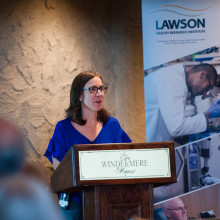
New Frontiers in the Treatment of Parkinson’s Disease: Addressing the unmet needs
By Dr. Mandar Jog
Time stamp: 45 minutes
Dr. Jog is a Lawson researcher, Director of the National Parkinson Foundation Centre of Excellence at LHSC, Director of the Movement Disorders Centre in London and Professor of Neurology at Western University. His research interests include topics such as motor control, neurophysiology and computational modeling, multichannel recording and web-based teaching of movement disorders. Dr. Jog has a passion for clinical and scientific innovation and holds numerous patents that are reaching commercialization with strong collaboration with university technology transfer and industry partners.
Highlights:
- How do clinician researchers take questions from the bedside and solve them at the bench using technology in order to treat movement disorders?
- How can wearable technology be used to detect movement disorders and monitor for optimized treatment – remotely from anywhere in the world?
- How can we use machine-guided sensors for personal diagnostics and therapy for essential tremors and Parkinson’s Disease?
- How can spinal cord stimulators improve movement and gait for patients, including those previously using wheelchairs and scooters?
Image
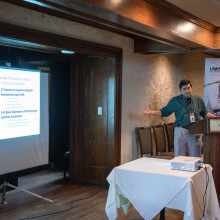
Did you miss the event? Add your email address to our Café Scientifique invite list so that you’ll be the first to know when the next event takes place.
Sign up here.
Go to Lawson’s Facebook page to see photos from the event.
Scientist