


Search
Search
1863 Search Results:
Dr. s copy ( Western Schulich School of Medicine & Dentistrys copy ( Department of s copy ( Medical Affairs copy ( THIS LETTER OF OFFER IS ONLY TO BE ISSUED AFTER CONFIRMATION OF THREE SATISFACTORY REFERENCES FOR THE CANDIDATE. Dea...
Dr. s copy Western Schulich School of Medicine & Dentistrys copy Department of s copy Medical Affairs copy THIS LETTER OF OFFER IS ONLY TO BE ISSUED AFTER CONFIRMATION OF THREE SATISFACTORY REFERENCES FOR THE CANDIDATE. Dear Dr.
Dr. s copy ( Western Schulich School of Medicine & Dentistrys copy ( Department of s copy ( Medical Affairs copy ( THIS LETTER OF OFFER IS ONLY TO BE ISSUED AFTER CONFIRMATION OF THREE SATISFACTORY REFERENCES FOR THE CANDIDATE. Dea...
Dr. s copy Western Schulich School of Medicine & Dentistrys copy Department of s copy Medical Affairs copy THIS LETTER OF OFFER IS ONLY TO BE ISSUED AFTER CONFIRMATION OF THREE SATISFACTORY REFERENCES FOR THE CANDIDATE. Dear Dr.
Dr. s copy ( Western Schulich School of Medicine & Dentistrys copy ( Department of s copy ( Medical Affairs copy ( THIS LETTER OF OFFER IS ONLY TO BE ISSUED AFTER CONFIRMATION OF THREE SATISFACTORY REFERENCES FOR THE CANDIDATE. Dea...
Hospital-based research in London ranked in the top 10 for Canada
Lawson Health Research Institute is ranked eighth in the country according to the 2018 edition of “Canada’s Top 40 Research Hospitals List” by Re$earch Infosource. This strong position has been maintained by Lawson for the past five years and also keeps the institute within the top five institutions in Ontario.
The research institute of London Health Sciences Centre (LHSC) and St. Joseph’s Health Care London (St. Joseph’s), Lawson has also maintained the top ranking for research intensity among the large tier institutions, with $616,300 of research spending per researcher.
“As a hospital-based research institute, our innovation happens where care is delivered,” says Dr. David Hill, Lawson Scientific Director. “Every day, teams of researchers are working directly with clinicians and patients to improve treatments, or create entirely new ones. They find innovative methods of delivering services that drive efficiency and reduce costs.”
The top 40 list analyzes hospital-based research institutes from across the country on several metrics, including total research income from the previous fiscal year. The ranking looks at funds received from all sources, including both internal and external, to support research at the organization. According to the report, Lawson received $123,255 million in research income in 2017, which was a 0.8 per cent drop from the previous fiscal year.
Dr. David Hill advocates for increased scientific funding nationally. “We held our position despite the modest decrease in funding. Canada as a whole requires significant investment in scientific discovery to increase the well-being of Canadians and build a robust economy.”
This year, a special spotlight on intellectual property (IP) is showcasing the top Canadian organizations – universities, corporations, hospitals and government departments/agencies – patenting at the US Patent and Trademark Office.
Lawson, as the research institute of LHSC and St. Joseph’s, is featured in the top 10 list for Hospital Patent Leaders as measured by ownership of patents granted between 2013-2017. Lawson has ranked in the sixth spot with 13 patents owned.
Commercialization opportunities are managed through WORLDiscoveries®, the business development arm of London’s extensive research network. Born out of a partnership between Lawson, Robarts Research Institute and Western University, WORLDiscoveries® draws upon a mix of industry connections, sector-specific market knowledge, and business development expertise to help researchers and local inventors commercialize their discoveries through licensing and new company spin-offs.
“We support technology development and licensing agreements by taking local knowledge and discoveries to industry partners worldwide,” explains Dr. Hill. “Research-intensive hospitals are improving health care, creating jobs and contributing to the country’s growing knowledge economy.”
Featured Innovations
A Stroke of Genius
Image

Based at St. Joseph’s Hospital in London, Dr. Ting-Yim Lee specializes in computed tomography (CT) imaging, a type of x-ray technology that captures images of slices of the body. As a young scientist, he dreamed of using CT imaging to measure how blood flows in the human body. The idea was to develop software that could be installed on existing CT scanners to make quick, easy work of a very complex algorithm. If a patient came to the emergency room suffering from a stroke, it would allow the doctor to quickly analyze and address the damage.
Thanks to decades of public and private sector support, Dr. Lee’s idea has evolved from concept to prototype to clinically-approved product. Through a licensing deal with GE Healthcare, his software is now installed on 70 per cent of the company’s new CT scanners on the market. It’s currently in use in more than 8,000 hospital imaging departments around the world.
Stroke is a situation where every minute of delay in treatment has grave consequences on the recovery of the patient, and this software allows physicians to quickly decide on the best treatment for the patient. Dr. Lee is extending his technology to measure blood flow in whole organs, including predicting and monitoring how cancer and heart attacks respond to treatment. The royalties from the licenses enabled Lawson to install Canada’s first PET/CT scanner to complement CT Perfusion with metabolic information from PET scanning.
Novel discovery in the field of Parkinson’s Disease
Image

In addition to a busy neurosurgery practice, Dr. Matthew Hebb maintains a highly productive research program. Dr. Hebb is creating tools to advance Parkinson’s Disease research and therapeutics across the globe. Parkinson’s Disease is characterized by progressive neurological impairment caused by the death of cells in the nervous system. Dr. Hebb’s team provided a novel description of brain-derived progenitor cells (BDPCs) that could protect and stimulate re-growth of disease-affected neurons. This discovery may offer critical insight into the disease process and provide a new personalized source of brain-derived cells for delivering therapy back into the same individual.
By using a patient’s own BDPCs, Dr. Hebb hopes to slow or halt disease progression and stimulate regeneration of damaged brain circuitry. BDPCs may further advance drug, genetic and functional screening across broad patient populations. This work also resulted in a patent and partnership with STEMCELL Technologies to develop innovative research tools for Parkinson’s Disease and other incurable neurological diseases.
Computer assisted surgical techniques and technologies
Image
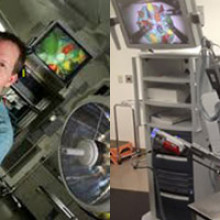
Dr. Christopher Schlachta is Medical Director of CSTAR, the Canadian Surgical Technologies & Advanced Robotics, at LHSC. His current research interests are focused on development of computer-assisted surgical techniques and technologies to enhance care and training. Along with his team, he has demonstrated how computer-assisted technologies in the operating room can enhance communication among surgeons and trainees to produce better outcomes for patients. He is currently partnering with industry to commercialize operating room technology developed with engineers at CSTAR.
His Wireless Hands-free Surgical Pointer system incorporates infrared and inertial tracking technologies to address the need for hands-free pointing during minimally invasive surgery. The combination of these technologies allows for optimal movement of the pointer and excellent accuracy while the user is located at a realistic distance from the surgical monitor.
Smart tech, smart treatment for movement disorders
Image
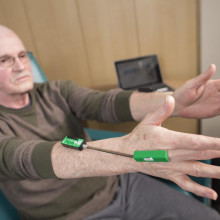
Dr. Mandar Jog operates the London Movement Disorders Centre and has driven the development of TremorTek, a wearable sensor technology that has already successfully treated hundreds of research patients who suffer from tremors in their arms and hands. These tremors, typically caused by Parkinson’s disease or essential tremor, are a common movement disorder symptom yet there is no effective treatment. Neurotoxin therapy has been identified as a possible treatment for tremors; however, an injection in the wrong place or at the wrong dose can cause negative side effects. Everyone experiences tremors in different ways – the location and strength of the movements, and how often they occur varies widely.
Using commercially available sensor technology, Dr. Jog and his team were able to isolate independent muscle movements. They created a system that matched the muscle activity pinpointed by the sensors with the correct amount of toxin to administer. This kinematic technology can be applied to the pre-treatment assessment of patients and the information generated can guide the placement of botulinum toxin. The technology has been taken by a spinoff company MDDT Inc. that has been working with numerous stakeholders interested in its applications.
Scientist
Dr. s copy ( Western Schulich School of Medicine & Dentistrys copy ( Department of s copy ( Medical Affairs copy ( THIS LETTER OF OFFER IS ONLY TO BE ISSUED AFTER CONFIRMATION OF THREE SATISFACTORY REFERENCES FOR THE CANDIDATE. Dea...
Dr. s copy ( Western Schulich School of Medicine & Dentistrys copy ( Department of s copy ( Medical Affairs copy ( THIS LETTER OF OFFER IS ONLY TO BE ISSUED AFTER CONFIRMATION OF THREE SATISFACTORY REFERENCES FOR THE CANDIDATE. Dea...
… Mattresses and box springs must be completely encased in medical-grade dust-proof covers. Even a four-month old … most comfortable and effective ones are only available at medical supply companies—you can see examples of mattress … Mattresses and box springs must be completely encased in medical-grade dust-proof covers. Even a four-month old …
House Dust Mite Dust avoidance Dust mites are the cause of dust allergy. People actually become allergic to the droppings the dust mites leave behind. Dust mites are small animals, so small you could fit several on the head of a pin. Dust mites eat the skin scales that we shed when sleeping or chang...
… Patients are expected to meet the following criteria: 1. Medical Stability Non-respiratory organs dysfunction … sampling (no greater than weekly). Treatment plan for all medical conditions is in place, that: • is free of … frequent changes, • can be implemented at the complex medical care site, • provides adequate nutrition using the …
Critieria for admission to LTV Program Feb 2024.doc Complex Care Program Parkwood Institute Patients Eligible for transfer to the Long Term Ventilation Beds There are six beds within the Complex Care Program at Parkwood Institute that provide a clinical setting for individuals requiring long-term m...
Hybrid PET/MRI Symposium
12:15pm - 10:00pm
On February 12, 2012, the first hybrid PET/MRI in Canada, and fifth in the world, was installed in London, Ontario at St. Joseph's Hospital. In 2016, hybrid PET/MRI started up in Toronto (UHN) and Ottawa (Royal) with new sites committed in Toronto (Sunnybrook), Edmonton, Winnipeg and Vancouver.
This one day symposium will summarize the London experience over the last five years. This will include the technological challenges that have been met (e.g. the need for PET compatible RF coils, MRI directed attenuation correction in brain imaging and the advantage of co-siting a medical cyclotron and radio-chemistry facility) and those that remain (e.g. reimbursement for routine patient use, hybrid reconstruction, hybrid kinetic modeling and respiratory and cardiac corrections for true registration). Experience with applications in cardiology, epilepsy, prostate cancer and rectal cancer will be presented. Presenters from Ottawa and Toronto will also look to the future of hybrid PET/MRI in cardiology, neurodegeneration and psychiatry.
Researchers and students interested in hybrid PET/MRI and its potential role in clinical diagnosis will benefit from this symposium. This includes those interested in technology development and those interested in using PET/MRI to discover the mechanisms of disease and the assessment of therapies. In one full day, attendees will gain knowledge concerning the strengths and challenges of hybrid PET/MRI technology and its growing role in oncology, neurology and cardiology. With a growing number of sites in Canada, there will be an excellent opportunity to form collaborations and the opportunity to establish a Canadian network.
Date and Time: Tuesday, March 14, 2017, 8:15 a.m. to 5:45 p.m.
Location: St. Joseph's Hospital, Shuttleworth Auditorium (D0-104)
Schedule: View the event schedule.
Registration: Online registration is now closed. Please contact Shelagh Ross at @email by Friday, March 10 to register.
Guidelines for Managing Hyperglycemia (High Blood Glucose) Signs and Symptoms of Hyperglycemia ( High Blood Glucose ) ONSET Gradual (hours to days) USUAL CAUSES Illness, infection, surgery, injury Stress: emotional or physical Too little insulin Increased food Exercise (in type 1) with blood g...
Guidelines for Managing Hyperglycemia (High Glucose Level) Signs and Symptoms of Hyperglycemia ( High Glucose Level ) ONSET Gradual (hours to days) USUAL CAUSES Illness, infection, surgery, injury Stress: emotional or physical Too little insulin Increased food Exercise (in type 1) with glucose...
Guidelines for Managing Hyperglycemia (High Glucose Level) Signs and Symptoms of Hyperglycemia ( High Glucose Level ) ONSET Gradual (hours to days) USUAL CAUSES Illness, infection, surgery, injury Stress: emotional or physical Too little insulin Increased food Exercise (in type 1) with glucose...
… http://www.mto.gov.on.ca/english/dandv/driver/medical-review/process.shtml … http://www.mto.gov.on.ca/english/dandv/driver/medical-review/process.shtml /media/5538 … http://www.mto.gov.on.ca/english/dandv/driver/medical-review/process.shtml … http://www.mto.gov.on.ca/english/dandv/driver/medical-review/process.shtml …
Hypoglycemia (Low blood sugar) What is Hypoglycemia? Hypoglycemia means low blood sugar (blood sugar less than 4.0 mmol/L). What are the symptoms of hypoglycemia? You may experience one or more of the following: Shaking/trembling Sweating Dizziness Sudden hunger Confusion Irritability When you...
… • http://www.mto.gov.on.ca/english/dandv/driver/medical-review/process.shtml … http://www.mto.gov.on.ca/english/dandv/driver/medical-review/process.shtml http://sjhc.london.on.ca … • http://www.mto.gov.on.ca/english/dandv/driver/medical-review/process.shtml … http://www.mto.gov.on.ca/english/dandv/driver/medical-review/process.shtml http://sjhc.london.on.ca …
Hypoglycemia (Low blood sugar) What is Hypoglycemia? Hypoglycemia means low blood sugar (blood sugar less than 4.0 mmol/L). What are the symptoms of hypoglycemia? You may experience one or more of the following: Shaking/trembling Sweating Dizziness Sudden hunger Confusion Irritability When you...
Internet-Based Cognitive Therapy (iCBT) is the delivery of cognitive behavioral therapy (CBT) through a computer, phone, or mobile device, often guided by a mental health professional. Veteran & active military members are unique populations for treatment. They have distinct symptom presentations & ...
ICU patients with non-brain-related injuries may suffer undetected cognitive dysfunction
LONDON, ON - A new study led by Western University and Lawson Health Research Institute has found that most patients entering hospital intensive care units (ICU) for non-brain-related injuries or ailments also suffer from some level of related cognitive dysfunction that currently goes undetected in most cases.
The findings were published today in the influential scientific journal, PLOS One.
Many patients spend time in the ICU for reasons that have nothing to do with a known brain injury, and most health care providers and caregivers don’t have any evidence to believe there is an issue with the brain. For example, a patient may have had a traumatic injury that does not involve the brain, yet still requires breathing support to enable surgeons to fix damaged organs, they may have issues with their heart or lungs, they may contract a serious infection, or they may simply be recovering from a surgical procedure like an organ transplant that has nothing directly to do with their brain.
For the study, Western researchers from the Schulich School of Medicine & Dentistry and the Brain and Mind Institute and researchers from Lawson assessed 20 such patients as they left the ICU and every single patient had detectible cognitive deficits in two or more cognitive areas of investigation, including memory, attention, decision-making and reasoning. Again, this is in spite of the fact that, on the face of it, they had no clear brain injury.
The discovery was made using online tests, developed by renowned Western neuroscientist Adrian Owen and his teams at the Brain and Mind Institute and BrainsCAN, which were originally designed to examine cognitive ability in patients following brain injuries but for this purpose, are being used to detect cognitive deficits in people who have spent time in an intensive care unit without a diagnosed brain injury.
“Many people spend time in an intensive care unit following a brain injury and, of course, they often experience deficits in memory, attention, decision-making and other cognitive functions as a result,” explains Owen, a professor at Schulich Medicine & Dentistry. “In this study, we were interested to see how patients without a specific brain injury fair after leaving the ICU. The results were astonishing.”
Why cognitive ability declines even in non-brain related visits to the ICU likely varies from patient to patient, but Dr. Kimia Honarmand from Schulich Medicine & Dentistry says the lesson to be learned is that many conditions affect brain function, even though they might not directly involve the brain.
“If you are having trouble breathing, your brain may be starved of oxygen. If you have a serious infection, the inflammation that occurs as a result of infection may affect brain function. If you are undergoing major surgery, you might be given drugs and have procedures that may affect your breathing, which in turn may affect the flow of oxygen to the brain,” explains Dr. Honarmand. “What we have shown here is that all or any of these events can lead to deficits in brain function that manifest as impairments in cognition. And healthy cognition is a vital determinant of functional recovery.”
Dr. Marat Slessarev, Lawson Scientist, says these findings can shift how the medical community treats incoming patients and more importantly, outpatients following ICU visits.
“Historically, the clinical focus has been on just survival. But now we can begin to focus on good survival,” says Dr. Slessarev, also an associate member at the Brain and Mind Institute and an assistant professor at Schulich Medicine & Dentistry. “These sensitive tests will enable doctors to both detect cognitive impairment and track cognitive performance over time, which is the first step in developing processes for optimizing brain recovery.”
-30-
About Western
Western delivers an academic experience second to none. Since 1878, The Western Experience has combined academic excellence with life-long opportunities for intellectual, social and cultural growth in order to better serve our communities. Our research excellence expands knowledge and drives discovery with real-world application. Western attracts individuals with a broad worldview, seeking to study, influence and lead in the international community.
About The Schulich School of Medicine & Dentistry
The Schulich School of Medicine & Dentistry at Western University is one of Canada’s preeminent medical and dental schools. Established in 1881, it was one of the founding schools of Western University and is known for being the birthplace of family medicine in Canada. For more than 130 years, the School has demonstrated a commitment to academic excellence and a passion for scientific discovery.
About Lawson Health Research Institute
Lawson Health Research Institute is one of Canada’s top hospital-based research institutes, tackling the most pressing challenges in health care. As the research institute of London Health Sciences Centre and St. Joseph’s Health Care London, our innovation happens where care is delivered. Lawson research teams are at the leading-edge of science with the goal of improving health and the delivery of care for patients. Working in partnership with Western University, our researchers are encouraged to pursue their curiosity, collaborate often and share their discoveries widely. Research conducted through Lawson makes a difference in the lives of patients, families and communities around the world. To learn more, visit www.lawsonresearch.ca.
Media Contacts
Celine Zadorsky
Senior Media Relations Consultant
Communications & Public Engagement
T: 519-685-8500 ext. 73502
Celine.zadorsky@lhsc.on.ca
Illuminating the body's smallest secrets
Lawson Research Institute’s cyclotron facility is a formidable partner in the fight against disease.
Tucked behind the protective lower walls of St. Joseph’s Hospital lies a futuristic workshop of sorts – a place where science, technology and leading-edge medical care converge.
Within a behemoth, 62-ton machine, a swirling vortex of powerful magnetic fields and electric pulses is creating bursts of radioactive isotopes – tiny, potent sparks of life-saving potential. In the hands of technologists, researchers and clinicians, these chemical elements become diagnostic tracers and therapeutic agents, each particle revealing secrets of the human body.
The machine is a cyclotron - a type of particle accelerator and the only one of its kind in the region. At Lawson Research Institute’s Cyclotron & PET Radiochemistry Facility, scientists are producing a steady and timely supply of short-lived radioisotopes every day to study, detect and treat disease.
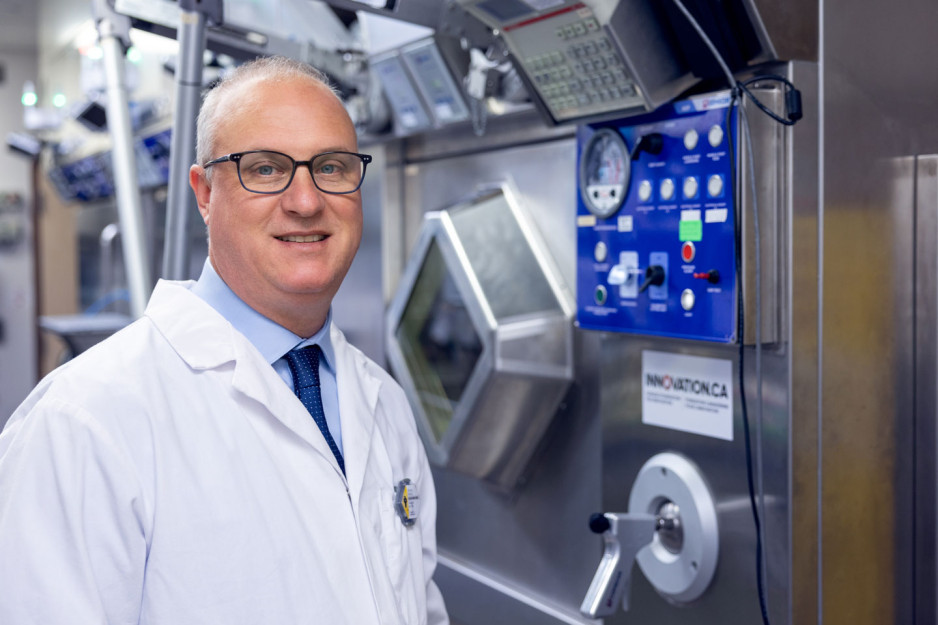
These radioisotopes become a beacon in positron emission tomography (PET) scans, illuminating the hidden shadows of cancer and other diseases. Others provide a precise map of the intricate pathways of blood flow, biological functions, location of specific cells and proteins, and the body’s skeletal architecture.
A formidable partner in the fight against disease, “the cyclotron facility is a hub for Southwestern Ontario that is uncovering the possibilities for improving patient care in numerous ways,” says Michael Kovacs, PhD, Lead, Lawson’s Cyclotron & PET Radiochemistry Facility and Program Lead, Lawson Imaging Research Program.
St. Joseph’s cyclotron supports a wide variety of research projects including imaging applied to oncology, cardiology, neurology, psychiatry, metabolic disease, infectious diseases, bioelectromagnetics and other areas.
“The scope of discoveries already making a difference, and the possibilities within reach, are a source of great pride for Lawson and for London,” adds Frank Prato, PhD Lawson scientist and Chief Medical Physicist at St. Joseph’s.
For Kovacs, Prato, their teams and partners, St. Joseph’s cyclotron is a testament to ingenuity and innovation, a world where every spin and burst of charged particles brings a promise of hope and healing.
Powering innovation
Generous donors to St. Joseph’s Health Care London have made both advanced research and next-level technology a reality. During the past few years, more than $1.1 million in donations funded extensive renovations to the Cyclotron & PET Radiochemistry Facility, making it possible to increase production of isotopes and expand life-saving care.
Recently, $1 million in donations supported a new PET/CT – the heart of the Canada’s first national GE centre of excellence in molecular imaging and theranostics being developed at St. Joseph’s Hospital.
Imaging
Lawson is in the international forefront of medical imaging
Research that takes a deep look inside the human body and seeks to understand how tissues, bones, organs and cells work, and then guides next steps when the body doesn’t work as it should.
At Lawson, we see things more clearly than anyone.
Lawson leads medical and imaging research. Learn more:
We’re home to a host of Canadian and world firsts that have resulted in new pathways of diagnosis, treatment and care.
We’re recognized as pioneers in molecular imaging: a virtual alphabet of MRIs, PET scans, CT scans and more.
With technologies that also include our state-of-the-art cyclotron, we keep pushing the boundaries of these technologies so that soon we hope to test treatments with the same pinpoint precision and technology we use for imaging. This is a new and exciting field called theranostics, and it offers the very real possibility of a magic bullet to eradicate some cancers.
Our award-winning scientists, trainees and staff share their discoveries to improve patient lives locally and around the world.
Lawson is a global leader in imaging research. Read on to see where it can lead you.
Lawson Intranet (password protected) | ICES: data-focused research | Animal Care Committee