


Search
Search
1863 Search Results:
… Hospital Privileges You will receive an email from Medical Affairs at LHSC and St. Joseph’s with instructions … your responsibility to maintain compliance. Your contact in Medical Affairs is Stacey Taylor, Human Resource Planning … visit the Orientation website at https://intra.lhsc.on.ca/medical-affairs/professional-staff/orientation You are …
Dr. s copy Western Schulich School of Medicine & Dentistrys copy Department of s copy Medical Affairs copy THIS LETTER OF OFFER IS ONLY TO BE ISSUED AFTER CONFIRMATION OF THREE SATISFACTORY REFERENCES FOR THE CANDIDATE. Dear Dr.
… Medicine & Dentistry’s copy Department of Oncology’s copy Medical Affairs’ copy DATE Dear Dr. Re: Letter of … (3) satisfactory reference letters by the Department of Medical Affairs. Upon acceptance of this offer, we may … the CWCC may recommend your appointment to the Joint Medical Advisory Committee. Final approval of your …
Dr. Candidates copy Western Schulich School of Medicine & Dentistrys copy Department of Oncologys copy Medical Affairs copy DATE Dear Dr. Re: Letter of Understanding It gives us great pleasure to offer you a position as a General Practitioner in Oncology (GPO) in the Depart...
Dr. s copy Western Schulich School of Medicine & Dentistrys copy Department of s copy Medical Affairs copy THIS LETTER IS ONLY TO BE ISSUED TO CONFIRM A CHANGE IN PRIVILEGES OR ARC CATEGORY TO AN EXISTING CREDENTIALED CLINICAL ACADEMIC
Dr. s copy Western Schulich School of Medicine & Dentistrys copy Department of s copy Medical Affairs copy THIS LETTER IS ONLY TO BE ISSUED TO NON CLINICAL ACADEMIC APPOINTMENTS SUCH AS TERM OR LOCUM CATEGORY. Dear Dr.
… reference form. · Email or fax completed reference form to Medical Affairs at medical.affairs@londonhospitals.ca / 519-667-6844 APPLICANT … No Does the applicant meet the requirements for continuing medical education? (attends conferenced, grand rounds, … reference form. · Email or fax completed reference form to Medical Affairs at medical.affairs@londonhospitals.ca / …
JOINT REFERENCE FORM For The Schulich School of Medicine & Dentistry, London Health Sciences Centre, and St. Josephs Health Care London Instructions to the Applicant: You are required to obtain three confidential references with your application for your academic appointment with Schulich School of...
… reference form. · Email or fax completed reference form to Medical Affairs at medical.affairs@londonhospitals.ca / 519-667-6844 APPLICANT … 1. Does the applicant meet the requirements for continuing medical education? (attends conferences, grand rounds, … reference form. · Email or fax completed reference form to Medical Affairs at medical.affairs@londonhospitals.ca / …
JOINT REFERENCE FORM For The Schulich School of Medicine & Dentistry, London Health Sciences Centre, and St. Josephs Health Care London Instructions to the Applicant: You are required to obtain three confidential references with your application for your academic appointment with Schulich School of...
… this signed letter of offer, you will receive an email from Medical Affairs at LHSC and St. Joseph’s with instructions … your responsibility to maintain compliance. Your contact in Medical Affairs is Gloria Castelo, Human Resource Planning … ID, please visit this site at: https://intra.lhsc.on.ca/medical-affairs/professional-staff/orientation You are …
Dr. s copy ( Western Schulich School of Medicine & Dentistrys copy ( Department of s copy ( Medical Affairs copy ( THIS LETTER OF OFFER IS ONLY TO BE ISSUED AFTER CONFIRMATION OF THREE SATISFACTORY REFERENCES FOR THE CANDIDATE. Dea...
… this signed letter of offer, you will receive an email from Medical Affairs at LHSC and St. Joseph’s with instructions … your responsibility to maintain compliance. Your contact in Medical Affairs is Gloria Castelo, Human Resource Planning … of ----------------- Interim Integrated Vice President Medical Affairs Hospital name ---------------- and Medical …
Dr. s copy ( Western Schulich School of Medicine & Dentistrys copy ( Department of s copy ( Medical Affairs copy ( THIS LETTER OF OFFER IS ONLY TO BE ISSUED AFTER CONFIRMATION OF THREE SATISFACTORY REFERENCES FOR THE CANDIDATE. Dea...
Dr. s copy ( Western Schulich School of Medicine & Dentistrys copy ( Department of s copy ( Medical Affairs copy ( THIS LETTER IS ONLY TO BE ISSUED TO NON CLINICAL ACADEMIC APPOINTMENTS SUCH AS TERM OR LOCUM CATEGORY. Dear Dr.
Dr. s copy ( Western Schulich School of Medicine & Dentistrys copy ( Department of s copy ( Medical Affairs copy ( THIS LETTER IS ONLY TO BE ISSUED TO NON CLINICAL ACADEMIC APPOINTMENTS SUCH AS TERM OR LOCUM CATEGORY. Dear Dr.
… recommendations to the Governing Committee of the Academic Medical Organization of Southwestern Ontario (AMOSO). … School of Medicine & Dentistry • Integrated Vice-President Medical and Academic Affairs • Past Chair or delegate, Medical Advisory Committee, St. Joseph’s • Past Chair or …
December 2020 Joint Professional Staff Human Resource Committee Joint Professional Staff Human Resources Committee (JPSHRC) Terms of Reference The Committee has been established by St. Josephs Health Care (St. Josephs), London, London Health Sciences Centre (LHSC), and the Schulich School of Medicin...
… often see these patients as problematic and undeserving of medical care 12,13,14. Without the proper diagnosis and … often see these patients as problematic and undeserving of medical care 12,13,14. Without the proper diagnosis and …
_______________________________________________________________________________________________________________ Case Report CONSEQUENCES OF THE MISDIAGNOSIS OF BIPOLAR DISORDER AS BORDERLINE PERSONALITY DISORDER by Hyacinth John, MD1, Verinder Sharma, MB, BS, FRCP(C) 2, 3 1 Resident, Department of P...
… and Public Affairs Strategy (for approval) 2.3 Medical Advisory Committee Chair [B. Rotenberg] (5 mins) 2.4 … 3) Renewing Board Policy: Eligibility for Prizes C. Medical Advisory Committee of the Board: 1) REFERENCE for … 6) Governance Committee Minutes of June 14, 2023 7) Medical Advisory Committee Minutes of June 7, 2023 …
Regrets to Terri-Lynn Cook 519-646-6100 ext. 64202 or terrilynn.cook@sjhc.london.on.ca P a g e | 1 Meeting of the Board of Directors Wednesday June 21, 2023 12:30 pm start time Parkwood Institute Main Bldg, Room A2-109A/B AGENDA REMINDER: At the forefront of our discussions today, we are to ensure t...
Keeping an eye on care of the future
Dr. Khaldon Abbas is using his curiosity and passion for ophthalmology to improve patient care and outcomes for people with eye diseases and disorders.
While in university, Dr. Khaldon Abbas had a deeply moving experience as a volunteer with the Canadian Centre for Victims of Torture (CCVT) that changed the trajectory of his life and career.
The community-based organization helps victims of war and torture, and Abbas, whose family immigrated to Canada from Iraq a little more than a decade before, wanted to share his skills as a translator and tutor with newcomers.
“I came to Canada when I was 12. I had limited English, we had no family or friends here, and it was really hard to acclimate,” says Abbas. “I wanted to give back to the community and to be there for immigrant families who were facing similar challenges that my family had to deal with.”
During one shift with CCVT, Abbas was paired with a family from Syria, whose nine-year old daughter was losing her eyesight. She was living with retinal dystrophy, a degenerative disorder that can progress to complete blindness.
Witnessing the impact the eye disorder had on the young girl and her family inspired Abbas to further his own education and set a goal to become an ophthalmologist.
That was eight years ago. Since then, Abbas spent several years working as a clinical research coordinator and completed four years of medical school at the University of British Columbia.
Today, he is a clinical research fellow at the Ivey Eye Institute of St. Joseph’s Health Care London (St. Joseph’s) – a position supported through St. Joseph’s Health Care Foundation thanks to the generosity of donors.
During the next year, Abbas’ research will focus on improving patient care and outcomes for people with eye diseases and disorders.
Drs. Phil Hooper, Verena Juncal and Tom Sheidow, all retinal surgeons at Ivey Eye, are the impetus behind the fellowship and now serve as Abbas’ mentors. Through the fellowship, the trio wanted to expand their clinical research program which is heavily focused on clinical trials. Their goal was to delve into quality improvement projects and explore, among other things, patient data, referral patterns and wait times – information that could guide Ivey Eye in refining care to better understand how to improve the overall flow of patient care.
As surgeons at the largest single-site eye care centre in Canada committed to innovative care, the Ivey Eye physician leaders felt a responsibility to make this work a reality.
“We started talking about this about three years ago,” says Sheidow. “We were familiar with similar roles at other academic eye care centres and we were fortunate to have some funding, so we brought the idea to the foundation and started to craft the terms of reference,” he adds.
Abbas is the second physician in this fellowship, following in the footsteps of Dr. Amy Basilious, who is now in her second year of residency at Ivey Eye.
“Amy did an exceptional job as our inaugural fellow and we were looking for someone with similar characteristics – bright, curious, motivated, a self-starter and a passion for ophthalmology,” says Sheidow. “Khaldon has all of that and more,” he adds, referring to Abbas’ interest and background in clinical trial work.
Even before arriving in London for the fellowship, Abbas began working with his new team to generate research project ideas and shape a research plan. Among the projects he will tackle is one that will assess the effectiveness and complications of lens exchange surgeries, and another in collaboration with Basilious focused on macular hole repairs.
He will also spearhead two quality improvement studies aimed at streamlining the referral process to Ivey Eye for optometrists and enhancing education and information resources for patients with eye diseases and disorders. Through his work, Abbas is excited to build his research skills, forge new professional connections and see some of his research translated into tangible improvements in patient care.
He’s grateful to Hooper, Juncal and Sheidow, along with St. Joseph’s and the Foundation, for their vision and spirit of innovation in establishing the fellowship.
“Everyone has been extremely welcoming and supportive of me, especially my mentors and fellow co-workers” he says. “There’s a real family environment at St. Joseph’s. I feel like this is my new home away from home.”
Keith Sequeira
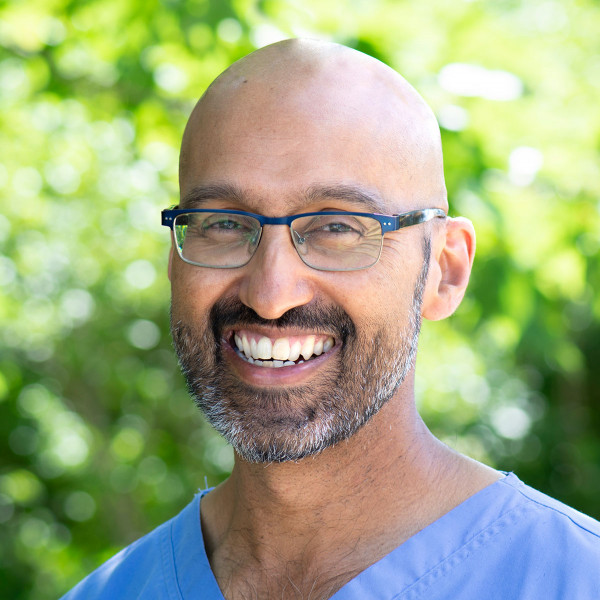
Keith Sequeira, MD
Associate Professor, Schulich School of Medicine and Dentistry
Key Areas of Focus:
Implementation Science and Education
Phone:
519-685-4292 ext. 44029
Email:
Publications:
Accepting Grad Students:
No
About:
Dr. Keith Sequeira is a physiatrist at St. Joseph's Health Care London and London Health Sciences Centre and an associate professor in the Department of Physical Medicine and Rehabilitation in the Schulich School of Medicine and Dentistry at Western University. Dr. Sequeira completed his medical degree at the University of Toronto in 1994, residency training in Physical Medicine and Rehabilitation at Albany Medical Center in 1998, followed by a fellowship in Electrodiagnostic and Sports Medicine at Michigan State University.
Dr. Sequeira is the Medical Director of the Acquired Brain Injury Rehabilitation Program at Parkwood Institute and runs spasticity, EMG, brain and spinal cord injury clinics. Dr. Sequeira is the past Residency Program Director of Physical Medicine & Rehabilitation at Western, a program that he designed and initiated in 2005 and functions. He is the WSIB Champion, working on the integration of WSIB education into the medical school curriculum at Western, past director of the undergraduate the musculoskeletal curriculum within the medical school at Western, the recipient of the Dean’s Award of Excellence for Undergraduate Medical Education, and has authored numerous publications, including a 2020 article in the New England Journal of Medicine on lumbar radiculopathy.
CARING FOR THE BODY, MIND & SPIRIT SINCE 1869 Renowned for compassionate care, St. Joseph's is one of the best academic health care organizations in Canada dedicated to helping people live to their fullest by minimizing the effects of injury, disease and disability through excellence in care, teachi...
… guidelines for nonhandicapping language • ADA Standards of Medical Care 2017- patient centered communication • AMA … guidelines for nonhandicapping language • ADA Standards of Medical Care 2017- patient centered communication • AMA …
Empowering Our Patients through Language Robin Nwankwo, MPH, RDN, CDE THANK YOU! Lifelong thanks to my colleague and mentor Martha M. Funnell, MS, RN, CDE, FAAN, FAADE Objectives Define patient empowerment for diabetes care and education Explain the impact of diabetes related-distress, depression ...
Isnt there just a surgery that can fix it? Surgery for this condition is only VERY rarely performed. A general surgeon or thoracic surgeon can perform a procedure called a Nissen Fundoplication. It is a laparoscopic surgery, where the stomach is wrapped around opening to esophagus opening. It is onl...
… the following late enrolment penalties will be enforced: 1. Medical evidence will be required for Extended Health … a form and in some cases may involve the completion of a medical exam to determine if you qualify for coverage. … the following late enrolment penalties will be enforced: 1. Medical evidence will be required for Extended Health …
University Hospital Victoria Hospital & Childrens Hospital Late Enrolment Penalties for Benefits If you choose to waive benefit coverage or enroll with single coverage because you or your dependents are covered under a spousal plan, you and/or your dependents will only be eligible to re-enroll with...
Lawson and Western researchers suggest walking and talking can be an early predictor of dementia
In a new study, researchers at Lawson Health Research Institute and Western University are demonstrating that gait, or motion testing, while simultaneously performing a cognitively demanding task can be an effective predictor of progression to dementia and eventually help with earlier diagnosis. To date, there is no definitive way for health care professionals to forecast the onset of dementia in a patient with memory complaints.
Dr. Manuel Montero-Odasso, a Lawson scientist, geriatrician at St. Joseph’s Health Care London, and associate professor in the Division of Geriatric Medicine at Western University’s Schulich School of Medicine & Dentistry, is leading the “Gait and Brain Study.” His team is assessing up to 150 seniors with mild cognitive impairment (MCI), a slight decline of memory and other mental functions which is considered a pre-dementia syndrome, in order to detect an early predictor of cognitive and mobility decline and progression to dementia.
Image
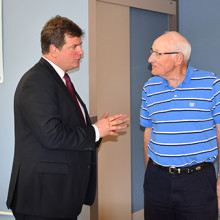
Dr. Montero-Odasso with study participant, Roy Bratty
“Finding methods to detect dementia early is vital to our ability to slow or halt the progression of the disease,” says Dr. Montero-Odasso. The study, funded by the Canadian Institutes of Health Research, followed participants for six years and included bi-annual visits. Researchers asked participants to walk while simultaneously performing a cognitively demanding task, such as counting backwards or naming animals. Those individuals with MCI that slow down more than 20 per cent while performing a cognitively demanding task are at a higher risk of progressing to dementia.
“While walking has long been considered an automatic motor task, emerging evidence suggests cognitive function plays a key role in the control of walking, avoidance of obstacles and maintenance of navigation,” says Dr. Montero-Odasso. “We believe that gait, as a complex brain-motor task, provides a golden window of opportunity to see brain function.”
The “gait cost,” or speed at which participants completed a single task (walking) versus a dual-task, was higher in those MCI individuals with worse episodic memory and who struggle with executive functions such as attention keeping and time management.
“Our results reveal a ‘motor signature’ of cognitive impairment that can be used to predict dementia,” adds Dr. Montero-Odasso. “It is conceivable that we will be able to diagnose Alzheimer’s disease and other dementias before people even have significant memory loss. Our hope is to combine these methods with promising new medications to slow or halt the progression of MCI to dementia.”
The study, “Association of Dual-Task Gait with Incident Dementia in Mild Cognitive Impairment”, was published in the journal, JAMA NEUROLOGY.
Image
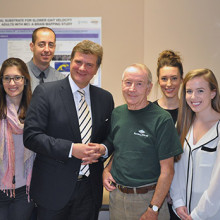
Members of the study’s research team, from left to right: Korbin Blue, Research Assistant (Co-op Student); Yanina Sarquis-Adamson, Lab Research Assistant; Frederico Faria, Post-Doctoral Fellow; Dr. Montero Odasso, Director, Gait and Brain Lab; research participant; Alanna Black, Lab Research Coordinator; Stephanie Cullen, Research Assistant (Undergraduate Student); and, Navena Lingum, Research Assistant (Master Student).
Scientist