


Search
Search
1080 Search Results:
… Mental Health Inpatient NRCC Inpatient Survey Results … using Good, Very Good and Excellent. St. Joseph London - Mental Health Inpatient Percent of Responses: Good Very Good … 63.78 66.67 68.430000000000007 Percentage of Responses Mental Health Family NRCC Family Survey Results OVERALL …
Mental Health Inpatient NRCC Inpatient Survey Results OVERALL RATING OF CARE Question NRCC calculates the % positive score using Good, Very Good and Excellent. St. Joseph London - Mental Health Inpatient Percent of Responses: Good Very Good Excellent % Excellent Target St. Joseph's % Positive FY 201...
… Mental Health Inpatient NRCC Inpatient Survey Results … using Good, Very Good and Excellent. St. Joseph London - Mental Health Inpatient Percent of Responses: Good Very Good … = 72) Feb 2015 (n = 57) 14 14 14 18 Percentage of Responses Mental Health Family NRCC Family Survey Results OVERALL …
Mental Health Inpatient NRCC Inpatient Survey Results OVERALL RATING OF CARE Question NRCC calculates the % positive score using Good, Very Good and Excellent. St. Joseph London - Mental Health Inpatient Percent of Responses: Good Very Good Excellent % Excellent Target % Positive Feb 2012 (n = 69) 4...
… Mental Health Inpatient NRCC Inpatient Survey Results … using Good, Very Good and Excellent. St. Joseph London - Mental Health Inpatient Percent of Responses: Good Very Good … 68.430000000000007 Time Period Percentage of Responses Mental Health Family NRCC Family Survey Results OVERALL …
Mental Health Inpatient NRCC Inpatient Survey Results OVERALL RATING OF CARE Question NRCC calculates the % positive score using Good, Very Good and Excellent. St. Joseph London - Mental Health Inpatient Percent of Responses: Good Very Good Excellent % Excellent Target St. Joseph's % Positive FY 201...
… and services that your family member receives at Regional Mental Health Care. Please focus on the most recent or … the following family support services offered by Regional Mental Health Care? 33. Family Support Groupsa. E E E Yes … and services that your family member receives at Regional Mental Health Care. Please focus on the most recent or …
B B B 0060421*001AMD14**001AMD14* *00* Please fill in the circle that best describes how you feel about the care and services that your family member receives at Regional Mental Health Care. Please focus on the most recent or current inpatient stay when answering the questions. If your family member...
… Hospital ABC Agency *12345 Satisfaction with Inpatient Mental Health Care (Long-Stay) Consent: We are doing a … interview will take about 20 minutes. Site:1. E E Regional Mental Health Care, London Regional Mental Health Care, St. Thomas Units:2. E E E E E E E E E E …
B B B 0060421*001AMD14**001AMD14* *00* Alpha Hospital ABC Agency *12345 Satisfaction with Inpatient Mental Health Care (Long-Stay) Consent: We are doing a survey to learn about the care patients are receiving at this hospital. The survey has questions about all aspects of care such as the food, acti...
People experiencing homelessness more likely to develop dementia at younger ages, study finds
Dementia in unhoused people was 1.9 times greater than the general population, with a higher prevalence for age groups younger than 85 years, according to new research from Lawson Health Research Institute and ICES.
In one of the first population-based studies of its kind and published in The Lancet Public Health, researchers compared dementia prevalence in people experiencing homeless with the general population and people living in low-income neighbourhoods in Ontario, Canada.
“Not only did we find that dementia was more common among unhoused individuals, but the difference was greatest between the ages of 55 to 64 years,” says lead author Dr. Richard Booth, Scientist at ICES and Lawson Health Research Institute, and Associate Professor and Arthur Labatt Family Research Chair in Nursing at Western University.
“There’s a strong link between homelessness and accelerated ageing, which may be one of the reasons people experience an earlier onset of the disease,” says Dr. Booth.
Using a prevalence ratio, the researchers found that within the ages of 55-74 years rates of dementia were 4 to 5 times higher than the general population and 3 to 3.5 times higher than the low-income group. There was a higher dementia prevalence in all age groups younger than 85 years among people experiencing homelessness in both males and females.
Unhoused people were younger on average, less likely to be female, and less likely to live in rural areas compared to the other two groups. They also had higher rates of health conditions associated with dementia, such as head trauma, neurological conditions, HIV, and mental health and substance-use disorders.
After adjusting for factors such as age, sex, residential area, and health conditions, the prevalence ratio for people experiencing homelessness was 1.7 times higher compared to the low-income group, and 1.9 times higher compared to the general population.
“Other research has outlined that the rates of homelessness in older adults are expected to double by 2030, which means that the number of people living with dementia could rise substantially,” says Dr. Booth. “Our findings suggest that unhoused individuals should be screened for dementia at younger ages, rather than waiting until age 65 as many guidelines suggest.”
The researchers also note the complexity of diagnosing dementia in an individual experiencing multiple, chronic health conditions, as cognitive symptoms can overlap. Because of the difficulty in obtaining a medical history and diagnosis in this population, the study could have underestimated the true prevalence of dementia.
“We hope this work serves to enhance the awareness of policy makers and practitioners of the increasing prevalence of dementia among people experiencing homelessness,” says study author Salimah Shariff, Staff Scientist with the Populations & Public Health Research Program at ICES, Associate Director of research operations and strategic partnerships at ICES Western, and Associate Scientist at Lawson. “As housing is a core determinant of health and essential to the sustainment of individuals’ health and wellbeing, access to permanent, supportive housing structures for people experiencing homelessness is also critical in preventing and slowing the progression of dementia in this population.”
This study was funded by the Public Health Agency of Canada.
FOR FURTHER INFORMATION PLEASE CONTACT:
Misty Pratt
Senior Communications Associate, ICES
@email 613-882-7065
Perceptions of confidentiality for Canadian Veterans discussing moral injuries
A new study from Lawson Health Research Institute will be the first to explore Canadian Veterans’ beliefs about confidentiality in mental health care and whether those beliefs act as a barrier to seeking treatment for a type of trauma known as moral injury.
Moral injury describes psychological distress following events where a person performs, witnesses or fails to prevent acts that conflict with deeply held moral standards. Evidence suggests that moral injuries are on the rise among deployed members of the Canadian Armed Forces (CAF), and that those exposed to such events are at a higher risk of developing post-traumatic stress disorder (PTSD) and depression.
Through the study, researchers aim to understand barriers that might prevent military personnel from disclosing details of moral injury.
“A commonly reported barrier when seeking mental health treatment is a perceived lack of confidentiality,” explains Dr. Anthony Nazarov, Post-Doctoral Associate at Lawson. “Since some events that induce moral injuries are ethically ambiguous, it’s possible that military personnel may withhold details of their trauma or even avoid seeking help due to worries about confidentiality.”
The two-year study will engage 200 Canadian Armed Forces Veterans to investigate their perceptions around the confidentiality of disclosing moral injuries in the mental health care and research settings. This will be accomplished not only by interviewing Veterans receiving care at St. Joseph’s Health Care London’s Operational Stress Injury Clinic, but also through online surveys made available to military personnel and Veterans across Canada. The research team will also interview mental health professionals to understand their perspectives on this topic.
“Many Veterans seek help for mental health, and that’s great to see. We’ve come a long way in reducing stigma and barriers, but there’s more work to be done,” says Dr. Don Richardson, Lawson Associate Scientist, Director of the MacDonald/Franklin OSI Research Centre and Physician Lead at St. Joseph’s OSI Clinic. “It’s our duty as mental health researchers and clinicians to ensure that everyone who needs help seeks it. If Veterans do not feel comfortable disclosing certain details because of perceived mistrust related to privacy, we need to know why that is and what we can do to address this issue.“
“Through appropriate messages, it may be possible to dispel any false beliefs, increase trust in mental health professionals and, in turn, increase the number of veterans who choose to seek help,” notes Dr. Nazarov.
The study is being funded by Veterans Affairs Canada and St. Joseph’s Health Care Foundation’s Robert S. & Mary Gay, Donald, James, and Helen (Taylor) Gay Endowed Research Fellowship in Veterans Care.
Those interested in participating in this research study are asked to contact the study team at 519-685-4292 ext. 48211 or @email.
Image
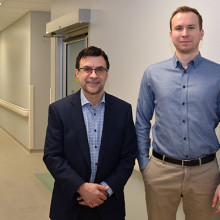
Above: Drs. Don Richardson and Anthony Nazarov
Scientist
Perceptions of confidentiality for Canadian Veterans discussing moral injuries
LONDON, ON – A new study from Lawson Health Research Institute will be the first to explore Canadian Veterans’ beliefs about confidentiality in mental health care and whether those beliefs act as a barrier to seeking treatment for a type of trauma known as moral injury.
Moral injury describes psychological distress following events where a person performs, witnesses or fails to prevent acts that conflict with deeply held moral standards. Evidence suggests that moral injuries are on the rise among deployed members of the Canadian Armed Forces (CAF), and that those exposed to such events are at a higher risk of developing post-traumatic stress disorder (PTSD) and depression.
Through the study, researchers aim to understand barriers that might prevent military personnel from disclosing details of moral injury.
“A commonly reported barrier when seeking mental health treatment is a perceived lack of confidentiality,” explains Dr. Anthony Nazarov, Post-Doctoral Associate at Lawson. “Since some events that induce moral injuries are ethically ambiguous, it’s possible that military personnel may withhold details of their trauma or even avoid seeking help due to worries about confidentiality.”
The two-year study will engage Canadian Armed Forces Veterans to investigate their perceptions around the confidentiality of disclosing moral injuries in the mental health care and research settings. This will be accomplished not only by interviewing Veterans receiving care at St. Joseph’s Health Care London’s Operational Stress Injury Clinic, but also through online surveys made available to military personnel and Veterans across Canada. The research team will also interview mental health professionals to understand their perspectives on this topic.
“Many Veterans seek help for mental health, and that’s great to see. We’ve come a long way in reducing stigma and barriers, but there’s more work to be done,” says Dr. Don Richardson, Lawson Associate Scientist, Director of the MacDonald/Franklin OSI Research Centre and Physician Lead at St. Joseph’s OSI Clinic. “It’s our duty as mental health researchers and clinicians to ensure that everyone who needs help seeks it. If Veterans do not feel comfortable disclosing certain details because of perceived mistrust related to privacy, we need to know why that is and what we can do to address this issue.“
“Through appropriate messages, it may be possible to dispel any false beliefs, increase trust in mental health professionals and, in turn, increase the number of veterans who choose to seek help,” notes Dr. Nazarov.
The study is being funded by Veterans Affairs Canada and St. Joseph’s Health Care Foundation’s Robert S. & Mary Gay, Donald, James, and Helen (Taylor) Gay Endowed Research Fellowship in Veterans Care.
-30-
About Lawson Health Research Institute
Lawson Health Research Institute is one of Canada’s top hospital-based research institutes, tackling the most pressing challenges in health care. As the research institute of London Health Sciences Centre and St. Joseph’s Health Care London, our innovation happens where care is delivered. Lawson research teams are at the leading-edge of science with the goal of improving health and the delivery of care for patients. Working in partnership with Western University, our researchers are encouraged to pursue their curiosity, collaborate often and share their discoveries widely. Research conducted through Lawson makes a difference in the lives of patients, families and communities around the world. To learn more, visit www.lawsonresearch.ca.
Media Contacts
Celine Zadorsky
Senior Media Relations Consultant
Communications & Public Engagement
T: 519-685-8500 ext. 73502
Celine.zadorsky@lhsc.on.ca
Pinpointing the role of language disruptions in psychosis
LONDON, ON - The ability of humans to use language may also be what puts us at the unique risk of developing psychosis, a subset of mental illness characterized by changes in emotions, impaired functioning, and a disconnection from reality.
Difficulties with communication – both the ability to use language and to comprehend what others are saying – are some of the earliest symptoms. New research from Western University and Lawson Health Research Institute has shown that this may be because in patients with psychosis parts of the brain not meant to process language are trying to perform this complex job. Like a small airport trying to handle all the air traffic from a big hub like Pearson International Airport, some brain regions may be overloaded in psychosis.
“The language system seems to be key to understanding this illness,” said Dr. Lena Palaniyappan, the Tanna Schulich Chair in Neuroscience and Mental Health at Western’s Schulich School of Medicine & Dentistry and Scientist at Lawson and Robarts Research Institute. “We don’t yet fully understand how the disorganization of language takes place in patients affected by psychosis.”
Embarking on a mission to find out, Dr. Palaniyappan worked with a team of imaging scientists at Robarts to perform MRI scans on the brains of patients with acute psychosis. Patients were recruited from the Prevention and Early Intervention Program for Psychoses (PEPP) at London Health Sciences Centre, a flagship clinic that supports young individuals from a very early stage of psychosis.
The team divided the patients into two groups – those with severe language disturbances, and those whose language symptoms were less pronounced. They found that both groups had weakening of connectivity, or ‘hubness,’ in the part of the brain generally associated with language -- the superior temporal area. The group with more severe language symptoms also showed an emergence of higher hubness in some unexpected regions of the brain that may be compensating for some of the lost connectivity elsewhere.
“This finding led us to believe that the language problems may occur because the main hubs that are supposed to conduct language are now retired, and so these peripheral hubs, which have no business of orchestrating language as their main function, are picking up the job and aren’t doing it very well,” said Dr. Palaniyappan.
The researchers hope that by understanding how language becomes disorganized in psychosis, the data can inform new interventions to focus on strengthening the language systems in the brain to reduce or delay psychotic symptoms.
Using ultra-high-field magnetic resonance imaging at Robarts Research Institute, they were able to look at the entire brain of patients with acute psychosis. Instead of homing in on one specific area, the team looked at 3-D pixels of the brain (voxels) to get a full picture of what was happening in the whole brain and how different areas were interacting.
Using the airport analogy, Palaniyappan said that if they had only looked at the language area it would have been like only walking into one airport, and not understanding how the reduced traffic in that airport was influencing the air traffic at other surrounding airports.
“We went in without any expectations, and searched the whole brain,” said Palaniyappan. “This unique approach allowed us to get a picture of the forest rather than a picture of the tree.”
The study was funded through an early-career foundation grant from the Canadian Institutes of Health Research and was supported by PEPP.
-30-
About Lawson Health Research Institute
Lawson Health Research Institute is one of Canada’s top hospital-based research institutes, tackling the most pressing challenges in health care. As the research institute of London Health Sciences Centre and St. Joseph’s Health Care London, our innovation happens where care is delivered. Lawson research teams are at the leading-edge of science with the goal of improving health and the delivery of care for patients. Working in partnership with Western University, our researchers are encouraged to pursue their curiosity, collaborate often and share their discoveries widely. Research conducted through Lawson makes a difference in the lives of patients, families and communities around the world. To learn more, visit www.lawsonresearch.ca.
About Western
Western delivers an academic experience second to none. Since 1878, The Western Experience has combined academic excellence with life-long opportunities for intellectual, social and cultural growth in order to better serve our communities. Our research excellence expands knowledge and drives discovery with real-world application. Western attracts individuals with a broad worldview, seeking to study, influence and lead in the international community.
About The Schulich School of Medicine & Dentistry
The Schulich School of Medicine & Dentistry at Western University is one of Canada’s preeminent medical and dental schools. Established in 1881, it was one of the founding schools of Western University and is known for being the birthplace of family medicine in Canada. For more than 130 years, the School has demonstrated a commitment to academic excellence and a passion for scientific discovery.
Media Contacts
Celine Zadorsky
Senior Media Relations Consultant
Communications & Public Engagement
T: 519-685-8500 ext. 73502
Celine.zadorsky@lhsc.on.ca
Poverty, Mental Health and Social Inclusion Book Launch
2:00pm - 3:00pm
Join Drs. Cheryl Forchuk and Richard Csiernik for a discussion about their new book on poverty, mental health and social inclusion.
You're invited to the Poverty & Social Inclusion Virtual Book Launch hosted by Community- University Research Alliance (CURA). On Wednesday, June 2, 2021, they will announce and discuss a new publication from Canadian Scholars: Poverty, Mental Health, and Social Inclusion, edited by Cheryl Forchuk and Rick Csiernik.
They will be giving away two copies of the book and providing a 20% discount code available to all attendees, valid on canadianscholars.com June 2 - 4, 2021.
Time: 10 – 11 am
Format: Zoom Webinar and Facebook Live
*The Zoom link will be provided before the event to those who register.
This book summarizes the overall purpose of CURA (Community-University Research Alliance Poverty): Poverty, Mental Health, and Social Inclusion which is to better understand the inter-relationships between poverty and social inclusion for psychiatric survivors. Social inclusion involves the full participation of marginalized groups in the social and economic benefits of society; however, it is difficult to achieve for citizens with the “double jeopardy” of poverty and psychiatric disorder. With input from over 35 community partners and people with lived experience, the hope is to engender community- based initiatives to counteract poverty and promote social inclusion.
Image

… Vanier Children’s Mental … Mental Health Care, Health and Wellness at Western … 39 ADULT MENTAL HEALTH TRACK … 81 Adult Mental Health Track (181514) … Child and Parent Resource Institute; Vanier Children’s Mental Wellness; and Mental Health Care, Health and Wellness at Western …
CPA Accredited Member of APPIC & CCPPP Clinical Psychology Residency CONSORTIUM Predoctoral Residency in Clinical Psychology 20222023 Your guide to predoctoral training in clinical psychology within one of Canadas leading CPA accredited residency programs Clinical Psychology Residency CONSORTIUM Lon...
… • A disease, with genetic, psycho-social, and environmental factors influencing its development and … THE BODY, MIND & SPIRIT SINCE 1869 Center for Addiction and Mental Health • 350,000 Canadian kids have taken … Dependence Versus Addiction Center for Addiction and Mental Health Drug Diversion How can I work with the pain …
CARING FOR THE BODY, MIND & SPIRIT SINCE 1869 Pain Management Program Patient Orientation CARING FOR THE BODY, MIND & SPIRIT SINCE 1869 Orientation Goals Educate about what chronic pain is Inform about different components of chronic pain management Inform about the chronic pain multidisciplinary...
… intense and intrusive. These emotions start to have a detrimental effect on your day to day life. The neurochemical … because these prolonged stressors wear us down physically, mentally and emotionally. How do we treat depression? It is … your mood. Can you commit an hour or two per week to your mental health? "The Science of Well-being" is a virtual …
Preventing and Treating Depression What is depression? Depression is very different from normal, healthy feelings of sadness. When you become depressed, your emotional distress changes, becoming more frequent, intense and intrusive. These emotions start to have a detrimental effect on your day to da...
Prevention and Awareness: Delirium
8:00pm - 9:00pm
You are invited to the first in a series of Research Bites,. These informative and interactive talks will focus on specific illnesses, their prevention and related research being conducted by researchers in London, Ontario.
Topic: Prevention and Awareness: Delirium
Image

Dr. O'Regan will share about delirium and what it means, and provide highlights of her ongoing research happening locally. She will also be speaking about how to recognize delirium in a loved one and what to do in this scenario, as well as the steps you can take to help prevent it.
Date: Thursday, January 24, 2019
Time: 4 - 5 pm
Location: Parkwood Institute, Mental Health Building, Auditorium (F2-235)
550 Wellington Road South
London, Ontario N6C 0A7
Maps and Directions for Parkwood Institute.
Parking: The lot rate is $4.00 when you enter. $1 and $2 coins and credit card accepted (press the start button then insert payment)
Registration is required and spots will fill up quickly.
Click here to register.
These talks are hosted by Parkwood Institute Research, a program of Lawson Health Research Institute.
… patients with complex self- care challenges, such as mental illness, economic hardship, language barriers, social … patients with complex self- care challenges, such as mental illness, economic hardship, language barriers, social …
Primary Care Diabetes Support Program: What health care professionals can expect Effective diabetes management requires that patients have access to an ongoing course of self- care support, which is critical to enable them to effectively manage their disease and prevent its devastating complications...
… Health Care London and all staff and affiliates have a fundamental right to have their personal health … Parkwood Institute – Main Building Parkwood Institute – Mental Health Care Building Southwest Centre for Forensic Mental Health Care St. Joseph’s Family Medical and Dental …
Version Date: 2015-09-21 PRIVACY AND CONFIDENTIALITY AGREEMENT St. Josephs Health Care London All residents, patients and clients under the care of St Joseph's Health Care London and all staff and affiliates have a fundamental right to have their personal health information/personal information trea...
… Health Care London and all staff and affiliates have a fundamental right to have their health/medical/personal … Hope Centre for Long Term Care Parkwood Hospital Regional Mental Health Care London South West Centre for Forensic Mental Health Care St. Joseph’s Family Medical and Dental …
PRIVACY AND CONFIDENTIALITY AGREEMENT St. Josephs Health Care London All residents/patients/clients under the care of St Joseph's Health Care London and all staff and affiliates have a fundamental right to have their health/medical/personal information treated in confidence. This statement confirms ...
… to relevant Security Office – (exception: instructors at a mental health care site must obtain their items on first … to relevant Security Office – (exception: instructors at a mental health care site must obtain their items on first …
Student Affairs completes spreadsheet information related to student placements (this includes the assignment of packages) Instructor of Student Groups/Preceptor and Student Assignment of Security Items During Clinical Placements, January 2018 Is this a group placement or a 1:1 placement? 1:1 Placem...
… wayfinding and wai�ng for providers can be physically and mentally exhaus�ng. One caregiver stated “virtual care is … visit? •Language barrier? Interpreter required? •Physical, mental, cognitive ability? •Mood/affect? Significant patient … and High Health Care Utilization. Aging Clinical and Experimental Research, 31(4): 519-525. 5 College of Physicians and …
Providing Geriatric Virtual Care across the South West: Guidance Document for Health Care and Community Support Services Providers SOUTH WEST FRAIL SENIOR STRATEGY VERSION 1 NOVEMBER 2020 Guidance Document for Health Care and Community Support Services Providers on Providing Geriatric Virtual Care A...
… wayfinding and wai�ng for providers can be physically and mentally exhaus�ng. One caregiver stated “virtual care is … and High Health Care Utilization. Aging Clinical and Experimental Research, 31(4): 519-525. 5 College of Physicians and … visit? •Language barrier? Interpreter required? •Physical, mental, cognitive ability? •Mood/affect? Significant patient …
Providing Geriatric Virtual Care across the South West: Guidance Document for Health Care and Community Support Services Providers SOUTH WEST FRAIL SENIOR STRATEGY VERSION 1 NOVEMBER 2020 Contact South West Frail Senior Strategy at RegionalFrailSeniors@sjhc.london.on.ca for further informaon and fee...