


Search
Search
1080 Search Results:
… COMPLEX CHRONIC DISEASE MANAGEMENT SPECIALIZED MENTAL HEALTH CARE DIAGNOSTIC AND SURGERY SERVICES Strategic … COMPLEX CHRONIC DISEASE MANAGEMENT SPECIALIZED MENTAL HEALTH CARE DIAGNOSTIC AND SURGERY SERVICES Realizing … COMPLEX CHRONIC DISEASE MANAGEMENT SPECIALIZED MENTAL HEALTH CARE DIAGNOSTIC AND SURGERY SERVICES St. …
STRATEGIC PLAN 2015 | 2018ST. JOSEPHS HEALTH CARE LONDON Realizing our Vision St. Josephs Vision, Mission and Values OUR VISION OUR MISSION OUR VALUES RESPECT, EXCELLENCE, COMPASSION STRATEGIC PLAN 2015 TO 2018 Our Patients, Residents and Families GOAL GUIDED BY THEIR VOICES; EXCELLENCE ALWAYS STRA...
… COMPLEX CHRONIC DISEASE MANAGEMENT SPECIALIZED MENTAL HEALTH CARE DIAGNOSTIC AND SURGERY SERVICES … COMPLEX CHRONIC DISEASE MANAGEMENT SPECIALIZED MENTAL HEALTH CARE DIAGNOSTIC AND SURGERY SERVERVER ICES … COMPLEX CHRONIC DISEASE MANAGEMENT SPECIALIZED MENTAL HEALTH CARE DIAGNOSTIC AND SURGERY SERVICES At St. …
STRATEGIC PLAN 2015 | 2018ST. JOSEPHS HEALTH CARE LONDON Realizing our Vision St. Josephs Vision, Mission and Values OUR VISION OUR MISSION OUR VALUES RESPECT, EXCELLENCE, COMPASSION STRATEGIC PLAN 2015 TO 2018 Our Patients, Residents and Families GOAL GUIDED BY THEIR VOICES; EXCELLENCE ALWAYS STRA...
… initiatives focusing on mobility and activity, cognition, mental health, restoration and all activities that enable … synergies in mobility and activity, cognition, brain and mental health, have converged. COMPLEX CHRONIC DISEASE … treatment and, when needed, inpatient care. SPECIALIZED MENTAL HEALTH CARE St. Joseph’s now leads regional specialty …
Because of our commitment to care, teaching and research... St. Josephs is earning complete confidence. CARING FOR THE BODY, MIND & SPIRIT SINCE 1869 With 17 years of health care restructuring and hospital renewal recently completed, St. Josephs is at an important and exciting juncture. This is St. ...
… and spirit – to our community and the region. Through monumental change, we have maintained a steadfast focus on those … have medically complex conditions, and people living with mental health or addiction issues. The London and Middlesex … for so many of the people St. Joseph’s serves – people with mental illness and addiction, aging and frail adults, people …
sjhc.london.on.ca 2018-2021 Strategic Plan Reaching Out Connecting Care Innovating Together Contents Board Chair and CEO Message Background Mission, Vision, Values Strategic Priorities Reaching Out Connecting Care Innovating Together Leveraging Technology Empowering People Key Principles Uncom...
… and spirit – to our community and the region. Through monumental change, we have maintained a steadfast focus on those … have medically complex conditions, and people living with mental health or addiction issues. The London and Middlesex … for so many of the people St. Joseph’s serves – people with mental illness and addiction, aging and frail adults, people …
sjhc.london.on.ca 2018-2021 Strategic Plan Reaching Out Connecting Care Innovating Together Contents Board Chair and CEO Message Background Mission, Vision, Values Strategic Priorities Reaching Out Connecting Care Innovating Together Leveraging Technology Empowering People Key Principles Uncom...
… Connect with others. Feeling connected is important for our mental health. Make connecting part of your daily routine. … Connect with others. Feeling connected is important for our mental health. Make connecting part of your daily routine. …
Strategies to manage self-isolation Isolating yourself is hard! It is lonely and stressful, and it disrupts your habits, routines, and coping strategies. Anyone who has to had self-isolate must work hard to stay happy and healthy. However, the coping strategies are similar to what we teach in our gr...
… Devices: Students who are learning at Parkwood Institute Mental Health Care Building or Southwest Centre for Forensic Mental Health Care will receive a personal alert device. … of Package Parkwood Institute, Main Building Parkwood Mental Health Care Building NRC Southwest Centre for …
Student Placement Checklist PRIOR TO THE START OF PLACEMENT check () as applicable Corporate Network Login: You will receive your corporate login directly from your school. Please note: You will need your corporate network login to access St. Josephs polices below. Student Requirements: Ensure you ...
… Exception: Clinical groups learning at Parkwood Institute Mental Health Care Building or Southwest Centre for Forensic Mental Health Care must return their items at the end of … Devices: Students who are learning at Parkwood Institute Mental Health Care Building or Southwest Centre for Forensic …
Student Placement Checklist for Clinical Group Placements PRIOR TO THE START OF PLACEMENT check () as applicable Corporate Network Login: You will receive your corporate login directly from your school for placement purposes. Your login credentials will provide you with access to the Electronic Pat...
… Long Term Care St. Joseph’s Hospital Parkwood Institute’s Mental Health Care Building Parkwood Institute’s Main Building Southwest Centre for Forensic Mental Health Care St. Joseph’s Family Medical and Dental … Long Term Care St. Joseph’s Hospital Parkwood Institute’s Mental Health Care Building Parkwood Institute’s Main …
DECLARATION ACKNOWLEDGEMENT FORM St. Josephs Placement Agreement and Required Learning Modules Thank you for completing the on-line required learning program. It has provided you with important information pertaining to your placement experience at St. Josephs. It is expected that you will apply thi...
… London ACT 3 Health Information Management 4AE SCI Developmental Service Work Mount Hope Infectious Disease Care … Imagining 5AN/5AE EMG Technology Parkwood Institute, Mental Health Care Building Medicine Services A1 - Rehab Readiness Unit Ethics Southwest Centre for Forensic Mental Health Care Mental Health A2 - Treatment Unit North …
Student Placement Information Student Placement Details School Information Academic Institution Academic Program Level Placement Site St. Joseph's Progam Name Location/Unit St. Joseph's Supervisor Student FIRST Name Student LAST Name Student MIDDLE Initital Is the Student OR CI an EMPLOYEE? (ONLY ne...
… Exception: Clinical groups learning at Parkwood Institute Mental Health Care Building or Southwest Centre for Forensic Mental Health Care must return their items at the end of … Devices: Students who are learning at Parkwood Institute Mental Health Care Building or Southwest Centre for Forensic …
Student Placement Checklist for Clinical Group Placements PRIOR TO THE START OF PLACEMENT check () as applicable Corporate Network Login: You will receive your corporate login directly from your school for placement purposes. Your login credentials will provide you with access to the Electronic Pa...
… Rehab 3AEast NO Audiology Masters Parkwood Institute, Mental Health Care Building Cardiac Investigation Unit … Child and Youth Care PhD Southwest Centre for Forensic Mental Health Care Complex Care 3Kent/Essex Dental Hygiene … Infection Prevention 4AN Diagnostic Medical Sonography Mental Health 4Bruce/Elgin EMG Technologist Rehab 5AN/5AE …
Student Placement Information Student Placement Details School Information St. Joseph's Health Care London Academic Institution Placement Coordinator Academic Program Level Research Placement Placement Site St. Joseph's Progam Name Location/Unit St. Joseph's Supervisor Student Name Student ID Studen...
… Cardiac Rehab 3AEast Audiology Masters Parkwood Institute, Mental Health Care Building Cardiac Investigation Unit … Child and Youth Care PhD Southwest Centre for Forensic Mental Health Care Complex Care 3Kent/Essex Dental Hygiene … Infection Prevention 4AN Diagnostic Medical Sonography Mental Health 4Bruce/Elgin EMG Technologist Rehab 5AN/5AE …
Student Placement Information Student Placement Details School Information St. Joseph's Health Care London Academic Institution Placement Coordinator Academic Program Level Research Placement Placement Site St. Joseph's Progam Name Location/Unit St. Joseph's Supervisor Student Name Student ID Studen...
… Cardiac Rehab 2Perth Audiology Masters Parkwood Institute, Mental Health Care Building Complex Care 3AEast Child and Youth Care PhD Southwest Centre for Forensic Mental Health Care Geriatrics 3BWest Dental Hygiene Research … Infection Prevention 3Kent/Essex Development Service Work Mental Health 4AE ABI Diagnostic Medical Sonographer Rehab …
Student Placement Information Student Placement Details School Information St. Joseph's Health Care London Academic Institution Placement Coordinator Academic Program Level Research Placement Placement Site St. Joseph's Progam Name Location/Unit St. Joseph's Supervisor Student Name Student ID Studen...
… Cardiac Rehab 3AEast Audiology Masters Parkwood Institute, Mental Health Care Building Cardiac Investigation Unit … Child and Youth Care PhD Southwest Centre for Forensic Mental Health Care Complex Care 3Kent/Essex Dental Hygiene … Infection Prevention 4AN Diagnostic Medical Sonography Mental Health 4Bruce/Elgin EMG Technologist Rehab 5AN/5AE …
Student Placement Information Student Placement Details School Information St. Joseph's Health Care London Academic Institution Placement Coordinator Academic Program Level Research Placement Placement Site St. Joseph's Progam Name Location/Unit St. Joseph's Supervisor Student Name Student ID Studen...
… to relevant Security Office – (exception: instructors at a mental health care site must obtain their items on first … to relevant Security Office – (exception: instructors at a mental health care site must obtain their items on first …
Student Affairs completes spreadsheet information related to student placements (this includes the assignment of packages) Instructor of Student Groups/Preceptor and Student Assignment of Security Items During Clinical Placements, January 2018 Is this a group placement or a 1:1 placement? 1:1 Placem...
… Institute, Main Building PIMH – Parkwood Institute, Mental Health Care Building January 2016 Corporate … Institute, Main Building PIMH – Parkwood Institute, Mental Health Care Building August 2016 Corporate … Institute, Main Building PIMH – Parkwood Institute, Mental Health Care Building January 2016 Corporate …
St. Josephs Health Care London Corporate and Health Care Professionals 2016 Orientation Dates PIMB Parkwood Institute, Main Building PIMH Parkwood Institute, Mental Health Care Building January 2016 Corporate Orientation Health Care Professionals Orientation Cerner Training Mon, Jan 11, 2016 Tues,...
… Cardiac Rehab 2Perth Audiology Masters Parkwood Institute, Mental Health Care Building Complex Care 3AEast Child and Youth Care PhD Southwest Centre for Forensic Mental Health Care Geriatrics 3BWest Dental Hygiene Research … Infection Prevention 3Kent/Essex Development Service Work Mental Health 4AE ABI Diagnostic Medical Sonographer Rehab …
Student Placement Information Student Placement Details School Information St. Joseph's Health Care London Academic Institution Placement Coordinator Academic Program Level Research Placement Placement Site St. Joseph's Progam Name Location/Unit St. Joseph's Supervisor Student Name Student ID Studen...
Study examining moral injury in health care workers is focusing on functional brain changes
LONDON, ON – For many health care workers, the past year and a half of the COVID-19 pandemic has taken a toll on their mental health. Recognizing this is a growing concern, a London research team from Lawson Health Research Institute and Western University’s Schulich School of Medicine & Dentistry is examining moral injury amongst health care workers by imaging the effects on the brain.
“We are trying to look closely at what happens in the brain when a person recalls a moral injury event,” says Dr. Ruth Lanius, Associate Scientist at Lawson and Professor at Western’s Schulich School of Medicine & Dentistry. “By understanding the changes happening in the brain, we may be better able to treat individuals suffering from moral injury.”
Moral injury refers to an injury to an individual’s moral conscious which can produce profound emotional guilt and shame. During this ongoing pandemic, some health care workers have experienced emotionally difficult situations that resulted in moral injury.
“Those suffering from moral injury have a cognitive or thinking component which may include repeated thoughts that they didn’t provide the best care for example, or that they let their family down do to their intense work schedule or need to self-isolated,” explains Dr. Lanius, who is also a psychiatrist at London Health Sciences Centre (LHSC). ‘These thoughts are coupled with intense visceral distress, a gnawing sensation in the stomach or the feeling like one is being eaten up inside. I think once we help resolve the visceral distress, we will also see the negative thinking patterns settle down.”
The new study will involve around 60 health care workers. These research participants will undergo a functional MRI scan at St. Joseph's Health Care London at the beginning of the study and have the option to receive eight weeks of treatment. Then, another MRI scan will be done to see if and how the moral injury changes and possibly resolves within the brain. “This can be very validating for the health care workers since brain scans can make the invisible wound of moral injury visible,” adds Dr. Lanius.
The research team’s goal is to better understand what networks of the brain are activated with moral injury. Dr. Lanius hopes this would help establish more neuroscientifically guided treatments. “We have to help our health care workers heal from the tremendous hardships they often endure.”
Health care workers are still being recruited for this study. Interested participants can contact Research Coordinator Suzy Southwell 519-685-8500 ext. 35186 or @email.
See all Lawson Media Releases
About Lawson Health Research Institute
Lawson Health Research Institute is one of Canada’s top hospital-based research institutes, tackling the most pressing challenges in health care. As the research institute of London Health Sciences Centre and St. Joseph’s Health Care London, our innovation happens where care is delivered. Lawson research teams are at the leading-edge of science with the goal of improving health and the delivery of care for patients. Working in partnership with Western University, our researchers are encouraged to pursue their curiosity, collaborate often and share their discoveries widely. Research conducted through Lawson makes a difference in the lives of patients, families and communities around the world. To learn more, visit www.lawsonresearch.ca.
About Western
Western delivers an academic experience second to none. Since 1878, The Western Experience has combined academic excellence with life-long opportunities for intellectual, social and cultural growth in order to better serve our communities. Our research excellence expands knowledge and drives discovery with real-world application. Western attracts individuals with a broad worldview, seeking to study, influence and lead in the international community.
About The Schulich School of Medicine & Dentistry
The Schulich School of Medicine & Dentistry at Western University is one of Canada’s preeminent medical and dental schools. Established in 1881, it was one of the founding schools of Western University and is known for being the birthplace of family medicine in Canada. For more than 130 years, the School has demonstrated a commitment to academic excellence and a passion for scientific discovery.
Media Contacts
Celine Zadorsky
Senior Media Relations Consultant
Communications & Public Engagement
T: 519-685-8500 ext. 73502
Celine.zadorsky@lhsc.on.ca
Study results prove success of project aimed at preventing family homelessness
Lawson Health Research Institute, Western University, City of London, and Mission Services of London, Ontario, partnered on the Prevention of Homelessness Among Families (PHAF) project to assess the effectiveness of a shelter diversion pilot-program at Rotholme Women’s and Family Shelter (Mission Services).
The results of the study illustrate that a low percentage of families ended up in shelter when accessing the program, and as many as 90 per cent of the families were known to still be housed 18-months later.
The project was supported by $134,000 in funding delivered through the Government of Ontario’s Local Poverty Reduction Fund (LPRF). The grant, funded by the Government of Ontario and administered by its agency, the Ontario Trillium Foundation, is helping groups disproportionately affected by poverty get into housing, develop skills and find employment in London, Ontario.
This project focuses on local community partnerships and includes a third-party evaluation component, which is important because better data will help communities develop better solutions to increasing food security, reducing child poverty and homelessness, and helping people find jobs and earn a stable income.
Rotholme’s shelter diversion program aims to divert family homelessness by working with families to maintain stable housing prior to eviction. Families at risk of homelessness who contact the shelter before leaving their home are immediately connected with a housing crisis worker. Together, parents and the crisis worker explore alternate housing arrangements, services, and supports.
“To keep families in their home we have a ‘whatever it takes approach.’ Once families have left their homes and belongings it is very difficult to escape homelessness,” says Gordon Russell, director of shelters, Mission Services, of London. A variety of tactics are used to divert families from shelter, such as negotiating with landlords to keep the family in their home or move them into an available unit.
To evaluate the success of the program, researchers assessed administrative shelter data, interviewed parents who participated in the program, and conducted focus groups with staff and families who did not access the program.
Image
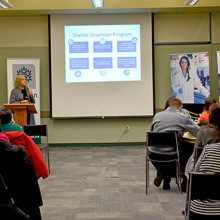
Researchers interviewed 20 families at four time points, approximately six months apart. Thirteen families were able to complete all four interviews. In total the information of 75 individuals, including 29 parents and 46 dependents, was collected, and included demographics, specific needs, utilization of health services, and quality of life metrics. A majority of the parents interviewed had never experienced homelessness before accessing Mission Services.
“We found that Rotholme’s pilot program was effective for preventing family homelessness,” explains Dr. Cheryl Forchuk, assistant scientific director at Lawson, and professor of Nursing at Western University. “Family homelessness is a serious problem, one that can be prevented with early intervention according to our results.”
Other themes that emerge from the study suggest:
- families at risk of homelessness may have life challenges such as mental health and addiction issues, language issues, or low level education levels;
- families at risk of homelessness may have a lack of understanding the system including shelter rules, social assistance and school supports and their own rights;
- and, families at risk of homelessness may experience difficulty with conflict, both within the family dynamic and in resolving conflicts with landlords.
“When we know the challenges that families face, we are better equipped to meet their needs and continue to help them live in stable housing,” continues Dr. Forchuk. “Understanding issues of service preference and outcomes from the context of the whole family are critical to planning appropriate services.”
This investment by the Government of Ontario is just one way the province is bolstering innovative local programs that support groups disproportionately affected by poverty. Through the Local Poverty Reduction Fund, Ontario is helping to break the cycle of poverty for children and youth, increase employment and income security, and end homelessness in Ontario.
Scientist