


Search
Search
33 Search Results:
… ’ Care Matters Here. Learn More. sjhc.london.on.ca BODY | MIND … care, St. Joseph’s is one of the best academic health care organizations in Canada, dedicated to helping … Care St. Joseph s Hospital Southwest Centre for Forensic Mental Health Care Parkwood Institute Teams, clinics and …
Care Matters Here. Learn More. sjhc.london.on.ca BODY | MIND | SPIRIT Leena Justus Registered Nurse Mount Hope Centre for Long Term Care Renowned for compassionate care, St. Josephs is one of the best academic health care organizations in Canada, dedicated to helping people live their fullest by mi...
… & Epidemiology and Biostatistics, UWO Scientist, Lawson Health Research Institute, London, Ontario 4 Associate … Professor, Dept./ Psychiatry, UWO and Clinical Lead/Shared Care Program, Regional Mental Health Care, London. Ontario * Corresponding author: … UWO and Clinical Lead/Shared Care Program, Regional Mental Health Care, London. Ontario * Corresponding author: …
Participant Learning at Psychiatry CME Sessions A Follow-up Evaluation at the University of Western Ontario Laeeq Tahir, MD, FRCP(C)1 , Nicole Tsang, MD2, Marnin Jori Heisel, PhD, CPsych3 *, Jatinder Takhar, MD, FRCP(C)4 Key Words: continuing medical education, CME, knowledge transfer, professional ...
… BULLETIN Acute Care Hospital Redevelopment News for Physicians in the Community Issue 3 - March 2011 LHSC’s adult mental health care program is moving to Victoria Hospital next … in the Community Issue 3 - March 2011 LHSC’s adult mental health care program is moving to Victoria Hospital …
BULLETIN Acute Care Hospital Redevelopment News for Physicians in the Community Issue 3 - March 2011 LHSCs adult mental health care program is moving to Victoria Hospital next month All adult acute mental health care services at LHSC will move from South Street Hospital to two locations at Victoria ...
… Hospital redevelopment next phase underway at St. Joseph’s Health Care, London and London Health Sciences Centre (LONDON, ON) … – Children’s hospital inpatient unit 7th floor – Adult mental health unit 8th floor – Child/adolescent mental … – Children’s hospital inpatient unit 7th floor – Adult mental health unit 8th floor – Child/adolescent mental …
MEDIA RELEASE For Immediate Release: March 23, 2009 Hospital redevelopment next phase underway at St. Josephs Health Care, London and London Health Sciences Centre (LONDON, ON) London Health Sciences Centre (LHSC) and St. Josephs Health Care, London (SJHC) are now well into the next phase of redeve...
… ’A publication of St. Joseph s Health Care London FALL 2020 | ISSUE 02 NEW OPTIONS IN AN OLD … Southwest Centre Centre for for Forensic Long Term Care Mental Health Care Teams, clinics and programs in our … Southwest Centre Centre for for Forensic Long Term Care Mental Health Care Teams, clinics and programs in our …
A publication of St. Joseph s Health Care London FALL 2020 | ISSUE 02 NEW OPTIONS IN AN OLD BATTLE Pain specialists at St. Joseph's Health Care London are part of a new, collaborative approach to improve care for a growing number of people living with sickle cell disease. 1 ~ ~ OSEPH'S n Cl A public...
… within one of Canada’s leading CPA accredited residency programs Clinical Psychology Residency CONSORTIUM London … contributions to this document. Thanks also go to London Health Sciences Centre Psychology Manager - Dr. Ian … 8 St. Joseph’s Health Care London … Vanier Children’s Mental …
CPA Accredited Member of APPIC & CCPPP Clinical Psychology Residency CONSORTIUM Predoctoral Residency in Clinical Psychology 20222023 Your guide to predoctoral training in clinical psychology within one of Canadas leading CPA accredited residency programs Clinical Psychology Residency CONSORTIUM Lon...
… Illuminating a vision of care 2005-2006 AnnuAl RepoRt Strategic Plan Creation of our … as well as community members, key partners and other health care providers in our region. St. Joseph’s Board of … in laparoscopic surgery 14, 15 Staff safety 16 Regional Mental Health Care 17 Digital Imaging Network 18, 19 Healthy …
Illuminating a vision of care 2005-2006 AnnuAl RepoRt Strategic Plan Creation of our new four-year strategic plan began in the summer of 2004 with the formation of a Board-appointed Strategic Planning Steering Committee. In the months that followed, a highly consultative process was used to gain inp...
… E P H ’ S H E A LT H C A R E , LO N D O N 2 0 0 4 / 2 0 0 5 care is at our core STAND TALL AND PROUD SINK YOUR ROOTS … – remembering through care 12 “SHARED CARE” – Regional Mental Health Care London’s approach to service delivery 13 Our … – remembering through care 12 “SHARED CARE” – Regional Mental Health Care London’s approach to service delivery 13 …
S T. J O S E P H S H E A LT H C A R E , LO N D O N 2 0 0 4 / 2 0 0 5 care is at our core STAND TALL AND PROUD SINK YOUR ROOTS DEEPLY INTO THE EARTH REFLECT THE LIGHT OF A GREATER SOURCE THINK LONG TERM GO OUT ON A LIMB REMEMBER YOUR PLACE AMONG ALL LIVING BEINGS EMBRACE WITH JOY THE CHANGING SEASON...
Rates of depression and substance use higher for pregnant teens, study finds
LONDON, ON – Researchers from Lawson Health Research Institute and Brescia University College found that teenage pregnant women are more likely to live in poverty, have poorer mental health and have higher rates of substance use.
There are limited Canadian studies on teenage pregnancies, in particular looking at risk factors and birth outcomes compared to women who became pregnant during adulthood. London researchers were able to take advantage of a large sample of pregnant women from Southwestern Ontario by accessing data from patients at London Health Sciences Centre. Of the 25,363 pregnant women making up the total sample of the retrospective cohort study, 4.3 per cent (1080) were 19 years old or younger.
Teenage pregnant women were much more likely than older pregnant women to live in poor, disadvantaged neighbourhoods across Southwestern Ontario. They were also more likely to have a history of depression and had higher rates of depression during pregnancy, with 10 per cent on medication while pregnant. Looking at substance use, 41 per cent of teenage women smoked cigarettes, 13 per cent used cannabis and 7 per cent drank alcohol during pregnancy, which was significantly higher than rates for older pregnant women.
Once adjusted for other medical, behavioural and economic factors, teenage pregnancy was not associated with a higher risk for preterm birth or low birth weight compared to pregnancy for women ages 20-34 years. However, the infants had a higher risk of low Apgar scores.
An Apgar score, a test given to newborns soon after birth, indicates how well the baby is doing outside of the womb. Babies with very low Apgar scores are more likely to need assistance with breathing. However, Apgar scores have little correlation with the long-term health of the baby.
“Although teenage pregnancy has been declining in Canada over the past few decades, this does not mean that we have solved this social issue. The majority, 70 per cent, of teenage pregnancies in this country are unintended,” says Dr. Seabrook, Scientist at Children’s Health Research Institute, a program of Lawson, and Associate Professor at Brescia University College. “Unfortunately, declining rates of teenage pregnancy means that the issue has received minimal attention in recent years with respect to social policy.”
Contrary to findings in the United States, where teenage pregnancy is associated with a higher risk for preterm birth and low birth weight, these recent results suggest that geographical context, differences in social inequality and type of health care system are important. It’s possible that Canada’s universal health care system provides a stronger safety net.
“There are so many factors associated with poor birth outcomes, and the advantage of our sample size and statistical modelling was that we were able to include key medical and behavioural factors which play a larger role than age,” says Dr. Jasna Twynstra, Associate Professor at Brescia University College.
“Although our study adds to the limited research on teenage pregnancy and birth outcomes, the findings are only from Southwestern Ontario,” adds Dr. Seabrook. “We are currently working on a systematic review and meta-analysis of all studies conducted in Canada on the relationship between teenage pregnancies and adverse birth outcomes to determine whether our findings here are consistent with what’s happening across the country.”
He hopes the study reopens discussion on this important issue so that work can be done to improve the overall health of teenage pregnant women and their children. “We need to target teenage mental illness, as well as their high substance use during pregnancy, to minimize the impact on their overall health and wellbeing.”
The study, “Risk Factors and Birth Outcomes Associated with Teenage Pregnancy: A Canadian Sample,” was published in the Journal of Pediatric and Adolescent Gynecology.
-30-
Media Contacts
Celine Zadorsky
Senior Media Relations Consultant
Communications & Public Engagement
T: 519-685-8500 ext. 73502
Celine.zadorsky@lhsc.on.ca
… ST. JOSEPH’S HEALTH CARE LONDON | ANNUAL REPORT TO THE COMMUNITY | 2002/2003 2 … 10. Expressions through art 11. Shared care approach to mental health 12. Branching out to meet our mission and … in the face of ongoing financial challenges. Specialized programs, including nursing education, were implemented. …
ST. JOSEPHS HEALTH CARE LONDON | ANNUAL REPORT TO THE COMMUNITY | 2002/2003 2 Dedication This years Annual Report to the Community is dedicated to the St. Josephs Health Care, London staff members and volunteers who continue to give so much of themselves to help manage SARS restrictions. Thank you t...
… St. Joseph’s Health Care London Annual Report 1 care 2 3 At St. Joseph’s Health … in rehabilitation, acute/ambulatory care, specialized mental health care, long-term care, specialized geriatric … in rehabilitation, acute/ambulatory care, specialized mental health care, long-term care, specialized geriatric …
St. Josephs Health Care London Annual Report 1 care 2 3 At St. Josephs Health Care, London, there are so many ways to care, all stemming from one vision to be a respected source of excellent health care. Uniting an organization of such diversity, embodying programs in rehabilitation, acute/ambulato...
… and the humble, the stoic hero and the whining rogue. She cares for people.” -TR Harrison, 1950 “The grand essentials … and Clinical Fellows are a vital part of the academic healthcare institution. The many roles you will strive to … Wellington Road, London, ON ● Parkwood Institute - Regional Mental Health Care 550 Wellington Road, London ON ● …
The Resident & Fellow Handbook This handbook is the property of: Dr. _____________________________ Resident / Clinical Fellow in the Department of: ________________________________ If found, please return to the Security office or notify me by email at: ________________________________ Preface Th...
Youth report improved wellbeing as result of tailored mental health services, study finds
In a new study from Lawson Health Research Institute and Western University, researchers partnered with youth receiving care at the First Episode Mood and Anxiety Program (FEMAP) at London Health Sciences Centre (LHSC) to better understand personal perspectives on care and treatment outcomes. The study found that patients experienced lasting improvements in managing their symptoms and improvements in academics, work performance and relationships, and they reported that these benefits involved being empowered by feelings of self-acceptance.
The study included 22 patients from FEMAP, a novel outpatient mental health program at LHSC that provides treatment to ‘emerging adults,’ ages 16 to 25, with emotional concerns that fall into the categories of mood and anxiety symptoms. Treatment at FEMAP takes a patient-centred approach and the research involved looking at what is meaningful and valuable to patients during their care journey.
“The transition from adolescence to adulthood is challenging. FEMAP employs an innovative model of care tailored to the needs of this complex population,” said Dr. Elizabeth Osuch, a clinician-scientist at Lawson, associate professor at Western University’s Schulich School of Medicine & Dentistry and medical director at FEMAP. “By engaging patients in a reflection of their experience, we can learn how effective the program is from the patient perspective.”
Participants shared their experiences through open-ended interviews with Dr. Osuch’s research team. Interview transcripts were collected and analyzed to determine common themes around treatment and outcomes. These themes were then presented back to the research participants for validation.
The study found that treatment led to development of coping strategies to better manage symptoms. Research participants credited these strategies for better functioning in academics, careers and personal relationships. Challenges in these areas are common among emerging adults and are often stressors that lead to youth seeking mental health care.
Participants characterized their treatment at FEMAP as an important investment in their mental health and wellbeing, and credited a collaborative partnership with their care provider for keeping them engaged in treatment. They appreciated the ease of accessing treatment at FEMAP where they could receive care from a psychiatrist, social worker, addictions counsellor, family counsellor and a psychologist, depending on their needs.
The research found that the complexities of treatment were initially frustrating to patients as they were seeking an “easy fix” to their mental health concerns, but they ultimately appreciated that mental health recovery is a journey. They valued that care providers partnered with them to set long-term treatment goals, choose the best treatment options and provide support both during and between appointments.
“Patients may prefer FEMAP over other mental health services because the care is tailored to emerging adults,” said Justin Arcaro, first author on the study and a former MSc candidate at Schulich Medicine & Dentistry and research associate at FEMAP. “There’s an important balance between recognizing emerging adults’ personal autonomy and their need for comprehensive support.”
Study results demonstrated that through treatment at FEMAP, patients realized they are not alone in their mental health journey which led to improved self-acceptance and self-compassion. Participants reported feeling empowered to create meaningful changes in their lives.
Participants also discussed the decision to seek mental health care in the first place. Many struggled with the decision of whether or not treatment was needed. “This shows a need for targeted campaigns to help emerging adults distinguish between normative feelings and those that indicate a need for help,” said Dr. Osuch.
This study also aligns with other research projects at FEMAP that suggest a need for targeted education campaigns about mental health care as a process with solutions that are not necessarily quick or easy. The research team highlights the importance of these findings in informing future funding decisions and policy around mental health care for emerging adults. The findings emphasize the need for quick engagement with a trusted care provider and an integrated treatment team that can partner with patients to support them while enhancing independent growth and self-acceptance.
The study, “Emerging adults’ evaluation of their treatment in an outpatient mood and anxiety disorders program,” is published in Emerging Adulthood.
Image
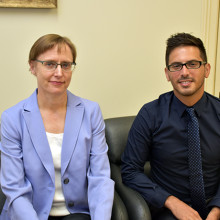
Above: Dr. Elizabeth Osuch and Justin Arcaro
Scientist