


Search
Search
1883 Search Results:
… feedback pertains to Description: To receive feedback via our website from the community Legal Authority for PIB: … to St. Joseph’s through the Corporate Feedback Form on our Internet. Retention Period: One year /media/2159 … feedback pertains to Description: To receive feedback via our website from the community Legal Authority for PIB: …
Personal Information Bank (PIB) Details Title: Corporate Feedback Form Location of Files: Various areas within St. Josephs Health Care London depending on what area the feedback pertains to Description: To receive feedback via our website from the community Legal Authority for PIB: Public Hospitals ...
… document and then follow all the steps below to set up your: · Corporate ID (network account) · Outlook (email … · Beep! (instant messaging) Purpose: How To: Corporate ID: Your Corporate ID will allow access to the following … (eLearning modules) · Intranet · NetScaler remote access Your Corporate ID will enable access to hospital computers …
Corporate Account, and System Access Please review this entire document and then follow all the steps below to set up your: Corporate ID (network account) Outlook (email account) Remote Access Beep! (instant messaging) Purpose: How To: Corporate ID: Your Corporate ID will allow access to the fol...
… document and then follow all the steps below to set up your: · Corporate ID (network account) · Outlook (email … · Beep! (instant messaging) Purpose: How To: Corporate ID: Your Corporate ID will allow access to the following … (eLearning modules) · Intranet · NetScaler remote access Your Corporate ID will enable access to hospital computers …
Corporate Account, and System Access Please review this entire document and then follow all the steps below to set up your: Corporate ID (network account) Outlook (email account) Remote Access Beep! (instant messaging) Purpose: How To: Corporate ID: Your Corporate ID will allow access to the fol...
… document and then follow all the steps below to set up your: Corporate ID (network account) Outlook (email … to starting. See Page 4. Purpose: How To: Corporate ID: Your Corporate ID will access to the following applications: … (elearning modules) Intranet Juniper remote access Your Corporate ID will enable access to hospital computers …
Corporate Account and System Access Please review this entire document and then follow all the steps below to set up your: Corporate ID (network account) Outlook (email account) ME(MyEducation) - please review ASAP as you will need to access and complete elearning and in class registrations prior...
… document and then follow all the steps below to set up your: · Corporate ID (network account) · Outlook (email … and complete elearning Purpose: How To: Corporate ID: Your Corporate ID will access to the following applications: … (elearning modules) · Intranet · Juniper remote access Your Corporate ID will enable access to hospital computers …
Corporate Account and System Access Please review this entire document and then follow all the steps below to set up your: Corporate ID (network account) Outlook (email account) ME(MyEducation) - please review ASAP as you will need to access and complete elearning Purpose: How To: Corporate ID: Y...
Could microorganisms in poop help treat the deadliest form of skin cancer?
A multidisciplinary team at Lawson Health Research Institute is exploring whether fecal transplants can improve outcomes in melanoma patients treated with immunotherapy.
Immunotherapy drugs stimulate a person’s immune system to attack and destroy cancer. While they can significantly improve survival outcomes in those with melanoma, they are only effective in 40 to 50 per cent of patients. Preliminary research has suggested that the human microbiome – the diverse collection of microbes in our body – may play a role in whether or not a patient responds.
“The gut microbiome helps establish immunity from an early age. It makes sense that a healthy gut could improve response to immunotherapy,” explains Dr. Jeremy Burton, a Lawson Scientist who specializes in human microbiome research. “This led us to consider the potential of fecal transplants.”
Fecal transplants involve collecting stool from a healthy donor, preparing it in a lab and transplanting it to the patient. The goal is to transplant the donor’s microbiome so that healthy bacteria will colonize in the patient’s gut.
Image
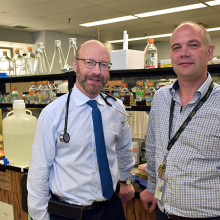
Above (from left): Drs. Michael Silverman and Jeremy Burton
In a phase I clinical trial, the research team is the first in Canada to study the use of fecal transplants to alter a cancer patient’s microbiome and improve their response to anti-PD1 immunotherapy drugs.
Research participants will be 20 melanoma patients recruited from the London Regional Cancer Program (LRCP) at London Health Sciences Centre (LHSC). They will undergo a fecal transplant at St. Joseph’s Hospital, a part of St. Joseph’s Health Care London, followed by immunotherapy at LRCP. The transplant will consist of taking a number of specially-prepared oral capsules.
Patients will be assessed over time for any changes to their cancer, microbiome, immune system and overall health. The primary goal of the study is to evaluate safety of the novel treatment combination, but researchers will also evaluate patient outcomes.
“Melanoma is the least common skin cancer but it is the most deadly and rates are going up,” says Dr. John Lenehan, Associate Scientist at Lawson and Oncologist at LHSC. “Anti-PD1 immunotherapy drugs can be extremely effective but we want to help more patients respond. That’s our goal.”
Image
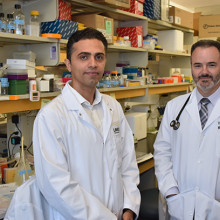
Above (from left): Drs. Saman Maleki and John Lenehan
While the team is studying the combination of fecal transplants and immunotherapy for melanoma, they see potential for other cancers as well.
“We’re one of the first in the world to study fecal transplants in cancer patients. This study is as cutting-edge as it gets with potential applications for multiple disease sites,” notes Dr. Saman Maleki, a Lawson Associate Scientist who specializes in cancer immunology. “With experts in microbiology, infectious disease, cancer and immunology, our institute is well-positioned to carry this forward.”
Image
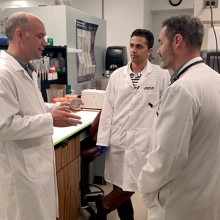
Dr. Michael Silverman, Lawson Associate Scientist and Chief of Infectious Disease at St. Joseph’s and LHSC, is a pioneer in the field of fecal transplants. St. Joseph’s is a leading centre for the procedure, performing them for Clostridium difficile (C. diff) patients across the province.
“Fecal transplants have saved the lives of countless patients with recurrent C. diff,” says Dr. Silverman. “We’re now starting to see its potential for the treatment of other diseases.”
Lawson researchers are planning fecal transplant studies for multiple other conditions including non-alcoholic fatty liver disease, multiple sclerosis (MS) and cancer treatment toxicity.“But in order to conduct this research, we need stool donors,” notes Dr. Silverman.
The team is in need of young, healthy stool donors for fecal transplants. All donors are required to go through a screening process. Those interested in becoming a stool donor can contact Dr. Seema Nair Parvathy, Research Coordinator, Fecal Transplant Program, at 519-646-6100 ext. 61726.
Check out media coverage of this research:
- CTV News: Why fecal transplants could be the next frontier in fighting skin cancer
- Forbes: Could poop be the next treatment for cancer?
- London Free Press: Researchers seeking poop donors for skin cancer treatment study
- Daily Mirror: How human poo 'transplants' could help doctors treat deadliest form of skin cancer
- CBC: London cancer researchers make number 2 their number 1 priority
Scientist
… Health Sciences Centre is taking steps to further protect our patients, visitors, staff and physicians. Effective Nov. … unpaid students wishing to be physically onsite at any of our hospitals or facilities to be fully vaccinated against … have received both doses and have waited 14 days after your second dose by Nov. 1 in order to attend an LHSC …
Mandatory COVID-19 Vaccinations for Medical Students London Health Sciences Centre is taking steps to further protect our patients, visitors, staff and physicians. Effective Nov. 1, 2021, LHSC will require all unpaid students wishing to be physically onsite at any of our hospitals or facilities to b...
… at a time, once per week. • Visits can be up to one hour in length. • Visitors should arrive 15 minutes prior to … screening, where they are asked questions by a member of our care team to see if they have; o symptoms of COVID o … times (no hugging or touching is allowed). • A member of our staff will be present to support each visit. [Type here] …
Updated July 17, 2020 Visiting Guidelines Veterans and Long-term Care Residents The following guidelines for visits with veterans at Parkwood Institute and residents at Mount Hope Centre for Long Term Care are in place to keep everyone safe from potential exposure to COVID-19. Visit guidelines Vete...
… visitors must pre-schedule their visits at least 24 hours in advance and can visit one resident per visit, once a week for up to one hour. • To arrange a visit with a resident at Mount Hope, … come first serve basis or as per resident need. To enter our building general visitors must: 1. enter at the main …
Mount Hope General Visitor Policy Fact Sheet Would you like to visit a resident at Mount Hope Centre for Long Term Care? Please follow the guidelines below. General visitors must pre-schedule their visits at least 24 hours in advance and can visit one resident per visit, once a week for up to one ho...
… for a resident such as feeding or personal care. To enter our building you must: 1. between 8 am- 7 pm enter at the … given to you at the entrance at all times • clean your hands as you enter and leave the facility and before and … visitors are welcome to visit any day between the hours of 8 am – 9pm. Essential visitors for end of life or …
Mount Hope Essential Visitor Policy Fact Sheet Are you an essential visitor(designated caregiver)? Here is what you need to know. Essential visitors (designated caregivers) are people: visiting a resident at the end of their life or in palliative care. who are a paid support worker (paid companion...
… Visiting long term care residents at St. Joseph’s Your questions answered for visits with residents at Mount … Institute Veterans Care Program any day between the hours of 8 am – 9pm. You can stay for any length of time … follow to enter St. Joseph’s buildings? Each time you enter our building you must: 1. enter at the main entrance …
Visiting long term care residents at St. Josephs Your questions answered for visits with residents at Mount Hope Centre for Long-Term Care and St. Josephs Veterans Care Program Who is an essential visitor? Essential visitors (designated caregivers) are people: visiting a resident at the end of thei...
COVID-19 shown to leave unique lung fingerprint
LONDON, ON – Researchers at Lawson Health Research Institute (Lawson) developed and tested an artificial neural network for diagnosing COVID-19. The AI system was trained to learn and recognize patterns in ultrasound lung scans of patients with confirmed COVID-19 infection at London Health Sciences Centre (LHSC) and compared them to ultrasound scans of patients with other types of lung diseases and infections.
“The AI tool that we developed can detect patterns that humans cannot. Lung ultrasound scans of patients with COVID-19, as well as other lung diseases, produce a highly abnormal imaging pattern, but it is almost impossible for a physician to tell apart different types of infections by looking at these images. There are details, however, that distinguish COVID-19 at the pixel level that cannot be perceived by the human eye,” explains Dr. Robert Arntfield, Lawson Researcher and Medical Director of the Critical Care Trauma Centre at LHSC.
“The neural network was able to identify the unique characteristics among different scans, and exceed human-level diagnostic specificity. Our study of over 100,000 ultrasound images showed that while trained physicians could – as expected - not distinguish between different causes of lung disease, the AI had nearly perfect accuracy in making the diagnosis. It’s almost like the AI sees a QR code that we cannot see, unique to the disease.”
LHSC is a global leader in the use of point-of-care ultrasound. It has become an important tool for the diagnosis and care of critically ill patients experiencing acute respiratory failure. The convenience, portability and low cost of using these machines makes them ideally suited for pandemic conditions.
This study is part of a collaborative effort by a small group of local clinicians driven to innovate and create technology that solves complicated problems with AI. “There are a lot of brilliant minds in our city, and I’m very proud that we were able to rapidly pull together a local team to design, develop and test a complex idea,” says Dr. Arntfield. “We are already expanding on these findings with more research.” Lawson has recently approved Dr. Arntfield’s “Project Deep Breathe” which aims to go beyond COVID-19 and explore multiple conditions where lung ultrasound and AI can be paired together.
The study, “Development of a convolutional neural network to differentiate among the etiology of similar appearing pathological B lines on lung ultrasound: a deep learning study”, is published in BMJ Open.
-30-
About Lawson Health Research Institute
Lawson Health Research Institute is one of Canada’s top hospital-based research institutes, tackling the most pressing challenges in health care. As the research institute of London Health Sciences Centre and St. Joseph’s Health Care London, our innovation happens where care is delivered. Lawson research teams are at the leading-edge of science with the goal of improving health and the delivery of care for patients. Working in partnership with Western University, our researchers are encouraged to pursue their curiosity, collaborate often and share their discoveries widely. Research conducted through Lawson makes a difference in the lives of patients, families and communities around the world. To learn more, visit www.lawsonresearch.ca.
Media Contacts
Celine Zadorsky
Senior Media Relations Consultant
Communications & Public Engagement
T: 519-685-8500 ext. 73502
Celine.zadorsky@lhsc.on.ca
… Director, Medical Affairs Sponsor: Vice President, Human Resources and Facilities Integrated Vice President, Medical and … All eligible staff and affiliates are strongly encouraged to receive a COVID-19 vaccine, unless it is … Joseph’s recognizes the critical role immunization has in our protection from COVID-19. St. Joseph’s is committed to …
~ SIJOSEPHs HEALTH CARE LONDON ~ CORPORATE STF063 Policy: COVID-19 Vaccination Owner: Director, Occupational Health and Infection Control Integrated Director, Medical Affairs Sponsor: Vice President, Human Resources and Facilities Integrated Vice President, Medical and Academic Affairs Approval...
… for a resident such as feeding or personal care. To enter our building you must: 1. Between 8 am and 5 pm enter at the … given to you at the entrance at all times • clean your hands as you enter and leave the facility and before and … visitors are welcome to visit any day between the hours of 8 am – 9pm. Essential visitors for end of life or …
St. Josephs Veterans Care Program Essential Visitor Policy Fact Sheet Are you an essential visitor(designated caregiver)? Here is what you need to know. Essential visitors (designated caregivers) are people: visiting a resident at the end of their life or in palliative care. who are a paid support...
… visitors must pre-schedule their visits at least 24 hours in advance and can visit one resident per visit, once a week for up to one hour. These visits will occur outside or indoors in the … first serve basis or as per veteran/resident need. To enter our building general visitors must: 1. enter at the Western …
St. Josephs Veterans Care Program General Visitor Policy Fact Sheet Would you like to visit a resident at Parkwood Institutes Veterans Care Program? Please follow the guidelines below. General visitors must pre-schedule their visits at least 24 hours in advance and can visit one resident per visit, ...
… Engagement As part of St. Joseph’s commitment to supporting our patients, staff and visitors, Southwest Centre is a … making a commitment to improve the health and well-being of our patients, visitors and staff by providing safe and … community and should be treated respectfully, as with all our patients and staff. Q - Are passes being given out to …
June 2012 Ongoing Engagement As part of St. Josephs commitment to supporting our patients, staff and visitors, Southwest Centre is a designated smoke-free facility, which includes the building and the grounds. Below are some common questions and answers. Q - Why is the Southwest Centre for Forensic ...
… dose averaged over the entire body. For This Procedure: Your Effective Radiation Dose Is: Comparable To Natural … Hospital WHAT ARE X-RAYS AND WHAT DO THEY DO? ENSURING YOUR SAFETY WHAT IS A MEDICAL RADIATION TECNOLOGIST? A … equipment electronics that do not produce x-ray radiation. Our radiation safety personnel (e.g. medical physicists, …
CARING FOR THE BODY, MIND & SPIRIT SINCE 1869 Renowned for compassionate care, St. Josephs is one of the best academic health care organizations in Canada dedicated to helping people live to their fullest by minimizing the effects of injury, disease and disability through excellence in care, teachin...
Current Participants
Thank you for volunteering as a clinical research participant at HULC. You are helping to contribute to our growing knowledge and the advancement of clinical care. Please use these resources to assist in your role as a research participant.
Getting Here
The Roth | McFarlane Hand & Upper Limb Centre (HULC) is located at St. Joseph’s Hospital.
St. Joseph’s Hospital
Room D0-101
268 Grosvenor Street
London, Ontario N6A 4V2 519 646-6100 ext. 64640
Find turn-by-turn directions to HULC.
Contact Us
If you have any questions related to the research study you’re participating in, please contact the HULC clinical research team at 519-646-6100 ext. 64640.
Cutting Edge: Surgical advancement through research
11:00pm - 1:00am
Before the bright lights of the operating room are turned on and the surgeons and operating room staff are gowned and ready, research conducted at Lawson Health Research Institute has backed many of the surgical innovations and firsts performed at London Health Sciences Centre and St. Joseph’s Health Care London. Join us to hear a panel of Lawson scientists discuss their cutting-edge work at this free community event.
In celebration of Canada’s 150th anniversary as a nation, this event is the second of a two-part series focusing on the future vision for health care in our country and the legacy our research will leave.
Date: Thursday, October 5, 2017
Time: 7 to 9 p.m. at Windermere Manor, 200 Collip Circle
Presented Talks
Computer-assisted gastrointestinal surgery
Dr. Christopher Schlachta
Transplant organ preservation: The best option may be “Stinky”
Dr. Alp Sener
Hand surgery: How small advances turn into complex surgical achievements
Dr. Bing Siang Gan
MODERATOR – Dr. David Hill
Registration
Registration is currently full. Please email @email to be placed on a wait list.
Event Information
Date: Thursday, October 5, 2017
Time: 7 to 9 p.m.
Location: Windermere Manor, 200 Collip Circle
… Reason for referral (PLEASE select from our List of Indications) Other (if … Saline Bubble Study Electrocardiogram Holter Monitor 48 hour Holter Monitor 24 hour Exercise Stress Test Research Electrocardiogram New … Reason for referral (PLEASE select from our List of Indications) Other (if …
CARDIOVASCULAR INVESTIGATION UNIT REFERRAL FORM Cardiovascular Investigation Unit St. Josephs Hospital; B3-030 268 Grosvenor St. London, ON N6A 4V2 Telephone: 519 646-6000 ext.64221 Fax: 519 646-629 PATIENT INFORMATION Surname: ___________________________ Given Name: ________________________________...