


Search
Search
1883 Search Results:
… Note: add this web address to your favourites for quick reference The referral and admission … standardizes the inpatient referral process for most of our Complex Care, Specialized Geriatric Services (including … Note: add this web address to your favourites for quick reference The referral and …
1 Updated: November 26, 2014 Parkwood Access Questions and Answers Parkwood Access is the central referral point at Parkwood Institute for: Inpatient Complex Care: Complex Continuing Care, Long-Term Mechanical Ventilation, Palliative Care and Respite Care Inpatient Rehabilitation: Acquired Brain I...
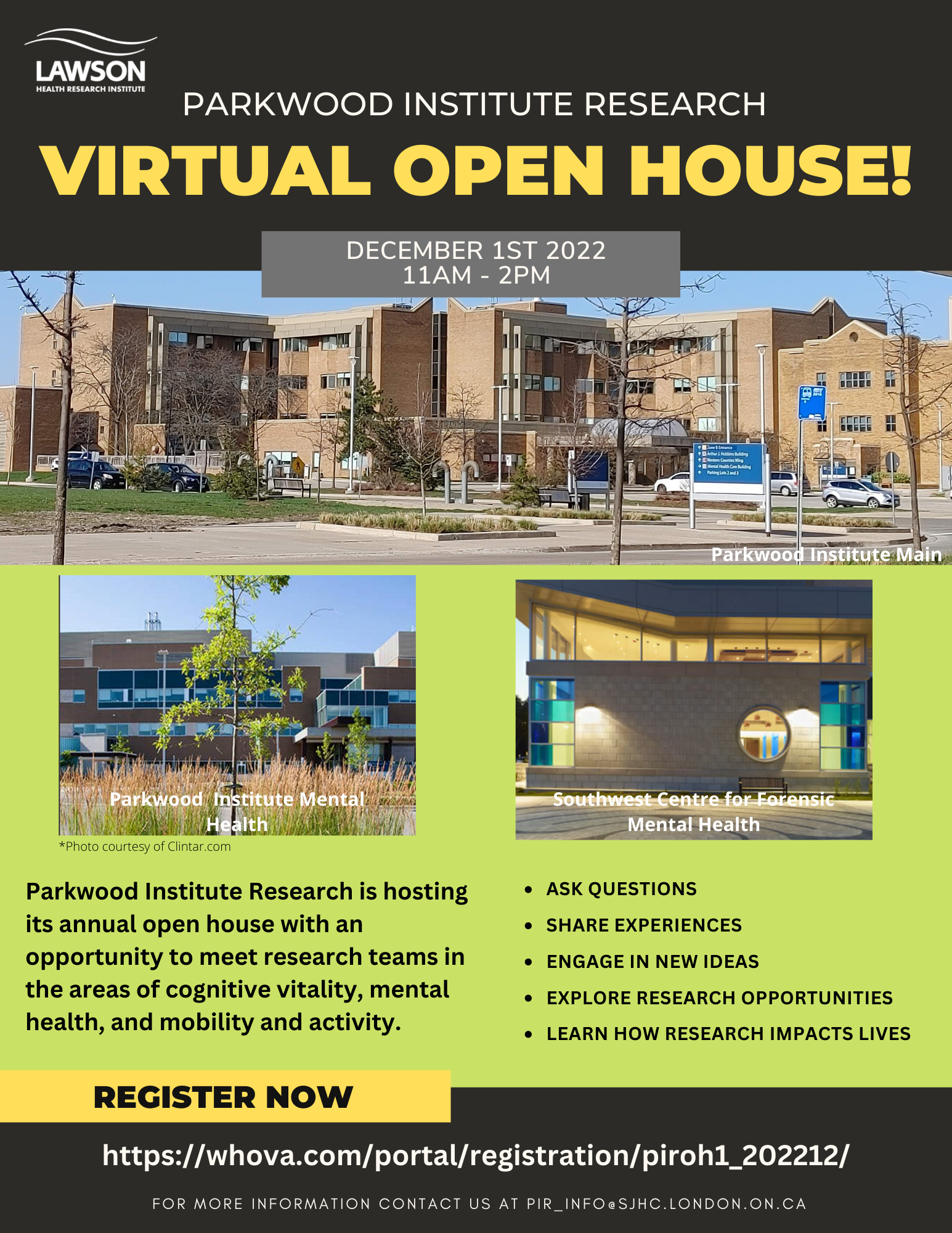
Parkwood Institute Research Open House
11:00am-2:00pm
Join us for the Parkwood Institute Research Open House on Thursday, December 1st, 2022 from 11:00am-2:00pm.
The Parkwood Institute Research (PIR) Open House is your opportunity to virtually meet research teams working in the areas of cognitive vitality and brain health, mobility and activity, and mental health. This is an exciting opportunity to learn about the exciting research that is being done in London, ON Canada.
Your free registration gives you exclusive access to video presentations from our labs. Potential research participant opportunities include live polls, games, Q&A session, surveys, and discussion boards. You’ll also be able to provide feedback on the event. Whova is accessible on phones, tablets or laptops. You do not need a camera or microphone to participate.
Register now: Parkwood Institute Research Open House Registration (whova.com)
Quick link: https://whova.com/portal/registration/piroh1_202212/
Please feel free to share with your circles, everyone is invited to attend.
We hope to see you there!
Dr. Cheryl Forchuk and the PIR Open House Committee
Parkwood Institute Research Virtual Open House
3:00pm - 6:00pm
The Parkwood Institute Research Open House is your opportunity to virtually meet research teams working in the areas of Cognitive Vitality and Brain Health, Mobility and Activity, and Mental Health.
Don't miss this opportunity to learn from a host of our dedicated research teams in London, ON Canada, that are making a difference in patient lives everyday.
Registration is now open on Whova: Parkwood Institute Research Open House Registration (whova.com)
Your free registration gives you exclusive access to video presentations from our labs, potential research participant opportunities as well as live polls, games, session Q&A, surveys, and discussion boards. You’ll also be able to provide feedback on the event. Whova is accessible on phones, tablets or laptops. You do not need a camera or microphone to participate.
… - Plan A Employee Name: Certificate Number: Welcome to Your Group Benefit Program Plan Document Effective Date: … This Benefit Booklet has been specifically designed with your needs in mind, providing easy access to the information … provide, but for the security they provide for you and your family, especially in case of unforeseen needs. Your …
Council of Academic Hospitals of Ontario (CAHO) 1 Council of Academic Hospitals of Ontario (CAHO) Plan Document Number: G0086936 Plan F: London Health Science Centre - Plan A Employee Name: Certificate Number: Welcome to Your Group Benefit Program Plan Document Effective Date: January 1, 2012 This B...
… - Plan A Employee Name: Certificate Number: Welcome to Your Group Benefit Program Plan Document Effective Date: … This Benefit Booklet has been specifically designed with your needs in mind, providing easy access to the information … provide, but for the security they provide for you and your family, especially in case of unforeseen needs. Your …
Council of Academic Hospitals of Ontario (CAHO) 1 Council of Academic Hospitals of Ontario (CAHO) Plan Document Number: G0086936 Plan F: London Health Science Centre - Plan A Employee Name: Certificate Number: Welcome to Your Group Benefit Program Plan Document Effective Date: January 1, 2012 This B...
… - Plan A Employee Name: Certificate Number: Welcome to Your Group Benefit Program Plan Document Effective Date: … This Benefit Booklet has been specifically designed with your needs in mind, providing easy access to the information … provide, but for the security they provide for you and your family, especially in case of unforeseen needs. Your …
Council of Academic Hospitals of Ontario (CAHO) Plan Document Number: G0086936 Plan F: London Health Science Centre - Plan A Employee Name: Certificate Number: Welcome to Your Group Benefit Program Plan Document Effective Date: January 1, 2012 This Benefit Booklet has been specifically designed with...
Partners
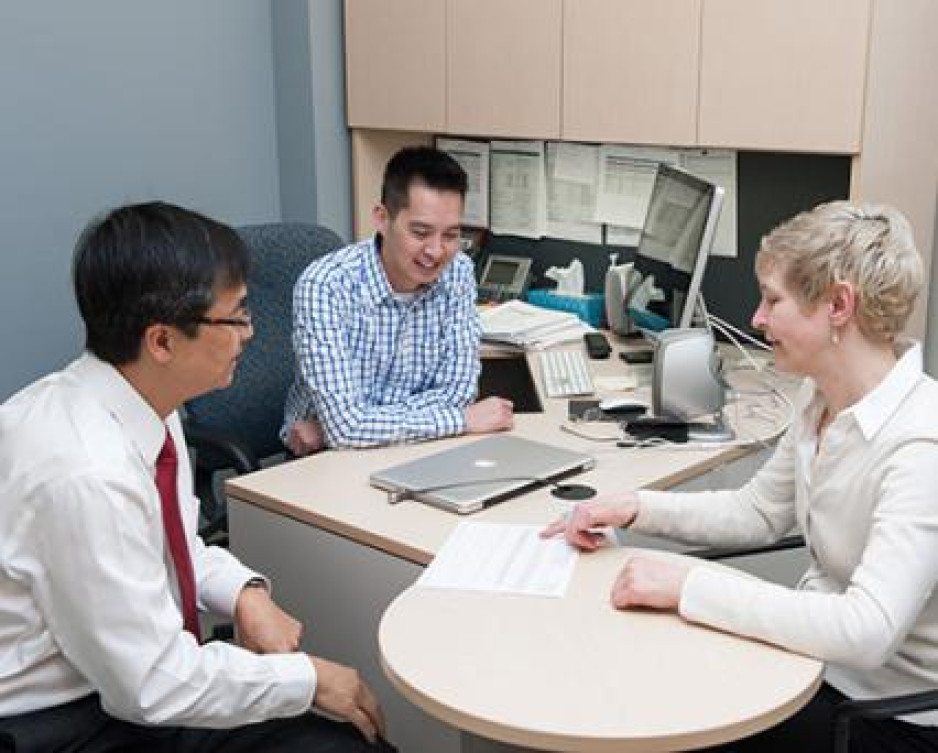
Lawson is the research institute of London Health Sciences Centre and St. Joseph's Health Care London. Our scientists work across the city at multiple hospital sites, and we are proud to be an integral part of both academic hospitals and the excellent, patient-centred care they provide. In addition to the hospitals, we work in close partnership Western University and a variety of other collaborators in London, Ontario, across Canada, and around the world.
Lawson works with over 200 business and industry partners in more than 25 countries.
Partnership with Siemens Healthineers will create a centre of excellence in advanced diagnostic imaging and therapeutics
Continuing to build on the established excellence in medical imaging, London’s academic teaching hospitals, London Health Sciences Centre (LHSC), and St. Joseph’s Health Care London, and Western University’s Schulich School of Medicine & Dentistry announced a partnership with Siemens Healthineers in magnetic resonance imaging (MRI), interventional angiography, cardiology and cardiac surgery that will create a centre of excellence in advanced diagnostic imaging and therapeutics in southwestern Ontario.
This new partnership includes the creation of an education, training and scientific research support fund in the area of advanced diagnostic imaging and therapeutics. Siemens will provide in excess of $1 million in support funding for research, advanced clinical applications, teaching and outcomes analysis.
“This partnership represents another important building block in the incredible foundation of imaging excellence that we have in London,” says Dr. Narinder Paul, Chair/Chief of the Department of Medical Imaging at LHSC, St. Joseph’s, and Schulich Medicine & Dentistry.
“Not only will we become leaders in state-of-the-art imaging and intervention through the centre of excellence, but thanks to the research contribution from Siemens Healthineers, we will also have dedicated funds for critical research in cardiovascular and neurological diseases that will translate to improved services and outcomes for patients in London and the region.”
The research fund will support collaborations between research teams in diagnostic and interventional radiology, cardiology, and cardiac surgery, with imaging scientists at Lawson Health Research Institute, the research institute of LHSC and St. Joseph’s, and Schulich Medicine & Dentistry’s Robarts Research Institute, as well as research teams from across Western. These teams will partner with scientists from Siemens Healthineers to focus on improving both the patient experience and the outcomes in important cardiovascular and neurological diseases. The research funds will be leveraged against provincial and federal research grants to increase the funds available to the research teams.
“Collectively, Western and our partner institutions in London are becoming a global powerhouse, recognized for our expertise and facilities in imaging that drives discovery and innovation across a broad range of disciplines,” says Alan Shepard, President & Vice-Chancellor of Western University. “This partnership with Siemens Healthineers builds on our strengths, increases capacity to enhance patient care, and expands opportunities to integrate education, training and research for the benefit of learners and faculty. It’s a huge win for London and southwestern Ontario.”
“Imaging scientists and clinicians, working on campus and within hospital walls, have positioned London as a leader in non-invasive biomedical imaging, conducting groundbreaking research that impacts health care here and around the world,” adds Dr. David Hill, Lawson Scientific Director and Integrated Vice President, Research for London’s hospitals.
“With strong industry partnerships and working seamlessly with our hospitals and academic partners, we can build on this success. The advancements made here can be quickly translated into care within the very units where the testing is being done, which ultimately improves care for the patients and families that we serve.”
The centre of excellence will provide hands-on training in MRI, diagnostic, and interventional catheter procedures through development of advanced simulation and phantom models. Medical learners and radiologists, cardiologists, cardiac surgeons, neurologists, neurosurgeons, and technologists in London and from across Canada will be able to access this centre to improve their diagnostic and therapeutic skills, which will in-turn improve patient access to skilled clinicians.
As well, LHSC and St. Joseph’s are acquiring six clinical MRIs and six angiogram suites to be used for patient care, which will include the introduction of the first 3T MRI in the region. University Hospital will acquire a 3T/1.5T pair of MRIs, and two biplane angiogram suites. Victoria Hospital will acquire a 3T/1.5T pair of MRIs, a biplane and two single plane angiogram suites. St. Joseph’s will acquire a 3T/1.5T pair of MRIs, and a single plane angiogram suite.
“Investments in capital equipment, such as these new MRI machines and angiogram suites, are incredibly important as they will immediately translate into safer, higher quality care for the patients we serve – in this case it’s by offering the highest resolution images available, in less time, and with improved comfort for patients,” says Dr. Paul Woods, President and CEO, London Health Sciences Centre.
“London has an illustrious history of innovation that has been groundbreaking in shaping the scope and possibilities of medical imaging within the health-care system,” says Dr. Gillian Kernaghan, President and CEO, St. Joseph’s Health Care London. “This exciting partnership ensures our ongoing leadership and expertise in the introduction of leading-edge medical imaging technologies and is a critical step toward new approaches in imaging research and patient care.”
MRI is used to provide critical diagnostic information about the physical structure and the biological processes of the body. MRI scanners differ from other imaging technologies as they use strong magnetic fields, magnetic field gradients, and radio waves, instead of X-rays, to generate images of the organs in the body. MRI is widely used in hospitals to facilitate medical diagnosis and/or the staging of disease without exposing patients to radiation.
Past Study Report
The HULC clinical research lab is committed to sharing our past study reports with research participants and the public.
Shoulder →
Elbow →
Wrist/hand →
Nerve →
Work→
… Friday, 7am 6pm A video virtual care appointment with your health care professional is one where you communicate … device – tablet, Internet connection that’s reliable Your valid Ontario Health Card or computer or smartphone – … microphone and speaker (most are built in) 4 5 6 A list of your current Any communication aids you List of questions for …
Patient and Caregiver Guide to Video Virtual Care Appointments Support for Webex Virtual Care Appointments Support for Ontario Telemedicine Network (OTN) Webex Website OTN Website 1 519 685 8390 Monday Friday, 8am 5pm 1 855 654 0888 Monday Friday, 7am 6pm A video virtual care appointment with your h...
… Patient & Family Safety on our Inpatient Units Specialized Geriatric Services It’s okay … you to feel comfortable and understand what to expect. Your care team will work with you to develop a discharge … plan, which includes a recommenda- tion form specific to your needs, i.e. appoint- ments, equipment, medication …
Patient & Family Safety on our Inpatient Units Specialized Geriatric Services Its okay to ask! Location Parkwood Institute CARING FOR THE BODY, MIND & SPIRIT SINCE 1869 Geriatric Rehabilitation Unit (5AN) (519) 685-4006 Musculoskeletal Rehabilitation Unit (5AE) (519) 685-4004 Parkwood Institute Main...
… on schedule. If you are more than 15 minutes late, your appointment may be rescheduled as the delay may affect … of others. This decision will be made at the discretion of your treating therapist. Please be advised that you may be … giving appropriate notice. We appreciate at least 24 hours’ notice of a cancellation unless a sudden illness or …
CARING FOR THE BODY, MIND & SPIRIT SINCE 1869 Renowned for compassionate care, St. Joseph's is one of the best academic health care organizations in Canada dedicated to helping people live to their fullest by minimizing the effects of injury, disease and disability through excellence in care, teachi...
… Remember to bring this booklet with you on the day of your surgery 201093 Rev. May 2023 UNDERSTANDING SHOULDER … REPLACEMENT Shoulder anatomy The shoulder joint allows your arm to move in a large range of motion, in all … sinus, chest, dental, skin). Any infections can settle in your new shoulder and become a serious complication. Seek …
A PATIENTS GUIDE TO ONE DAY STAY SHOULDER REPLACEMENT SURGERY AT ST. JOSEPHS HOSPITAL Remember to bring this booklet with you on the day of your surgery 201093 Rev. May 2023 UNDERSTANDING SHOULDER REPLACEMENT Shoulder anatomy The shoulder joint allows your arm to move in a large range of motion, in ...
… up to date due to the COVID-19 pandemic. Please refer to our website: www.sjhc.london.on.ca for more information … A guide to surgery at St. Joseph’s Hospital Earning your confidence in our care At St. Joseph’s Health Care London our vision is to … up to date due to the COVID-19 pandemic. Please refer to our website: www.sjhc.london.on.ca for more information …
Oct 2020 Please note the information in this booklet may not be completely up to date due to the COVID-19 pandemic. Please refer to our website: www.sjhc.london.on.ca for more information including screening information and visiting restrictions. http://www.sjhc.london.on.ca/ A guide to surgery at S...
Patients + Research: Wayne Kristoff
I was diagnosed in June 2014 with Type 2 diabetes. It was bothersome but not unexpected as I had been told by my family doctor that I was borderline diabetic for a while. My father was also Type 2 and my paternal grandmother had what was described as a “sugar problem” in the late 40’s and early 50’s. From what has been discussed in our family, I believe that it would be called Type 2 today. At the time of my diagnosis, I was told that I would be on medication for the rest of my life.
… questions ask about the facility's living enviroment. Does your family member's room meet his/her specific needs?1. E E … No Don't know/ N/A Does the layout of the facility meet your family member's needs?2. E E E E Are you encouraged to bring your family member's personal things into …
B B B 0060421*001AMD14**001AMD14* *0* LIVING ENVIRONMENT The following questions ask about the facility's living enviroment. Does your family member's room meet his/her specific needs?1. E E E E Yes Somewhat No Don't know/ N/A Does the layout of the facility meet your family member's needs?2. E E E ...
… questions ask about the facility's living enviroment. Does your family member's room meet his/her specific needs?1. E E … No Don't know/ N/A Does the layout of the facility meet your family member's needs?2. E E E E Are you encouraged to bring your family member's personal things into …
B B B 0060421*001AMD14**001AMD14* *0* LIVING ENVIRONMENT The following questions ask about the facility's living enviroment. Does your family member's room meet his/her specific needs?1. E E E E Yes Somewhat No Don't know/ N/A Does the layout of the facility meet your family member's needs?2. E E E ...
… CARE LONDON PAYROLL INFORMATION Confidential for Human Resources Use Only Payroll Direct Deposit Information: Using … deposit, St. Joseph’s Health Care London, will deposit your payroll automatically into your bank account. Payroll is deposited on a bi-weekly basis, …
PAYROLL DOCUMENTATION Welcome to St. Josephs Health Care London. What is Required for Payroll Documentation: Proof of banking information (i.e. void cheque or direct deposit form) Signed Acceptance Form Completed Employee Information Form Completed Provincial Tax Form (TD1ON) Completed Federal ...
People experiencing homelessness more likely to develop dementia at younger ages, study finds
Dementia in unhoused people was 1.9 times greater than the general population, with a higher prevalence for age groups younger than 85 years, according to new research from Lawson Health Research Institute and ICES.
In one of the first population-based studies of its kind and published in The Lancet Public Health, researchers compared dementia prevalence in people experiencing homeless with the general population and people living in low-income neighbourhoods in Ontario, Canada.
“Not only did we find that dementia was more common among unhoused individuals, but the difference was greatest between the ages of 55 to 64 years,” says lead author Dr. Richard Booth, Scientist at ICES and Lawson Health Research Institute, and Associate Professor and Arthur Labatt Family Research Chair in Nursing at Western University.
“There’s a strong link between homelessness and accelerated ageing, which may be one of the reasons people experience an earlier onset of the disease,” says Dr. Booth.
Using a prevalence ratio, the researchers found that within the ages of 55-74 years rates of dementia were 4 to 5 times higher than the general population and 3 to 3.5 times higher than the low-income group. There was a higher dementia prevalence in all age groups younger than 85 years among people experiencing homelessness in both males and females.
Unhoused people were younger on average, less likely to be female, and less likely to live in rural areas compared to the other two groups. They also had higher rates of health conditions associated with dementia, such as head trauma, neurological conditions, HIV, and mental health and substance-use disorders.
After adjusting for factors such as age, sex, residential area, and health conditions, the prevalence ratio for people experiencing homelessness was 1.7 times higher compared to the low-income group, and 1.9 times higher compared to the general population.
“Other research has outlined that the rates of homelessness in older adults are expected to double by 2030, which means that the number of people living with dementia could rise substantially,” says Dr. Booth. “Our findings suggest that unhoused individuals should be screened for dementia at younger ages, rather than waiting until age 65 as many guidelines suggest.”
The researchers also note the complexity of diagnosing dementia in an individual experiencing multiple, chronic health conditions, as cognitive symptoms can overlap. Because of the difficulty in obtaining a medical history and diagnosis in this population, the study could have underestimated the true prevalence of dementia.
“We hope this work serves to enhance the awareness of policy makers and practitioners of the increasing prevalence of dementia among people experiencing homelessness,” says study author Salimah Shariff, Staff Scientist with the Populations & Public Health Research Program at ICES, Associate Director of research operations and strategic partnerships at ICES Western, and Associate Scientist at Lawson. “As housing is a core determinant of health and essential to the sustainment of individuals’ health and wellbeing, access to permanent, supportive housing structures for people experiencing homelessness is also critical in preventing and slowing the progression of dementia in this population.”
This study was funded by the Public Health Agency of Canada.
FOR FURTHER INFORMATION PLEASE CONTACT:
Misty Pratt
Senior Communications Associate, ICES
@email 613-882-7065
Perceptions of confidentiality for Canadian Veterans discussing moral injuries
A new study from Lawson Health Research Institute will be the first to explore Canadian Veterans’ beliefs about confidentiality in mental health care and whether those beliefs act as a barrier to seeking treatment for a type of trauma known as moral injury.
Moral injury describes psychological distress following events where a person performs, witnesses or fails to prevent acts that conflict with deeply held moral standards. Evidence suggests that moral injuries are on the rise among deployed members of the Canadian Armed Forces (CAF), and that those exposed to such events are at a higher risk of developing post-traumatic stress disorder (PTSD) and depression.
Through the study, researchers aim to understand barriers that might prevent military personnel from disclosing details of moral injury.
“A commonly reported barrier when seeking mental health treatment is a perceived lack of confidentiality,” explains Dr. Anthony Nazarov, Post-Doctoral Associate at Lawson. “Since some events that induce moral injuries are ethically ambiguous, it’s possible that military personnel may withhold details of their trauma or even avoid seeking help due to worries about confidentiality.”
The two-year study will engage 200 Canadian Armed Forces Veterans to investigate their perceptions around the confidentiality of disclosing moral injuries in the mental health care and research settings. This will be accomplished not only by interviewing Veterans receiving care at St. Joseph’s Health Care London’s Operational Stress Injury Clinic, but also through online surveys made available to military personnel and Veterans across Canada. The research team will also interview mental health professionals to understand their perspectives on this topic.
“Many Veterans seek help for mental health, and that’s great to see. We’ve come a long way in reducing stigma and barriers, but there’s more work to be done,” says Dr. Don Richardson, Lawson Associate Scientist, Director of the MacDonald/Franklin OSI Research Centre and Physician Lead at St. Joseph’s OSI Clinic. “It’s our duty as mental health researchers and clinicians to ensure that everyone who needs help seeks it. If Veterans do not feel comfortable disclosing certain details because of perceived mistrust related to privacy, we need to know why that is and what we can do to address this issue.“
“Through appropriate messages, it may be possible to dispel any false beliefs, increase trust in mental health professionals and, in turn, increase the number of veterans who choose to seek help,” notes Dr. Nazarov.
The study is being funded by Veterans Affairs Canada and St. Joseph’s Health Care Foundation’s Robert S. & Mary Gay, Donald, James, and Helen (Taylor) Gay Endowed Research Fellowship in Veterans Care.
Those interested in participating in this research study are asked to contact the study team at 519-685-4292 ext. 48211 or @email.
Image
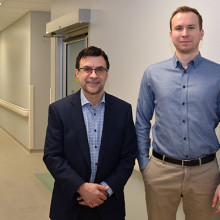
Above: Drs. Don Richardson and Anthony Nazarov
Scientist