


Search
Search
1663 Search Results:
… Diabetes and Kidney Disease Exciting Times Louise Moist MSc.MD Professor of Medicine and Epidemiology/Biostatistics London CANADA Louise.Moist@lhsc.on.ca Objectives 1. To … Diabetes and Kidney Disease Exciting Times Louise Moist MSc.MD Professor of Medicine and …
Diabetes and Kidney Disease Exciting Times Louise Moist MSc.MD Professor of Medicine and Epidemiology/Biostatistics London CANADA Louise.Moist@lhsc.on.ca Objectives 1. To understand the evidence supporting the use of SGLT2 I in patients with CKD 2. To identify the patient population best suited for ...
… of life, • increased family problems, • higher healthcare costs. The association between depression and diabetes is … at home. But if you often feel anxious without reason and your worries disrupt your daily life, you may have an anxiety disorder. Anxiety … at home. But if you often feel anxious without reason and your worries disrupt your daily life, you may have an anxiety …
Diabetes + mental health diabetes.ca | 1-800 BANTING *This document reflects the 2013 Canadian Diabetes Association Clinical Practice Guidelines. 2013 Copyright Depression Depression is more common in people with diabetes compared with the general population. Symptoms of depression affect 30% of peo...
… MIND & SPIRIT SINCE 1869 Renowned for compassionate care, St. Joseph’s is one of the best academic health care … pump and supplies. At the Diabetes Education Centre, it is our goal to support you in your efforts to meet these criteria. Please take a moment to …
CARING FOR THE BODY, MIND & SPIRIT SINCE 1869 Renowned for compassionate care, St. Josephs is one of the best academic health care organizations in Canada dedicated to helping people live to their fullest by minimizing the effects of injury, disease and disability through excellence in care, teachin...
… Virtual Platform: Chime Live Login Time: 8:00 a.m. Venue: Four Points by Sheraton - 1150 Wellington Road S. London, ON, N6E 1M3 To REGISTER please visit Diabetes Update 2023 | St. Joseph’s Health … in diabetes and obesity ACCREDITATION This one-credit-per-hour Group Learning program meets the certification criteria …
DIABETES UPDATE 2023 WEDNESDAY, NOVEMBER 8, 2023 8:00 a.m. - 1:00 p.m. Virtual Platform: Chime Live Login Time: 8:00 a.m. Venue: Four Points by Sheraton - 1150 Wellington Road S. London, ON, N6E 1M3 To REGISTER please visit Diabetes Update 2023 | St. Josephs Health Care London https://www.sjhc.londo...
Discovery shows promise for treatment of glaucoma
In a new study from Lawson Health Research Institute (Lawson), scientists have discovered that a specific protein has the potential to be used to treat some patients with primary open-angle glaucoma.
Primary open-angle glaucoma is the most common type of glaucoma, which is a group of diseases that affect nearly 70 million people worldwide. Glaucoma is characterized by progressive damage to the optic nerve which ultimately leads to blindness. In this new study, led by Dr. Sunil Parapuram, researchers examined the role of a protein called “phosphatase and tensin homolog” (PTEN) in the trabecular meshwork. The trabecular meshwork is a porous tissue in the eye through which the clear fluid that fills the eye drains out.
In some primary open-angle glaucoma patients, the structure of the trabecular meshwork is damaged by fibrosis. Fibrosis is a thickening or scarring of tissue which is caused by an excess amount of matrix molecules such as collagen. Fibrosis of the trabecular meshwork prevents the fluid in the eye from draining out normally, which leads to increased pressure in the eye and damage to the optic nerve.
Dr. Parapuram’s team found that the inactivation of the protein PTEN can cause too many matrix molecules to be deposited in the trabecular meshwork, leading to fibrosis. On the other hand, when PTEN activity was increased, it reduced the amount of matrix molecules being deposited in the trabecular meshwork. These results indicate that drugs that can activate PTEN have high potential to be used as a treatment for open-angle glaucoma.
“There’s an immediate need for a new generation of therapeutic drugs for more effective treatment of glaucoma,” says Dr. Parapuram, a Lawson scientist at St. Joseph’s Health Care London and an assistant professor in the Departments of Ophthalmology and Pathology at the Schulich School of Medicine & Dentistry, Western University. “While further research is needed, drugs that activate PTEN could be the answer.”
Dr. Parapuram’s team will continue to study the function of PTEN in the trabecular meshwork in more detail and test the role of drugs that activate the protein as a potential treatment for primary open angle glaucoma.
Image
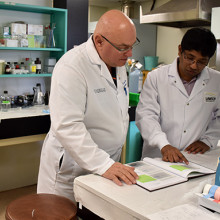
Dr. Michael Motolko (left), Chair/Chief, Department of Ophthalmology, and Dr. Sunil Parapuram (right).
“This study highlights the expansion of our department’s research activities into basic science application and its findings are relevant to many other fibrotic diseases,” says Dr. Michael Motolko, Chair/Chief, Department of Ophthalmology, Schulich School of Medicine & Dentistry,Western University, London Health Sciences Centre and St. Joseph’s Health Care London.
The study, “TGF-β induces phosphorylation of phosphatase and tensin homolog: implications for fibrosis of the trabecular meshwork tissue in glaucoma,” is published in Nature’s Scientific Reports.
Scientist
DocTalks - Beyond Memory: How Alzheimer’s and Other Dementias Affect Mental Health
11:00pm - 12:30am
Image

Beyond Memory: How Alzheimer’s and Other Dementias Affect Mental Health
Where: Shuttleworth Auditorium (Cheapside entrance)
Dr. Amer Burhan, associate scientist at Lawson and geriatric neuropsychiatrist at St. Joseph's Health Care London, is an expert in the field of neuropsychiatry. He will discuss how Alzheimer’s and other cognitive diseases can impact the feelings and behaviours of individuals as well as their caregivers, and how research is shaping new treatment options for hard-to-treat depression.
Online registration has reached capacity. Please consider joining the next scheduled DocTalk lecture.
DocTalks is a series of community health discussions featuring leading physicians and researchers at St. Joseph’s Health Care London. Learn from the experts how St. Joseph’s is tackling the pressing health issues of our time and why it matters to you and your family.
DocTalks is a joint initiative presented by St. Joseph’s Health Care London and St. Joseph’s Health Care Foundation.
DocTalks - Combating Food Allergies Using the Body’s Immune System
11:00pm - 12:30am
Image
Combating Food Allergies Using the Body’s Immune System
Where: Shuttleworth Auditorium (Cheapside entrance)
Dr. Harold Kim is the Medical Director of St. Joseph’s Allergy and Immunology Program. He will explain how certain food allergies can gradually be reduced or eliminated through the process of immunotherapy.
Registration opens Open 11.
DocTalks is a series of community health discussions featuring leading physicians and researchers at St. Joseph’s Health Care London. Learn from the experts how St. Joseph’s is tackling the pressing health issues of our time and why it matters to you and your family.
DocTalks is a joint initiative presented by St. Joseph’s Health Care London and St. Joseph’s Health Care Foundation.
Partners
DocTalks - How Aging Nerves and Muscles Affect Mobility
11:00pm - 12:30am
Image
How Aging Nerves and Muscles Affect Mobility
Where: Shuttleworth Auditorium (Cheapside entrance)
Dr. Tim Doherty is the Chair/Chief of the Department of Physical Medicine and Rehabilitation at St. Joseph’s and Western University and a researcher with Lawson Health Research Institute. He will explain how nerve and muscle function are impacted by aging and share the best ways to maintain healthy muscles and mobility as we grow older.
Registration opens August 15.
DocTalks is a series of community health discussions featuring leading physicians and researchers at St. Joseph’s Health Care London. Learn from the experts how St. Joseph’s is tackling the pressing health issues of our time and why it matters to you and your family.
DocTalks is a joint initiative presented by St. Joseph’s Health Care London and St. Joseph’s Health Care Foundation.
View more information on this DocTalks lecture.
DocTalks - Kidney Stones: From Ancient Times to Modern Practice and Prevention
11:00pm - 12:30am
Image
Kidney Stones: From Ancient Times to Modern Practice and Prevention
Where: Shuttleworth Auditorium (Cheapside entrance)
Dr. John Denstedt is a surgeon at St. Joseph’s Hospital and professor at Western University’s Schulich School of Medicine & Dentistry. He is also the former Chair/Chief of the Department of Surgery and a world renowned leader in the field of urology. Dr. Denstedt will discuss how treatments for kidney stones have evolved over time, including current prevention strategies and how new research is unlocking new possibilities for the future.
Registration opens February 7.
DocTalks is a series of community health discussions featuring leading physicians and researchers at St. Joseph’s Health Care London. Learn from the experts how St. Joseph’s is tackling the pressing health issues of our time and why it matters to you and your family.
DocTalks is a joint initiative presented by St. Joseph’s Health Care London and St. Joseph’s Health Care Foundation.
DocTalks - Managing Persistent Dry Eyes and Why it Matters
11:00pm - 12:30am
Image
Managing Persistent Dry Eyes and Why it Matters
Where: Shuttleworth Auditorium (Cheapside entrance)
Dr. Rookaya Mather is an ophthalmologist at St. Joseph’s Ivey Eye Institute and an associate professor at Western University’s Schulich School of Medicine & Dentistry. She will review the current understanding of Dry Eye Disease and how the condition can be managed effectively.
Registration opens October 16.
DocTalks is a series of community health discussions featuring leading physicians and researchers at St. Joseph’s Health Care London. Learn from the experts how St. Joseph’s is tackling the pressing health issues of our time and why it matters to you and your family.
DocTalks is a joint initiative presented by St. Joseph’s Health Care London and St. Joseph’s Health Care Foundation.
DocTalks - Recovery After Stroke: Retraining the Injured Brain Through Rehabilitation
11:00pm - 12:30am
Image
Recovery After Stroke: Retraining the Injured Brain Through Rehabilitation
Where: Shuttleworth Auditorium (Cheapside entrance)
Dr. Robert Teasell is the Medical Director of St. Joseph’s Stroke Rehabilitation Program, Professor of Physical Medicine and Rehabilitation at Western University and a clinical scientist at Lawson Health Research Institute. He will discuss various rehabilitation therapies and technologies that can help an individual recover after a stroke.
Registration opens April 16.
DocTalks is a series of community health discussions featuring leading physicians and researchers at St. Joseph’s Health Care London. Learn from the experts how St. Joseph’s is tackling the pressing health issues of our time and why it matters to you and your family.
DocTalks is a joint initiative presented by St. Joseph’s Health Care London and St. Joseph’s Health Care Foundation.
… St. Joseph’s Health Care Foundation Page 1 of 3 Donor … June 8, 2018 June 4, 2014 FOUNDATION VISION STATEMENT: Our donors will have a personally fulfilling giving … St. Joseph’s Health Care Foundation encourages and welcomes all stakeholder feedback. The purpose …
St. Josephs Health Care Foundation Page 1 of 3 Donor Complaint and/or Concerns Policy #200-3 Board Policy Subject: Donor Complaint and/or Concerns Policy No.: #200-3 Section: Donor Relations Approved by: Board of Directors Date Approved: June 20, 2018 June 18, 2014 Reviewed by: Executive Committee D...
… Health, (N) - Nurses, PSWs, (P) - Physicians, Pharmacists A minimum of 25% of this program is dedicated to … About the Conference We are proud to present and celebrate our 37th annual conference in Geriatric Medicine that … quality care for the older adult. The plenary session encourages interdisciplinary discussion of a subject common to …
37th Annual Geriatric Medicine Refresher Day Current and Practical Knowledge To Inspire and Advance Care Wednesday, May 1, 2024 . RBC Place, London, Ontario . 7:30 a.m. - 4:00 p.m. Overall Learning Objectives: By the end of this program, participants will be able to: 1. Apply current literature in c...
… professionals will focus on rehabilitation of the elbow, wrist and hand. The Roth|McFarlane Hand & Upper Limb surgeons … of research in the IMPRinT lab is focused on advancing our understanding and management of persistent pain, and … into practice. She serves on the editorial board of the Journal of Hand Therapy and is a senior editor at Pain …
June 2 3, 2023 HAND AND UPPER LIMB SYMPOSIUM SURGERY & REHABILITATION OF THE UPPER LIMB Back t o Basics NOVEMBER 22ND & 23RD, 2019 SYMPOSIUM DESCRIPTION This 2 day symposium for health professionals will focus on rehabilitation of the elbow, wrist and hand. The Roth|McFarlane Hand & Upper Limb surg...
… Because we all need St. Joseph’s. … the criminal justice system. Specialized Mental Health Care OUR PROGRAMS Mood and Anxiety Disorders Program Psychosis … PROGRAM 519 646-6100 ext. 49354 Forensic Psychiatry Program Our Program Individuals are admitted to the program for …
Because we all need St. Josephs. www.sjhc.london.on.cawww.sjhc.london.on.cawww.sjhc.london.on.ca Safe and successful transition back into the community. RMHC Regional Mental Health Care Who We Are The Forensic Psychiatry Program at St. Josephs Regional Mental Health Care (RMHC) St. Thomas provides s...
… ~------...... ........._ LAWSON HEALTH RESEARCH INSTITUTE Public Information and Disclosure Protocol Cyclotron … electronic newsletters). Direct letter to neighbours. Public forums and/or virtual town halls (live web … by a designated spokesperson or subject matter expert. Tours of the facility may be provided. Information Disclosure …
~------...... ........._ LAWSON HEALTH RESEARCH INSTITUTE Public Information and Disclosure Protocol Cyclotron & PET Radiochemistry Facility located at St. Josephs Health Care London Updated September 2021 LAWSON HEALTH RESEARCH INSTITUTE Public Information and Disclosure Protocol Cyclotron & PET Ra...
… Upper Limb Centre Hand Therapy Fellowship Application Interested candidates are required to complete this application … year, however, this will be based on the availability of resources within our Hand Therapy Department. Please refer to the cycle … year, however, this will be based on the availability of resources within our Hand Therapy Department. Please refer to …
(;j~ S'!JOSEPHs HEALTH CARE LONDON Roth McFarlane Hand and Upper Limb Centre Hand Therapy Fellowship Application Interested candidates are required to complete this application and email to Joey Pipicelli. Applications are reviewed bi-annually. Once applications are reviewed interviews will be arran...
… � A Future Nurtured in Histories of Faith & Compassion ∏ ∏ � � A Future Nurtured in … to grow from the humble and compassionate beginnings of our founders, the sisters of st. Joseph, the Women’s … a volunteer board of directors who represent the community. our collective identity or culture may generate questions …
A Future Nurtured in Histories of Faith & Compassion A Future Nurtured in Histories of Faith & Compassion Like the tree that takes root & then bears fruit, st. Josephs health Care, London continues to grow from the humble and compassionate beginnings of our founders, the sisters of st. Joseph, ...
Dr. Gregor Reid elected to Royal Society of Canada
From crafting a global definition of probiotics to developing novel therapies used by millions, Dr. Gregor Reid has significantly advanced our knowledge of how beneficial microbes, especially bacteria, contribute to health. Recognizing his role as a world leader in probiotics research, Dr. Reid has now been elected to the Fellowship of the Royal Society of Canada.
The Royal Society of Canada was established in 1883 as Canada’s National Academy of distinguished scholars, artists and scientists. With over 2,000 fellows, the primary objective of the Society is to promote learning and research through its three Academies – the Academy of Arts and Humanities, the Academy of Social Sciences and the Academy of Science. Dr. Reid has been elected by his peers to the Life Sciences division of the Academy of Science.
“Being elected to the Royal Society of Canada is a huge honour and a recognition that the concepts of probiotics and beneficial microbes, and the work we are doing, are appreciated by distinguished Canadians,” said Dr. Reid, Endowed Chair in Human Microbiome and Probiotics at Lawson Health Research Institute (Lawson) and Professor of Microbiology and Immunology and Surgery at Schulich School of Medicine & Dentistry at Western University.
Probiotics are live microorganisms that, when administered in adequate amounts, provide health benefits to their host. Dr. Reid’s research in probiotics has made a global impact. He has held 28 patents, published 473 peer-reviewed papers and given over 560 talks in 54 countries.
In addition to his current role as Director of the Canadian Centre for Human Microbiome and Probiotics Research, located at Lawson in St. Joseph’s Hospital, Dr. Reid has previously acted as President for the International Scientific Association for Probiotics and Prebiotics. In 2001 and 2002, he chaired a United Nations/World Health Organization (WHO) Expert Panel and Working Group on Probiotics.
Dr. Reid is especially interested in how his research can benefit those in need. He helped to establish Western Heads East, a Western University program that has established community kitchens in Tanzania, Kenya, and Rwanda, and through partnerships has expanded this in Uganda to reach over 40,000 people each day. The community kitchens are owned and operated mostly by local women and youth where they produce a probiotic yogurt that helps counter malnutrition, side effects of infectious diseases including HIV/AIDS and enhances immunity. The yogurt was developed by Dr. Reid and Dr. Sharareh Hekmat of Western's Brescia University College.
“My research was not mainstream until very recently, so being inducted to the Society signifies that they recognize what I have achieved first and foremost,” said Dr. Reid, “but I hope my appointment helps to further bring the concepts of beneficial microbes to the forefront of research.”
An induction ceremony will take place in Kingston, Ontario on November 17 and 18, 2016. To learn more about Dr. Reid’s research, please visit his Scientist Profile and Google Scholar.
Scientist
Dr. Miho Iijima delivers talk on role of PTEN in cancer
Dr. Miho Iijima, Associate Professor at John Hopkins School of Medicine, visited St. Joseph’s Hospital on Friday, November 17 to deliver a talk on the role of a protein called “phosphatase and tensin homolog” (PTEN) in cancer.
The talk was organized by the Department of Ophthalmology. Dr. Sunil Parapuram, scientist at Lawson who invited Dr. Iijima, has been collaborating with her to study the role of PTEN in fibrosis.
Dr. Iijima’s talk focused specifically on controlling PTEN localization and function in cancer. Mutations and deletions in the gene encoding PTEN are associated with many cancers and autism. Dr. Iijima’s laboratory recently discovered a new class of cancer and autism-associated PTEN mutations that specifically interfere with membrane association. During her talk, Dr. Iijima discussed how PTEN is recruited to the plasma membrane and how enhancing the membrane recruitment of PTEN suppresses oncogenic signaling in cancer.
"Dr. Miho Iijima gave a very informative talk about the meticulous work her laboratory is doing about controlling the location and function of PTEN,” said Dr. Parapuram. “Her visit also provided an opportunity to reinvigorate the collaboration between our labs on the role of PTEN in fibrosis.”
To learn more about Dr. Iijima’s research, please visit the John Hopkins School of Medicine’s website.