


Search
Search
308 Search Results:
… serotonin, that help to lessen the intensity of incoming pain signals. • Duloxetine is used to treat pain from damaged nerves, fibromyalgia, chronic low back … a day, at the same time each day. • The usual dose for pain management is 60 mg daily. o To minimize side effects, your …
June 16, 2020; Page 1 of 3 Duloxetine (Cymbalta) Why is this medication prescribed? Duloxetine works by increasing the brain levels of two chemical messengers, norepinephrine and serotonin, that help to lessen the intensity of incoming pain signals. Duloxetine is used to treat pain from damaged ne...
… the head to twist or turn into uncomfortable and often painful positions. Botulinum toxin injections are … are unable to contract. This muscle relaxation helps reduce pain intensity. Botulinum toxin also helps manage pain by blocking the release of certain chemical …
July 12, 2022; Page 1 of 2 Abobotulinumtoxin A (Dysport) for Cervical Dystonia/Spasmodic Torticollis What is cervical dystonia and how is it typically treated? Cervical dystonia is a rare neurological disorder involving involuntary muscle contractions in the neck that cause the head to twist or turn...
Eldon Loh
Eldon Loh , MD
Associate Professor, Schulich School of Medicine and Dentistry
Key Areas of Focus:
Chronic Pain
Phone:
519-685-4292 ext. 44080
Email:
Publications:
Accepting Grad Students:
No
About:
Dr. Eldon Loh is a Physiatrist at Parkwood Institute and an Associate Professor in the Department of Physical Medicine and Rehabilitation at the Schulich School of Medicine and Dentistry at Western University. He completed residency training in Physical Medicine and Rehabilitation at the University of Alberta in 2010 and a clinical fellowship in interventional pain management in 2011. His research interests include improving the management of chronic neuropathic pain after spinal cord injury, and the development of novel and improved techniques for interventional pain management of axial spine pain.
He is Chair of the panel that developed and updates the Canadian Best Practice Guidelines for Neuropathic Pain after spinal cord injury and works with international partners to improve point-of-care tools for implementing the guidelines. His interventional pain research focuses heavily on a bench to bedside approach, utilizing anatomical findings to inform clinical practice. He has also examined the impact of Ontario’s healthcare utilization of different interventional procedures such as radiofrequency ablation and paravertebral nerve blocks.

… or her physical and emotional condition such as excessive pain, suffering, expense or other serious inconvenience, as … to best practices in palliative care, chronic disease management (including chronic pain) and suicide prevention. We have a highly specialized …
End-of-Life Care Contact St. Josephs Health Care London St. Josephs supports individuals making informed decisions about their end-of-life care. This includes talking with family, planning ahead when possible, and deciding when to decline or withdraw treatment (to allow natural death). Patients and ...
… are provided to patients who are experiencing arm or leg pain from a pinched nerve in the spine. They are not helpful for isolated neck or back pain. • The procedure involves inserting a needle into the … or greater participation in activities such as the pain management groups. • If the injection is effective, it may …
Epidural Injections When and how the injections are done Epidural steroid injections are provided to patients who are experiencing arm or leg pain from a pinched nerve in the spine. They are not helpful for isolated neck or back pain. The procedure involves inserting a needle into the spinal canal...
… to help individuals improve their ability to function and manage their mental health on a daily basis. o When treating … with risk of depression recurrence such as chronic pain patients, the minimum duration of treatment is two … with risk of depression recurrence such as chronic pain patients, the minimum duration of treatment is two …
CARING FOR THE BODY, MIND & SPIRIT SINCE 1869 Renowned for compassionate care, St. Joseph's is one of the best academic health care organizations in Canada dedicated to helping people live to their fullest by minimizing the effects of injury, disease and disability through excellence in care, teachi...
… immunized. All personal health information will be managed in accordance with privacy requirements. Emergency, … or taste disorder(s) • Nausea/vomiting, diarrhea, abdominal pain • Runny nose or nasal congestion (in the absence of an … • Presentation may include persistent fever, abdominal pain, conjunctivitis, gastrointestinal symptoms (nausea, …
HEALTH CARE LONDON ESSENTIAL CAREGIVER COVID-19 GUIDELINES AND EDUCATION REQUIREMENTS ~~ STJOSEPHs HEALTH CARE LONDON Essential Caregiver COVID-19 Guidelines and Education Requirements Caregiver A caregiver is defined in the Fixing Long-Term Care Act, 2021, O. Reg 246/22 section (4) as follows: a. i...
… and rectum. While an EUS can help to evaluate and manage benign disease it is most frequently used to diagnose … done without sedation unless you are having rectal pain. During the procedure, you may feel bloated due to the … form where the IV was placed. Call your doctor if redness, pain or swelling appears to be spreading. A sore throat is …
CARING FOR THE BODY, MIND & SPIRIT SINCE 1869 Renowned for compassionate care, St. Josephs is one of the best academic health care organizations in Canada dedicated to helping people live to their fullest by minimizing the effects of injury, disease and disability through excellence in care, teachin...
… Exercise with Chronic Pain May 25, 2020, 9:00 am – 11:00 am Vanitha Arumugam, … for maintaining strength, flexibility and endurance. ● Pain and fatigue management. ● How to find and access community resources to … Exercise with Chronic Pain May 25, 2020, 9:00 am – 11:00 am Vanitha Arumugam, …
Exercise with Chronic Pain May 25, 2020, 9:00 am 11:00 am Vanitha Arumugam, Physiotherapist Patients attending this session will learn about: How to add exercise to your day. Am I doing the right exercise. Appropriate exercise for maintaining strength, flexibility and endurance. Pain and fatigu...
… it is NOT Health Canada approved) to treat certain chronic pain disorders such as fibromyalgia, complex regional pain syndrome (CRPS), multiple sclerosis and abdominal pain/inflammatory bowel conditions. • Low-dose naltrexone … it is NOT Health Canada approved) to treat certain chronic pain disorders such as fibromyalgia, complex regional pain …
August 11, 2022; Page 1 of 2 Low-Dose Naltrexone What is naltrexone? Naltrexone is an opioid antagonist, which means it blocks the effects of opioids such as codeine, morphine, oxycodone, etc. Naltrexone was developed to treat opioid addiction. A standard dose to treat opioid addiction is typicall...
… and muscles, a reduction in muscle tension, spasticity and pain intensity occurs. Botulinum toxin also helps manage pain by blocking the release of several excitatory chemical … and muscles, a reduction in muscle tension, spasticity and pain intensity occurs. Botulinum toxin also helps manage …
Page 1 of 2 February 16, 2023; Onabotulinumtoxin A (Botox) for Upper and Lower Limb Spasticity What is spasticity and how is it typically treated? Spasticity is a neuromuscular condition in which there is an abnormal increase in muscle tone, making the affected body parts stiff and difficult to move...
… and muscles, a reduction in muscle tension, spasticity and pain intensity occurs. Botulinum toxin also helps manage pain by blocking the release of several excitatory chemical … and muscles, a reduction in muscle tension, spasticity and pain intensity occurs. Botulinum toxin also helps manage …
Page 1 of 2 February 16, 2023; Abobotulinumtoxin A (Dysport) for Upper and Lower Limb Spasticity What is spasticity and how is it typically treated? Spasticity is a neuromuscular condition in which there is an abnormal increase in muscle tone, making the affected body parts stiff and difficult to mo...
… and muscles, a reduction in muscle tension, spasticity and pain intensity occurs. Botulinum toxin also helps manage pain by blocking the release of several excitatory chemical … and muscles, a reduction in muscle tension, spasticity and pain intensity occurs. Botulinum toxin also helps manage …
Page 1 of 2 February 16, 2023; Incobotulinumtoxin A (Xeomin) for Upper Limb Spasticity What is spasticity and how is it typically treated? Spasticity is a neuromuscular condition in which there is an abnormal increase in muscle tone, making the affected body parts stiff and difficult to move. Spasti...
… it is NOT Health Canada approved) to treat certain chronic pain disorders such as fibromyalgia, complex regional pain syndrome (CRPS), multiple sclerosis and abdominal pain/inflammatory bowel conditions. • Low-dose naltrexone … it is NOT Health Canada approved) to treat certain chronic pain disorders such as fibromyalgia, complex regional pain …
August 11, 2022; Page 1 of 2 Low-Dose Naltrexone What is naltrexone? Naltrexone is an opioid antagonist, which means it blocks the effects of opioids such as codeine, morphine, oxycodone, etc. Naltrexone was developed to treat opioid addiction. A standard dose to treat opioid addiction is typicall...
… Disease Program • Otolaryngology – Head & Neck Surgery • Pain Management Program • Peripheral Nerve Clinic • Regional … Care Unit - Veterans Arts Assessments - Palliative Pain and Symptom - Operational Stress Injury Clinic - Spinal … Disease Program • Otolaryngology – Head & Neck Surgery • Pain Management Program • Peripheral Nerve Clinic • Regional …
Care Matters Here. Learn More. sjhc.london.on.ca BODY | MIND | SPIRIT Leena Justus Registered Nurse Mount Hope Centre for Long Term Care Renowned for compassionate care, St. Josephs is one of the best academic health care organizations in Canada, dedicated to helping people live their fullest by mi...
… er ended Dec ve the opera greements (M Health and A h Pain & Symp ve authorizati ’s Health Ca ng Authority P e the … cember 31, 20 ating budgets M-SAAs) for 2 Addictions ptom Manage ion of signing are, London Policy. l’s Declaratio … er ended Dec ve the opera greements (M Health and A h Pain & Symp ve authorizati ’s Health Ca ng Authority P e the …
St. 1. (2m Tab 1 2. (45m Tab 2 Tab 3 Tab 4 No Re Josephs Board min) BO Mi min) RE 2.1 2 2.2 3 4 eport 2.3 of Directors Mee B (1530hrs Unveili (Found OARD MINUT inutes of mee EPORTS 1 Board Cha Meeting Att 2 President a Report to th Strategic P Moving For 3 St. Joseph At any confli meeting eting...
First clinical guidelines in Canada for pain following spinal cord injury
Researchers at Lawson Health Research Institute are the first in Canada to develop clinical practice guidelines for managing neuropathic pain with patients who have experienced a spinal cord injury (SCI).
Neuropathic pain is complex and chronic, and is the most common complication reported by people following SCI. The research team worked with care providers at Parkwood Institute, part of the St. Joseph’s Health Care London family, and an international panel to address the complex and unique challenges for managing pain during recovery and rehabilitation.
In 2003, Dan Harvey sustained a spinal injury after falling off a trampoline. Using his personal experience, as well as his experiences meeting with newly injured people, Harvey contributed to the development of the new guidelines.
“Neuropathic pain – and pain in general – affects every person with a spinal cord injury very differently. Some people have it, some people don’t. But for those who do have it, it can make rehabilitation and recovery much more difficult,” explains Harvey.
“On top of just learning how to use your body again, you also have to deal with various forms of physical pains, which can make it challenging to mentally adapt to an injury.”
For those with chronic pain, it may be hard to just get out of bed in the morning, feel well enough to leave the house, or even fall asleep. “I have fairly extensive neuropathic pain, so I’m well aware of how difficult it can be to get a full night’s sleep, or show attentiveness at work or at school when it literally feels like your legs are on fire,” says Harvey.
Image
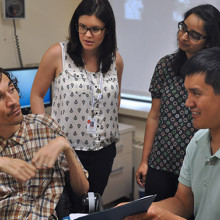
Dan Harvey with Lawson researchers Stacey Guy, Swati Mehta and Dr. Eldon Loh.
Dr. Eldon Loh, Lawson Researcher and Physical Medicine and Rehabilitation Specialist at St. Joseph’s, and his team recognized that pain can be an overlooked part of a spinal cord injury and plays a major factor in the success of rehabilitation. It’s difficult for someone in pain to participate fully in their own recovery, and so long-term disability becomes more likely. Pain is difficult to manage and it often takes multiple approaches to find something that works for each person.
“This is a starting point for us to standardize how we approach pain in the clinic. We have identified gaps and offered recommendations to not only manage the pain, but also ensure that our patients can fully benefit from rehabilitation,” says Dr. Loh.
The results of the three-year process led to recommendations for screening and diagnosis, treatment and models of care. Important clinical considerations accompany each recommendation.
“For those in hospital following an injury, it’s about making sure they can be as independent as possible before discharge. Over time, we want to keep pain levels under control so that they are able to live life to the fullest,” adds Dr. Loh.
The research will inform new tools and resources for care providers and patients.
Harvey believes the guidelines will have a tremendous impact for patients whose pain may have been overlooked. “Pain can be created through many different avenues and the effects can snowball after a person is discharged and sent home. If you don’t check all of the boxes, you might be missing a very important item.”
The new guidelines have been published in the international journal Spinal Cord. The Ontario Neurotrauma Foundation and Rick Hansen Institute provided funding for the research study.
A special thanks to individuals from St. Joseph's who were involved in the project: Steve Orenczuk, Patrick Potter, Keith Sequiera, Lindsey Guilbault, Robert Teasell, Anna Kras-Dupuis, Dalton Wolfe, Alba Casalino and Dwight Moulin.
Image

Additional members of the panel that developed the new clinical practice guidelines.
… • Your appointment is scheduled in the Outpatient Pain Management Clinic at St. Joseph’s Hospital. Please use … Dipyridamole + ASA (Aggrenox®) you must consult your pain clinic specialist about when to stop this medication … • Your appointment is scheduled in the Outpatient Pain Management Clinic at St. Joseph’s Hospital. Please use …
June 16, 2020; Page 1 of 1 Fluoroscopy Pre-Procedure Instructions Your appointment is scheduled in the Outpatient Pain Management Clinic at St. Josephs Hospital. Please use Grosvenor Street Entrance 2. Take the main elevators to Zone B, Level 3 and register at the Central Registration Desk (B3-030)...
For Researchers
HULC publishes high-impact clinical research and trains the next generation of clinicians and researchers, to improve management of painful, disabling conditions affecting the arm/hand. Our research leads to new devices, treatments and processes for managing injuries (like fractures and work injuries) or diseases (like arthritis and osteoporosis) that impair the function of the person, their arm and/or hand See links on this page for outputs and summaries of this work, and work in progress. We conduct:
- Measurement of patient outcomes and perspectives
- Clinical trials of new surgery and rehabilitation interventions
- Studies identifying the predictors of health and work outcomes
Learn more about research studies from the HULC clinical research lab:
- Outcome measures
- Tools and Products of Research
- Patient program
- COVID-19 project
- Training Resources
- Open Access Publications
- Lay Summaries
- Past Study Reports
- Media
- Presentations
- Item Perspective Classification framework (IPC) Information Site
… (Neurontin®) Why is this medication prescribed? • To treat pain from damaged nerves (neuropathic pain). Gabapentin works by dampening the pain signals sent … and 1 capsule at bedtime The usual target dose for pain management is approximately 1800 mg/day (e.g., 600 mg three …
June 16, 2020; Page 1 of 3 Gabapentin (Neurontin) Why is this medication prescribed? To treat pain from damaged nerves (neuropathic pain). Gabapentin works by dampening the pain signals sent through the bodys nervous system. Gabapentin can also be used in the treatment of seizure disorders. How sh...