


Search
Search
352 Search Results:
… role in rehabilitation and highlighted the cutting-edge equipment in the Locomotor Training program, made possible … promote the health and well-being of veterans living at Parkwood Institute, as well as outpatient services for … Donor support makes it possible for people like Lee to have access to innovative technologies like the Lokomat. Donors …
Community Stewardship Report 2014 2015 An average day at St. Josephs is filled with possibilities, whether its through innovative approaches to treatment or the potential offered by new medical technologies. Each day, these seemingly endless possibilities can be measured in the way people recovering...
… use, it was time to upgrade our operating rooms. The equipment – lighting (to light the surgical field), video … FEEL YOUNG AT HEART On Valentine’s Day, Veterans at Parkwood Institute shined up their dancing shoes for a … like Brad – who was diagnosed with prostate cancer – have access to early detection and life-saving care. DID YOU …
Back row left: Holly Bridge, Diane Davis-Miller, Barb Simmonds Front row left: Dr. Jennifer Bjazevic, Roger Blum, Leanne Summers, Dr. Hassan Razvi, Surgical Services You make health care innovation possible. Just one of the reasons why YOU HELPED ENHANCE OUR OPERATING ROOMS 20192020 Community Impact...
… In response to COVID-19, care providers across St. Joseph’s quickly and expertly pivoted to meet challenges during the … and minds were kept active in the Dual Diagnosis Program at Parkwood Institute with indoor and outdoor sensory and … Institute made recovery possible and now others can access the same tools and support. Whether facing disease, …
In response to COVID-19, care providers across St. Josephs quickly and expertly pivoted to meet challenges during the pandemic. Seen here, team members from the Urgent Care Centre at St. Josephs Hospital. Learn how donors made all the difference on pg. 3. 20202021 Community Impact Report Your donati...
… Revised December 15.2020 P a g e | 1 GERIATRIC AMBULATORY ACCESS TEAM (GAAT) REFERRAL FORM PHONE: 519-685-4046 ADDRESS: Parkwood Institute Main Building FAX: 519-685-4020 London … City) Phone: Date of birth: YYYY/MM/DD Is interpreter required? Y N Can friend/family interpret? Y N …
G:\SGS General\GAAT\GERIATRIC ASSESSMENT REFERRAL FORM Revised December 15.2020 P a g e | 1 GERIATRIC AMBULATORY ACCESS TEAM (GAAT) REFERRAL FORM PHONE: 519-685-4046 ADDRESS: Parkwood Institute Main Building FAX: 519-685-4020 London Hospitals #44020 St. Josephs Health Care London EMAIL: GeriatricAmb...
… relevant social history): Surgical Interventions/Procedures Parkwood Institute Main Building Inpatient Referral Form … to abstain from smoking during their admission. PROGRAM REQUESTED (SELECT ONE) Complex Continuing Care Short Term … PROFILE: P rimary Medical Diagnosis Email: parkwoodaccess@sjhc.london.on.ca Fax: 519-685-4804 Phone: …
Language of Preference / Cultural Preferences: Smoke free policy has been reviewed with patient Most recent/updated progress notes available in Cerner (if no, please send) History & Physical notes updated in Cerner (if no, please send ower or Attorney for Personal Care (if not in place identify SDM ...
… 2011-05-27 2011-10-25 This policy applies to: SJH Parkwood Mount Hope RMHCL & ST KEY PRINCIPLES The following … must be provided with the expense report or purchase requisition in the form of a briefing note that is authorized … not otherwise covered will be reimbursed, such as computer access charges, photocopying, word processing services, …
Policy Administration Console Policy: Corporate Expense Policy Policy Owner: General Manager, HMMS SLT Sponsor: VP Corporate Services and Chief Financial Officer Approval By: Senior Leadership Team Date: 2011-05-03 Effective Date: Reviewed Date: Revised Date: 2007-02-05 2011-05-27 2011-10-25 This po...
Could online programming reduce barriers for those with mobility impairments?
LONDON, ON – A new study at Lawson Health Research Institute will offer online exercise and behavioral intervention for adults who are mobility impaired. The goal is to reduce barriers to accessing activity programs.
“Many people with mobility concerns experience barriers to physical activity, such as fear of falling because of their past injuries,” says Dr. Swati Mehta, Lawson Scientist. “This project aims to help them cope and learn skills to continually, actively engage in physical activity.”
The 10-week virtual program is being coordinated through St. Joseph’s Health Care London’s Parkwood Institute. It will consist of weekly personal behavioral coaching. Participants will also be asked to complete two or three group physical activity programs each week, such as seated aerobics, seated boxercise and seated yoga.

“This study is really exciting because it brings together both behavioral coaching and physical activity classes, which are normally offered separately,” explains Dr. Dalton Wolfe, Lawson Scientist. “This provides extra support to help those with mobility impairments overcome barriers to maintaining an active lifestyle.”

Those barriers can include things like fatigue and transportation challenges that often accompany neurological conditions like multiple sclerosis, spinal cord injury, brain injury and stroke.
“Ultimately this study is about enhancing quality of life and wellbeing while improving participants’ ability to engage in the community,” says Dr. Wolfe.
The research team is currently recruiting 20 participants for the study. For more information on the study you can email @email.
About Lawson Health Research Institute
Lawson Health Research Institute is one of Canada’s top hospital-based research institutes, tackling the most pressing challenges in health care. As the research institute of London Health Sciences Centre and St. Joseph’s Health Care London, our innovation happens where care is delivered. Lawson research teams are at the leading-edge of science with the goal of improving health and the delivery of care for patients. Working in partnership with Western University, our researchers are encouraged to pursue their curiosity, collaborate often and share their discoveries widely. Research conducted through Lawson makes a difference in the lives of patients, families and communities around the world. To learn more, visit www.lawsonresearch.ca.
Media Contacts
Amanda Taccone
Communications Consultant & External Relations
Lawson Health Research Institute
T: 519-685-8500 ext. ext. 64059
C: 226-919-4748
@email
Could online programming reduce barriers for those with mobility impairments?
LONDON, ON – A new study at Lawson Health Research Institute will offer online exercise and behavioral intervention for adults who are mobility impaired. The goal is to reduce barriers to accessing activity programs.
“Many people with mobility concerns experience barriers to physical activity, such as fear of falling because of their past injuries,” says Dr. Swati Mehta, Lawson Scientist. “This project aims to help them cope and learn skills to continually, actively engage in physical activity.”
The 10-week virtual program is being coordinated through St. Joseph’s Health Care London’s Parkwood Institute. It will consist of weekly personal behavioral coaching. Participants will also be asked to complete two or three group physical activity programs each week, such as seated aerobics, seated boxercise and seated yoga.

“This study is really exciting because it brings together both behavioral coaching and physical activity classes, which are normally offered separately,” explains Dr. Dalton Wolfe, Lawson Scientist. “This provides extra support to help those with mobility impairments overcome barriers to maintaining an active lifestyle.”

Those barriers can include things like fatigue and transportation challenges that often accompany neurological conditions like multiple sclerosis, spinal cord injury, brain injury and stroke.
“Ultimately this study is about enhancing quality of life and wellbeing while improving participants’ ability to engage in the community,” says Dr. Wolfe.
The research team is currently recruiting 20 participants for the study. For more information on the study you can email @email.
… Health Care London or Mount Hope Centre for Long-Term Care Parkwood Institute Main Building Parkwood Institute Mental … a number of other symptoms. Asymptomatic infection and subsequent transmission have been documented. COVID-19 is … COVID-19: Long-Term Care Home Surveillance Testing and Access to Homes which outlines rapid testing requirements. …
~ SIJOSEPHs HEALTH CARE LONDON ~ CORPORATE STF063 Policy: COVID-19 Vaccination Owner: Director, Occupational Health and Infection Control Integrated Director, Medical Affairs Sponsor: Vice President, Human Resources and Facilities Integrated Vice President, Medical and Academic Affairs Approval...
… 3.3 Qualifications and Criteria for Appointment 6 … of Mount Hope Centre for Long Term Care or Veterans Care at Parkwood Main; (hh) “Physician” means a medical practitioner … Officer shall supply a copy of, or information on how to access, a form of the application, and the mission, vision, …
ST. JOSEPHS HEALTH CARE, LONDON CREDENTIALED PROFESSIONAL STAFF BY-LAW EFFECTIVE APRIL 1, 2024 AMENDED AND APPROVED BY THE: ST. JOSEPHS BOARD OF DIRECTORS - January 29, 2024 ST. JOSEPHS HEALTH CARE SOCIETY - March 27, 2024 Contents Article 1 Definitions and Interpretation 0 ...........................
… the building and the grounds. Below are some common questions and answers. Q - Why is the Southwest Centre for … assessment by the Ontario Review Board. (See “How People Access the Community”) Q - What can I do if I see unsafe … Regional Mental Health Care London, St. Joseph’s Hosptial, Parkwood Hospital and Mount Hope Centre for Long Term Care. …
June 2012 Ongoing Engagement As part of St. Josephs commitment to supporting our patients, staff and visitors, Southwest Centre is a designated smoke-free facility, which includes the building and the grounds. Below are some common questions and answers. Q - Why is the Southwest Centre for Forensic ...
… Illness Christina Seely, BSc, RD, CDE Clinical Dietitian Parkwood Institute Mental Health Care Diabetes Update May 4, … at LHSC or SJHC should be submitted via this Centralized Access Point e- referral system webform” • … Visitors/MHCP_Adult/Services/Centralize d_Access_Point_Ambulatory.htm …
Nutrition Interventions in Patients Living with Diabetes and Mental Illness Christina Seely, BSc, RD, CDE Clinical Dietitian Parkwood Institute Mental Health Care Diabetes Update May 4, 2018 http://www.google.ca/url?sa=i&rct=j&q=&esrc=s&source=images&cd=&cad=rja&uact=8&ved=0ahUKEwjA8uXUq7rQAhWM7YMKH...
… Parkwood Access – Admission Process Flow Questions? Call 519-685-4809 or e-mail parkwoodaccess@sjhc.london.on.ca or fax 519-685-4804 Step 1 … Parkwood Access – Admission Process Flow Questions? Call 519-685-4809 … Download step-by-step details of the Parkwood Access admission steps …
Parkwood Access Admission Process Flow Questions? Call 519-685-4809 or e-mail parkwoodaccess@sjhc.london.on.ca or fax 519-685-4804 Step 1 Go to http://www.sjhc.london.on.ca/parkwoodaccess and read the General Program Information and Admission Criteria and then identify the most appropriate program ...
… community. our collective identity or culture may generate questions about what makes us unique in today’s emerging … was to create a shared understanding of the cultures of Parkwood hospital, the London and st. thomas Psychiatric … serve, their families and our care providers have �4-hour access to counselling and support. We help people make their …
A Future Nurtured in Histories of Faith & Compassion A Future Nurtured in Histories of Faith & Compassion Like the tree that takes root & then bears fruit, st. Josephs health Care, London continues to grow from the humble and compassionate beginnings of our founders, the sisters of st. Joseph, ...
… Parkwood Access – Admission Process Flow Questions? Call 519-685-4809 or e-mail parkwoodaccess@sjhc.london.on.ca or fax 519-685-4804 Step 1 … Parkwood Access – Admission Process Flow Questions? Call 519-685-4809 … download the Parkwood Admission referral and admission steps flow chart …
Parkwood Access Admission Process Flow Questions? Call 519-685-4809 or e-mail parkwoodaccess@sjhc.london.on.ca or fax 519-685-4804 Step 1 Go to http://www.sjhc.london.on.ca/parkwoodaccess and read the General Program Information and Admission Criteria and then identify the most appropriate program ...
Easing the pressure for patients with chronic wounds
Chronic wounds represent a significant burden in Canada. Between four and 30 per cent of patients develop a chronic wound, depending on the health care setting. Over 85 per cent of all Spinal Cord Injury (SCI) survivors will experience health complications related to pressure ulcers, injuries to the skin and underlying tissue resulting from prolonged pressure. These types of wounds can significantly reduce participation in meaningful activities and overall quality of life.
Research from around the world shows that electrical stimulation can help speed the healing of pressure ulcers. This therapy is currently done by a trained health care provider and is not readily available for people across Canada.Electrical stimulation therapy (E-Stim) is a wound treatment that involves applying low levels of electrical current to the wound bed and surrounding tissues. It stimulates several healing processes, promotes local circulation and prevents infections.
The E-Stim Collaboration: A Best Practice Implementation Project for Better Pressure Ulcer Care aims to improve the coordination of pressure ulcer care and promote the use of evidence-informed wound treatments for people living with SCI. In particular, the research project is studying how to best provide E-Stim to people with pressure ulcers, in their own communities.
“Over the years I’ve seen the serious impact pressure ulcers have on the lives of people with spinal cord injury and other health challenges. This is what drives my commitment to not only develop best practice guidelines, but also to ensure they are put into action,” says Dr. Pamela Houghton, Associate Scientist, Lawson and Professor, School of Physical Therapy at Western University. “Advances in technology make it possible for more people with care needs to live at home.”
The pilot project in the South West LHIN has a unique model that builds capacity in the community and taps into the lived experience of people with pressure ulcers and SCI. It brings together the expertise of researchers, clinicians and managers from academia, hospital centres and community care.
Partners include the Parkwood Institute Research program at Lawson Health Research Institute, Western University, Saint Elizabeth’s Health Care Research Centre, Sunnybrook Health Sciences Centre and the South West Community Care Access Centre. An interdisciplinary specialized team, called SCIPUT, has been established within the Spinal Cord Injury Rehabilitation program provided at Parkwood Institute, St. Joseph’s Health Care London.
“Our collaborative team is using the PLAN-DO-STUDY-ACT quality improvement model. This allows us to learn from each cycle and make adjustments as we go,” says Dr. Houghton. “We have just completed the first cycle and are reporting on lessons learned.” Funded by the Rick Hansen Foundation, the team hopes this will set the stage for a larger cross-country initiative.
Those interested in participating can contact phoughto@uwo.ca. The study is open to:
- Individuals with an open pressure ulcer and with a condition that causes limited mobility and/or requires a wheelchair;
- Those who are able and willing to participate in treatment plan, and communicate feedback; and,
- People who are eligible to receive services from South West CCAC.
|
Image
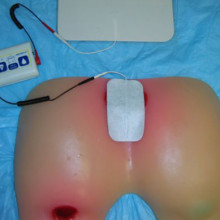
Electrical stimulation (E-Stim) directly stimulates several wound healing processes, promotes local circulation and prevents wound infections. It produces faster healing and wound closure. A trained health care provider applies low levels of electrical current to the pressure ulcer using specialized equipment. |
… Annual Accessibility Plan for St. Joseph’s Health Care, London … Care, London’s website and in alternative formats upon request 2 Table of Contents PAGE EXECUTIVE SUMMARY 3 1. Aim 4 … of $410 million. It is comprised of St. Joseph’s Hospital, Parkwood Hospital, Mount Hope Centre for Long Term Care, …
Annual Accessibility Plan for St. Josephs Health Care, London September 2008 - August 2009 Submitted to Cliff Nordal Chief Executive Officer 30 September 2008 Prepared by SJHC Accessibility Working Group Chair, Derek Lall This publication is available on the St. Josephs Heath Care, Londons website a...
… Annual Accessibility Plan October 2009 – March 31, 2011 Submitted … the Ontarians with Disabilities Act (ODA) (2001). The ODA requires hospitals prepare annual plans that address the … research centre. It is comprised of St. Joseph’s Hospital, Parkwood Hospital, Mount Hope Centre for Long Term Care, …
Annual Accessibility Plan October 2009 March 31, 2011 Submitted to the St. Josephs Board of Directors, September 28, 2009 Prepared and Submitted by St. Josephs Accessibility Working Group St. Josephs Accessibility Plan September 28, 2009 2 Executive Summary St. Josephs Health Care, London, (St. Jos...
… Annual Accessibility Plan for St. Joseph’s Health Care, London … Care, London’s website and in alternative formats upon request 2 Table of Contents PAGE EXECUTIVE SUMMARY 3 1. Aim 4 … of $410 million. It is comprised of St. Joseph’s Hospital, Parkwood Hospital, Mount Hope Centre for Long Term Care, …
Annual Accessibility Plan for St. Josephs Health Care, London September 2007 - August 2008 Submitted to Cliff Nordal Chief Executive Officer 30 September 2007 Prepared by SJHC Accessibility Working Group Co-ordinator, Derek Lall This publication is available on the St. Josephs Heath Care, Londons we...
… Accessibility Plan January 2013 – December 2015 Submitted to … is also committed to ensuring that all patients have an equal opportunity to obtain, use, and benefit from our … research centre. It is comprised of St. Joseph’s Hospital, Parkwood Hospital, Mount Hope Centre for Long Term Care, …
Accessibility Plan January 2013 December 2015 Submitted to St. Josephs Senior Leadership Team on January 8, 2013 Prepared and Submitted by St. Josephs Accessibility Advisory Committee Table of Contents St. Josephs Mission Statement. ...... 1 Introduction.. .............................................