


Search
Search
352 Search Results:
Latest findings on gait and dementia available to public through open access
September is World Alzheimer’s Month and Saturday, September 21 was World Alzheimer’s Day.
In recognition, the Journal of Alzheimer’s Disease has published an open access, special issue that will be available to everyone for the first two weeks of publication.
Dr. Manuel Montero-Odasso, Scientist at Lawson Health Research Institute, has edited and led the special issue focusing on gait disorders and dementia.
He is world renowned for his findings on the relationship between cognition and mobility in the elderly, and gait as a predictor of frailty and dementia. He leads the Mobility, Exercise and Cognition (MEC) Team in London, comprised of top researchers in the areas of mobility, exercise and brain health.
Image
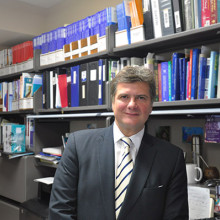
Dr. Montero-Odasso is also a professor at Western University’s Schulich Medicine & Dentistry, geriatrician at St. Joseph’s Health Care London and London Health Sciences Centre, and Director of the Gait and Brain Lab, a part of Lawson’s Parkwood Institute Research group.
“This Journal of Alzheimer’s Disease supplemental issue showcases studies presenting the epidemiology of gait disturbances and cognitive impairment, dissecting specific associations between cognitive domains and quantitative gait parameters, and addressing with advanced neuroimaging techniques the potential mechanisms underlying the gait-cognitive interaction seen before dementia,” explains Dr. Montero-Odasso. “Also, this issue highlights how to manage mobility impairment in the cognitive impaired by using assistive devices.”
Alzheimer’s disease is an irreversible, progressive brain disorder that slowly destroys memory and thinking skills. It is the most common cause of dementia among older adults. There are over half a million Canadians living with dementia - plus about 25,000 new cases diagnosed every year. By 2031, that number is expected to rise to 937,000, an increase of 66 per cent.
Read the Gait Disorders Special Issue with editorial from Drs. Montero-Odasso and George Perry entitled “Gait Disorders in Alzheimer’s Disease and Other Dementias: There is Something in the Way You Walk.”
Scientist
LHSC and St. Joseph’s introduce new research institutes
Lawson Research Institute at St. Joseph’s and London Health Sciences Centre Research Institute will strengthen hospital-based innovation in London, Ontario
LONDON, Ont. – Today, London Health Sciences Centre (LHSC) and St. Joseph’s Health Care London (St. Joseph’s) unveiled new research institutes designed to strengthen hospital-based innovation. Lawson Research Institute (Lawson) at St. Joseph’s and London Health Sciences Centre Research Institute (LHSCRI) will leverage each hospital’s unique areas of clinical focus while further integrating research with care, helping to advance discoveries that lead to improved patient outcomes.
The new institutes were announced at a launch event with guided open house tours taking place across LHSC’s Victoria Hospital, Children’s Hospital and University Hospital, as well as at St. Joseph’s Hospital and Parkwood Institute. Attendees were able to experience signature research areas, including aging, mental health and microbiome research at Lawson, as well as cancer, children’s and mental health research at LHSCRI. The day included demonstrations of discoveries that are reshaping care in Ontario and around the world, including a new robotic, body-weight support for people with mobility difficulties and studies using artificial intelligence (AI) to diagnose rare diseases.
“When research takes place in a hospital context, scientists have more direct connection to the needs of the patients they serve,” said Roy Butler, President and CEO of St. Joseph’s. “There’s data to show that patients treated in research-intensive hospitals live longer because they have access to cutting-edge science. All patients benefit, not just those involved in clinical trials – and that’s the power of health research. That’s why this milestone day and the discoveries to come are real cause for celebration.”
LHSC and St. Joseph’s have been innovating for more than 150 years. The research institutes will build on the legacy of scientific excellence at both organizations. Their launch marks the completion of the transition from Lawson Health Research Institute, a research brand shared between the two organizations since 2000.
“We’re building on our history while introducing the next era in health research excellence, ensuring we will continue to attract the brightest minds in science and that patients will receive world-class, innovative care,” said David Musyj, Supervisor, LHSC. “We will continue to collaborate with each other, Western University, and health research partners across the country and around the world, bolstering London’s position as a national hub for health research.”
Research teams across Lawson and LHSCRI will continue to collaborate closely on projects and large scientific initiatives. LHSC and St. Joseph’s will also continue to share administrative support for research activities.
Learn more about the new research institutes and their transformative work at:
Lawson Research Institute
London Health Sciences Centre Research Institute
-30-
For more information, please contact:
Celine Zadorsky
Senior Media Relations Consultant
London Health Sciences Centre
(226) 927-2309
OR
Debora (Flaherty) Van Brenk
Communications Consultant
St. Joseph’s Health Care London
226-577-1429 or 519-318-0657
About Lawson Research Institute: Lawson Research Institute, the health innovation arm of St. Joseph’s Health Care London, is committed to making and sharing discoveries that improve lives locally and internationally. Every day, Lawson’s 250-plus scientists work to transform imagination to innovation to patient impact. Lawson leads health-care research. Find us online at sjhc.london.on.ca/research and on social media @stjosephslondon
About London Health Sciences Centre Research Institute: At London Health Sciences Centre Research Institute (LHSCRI), our teams pioneer discoveries that transform the health of adult and paediatric patients around the world. As the research institute of London Health Sciences Centre (LHSC), we conduct research where patient care is delivered, working alongside patients, families, health-care providers and academic partners like Western University. We are leaders in advancing the understanding, diagnosis, treatment and management of diseases and health conditions through a diverse research program that ranges from laboratory-based science to clinical trials. Our research has a global impact as we build on LHSC’s 150-year legacy of health innovation and drive forward medical breakthroughs that make a difference in the lives of patients and their families. Find us online at www.lhscri.ca and on social media @LHSCRI.
… Dependent Client) VENTILATOR DEPENDENT CLIENT APPLICATION Parkwood Institute - Complex Care Program FAX completed form … Please attach medication list with name, dosage and frequency of administration. Page 2 of 7 – Complex Care Program … Owned Borrowed From where: Owned Borrowed From where: ACCESS TO ENVIRONMENT: Can client activate call bell? Yes …
Page 1 of 7 Complex Care Program Admission Application (Ventilator Dependent Client) VENTILATOR DEPENDENT CLIENT APPLICATION Parkwood Institute - Complex Care Program FAX completed form to (519) 685-4804 ------- Please ensure that you have included all pertinent patient information. In addition to ...
… from attending an in- service, you can complete an on-line quiz. This on-line learning event was designed from the … in the smoking lounge on the Western Counties Wing at Parkwood, involving a patient travelling with oxygen... • A … emergency response. Calling 55555 - which is your direct access to the hospital’s internal security and emergency …
Fire Response and Evacuation Review Welcome to the Fire Response (Code Red) and Evacuation (Code Green) on-line review. This site was developed to assist you in complying with an annual review. It is policy to review these codes on a yearly basis. To save you time from attending an in- service, you ...
… to Medical Affairs we will look after arranging system access for your new employee. This needs to be done as soon … secretary. In order to obtain systems access the helpdesk requires at least 5 business days. Option 2: Professional … University Hospital - ext. 32446 St. Joseph’s - ext. 65113 Parkwood Hospital - 42320 Parking fees are deducted on a …
London Health Sciences Centre and St. Josephs Health Care London A Guide to Secretarial Support Services For Credentialed Professional Staff Produced by Medical Affairs London, ON Revised: May 2014 London Health Sciences Centre and St. Josephs Health Care London Revised May 2014 Page 2 of 19 Table o...
… the Corporations Act (Ontario), and where the context requires, includes the Regulations made under it; iii) … Health Care London, and/or St. Joseph‟s Hospital and/or Parkwood Hospital (including the Western Counties Wing) … guidelines are maintained in order to enhance patient care, access and flow, to remove disagreement between physicians …
LONDON HEALTH SCIENCES CENTRE ST. JOSEPHS HEALTH CARE, LONDON PROFESSIONAL STAFF RULES AND REGULATIONS [Approved by the Joint Medical Advisory Committee June 2007 and September 2007] [Revised October 2009; Approved by the Joint Medical Advisory Committee October 2009] -Page 2 - TABLE OF CONTENTS DEF...
… System (WHMIS) legislation and how to follow its requirements. Goals • To educate employees about working … the difference between supplier and workplace labeling. • Access information on a MSDS. • Know about the hazards … or Jeff Tucker, Safety Consultant, St. Joseph's & Parkwood Hospitals. Page 12 NOTE: IF POSSIBLE, MSDS'S MUST …
Workplace Hazardous Materials Information System (WHMIS) This information was compiled in consultation with the Joint Occupational Health and Safety Committees for the purpose of providing a reference tool and a self-education booklet for all staff and physicians. By law, all staff must understand ...
Methamphetamine Harm Reduction Project Launch Event
2:00pm - 3:00pm
Integrating harm reduction strategies into hospital settings for people who use methamphetamine
You are invited to attend this virtual launch event for the Methamphetamine Harm Reduction Project, being led by researchers at Parkwood Institute Research, a program of Lawson Health Research Institute.
Friday, April 23, 2021
10 - 11 a.m.
Register here
Evidence-based harm reduction strategies, for example needle exchange services, supervised injection sites and safe supplies, have been used in the community to reduce the risk of infection and overdose, and the risk of other harmful behaviour like crime.
Currently, harm reduction strategies for methamphetamine use are not used in Canadian hospitals. The standard of care does not allow the use of illicit substance in hospital, making implementation of harm reduction strategies challenging. A safe consumption of substances requires an exemption under Section 56.1 of the Controlled Drugs and Substances Act from Health Canada.
A recent London, Ontario study found that people who use methamphethamine actually have a greater risk of infection in hospital than in the community. "This may be due to better access to harm reduction in the community compared to in hospital, and so people are using cleaner techniques," explains Dr. Michael Silverman.
With support from Health Canada, a new hospital-based research study led by Dr. Cheryl Forchuk seeks to find what harm reduction strategies are needed and whether these can be implemented in hospital. This study represents a groundbreaking shift for the health care system in Canada.
The views expressed herein do not necessarily represent the views of Health Canada.
… system to improve the health of Ontarians through better access to high quality health services, co-ordinated health care in local … Interim Co-CEO Date St. Joseph's Health Care, London Parkwood Institute By: _________________________________ … Interim Co-CEO Date St. Joseph's Health Care, London Parkwood Institute By: _________________________________ …
MULTI-SECTOR SERVICE ACCOUNTABILITY AGREEMENT April 1, 2018 to March 31, 2019 SERVICE ACCOUNTABILITY AGREEMENT with St. Joseph's Health Care, London Effective Date: April 1, 2018 Index to Agreement ARTICLE 1.0 - DEFINITIONS & INTERPRETATION ARTICLE 2.0 - TERM AND NATURE OF THIS AGREEMENT ARTICLE 3.0...
… stjosephslondon MY ST. JOSEPH’S IS St. Joseph’s Hospital Parkwood Institute Mount Hope Southwest Centre Centre for … diabetes had converged began slipping. He couldn’t climb quality of life by addressing the to make every breath, … he once got stuck on the third step gasping for air, requiring paramedics to be called. In one care pathways are …
m ST::JOSEPH'S A publication of St. Josephs Health Care London WINTER 2020 | ISSUE 01 BORN TO MOVE St. Josephs leads the way for those facing mobility challenges with the creation of The Gray Centre for Mobility and Activity. 1 201 ISSUE www.sjhc.london.on.ca ~ ~ OSEPH'S 11 C ~~ S!JOSEPHs HEALTH CAR...
… stjosephslondon MY ST. JOSEPH’S IS St. Joseph’s Hospital Parkwood Institute 06. Mount Hope Southwest Centre Centre … in institutions and many are reluctant to go to hospital or access help from health care agencies. “We know that the … says Jodi Younger, Vice President of Patient Care and Quality at 3 The name Biigajiiskaan (bee-gaw-jees-gawn) is …
A publication of St. Joseph s Health Care London FALL 2020 | ISSUE 02 NEW OPTIONS IN AN OLD BATTLE Pain specialists at St. Joseph's Health Care London are part of a new, collaborative approach to improve care for a growing number of people living with sickle cell disease. 1 ~ ~ OSEPH'S n Cl A public...
… stjosephslondon MY ST. JOSEPH’S IS St. Joseph’s Hospital Parkwood Institute Mount Hope Southwest Centre Centre for … in our community and beyond. 03. 03. A LUCKY BREAK 06. EQUIPPING STROKE PATIENTS FOR SUCCESS 07. TRIUMPHS AND A … The platform addresses three needs for SCI patients: • Easy access to a library of reliable SCI resources to support …
Our entrances have m S1: A publication of St. Joseph s Health Care London WINTER 2021 | ISSUE 03 Our entrances have KEEPING IT SAFE become a gateway of safety to protect our patients and sta . It's a responsibility more than 160 screeners take very seriously. These "perimeter protectors" are vital ...
… LITTLE FALL TO A BIG CLIMB With help from her care team at Parkwood Institute, Miranda Scott was able to reach great … Dr. Megan Devlin. “It has really afected some people's quality of life and normal level of functioning. Some … I have been.” ST. JOSEPH'S POST- ACUTE COVID-19 PROGRAM • Accessible by referral only from London Health Sciences …
ST::JOSEPH'S A publication of St. Josephs Health Care London FALL 2021 | ISSUE 04 A LITTLE FALL TO A BIG CLIMB With help from her care team at Parkwood Institute, Miranda Scott was able to reach great heights fguratively and literally by incorporating wall climbing into her recovery. 1 2 V,l~ OSEP...
… ’ m ST.JOSEPH'S ,.., ' , \ .. LAUNr.Y PRQprY L.f'J' O,P.t/300 A publication of St. Joseph s Health … stjosephslondon MY ST. JOSEPH’S IS St. Joseph’s Hospital Parkwood Institute Mount Hope Southwest Centre Centre for … with retinal issues, these changes will ensure timely access to care, less waiting and the best possible outcomes. …
m ST.JOSEPH'S ,.., ' , \ .. LAUNr.Y PRQprY L.f'J' O,P.t/300 A publication of St. Joseph s Health Care London SPRING 2022 | ISSUE 05 HOVERING HOLOGRAMS HONE SURGEONS' SKILLS Surgical visionary Dr. George Athwal at St. Josephs Hospital has introduced a revolutionary new tool into operating rooms in C...
New study aims to improve mental health treatments for stroke patients
LONDON, ON- A team at Lawson Health Research Institute are looking to improve mental health treatments and resources for patients who have experienced a stroke. The team will recruit 100 stroke patients to assess whether the completion of a guided therapy program can improve mental health and quality of life.
Strokes affect approximately 400,000 Canadians each year and can be debilitating. They can negatively affect a person’s cognition and mobility, and severely impact mental health and wellbeing.
“More than sixty per cent of patients experience depression after stroke,” says Dr. Robert Teasell, Lawson Scientist and Physiatrist at St. Joseph’s Health Care London’s Parkwood Institute. “Having a stroke itself makes people more vulnerable and makes people feel their lives have changed negatively.”
During stroke rehabilitation, patients are typically offered mental health treatments, but the research team say it is post rehabilitation that stroke patients tend to experience worsening depression.
“Publicly funded allied health care services are available at inpatient and outpatient care; however, psychology is often limited across the rehabilitation continuum from acute to community care,” says Dr. Swati Mehta, Lawson Scientist. “We are looking at how we can provide a program that is cost effective to help those who have these barriers to access mental health services.”
The study will examine the use of cognitive behavioral therapy (CBT), which is an evidence based psychological intervention that aims to provide people with increased coping ability and self-efficacy. Participants will complete a 10-week guided program with specific targeted lessons, tailored to the needs of those post stroke, delivered virtually through a trained clinician. They will then complete a questionnaire to see if there have been any improvements to self-efficacy and emotional wellbeing.
“We have found this form of therapy (CBT) has been very effective and feasible for spinal cord injury patients with mild traumatic brain injury and we want to see how a modified version could potentially help those with stroke and depression,” says Randy Upper, Clinical Research Associate at Lawson.
If CBT is proven effective through this study, Dr. Mehta hopes it will encourage similar programming that would be available to stroke patients after rehab.
“We are hoping we can connect with community organizations and work with them to implement this program in a service delivery model that would be easily accessible for stroke patients living in the community.”
Recruitment for this study is currently underway, those interested in taking part can email Dr. Swati Mehta at: @email
About Lawson Health Research Institute
Lawson Health Research Institute is one of Canada’s top hospital-based research institutes, tackling the most pressing challenges in health care. As the research institute of London Health Sciences Centre and St. Joseph’s Health Care London, our innovation happens where care is delivered. Lawson research teams are at the leading-edge of science with the goal of improving health and the delivery of care for patients. Working in partnership with Western University, our researchers are encouraged to pursue their curiosity, collaborate often and share their discoveries widely. Research conducted through Lawson makes a difference in the lives of patients, families and communities around the world. To learn more, visit www.lawsonresearch.ca.
Media Contacts
Celine Zadorsky
Senior Media Relations Consultant
Communications & Public Engagement
T: 519-685-8500 ext. 73502
Celine.zadorsky@lhsc.on.ca
… in electronic or hard copy format · Having independent access to health records, either in electronic or hard copy … any contact with a patient/SDM, the Sponsor must: · Request verbal consent from the patient/SDM to allow the … Joseph’s Health Care, London: [ ] St. Joseph’s Hospital [ ] Parkwood Institute Main Building [ ] Mount Hope [ ] Parkwood …
Policy Administration https://apps.sjhc.london.on.ca/sjhc-policy/search_res.php?polid=EDU014&live=1[2018/10/31 1:52:43 PM] Policy Administration Console Policy: Observer (Medical and Non-Medical) Policy Owner: Integrated Director, Medical Affairs SLT Sponsor: Integrated Vice President, Medical Affai...
… Annual Accessibility Plan April 2011 – March 31, 2012 Submitted to … the Ontarians with Disabilities Act (ODA) (2001). The ODA requires hospitals prepare annual plans that address the … research centre. It is comprised of St. Joseph’s Hospital, Parkwood Hospital, Mount Hope Centre for Long Term Care, …
Annual Accessibility Plan April 2011 March 31, 2012 Submitted to the St. Josephs Accessibility Steering Committee, February 15, 2011, St. Josephs Senior Leadership Team, February 25, 2011; and St. Josephs Board of Directors, March 22, 2011 Prepared and Submitted by St. Josephs Accessibility Working...
… Revised March 16, 2016 How to Access Archived Webcasts of the Survivor & Family Education … 3. In the Search Box in the top right hand corner, type: Parkwood ABI Survivor Series and press enter. 4. To make it … and start playing the video. If you experience difficulty accessing the webcasts please contact: Ontario Telemedicine …
Revised March 16, 2016 How to Access Archived Webcasts of the Survivor & Family Education Series 1. Go to http://webcast.otn.ca 2. In the middle of the screen, under Archived Events, select Public. 3. In the Search Box in the top right hand corner, type: Parkwood ABI Survivor Series and press enter....
… 1 Quality Improvement Plan (QIP) Narrative for St. Joseph’s … in injury at Mount Hope Centre for Long Term Care and Parkwood Hospital Minimization of patient falls and in … in rounding with ICPs monthly. 5)Ensure point of care access to alcohol based hand rub (ABHR). Audits of access to …
1 Quality Improvement Plan (QIP) Narrative for St. Josephs Health Care London 3/31/2014 2 Overview Being a National Leader in Quality and Patient Safety is a strategic goal for St. Josephs Health Care London (St. Josephs). In pursuit of this goal we are proud to have received the highest Accreditati...
… below) No Preference Prefers Residential Hospice Prefers Parkwood Palliative Care Unit If preferred location choice … No PPPATIENT’S PERSONAL INFORMATION If LHSC Patient only require NAME & PIN # DATE OF REFERRAL: DD: M: YR: Last Name … below) No Preference Prefers Residential Hospice Prefers Parkwood Palliative Care Unit If preferred location choice …
Page 1 PALLIATIVE CARE BED REFERRAL FORM REASON FOR REFERRAL: ________________________________________________________________________ Non-urgent Urgent (within 24 hours) Reason for urgency: ________________________________________________________________________________ Date last seen by MRP/NP: ...