


Search
Search
581 Search Results:
… stjosephslondon MY ST. JOSEPH’S IS St. Joseph’s Hospital Parkwood Institute Mount Hope Southwest Centre Centre for … Long Term Care Mental Health Care Teams, clinics and programs in our community and beyond. 03. 03. A LUCKY BREAK … get StrokeSMaRT in collaboration with clinicians at Parkwood Institute. It’s an assortment of everyday items, …
Our entrances have m S1: A publication of St. Joseph s Health Care London WINTER 2021 | ISSUE 03 Our entrances have KEEPING IT SAFE become a gateway of safety to protect our patients and sta . It's a responsibility more than 160 screeners take very seriously. These "perimeter protectors" are vital ...
… LITTLE FALL TO A BIG CLIMB With help from her care team at Parkwood Institute, Miranda Scott was able to reach great … stjosephslondon MY ST. JOSEPH’S IS St. Joseph’s Hospital Parkwood Institute Mount Hope Southwest Centre Centre for … Mental Health CareLong Term Care Teams, clinics and programs in our community and beyond. 0803. 07. 25. 23. 03. …
ST::JOSEPH'S A publication of St. Josephs Health Care London FALL 2021 | ISSUE 04 A LITTLE FALL TO A BIG CLIMB With help from her care team at Parkwood Institute, Miranda Scott was able to reach great heights fguratively and literally by incorporating wall climbing into her recovery. 1 2 V,l~ OSEP...
… stjosephslondon MY ST. JOSEPH’S IS St. Joseph’s Hospital Parkwood Institute Mount Hope Southwest Centre Centre for … Mental Health Care Long Term Care Teams, clinics and programs in our community and beyond. 03. 03. A HORSE OF A … was able to get back in the saddle again with the help of Parkwood Institute’s Acquired Brain Injury Rehabilitation …
m ST.JOSEPH'S ,.., ' , \ .. LAUNr.Y PRQprY L.f'J' O,P.t/300 A publication of St. Joseph s Health Care London SPRING 2022 | ISSUE 05 HOVERING HOLOGRAMS HONE SURGEONS' SKILLS Surgical visionary Dr. George Athwal at St. Josephs Hospital has introduced a revolutionary new tool into operating rooms in C...
New Alzheimer’s research aims to improve treatment and support for patients with agitation
Two new interventional studies have been brought to London, focused on improving quality of life for patients with Alzheimer’s disease and their caregivers. Both hope to improve upon standard approaches to treating agitation, a core symptom of Alzheimer’s.
Agitation is a significant source of stress for patients and caregivers. It is complex and difficult to treat. Often, families do not know about this particular symptom of Alzheimer’s and are not properly trained on how to manage care while dealing with agitation.
“These studies are designed to have a direct impact on patients, families and care providers, to improve quality of life and function in those suffering from agitation due to Alzheimer’s,” says Dr. Amer Burhan, Associate Scientist at Lawson Health Research Institute (Lawson) and Geriatric Neuropsychiatrist, St. Joseph’s Health Care London (St. Joseph’s).
Parkwood Institute, a part of St. Joseph’s, is one of multiple sites participating in these studies across Canada and the United States.
One study aims to identify patients early in their diagnosis, while they are living at home or in the community, and apply a comprehensive psychosocial approach, with or without medication, to help with the management of agitation. “We hope to identify participants and have them participating in our program before they experience a crisis due to agitation,” explains Dr. Burhan.
Psychosocial intervention is a way of helping patients and caregivers understand the reasons for agitation. Agitation can develop due to a wide range of causes. For example, patients may just be bored and need help to find something meaningful to occupy their time, they could be upset about something in their current environment, or may be suffering from physical discomfort or pain.
Interventions can include communicating with patients in a manner that creates calm, scheduling meaningful activities, and maintaining routine and rhythm in life. The research team will connect with families early after diagnosis to give them the tools and support they need.
Initially, participants will be treated using structured psychosocial intervention to help reduce and manage their agitation. After three weeks, they will be reassessed and if significant agitation continues to persist, the patient will be randomly selected to receive either a placebo, or medication known as S-Citalopram to treat agitation while they continue to receive psychosocial care.
Sylvia Wilson is the wife of one of the study participants. By enrolling in this trial, she feels she has gained a much better understanding of her husband’s disease, and is grateful for the support that study participants receive.
“My husband typically does not like going to visit doctors, but Dr. Burhan and his team are great,” says Wilson. “They understand agitation, and other symptoms of the disease very well, and I notice a difference in his mood with the treatment he receives through the study.”
Participants are still able to receive care from their primary physician and care teams, with the study providing an added layer of support.
Another study is focused on Alzheimer’s patients who are admitted to hospital or living in long-term care. The aim is to standardize the approach to care for agitation related to Alzheimer’s. After baseline assessment, participants will be randomized to receive the current treatment as per usual, or an integrated care pathway derived from evidence-informed treatment guidelines. These include washing out medications that have not helped, adding individualized behavioral and environmental support, and if medications are needed, use a specific set of medications and dosages based on best evidence.
“Better understanding agitation is a growing area of interest in geriatric research. The work being done locally is part of an international effort to create a paradigm shift in treating patients with Alzheimer’s disease and agitation,” explains Dr. Burhan.
Researchers are ready to offer these studies to patients and their families, hoping to make these treatment protocols an integral part of care for patients with agitation due to Alzheimer’s disease. Those interested in learning more about these studies can contact Dr. Burhan at @email or call 519-646-6100 x. 48170.
In the media: Study on 'agitation' in Alzheimer's patients seeks participants
New national strategy to tackle dementia
Researchers in London, Ontario have been awarded $1.345 million over five years through the second phase of the Canadian Consortium on Neurodegeneration in Aging (CCNA), announced today as part of Canada’s first national dementia strategy. CCNA is a collaborative research program tackling the challenge of dementia and other neurodegenerative illnesses.
A Dementia Strategy for Canada: Together We Aspire focuses on preventing dementia, advancing therapies and finding a cure, as well as improving quality of life for people living with dementia and caregivers.
Clinician researchers from across the country working together
Dr. Manuel Montero-Odasso, Scientist at Lawson Health Research Institute, is world renowned for his findings on the relationship between cognition and mobility in the elderly, and gait as a predictor of frailty and dementia. He leads the Mobility, Exercise and Cognition (MEC) Team in London, comprised of top researchers in the areas of mobility, exercise and brain health.
Image
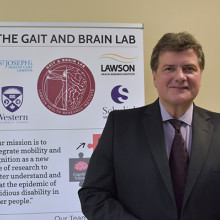
“Evidence from other countries with dementia strategies shows that coordinated, targeted efforts at the national level improves results for all aspects of dementia care and also for research,” says Dr. Montero-Odasso, also a geriatrician and Director of the Gait and Brain Lab at Parkwood Institute, a part of St. Joseph’s Health Care London.
CCNA was purpose-built to synergize dementia research within the Canadian context. Phase I saw the creation of infrastructure fostering collaboration amongst Canadian researchers, and there are now 20 teams built around important research topics.
“This kind of effective national collaboration by scientists and clinicians from many disciplines gives the CCNA a cutting edge in research, prevention, treatment and management of all forms of dementia,” explains Dr. Montero-ODasso. “We created a national network of researchers form west to east coast with a high level of expertise to deliver lifestyle interventions to improve cognition and slow down progression to dementia. I feel privileged working with such excellent investigators and leading this important endeavour locally.”
Preventing dementia through lifestyle changes
The MEC team has several projects in the works, but the majority of the new funding is to complete the SYNERGIC Trial, SYNchronizing Exercises and Remedies on Gait and Cognition.
This first-in-the-world clinical study is testing a triple intervention aimed at treating Mild Cognitive Impairment (MCI) and delaying the onset of dementia. The SYNERGIC Trial incorporates physical exercises and cognitive training, along with vitamin D supplementation to determine the best treatment for improving mobility and cognition.
“We are looking at how interventions will work together and targeting cognitive decline at its earliest stage – individuals with MIC,” explains Dr. Montero-Odasso. “Both physical and cognitive exercises have shown promising effects for maintaining cognition, while vitamin D deficiency is associated with cognitive decline.”
A professor at Western University’s Schulich Medicine & Dentistry, Dr. Montero-Odasso partners with researchers from across the city including Dr. Rob Bartha, imaging scientist at Schulich Medicine & Dentistry and Robarts Research Institute at Western University, and Dr. Kevin Schoemaker who leads the Laboratory for Brain and Heart Health.
Study participants in the SYNERGIC Trial are asked to complete an individualized and progressive routine of exercises and cognitive training three times a week for six months, with one final assessment at 12 months. The main site for the study is Parkwood Institute with the physical exercises taking place at the Labatt Health Sciences Building on the Western campus.
To date, 138 research patients has been recruited across multiple sites in Canada.
One participant’s experience
Image
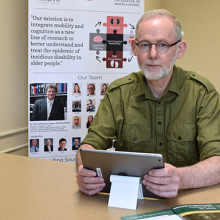
One day, Peter Saracino saw an advertisement about a research study. They were looking for participants who were a minimum age of 60 and had minor cognitive impairment. He felt he fit the bill and he was interested in this kind of research.
“I have family members who suffered from forms of dementia and Parkinson’s Disease. I really understand how hard it hits and I liked that this study was about prevention,” explains Peter.
Going into it, Peter thought he was in pretty good shape. He has two dogs and walks them regularly. “But by going to the gym and doing the exercises and faster-paced walking, I realized that I wasn’t in as good shape as I thought. My diet was under control but I was still taking blood pressure medication. I didn’t have much energy.”
After 10 weeks in the study, he feels better than he has for over a decade. “I can garden for longer. I took two notches off my belt. I no longer take my blood pressure medication. I actually feel younger.”
He remembered that last year he slipped and fell four times, which was very unusual for him. Part of his cognitive impairment is that he had trouble with balance, and that has improved for him as well.
Peter feels that “this is exactly the kind of research that the government should be investing in – an ounce of prevention is worth a pound of cure. This kind of research leads to keeping people independent and healthier as they get older. People are happier. They feel like doing more. There is no downside to improving someone’s health through lifestyle changes, and in fact it is cost effective and helps ease the burden on the health care system.”
Individuals over 60 years old with mild cognitive impairment without dementia are eligible for this clinical trial. Those interested in participating are encouraged to contact a Lawson research coordinator at 519-685-4292 ext. 42179.
Looking forward
“Our preliminary analysis from SYNERGIC is giving us a strong indication that a multimodal approach, combining physical exercise, cognitive training and supplementation, has a synergistic effect. It seems the whole is greater than the sum of its parts,” says Dr. Montero-Odasso.
A major goal for the work of the MEC team in London is to translate their research findings into clinical guidelines that can be used at the front line of care. “Practitioners understand the overall importance of exercise and cognitive vitality, but we are missing more specific guidelines on what kind and how much will work for different patients. Basically, what is an effective lifestyle prescription.”
Image
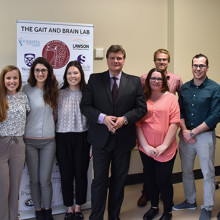
Dr. Montero-Odasso adds that “as our population ages, a comprehensive strategy is vital to ensure the growing number of those living with dementia receive the care and support they deserve. Over half a million Canadians are currently living with dementia. By 2031, this number is expected to nearly double.” More than one third of dementia cases might be preventable.
CCNA Phase II
In CCNA’s Phase II, researchers are working on analyzing the overall health of every patient in a large clinical cohort study, COMPASS-ND. This information will be used to enhance understanding of how changes in the brain affect dementia severity and ways to reduce and prevent this through lifestyle changes. Lawson is the leading recruitment site for COMPASS-ND and the London team will be instrumental in the larger lifestyle interventions moving forward.
CCNA is funded by the Government of Canada, Canadian Institutes of Health Research (CIHR) and other funding partners. CIHR is providing $31.6 million, and partners—including provincial agencies and non-profit organizations—are providing an additional $14.4 million for a total investment of $46 million over five years. The research on dementia prevention, diagnosis, treatment and care as part of Phase II of the CCNA will support the national strategy.
Related stories
Scientist
New research showcased at third annual Parkwood Institute Research Spring Update Half Day
More than 100 researchers, staff and trainees attended the third annual Parkwood Institute Research (PIR) Spring Update Half Day on April 27, 2018 to share their innovative research and learn about work from across PIR through interactive workshops and poster presentations.
A program of Lawson Health Research Institute and located at St. Joseph’s Health Care London’s Parkwood Institute, PIR represents three major research programs: cognitive vitality and brain health, mobility and activity, and mental health. The event allowed guests to hear about new studies and recent research developments from across these three themes.
“Parkwood Institute Research covers different research areas but what we want to emphasize with this event is the overlap and collaboration between our programs. Having an inter-disciplinary approach that encourages partnerships ultimately helps us to incorporate new knowledge into patient care at Parkwood Institute,” says Dr. Cheryl Forchuk, Beryl and Richard Ivey Research Chair in Aging, Mental Health, Rehabilitation and Recovery, and Assistant Director, Lawson.
Five interactive workshops were held on a variety of different topics, such as clinical trials, systematic reviews, innovation in health care, practice-based research methods and evaluating SMART technology. The workshops were led by some of Parkwood Institute’s research leaders, including Drs. Cheryl Forchuk, Robert Teasell, Michael Borrie, Dalton Wolfe, and Arlene MacDougall.
Attendees also had the opportunity to visit poster presentations on recent PIR projects.
Image
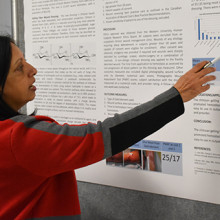
Ashrafunissa Janmohammad (above), Lawson research coordinator at Parkwood Institute’s Chronic Wound Management Clinic, was one of the poster presenters at the event. She presented on a study led by Lawson associate scientist Dr. David Keast, which assessed whether chitosan gelling fibre dressing could be effective in controlling bleeding after minor wound surgery. Chitosan is derived from chitin, the structural component of the cell walls of fungi and the shells of arthropods such as crabs, lobsters, shrimps and insects.
Image

Juweiriya Ahmed (above), a MSc candidate at Lawson and Western University’s Schulich School of Medicine & Dentistry, was another presenter. Her poster outlined a study investigating the interaction between neuroanatomical and genetic risk factors that may contribute to the development of psychotic symptoms (delusions and hallucinations) in patients with Alzheimer’s disease. Supervised by Lawson scientist Dr. Elizabeth Finger, the study could help inform the development of therapeutic targets and treatment plans.
New study aims to improve mental health treatments for stroke patients
LONDON, ON- A team at Lawson Health Research Institute are looking to improve mental health treatments and resources for patients who have experienced a stroke. The team will recruit 100 stroke patients to assess whether the completion of a guided therapy program can improve mental health and quality of life.
Strokes affect approximately 400,000 Canadians each year and can be debilitating. They can negatively affect a person’s cognition and mobility, and severely impact mental health and wellbeing.
“More than sixty per cent of patients experience depression after stroke,” says Dr. Robert Teasell, Lawson Scientist and Physiatrist at St. Joseph’s Health Care London’s Parkwood Institute. “Having a stroke itself makes people more vulnerable and makes people feel their lives have changed negatively.”
During stroke rehabilitation, patients are typically offered mental health treatments, but the research team say it is post rehabilitation that stroke patients tend to experience worsening depression.
“Publicly funded allied health care services are available at inpatient and outpatient care; however, psychology is often limited across the rehabilitation continuum from acute to community care,” says Dr. Swati Mehta, Lawson Scientist. “We are looking at how we can provide a program that is cost effective to help those who have these barriers to access mental health services.”
The study will examine the use of cognitive behavioral therapy (CBT), which is an evidence based psychological intervention that aims to provide people with increased coping ability and self-efficacy. Participants will complete a 10-week guided program with specific targeted lessons, tailored to the needs of those post stroke, delivered virtually through a trained clinician. They will then complete a questionnaire to see if there have been any improvements to self-efficacy and emotional wellbeing.
“We have found this form of therapy (CBT) has been very effective and feasible for spinal cord injury patients with mild traumatic brain injury and we want to see how a modified version could potentially help those with stroke and depression,” says Randy Upper, Clinical Research Associate at Lawson.
If CBT is proven effective through this study, Dr. Mehta hopes it will encourage similar programming that would be available to stroke patients after rehab.
“We are hoping we can connect with community organizations and work with them to implement this program in a service delivery model that would be easily accessible for stroke patients living in the community.”
Recruitment for this study is currently underway, those interested in taking part can email Dr. Swati Mehta at: @email
About Lawson Health Research Institute
Lawson Health Research Institute is one of Canada’s top hospital-based research institutes, tackling the most pressing challenges in health care. As the research institute of London Health Sciences Centre and St. Joseph’s Health Care London, our innovation happens where care is delivered. Lawson research teams are at the leading-edge of science with the goal of improving health and the delivery of care for patients. Working in partnership with Western University, our researchers are encouraged to pursue their curiosity, collaborate often and share their discoveries widely. Research conducted through Lawson makes a difference in the lives of patients, families and communities around the world. To learn more, visit www.lawsonresearch.ca.
Media Contacts
Celine Zadorsky
Senior Media Relations Consultant
Communications & Public Engagement
T: 519-685-8500 ext. 73502
Celine.zadorsky@lhsc.on.ca
… tour involving more than one program must ensure that all programs are notified prior to the agreed upon tour date. … Joseph’s Health Care, London: [ ] St. Joseph’s Hospital [ ] Parkwood Institute Main Building [ ] Mount Hope [ ] Parkwood Institute Mental Health Building [ ] Southwest …
Policy Administration https://apps.sjhc.london.on.ca/sjhc-policy/search_res.php?polid=EDU014&live=1[2018/10/31 1:52:43 PM] Policy Administration Console Policy: Observer (Medical and Non-Medical) Policy Owner: Integrated Director, Medical Affairs SLT Sponsor: Integrated Vice President, Medical Affai...
… in the organization's by-laws, if any, and in its policies, programs, practices and services. The act also stipulates … research centre. It is comprised of St. Joseph’s Hospital, Parkwood Hospital, Mount Hope Centre for Long Term Care, … to enhance readability Complete by 03/12 *Informational/ Parkwood Hospital Current signage not “senior friendly” …
Annual Accessibility Plan April 2011 March 31, 2012 Submitted to the St. Josephs Accessibility Steering Committee, February 15, 2011, St. Josephs Senior Leadership Team, February 25, 2011; and St. Josephs Board of Directors, March 22, 2011 Prepared and Submitted by St. Josephs Accessibility Working...
… Methicillin Resistant Staphylococcus Aureus (MRSA) rates at Parkwood Hospital: Number of patients with hospital-acquired … by the number of patient days, multiplied by 1000 for Parkwood Hospital 0.45/1000 patient days 0.2/1000 patients … risk assessment and management has taken place in all programs at Regional Mental Health Care (RMHC) London and …
March, 2012 St. Josephs Health Care London Progress on Quality Improvement Plan from 2011/12 St. Josephs Health Care London Progress on Quality Improvement Plan from 2011/12 Priority Indicators for 2011-2012 Baseline performance March 2011 Goal for 2011-2012 Progress to date Comments Hand Hygiene co...
… in injury at Mount Hope Centre for Long Term Care and Parkwood Hospital Minimization of patient falls and in … Joseph’s. Approximately 85 per cent of our falls occur at Parkwood Hospital and Mount Hope Centre for Long Term Care, … Care. Patient experience and satisfaction is a focus in all programs at St. Joseph’s and is aligned with our vision of …
1 Quality Improvement Plan (QIP) Narrative for St. Josephs Health Care London 3/31/2014 2 Overview Being a National Leader in Quality and Patient Safety is a strategic goal for St. Josephs Health Care London (St. Josephs). In pursuit of this goal we are proud to have received the highest Accreditati...
… relevant social history): Surgical Interventions/Procedures Parkwood Institute Main Building Inpatient Referral Form … Addressograph Patient Name/MR#: Referral Contact Phone #: Parkwood Institute is a smoke-free facility. This means there will be no smoking indoors or outdoors on the Parkwood Institute property, including in parking lots. …
Language of Preference / Cultural Preferences: Smoke free policy has been reviewed with patient Most recent/updated progress notes available in Cerner (if no, please send) History & Physical notes updated in Cerner (if no, please send ower or Attorney for Personal Care (if not in place identify SDM ...
… 1 Updated: November 26, 2014 Parkwood Access Questions and Answers Parkwood Access is the central referral point at Parkwood … specialized geriatric services, and veterans care programs. How does this process work? • On the Parkwood … 1 Updated: November 26, 2014 Parkwood Access Questions and Answers Parkwood Access is the …
1 Updated: November 26, 2014 Parkwood Access Questions and Answers Parkwood Access is the central referral point at Parkwood Institute for: Inpatient Complex Care: Complex Continuing Care, Long-Term Mechanical Ventilation, Palliative Care and Respite Care Inpatient Rehabilitation: Acquired Brain I...
Parkwood Institute Research Open House 2019
6:00pm - 9:00pm
Parkwood Institute Research, a program of Lawson Health Research Institute, is hosting its third annual Open House and interactive tour showcasing research that is making an impact for patients and their families.
A part of St. Joseph’s Health Care London, Parkwood Institute represents the next era in care, recovery and rehabilitation. Across the site, clinical and research teams from across disciplines and specialties work together to bring tested solutions to the people who need them the most.
The special open house with interactive tour gives guests the opportunity to meet researchers and their teams to learn more about their work in the areas of Cognitive Vitality and Brain Health, Mobility and Activity, and Mental Health.
This free event is open to the public including members of London’s vibrant health care and research community.
Image

Event Details
Date: Thursday, November 28, 2019
Time: 2:00 – 5:00 p.m.
Locations: Parkwood Institute Main Building Auditorium (Room B2-109)
*PLUS selected locations throughout the building. Directions to be provided.
Click here for directions to Parkwood Institute and parking maps.
The lot rate is $5.00 when you enter. $1 and $2 coins and credit card accepted (press the start button then insert payment)
Refreshments and snacks will be available along your tour.
If you have any questions, please contact @email
Download the event poster.
Parkwood Institute Research Open House 2020 – VIRTUAL EVENT
6:00pm - 8:00pm
Parkwood Institute Research, a program of Lawson Health Research Institute, is hosting its fourth annual Open House showcasing research that is making an impact for patients and their families.
The special open house this year will move to a VIRTUAL platform making it even easier to connect to the researchers and their teams who work in the areas of Cognitive Vitality and Brain Health, Mobility and Activity, and Mental Health.
Why you should attend:
- See videos, demonstrations and project summaries presented by the different research teams.
- Participate in interactive activities so you can learn more about PIR and why their work matters.
- Ask questions to the research teams LIVE during the online event.
- Learn about ways to get involved with research.
- Have fun with live polls, games, match-making and more!
A part of St. Joseph’s Health Care London, Parkwood Institute represents the next era in care, recovery and rehabilitation. Across the site, clinical and research teams from across disciplines and specialties work together to bring tested solutions to the people who need them the most.
This free virtual event is open to anyone interested in learning more about hospital-based research happening in this region and getting to know members of London’s vibrant health care and research community.
Event Details
Date: Thursday, November 26, 2020
Time: 2:00 – 4:00 p.m.
Location: This is a VIRTUAL event being held on the Whova event and conference app. It can be accessed through a web browser or by downloading the Whova app on your preferred device.
If you have any questions, please contact PIR_Info@sjhc.london.on.ca.
Event poster
Parkwood Institute's Transitional Care Education Day & Program Launch
1:30pm - 7:15pm
If you are an adult or youth living with medical complexities, or a caregiver for someone living with medical complexities, please join us for a day of education and networking with individuals and families affected by complex medical issues, and help celebrate the launch of Parkwood Institute’s Transitional and Lifelong Care Program.
For more information, please visit the St. Joseph's event page.
Partners
… -C2 Physiotherapy Gym - B2 Geriatric Day Hospital - A2 Parkwood Auditorium - B2 Inpatients Acquired Brain Injury - … Day Hospital - A2 Geriatric Clinics/Research - A2 Driving Programs - Driveable A2, DARP D2 Neurotrauma Rehabilitation … -C2 Physiotherapy Gym - B2 Geriatric Day Hospital - A2 Parkwood Auditorium - B2 Inpatients Acquired Brain Injury - …
S N E Entrance to Western Counties Wing Entrance to Arthur J. Hobbins Building Entrance to Main Building LOT 1 Visitors LOT 3 Visitors E D B C A LOT 2 Staff MENTAL HEALTH CARE BUILDING Preferred Parking Zone Legend Barrier Free Parking Entrance E General Store - C2 Cafeteria - C1 Corner Store - E2 I...
… a concern or comment to make about the care we deliver at Parkwood Institute or Southwest Centre for Forensic Mental … Hours: 8:30 am to 4:30 pm Monday to Thursday Location: Parkwood Institute Mental Health Care Building 550 … received care in one of St. Joseph’s mental health care programs. They work in partnership with staff, family …
CARING FOR THE BODY, MIND & SPIRIT SINCE 1869 Renowned for compassionate care, St. Josephs is one of the best academic health care organizations in Canada dedicated to helping people live to their fullest by minimizing the effects of injury, disease and disability through excellence in care, teachin...
… Keith MacDougall Shawn Steele - Site Chief, St. Joseph's Parkwood and SWC Vacant - Site Chief St Joseph's Main, MH, … Keith MacDougall Shawn Steele - Site Chief, St. Joseph's Parkwood and SWC Vacant - Site Chief St Joseph's Main, MH, …
GUIDELINES FOR PHYSICIAN PERFORMANCE MANAGEMENT - Listing of Physician Leaders in the Department/Organization DEPARTMENT DEPARTMENT CHIEFS SITE CHIEFS DIVISION DIVISION CHIEFS/SECTION HEADS/ DIVISION CHAIRS/MEDICAL DIRECTORS OTHER LEADERSHIP ROLE RESIDENCY PROGRAM DIRECTORS COMMENTS Ashraf Fayad (LH...
… (Interim) Dr. Henry Lapointe - Site Chief, St. Joseph's Parkwood and SWC Joe Armstrong (Oral & Maxillofacial … (Interim) Dr. Henry Lapointe - Site Chief, St. Joseph's Parkwood and SWC Joe Armstrong (Oral & Maxillofacial …
GUIDELINES FOR PHYSICIAN PERFORMANCE MANAGEMENT - Listing of Physician Leaders in the Department/Organization DEPARTMENT DEPARTMENT CHIEFS SITE CHIEFS DIVISION DIVISION CHIEFS/SECTION HEADS/ DIVISION CHAIRS/MEDICAL DIRECTORS OTHER LEADERSHIP ROLE RESIDENCY PROGRAM DIRECTORS COMMENTS ANESTHESIA & PER...