


Search
Search
2194 Search Results:
… manner Ability to communicate and relate appropriately with patients and their families Clinical knowledge and … relevant legislature Patient Management (ie. Monitoring of patients) Utilization of Hospital resources Willingness to … where the applicant has interacted inappropriately with patients or their families? FORMCHECKBOX FORMCHECKBOX Are …
JOINT REFERENCE FORM For The Schulich School of Medicine & Dentistry, London Health Sciences Centre, and St. Josephs Health Care London Instructions to the Applicant: You are required to obtain three confidential references with your application for your academic appointment with Schulich School of...
… manner Ability to communicate and relate appropriately with patients and their families Clinical knowledge and … relevant legislature Patient Management (ie. Monitoring of patients) Utilization of Hospital resources Willingness to … where the applicant has interacted inappropriately with patients or their families? |_| |_| Are you aware of any …
JOINT REFERENCE FORM For The Schulich School of Medicine & Dentistry, London Health Sciences Centre, and St. Josephs Health Care London Instructions to the Applicant: You are required to obtain three confidential references with your application for your academic appointment with Schulich School of...
… manner Ability to communicate and relate appropriately with patients and their families Clinical knowledge and … relevant legislature Patient Management (ie. Monitoring of patients) Utilization of Hospital resources Willingness to … where the applicant has interacted inappropriately with patients or their families? Are you aware of any situation …
February 2017 JOINT REFERENCE FORM For The Schulich School of Medicine & Dentistry, London Health Sciences Centre, and St. Josephs Health Care London Instructions to the Applicant: You are required to obtain three confidential references with your application for your academic appointment with Schu...
Dr. s copy Western Schulich School of Medicine & Dentistrys copy Department of s copy Medical Affairs copy THIS LETTER OF OFFER IS ONLY TO BE ISSUED AFTER CONFIRMATION OF THREE SATISFACTORY REFERENCES FOR THE CANDIDATE. Dear Dr.
Dr. s copy Western Schulich School of Medicine & Dentistrys copy Department of s copy Medical Affairs copy THIS LETTER OF OFFER IS ONLY TO BE ISSUED AFTER CONFIRMATION OF THREE SATISFACTORY REFERENCES FOR THE CANDIDATE. Dear Dr.
… Clinical Service Responsibilities · full assessment of new patients, and determination of an appropriate diagnostic and … of Hematology Oncology services. · assessment of follow-up patients, and initiation of appropriate tests and … dictating stat notes when and where appropriate · assessing patients in the adjuvant and metastatic chemotherapy clinic, …
Dr. Candidates copy Western Schulich School of Medicine & Dentistrys copy Department of Oncologys copy Medical Affairs copy DATE Dear Dr. Re: Letter of Understanding It gives us great pleasure to offer you a position as a General Practitioner in Oncology (GPO) in the Depart...
… manner Ability to communicate and relate appropriately with patients and their families Clinical knowledge and … relevant legislature Patient Management (ie. Monitoring of patients) Utilization of Hospital resources Willingness to … where the applicant has interacted inappropriately with patients or their families? |_| |_| Are you aware of any …
JOINT REFERENCE FORM For The Schulich School of Medicine & Dentistry, London Health Sciences Centre, and St. Josephs Health Care London Instructions to the Applicant: You are required to obtain three confidential references with your application for your academic appointment with Schulich School of...
… manner Ability to communicate and relate appropriately with patients and their families Clinical knowledge and … relevant legislature Patient Management (ie. Monitoring of patients) Utilization of Hospital resources Willingness to … where the applicant has interacted inappropriately with patients or their families? FORMCHECKBOX FORMCHECKBOX 3. Are …
JOINT REFERENCE FORM For The Schulich School of Medicine & Dentistry, London Health Sciences Centre, and St. Josephs Health Care London Instructions to the Applicant: You are required to obtain three confidential references with your application for your academic appointment with Schulich School of...
… are known to cause treatment refractoriness in patients with a bipolar diathesis. Hence the need for … in clinical settings1 affecting about 10% of psychiatric outpatients and up to 20% of inpatients2. The relationship between borderline personality … are known to cause treatment refractoriness in patients with a bipolar diathesis. Hence the need for …
_______________________________________________________________________________________________________________ Case Report CONSEQUENCES OF THE MISDIAGNOSIS OF BIPOLAR DISORDER AS BORDERLINE PERSONALITY DISORDER by Hyacinth John, MD1, Verinder Sharma, MB, BS, FRCP(C) 2, 3 1 Resident, Department of P...
… information includes information about St. Joseph’s patients, staff, affiliates and the business information of … information includes information about St. Joseph’s patients, staff, affiliates and the business information of …
Regrets to Terri-Lynn Cook 519-646-6100 ext. 64202 or terrilynn.cook@sjhc.london.on.ca P a g e | 1 Meeting of the Board of Directors Wednesday June 21, 2023 12:30 pm start time Parkwood Institute Main Bldg, Room A2-109A/B AGENDA REMINDER: At the forefront of our discussions today, we are to ensure t...
Keeping an eye on care of the future
Dr. Khaldon Abbas is using his curiosity and passion for ophthalmology to improve patient care and outcomes for people with eye diseases and disorders.
While in university, Dr. Khaldon Abbas had a deeply moving experience as a volunteer with the Canadian Centre for Victims of Torture (CCVT) that changed the trajectory of his life and career.
The community-based organization helps victims of war and torture, and Abbas, whose family immigrated to Canada from Iraq a little more than a decade before, wanted to share his skills as a translator and tutor with newcomers.
“I came to Canada when I was 12. I had limited English, we had no family or friends here, and it was really hard to acclimate,” says Abbas. “I wanted to give back to the community and to be there for immigrant families who were facing similar challenges that my family had to deal with.”
During one shift with CCVT, Abbas was paired with a family from Syria, whose nine-year old daughter was losing her eyesight. She was living with retinal dystrophy, a degenerative disorder that can progress to complete blindness.
Witnessing the impact the eye disorder had on the young girl and her family inspired Abbas to further his own education and set a goal to become an ophthalmologist.
That was eight years ago. Since then, Abbas spent several years working as a clinical research coordinator and completed four years of medical school at the University of British Columbia.
Today, he is a clinical research fellow at the Ivey Eye Institute of St. Joseph’s Health Care London (St. Joseph’s) – a position supported through St. Joseph’s Health Care Foundation thanks to the generosity of donors.
During the next year, Abbas’ research will focus on improving patient care and outcomes for people with eye diseases and disorders.
Drs. Phil Hooper, Verena Juncal and Tom Sheidow, all retinal surgeons at Ivey Eye, are the impetus behind the fellowship and now serve as Abbas’ mentors. Through the fellowship, the trio wanted to expand their clinical research program which is heavily focused on clinical trials. Their goal was to delve into quality improvement projects and explore, among other things, patient data, referral patterns and wait times – information that could guide Ivey Eye in refining care to better understand how to improve the overall flow of patient care.
As surgeons at the largest single-site eye care centre in Canada committed to innovative care, the Ivey Eye physician leaders felt a responsibility to make this work a reality.
“We started talking about this about three years ago,” says Sheidow. “We were familiar with similar roles at other academic eye care centres and we were fortunate to have some funding, so we brought the idea to the foundation and started to craft the terms of reference,” he adds.
Abbas is the second physician in this fellowship, following in the footsteps of Dr. Amy Basilious, who is now in her second year of residency at Ivey Eye.
“Amy did an exceptional job as our inaugural fellow and we were looking for someone with similar characteristics – bright, curious, motivated, a self-starter and a passion for ophthalmology,” says Sheidow. “Khaldon has all of that and more,” he adds, referring to Abbas’ interest and background in clinical trial work.
Even before arriving in London for the fellowship, Abbas began working with his new team to generate research project ideas and shape a research plan. Among the projects he will tackle is one that will assess the effectiveness and complications of lens exchange surgeries, and another in collaboration with Basilious focused on macular hole repairs.
He will also spearhead two quality improvement studies aimed at streamlining the referral process to Ivey Eye for optometrists and enhancing education and information resources for patients with eye diseases and disorders. Through his work, Abbas is excited to build his research skills, forge new professional connections and see some of his research translated into tangible improvements in patient care.
He’s grateful to Hooper, Juncal and Sheidow, along with St. Joseph’s and the Foundation, for their vision and spirit of innovation in establishing the fellowship.
“Everyone has been extremely welcoming and supportive of me, especially my mentors and fellow co-workers” he says. “There’s a real family environment at St. Joseph’s. I feel like this is my new home away from home.”
… lamotrigine is approximately three to four times higher in patients with a history of allergy or rash to other anti- … lamotrigine is approximately three to four times higher in patients with a history of allergy or rash to other anti- …
CARING FOR THE BODY, MIND & SPIRIT SINCE 1869 Renowned for compassionate care, St. Joseph's is one of the best academic health care organizations in Canada dedicated to helping people live to their fullest by minimizing the effects of injury, disease and disability through excellence in care, teachi...
Landmark study investigates potential of Ambroxol, a cough medicine, to slow Parkinson’s-related dementia
Researchers at Lawson are studying Ambroxol - a common cough medicine in Europe - as a potential treatment for dementia linked to Parkinson’s disease.
LONDON, Ont. – Dementia poses a major health challenge with no safe, affordable treatments to slow its progression.
Researchers at Lawson Research Institute (Lawson), the research arm of St. Joseph’s Health Care London, are investigating whether Ambroxol - a cough medicine used safely for decades in Europe - can slow dementia in people with Parkinson’s disease.
Published today in the prestigious JAMA Neurology, this 12-month clinical trial involving 55 participants with Parkinson’s disease dementia (PDD) monitored memory, psychiatric symptoms and GFAP, a blood marker linked to brain damage.
Parkinson’s disease dementia causes memory loss, confusion, hallucinations and mood changes. About half of those diagnosed with Parkinson’s develop dementia within 10 years, profoundly affecting patients, families and the health care system.
Led by Cognitive Neurologist Dr. Stephen Pasternak, the study gave one group daily Ambroxol while the other group received a placebo.
“Our goal was to change the course of Parkinson’s dementia,” says Pasternak. “This early trial offers hope and provides a strong foundation for larger studies.”
Key findings from the clinical trial include:
Ambroxol was safe, well-tolerated and reached therapeutic levels in the brain.
Psychiatric symptoms worsened in the placebo group but remained stable in those taking Ambroxol.
Participants with high-risk GBA1 gene variants showed improved cognitive performance on Ambroxol.
A marker of brain cell damage (GFAP) increased in the placebo group but stayed stable with Ambroxol, suggesting potential brain protection.
Although Ambroxol is approved in Europe for treating respiratory conditions and has a long-standing safety record - including use at high doses and during pregnancy - it is not approved for any use in Canada or the U.S.
“Current therapies for Parkinson’s disease and dementia address symptoms but do not stop the underlying disease,” explains Pasternak. “These findings suggest Ambroxol may protect brain function, especially in those genetically at risk. It offers a promising new treatment avenue where few currently exist.”
An old drug with new possibilities
Ambroxol supports a key enzyme called glucocerebrosidase (GCase), which is produced by the GBA1 gene. In people with Parkinson’s disease, GCase levels are often low. When this enzyme doesn’t work properly, waste builds up in brain cells, leading to damage.
Pasternak learned about Ambroxol during a fellowship at The Hospital for Sick Children (SickKids) in Toronto, where it was identified as a treatment for Gaucher disease - a rare genetic disorder in children caused by a deficiency of GCase. He is now applying that research to explore whether boosting GCase with Ambroxol could help protect the brain in Parkinson’s related diseases.
“This research is vital because Parkinson’s dementia profoundly affects patients and families,” says Pasternak. “If a drug like Ambroxol can help, it could offer real hope and improve lives.”
Funded by the Weston Family Foundation, this study is an important step toward developing new treatments for Parkinson’s disease and other cognitive disorders, including dementia with Lewy bodies. Pasternak and his team plan to start a follow-up clinical trial focused specifically on cognition later this year.
- 30 –
Dr. Stephen Pasternak is available for interviews on June 30.
To arrange, please contact:
Allison Hansen, Communication Consultant
St. Joseph’s Health Care London
Cell: 519-933-4272
About Lawson Research Institute: Lawson Research Institute, the health innovation arm of St. Joseph's Health Care London, is committed to making and sharing discoveries that improve lives locally and internationally. Every day, Lawson researchers work to transform imagination to innovation to patient impact. Lawson leads health-care research. Find us online at sjhc.london.on.ca/research and on social media @stjosephslondon
… Empowering Our Patients through Language Robin Nwankwo, MPH, RDN, CDE THANK … for Diabetes • empowerment is not something one does to patients. • empowerment begins when HCPs acknowledge that … occurs when the HCPs goal is to increase the capacity of patients to think critically and make autonomous, informed …
Empowering Our Patients through Language Robin Nwankwo, MPH, RDN, CDE THANK YOU! Lifelong thanks to my colleague and mentor Martha M. Funnell, MS, RN, CDE, FAAN, FAADE Objectives Define patient empowerment for diabetes care and education Explain the impact of diabetes related-distress, depression ...
Largest trial ever done in hemodialysis care examines optimal dialysis temperature
More than 15,000 patients participated across 84 hemodialysis centres
LONDON, ON – Published in the Lancet, findings from a large clinical trial through Lawson Health Research Institute (Lawson), ICES Western and Western University suggest that lowering dialysis temperatures does not lead to improved patient outcomes, despite previous studies suggesting otherwise.
The standard temperature for dialysis treatments is approximately 36.5 degrees Celsius, which is similar to a human’s body temperature. But over the past several years, there have been small studies suggesting that cooler dialysis temperatures could reduce the risk of cardiovascular-related deaths and hospitalizations and better maintain blood pressures during hemodialysis treatments.
“There have been studies looking at whether a lower dialysis temperature would result in better outcomes,” says Dr. Amit Garg, Lawson Scientist, Site Director for ICES Western and Associate Dean of Clinical Research at Western’s Schulich School of Medicine & Dentistry. “The studies have been limited, especially in numbers, yet the practice of lowering the dialysis temperature has become a practice growing in popularity. Some institutions have even made this a centre-wide policy for all hemodialysis patients.”
Over the course of four years, the research team examined outcomes of both standard and cooler dialysis treatments in more than 15,000 patients. This was done across 84 of 97 hemodialysis centres in Ontario, and in terms of the number of patients, it the largest hemodialysis trial ever published worldwide.
Ten of the centres were those operated through London Health Sciences Centre (LHSC).
“We wanted to determine if lowering the dialysis temperature would help people live longer and healthier,” explains Dr. Garg, who is also a Nephrologist at LHSC. “We also measured symptoms and how people felt on the dialysis. We set out to collect high-quality evidence to make sure we are doing the right thing for patients.”
The research team examined linked healthcare data sets from ICES. The trial period included a total of 4.3 million hemodialysis treatments. Patients were randomized to receive dialysis with either the standard temperature or a lowered dialysis temperature of 0.5 degrees Celsius to 0.9 degrees Celsius below each patient’s measured pre-dialysis body temperature, with a lowest recommended temperature of 35.5 degrees Celsius.
“We did not see any benefits to patients who had the lowered temperature with no improvements to cardiovascular health. Some patients experienced discomfort from the lower dialysis temperature,” says Dr. Garg. “The results suggest we should not be adopting lower dialysis temperatures, as a centre-wide policy, and its utility in select patient care warrants scrutiny.”
The findings were presented by Dr. Garg at the American Society of Nephrology conference in Orlando, Florida on Friday Nov 4th @ 11:45 am EST.
About Lawson Health Research Institute
Lawson Health Research Institute is one of Canada’s top hospital-based research institutes, tackling the most pressing challenges in health care. As the research institute of London Health Sciences Centre and St. Joseph’s Health Care London, our innovation happens where care is delivered. Lawson research teams are at the leading-edge of science with the goal of improving health and the delivery of care for patients. Working in partnership with Western University, our researchers are encouraged to pursue their curiosity, collaborate often and share their discoveries widely. Research conducted through Lawson makes a difference in the lives of patients, families and communities around the world. To learn more, visit www.lawsonresearch.ca.
About Western
Western delivers an academic experience second to none. Since 1878, The Western Experience has combined academic excellence with life-long opportunities for intellectual, social and cultural growth in order to better serve our communities. Our research excellence expands knowledge and drives discovery with real-world application. Western attracts individuals with a broad worldview, seeking to study, influence and lead in the international community.
About ICES
The Institute for Clinical Evaluative Sciences (ICES) is an independent, non-profit organization that uses population-based health information to produce knowledge on a broad range of health care issues. Our unbiased evidence provides measures of health system performance, a clearer understanding of the shifting health care needs of Ontarians, and a stimulus for discussion of practical solutions to optimize scarce resources. ICES knowledge is highly regarded in Canada and abroad, and is widely used by government, hospitals, planners, and practitioners to make decisions about care delivery and to develop policy. For the latest ICES news, follow us on Twitter: @ICESOntario
Media Contacts
Celine Zadorsky
Senior Media Relations Consultant
Communications & Public Engagement
T: 519-685-8500 ext. 73502
Celine.zadorsky@lhsc.on.ca
… pharyngeal Reflux (LPR) Etiam orci. Information for patients Dr. Brian Rotenberg (519) 646-6320 Dr. Leigh … pharyngeal Reflux (LPR) Etiam orci. Information for patients Dr. Brian Rotenberg (519) 646-6320 Dr. Leigh …
Isnt there just a surgery that can fix it? Surgery for this condition is only VERY rarely performed. A general surgeon or thoracic surgeon can perform a procedure called a Nissen Fundoplication. It is a laparoscopic surgery, where the stomach is wrapped around opening to esophagus opening. It is onl...
… pour les visiteurs Les visiteurs comptent beaucoup pour nos patients. Pour assurer le bien-être de tous les patients, visiteurs et membres de notre personnel, nous vous … de contrôle des infections à l’égard de certains patients; on appose alors une enseigne à l’entrée de la …
Contribuez rduire la propagation des germes Lignes directrices pour les visiteurs Les visiteurs comptent beaucoup pour nos patients. Pour assurer le bien-tre de tous les patients, visiteurs et membres de notre personnel, nous vous demandons de contribuer rduire la propagation des germes St. Josep...
Law Summaries
The HULC Clinical Research Laboratory provides a number of lay summaries every year to share the important findings of our research with public audience. The following are a list of lay summaries that anyone can access to read.
View lay summeries in the following categories:
Neck/Shoulder
- A systematic review of the cross-cultural adaptations and measurement properties of the Shoulder Pain and Disability Index.
- Evaluating the reproducibility of the short version of the Western Ontario Rotator Cuff Index (Short-WORC) prospectively
- A narrative review and content analysis of functional and quality of life measures used to evaluate the outcome after total shoulder arthroplasty (TSA): an ICF linking application.
Elbow
- The use of Patient-Rated Tennis Elbow Evaluation (PRTEE) questionnaire in patients with Tennis Elbow
Wrist/Hand
Lawson and Western researchers suggest walking and talking can be an early predictor of dementia
In a new study, researchers at Lawson Health Research Institute and Western University are demonstrating that gait, or motion testing, while simultaneously performing a cognitively demanding task can be an effective predictor of progression to dementia and eventually help with earlier diagnosis. To date, there is no definitive way for health care professionals to forecast the onset of dementia in a patient with memory complaints.
Dr. Manuel Montero-Odasso, a Lawson scientist, geriatrician at St. Joseph’s Health Care London, and associate professor in the Division of Geriatric Medicine at Western University’s Schulich School of Medicine & Dentistry, is leading the “Gait and Brain Study.” His team is assessing up to 150 seniors with mild cognitive impairment (MCI), a slight decline of memory and other mental functions which is considered a pre-dementia syndrome, in order to detect an early predictor of cognitive and mobility decline and progression to dementia.
Image
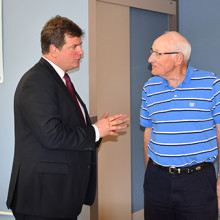
Dr. Montero-Odasso with study participant, Roy Bratty
“Finding methods to detect dementia early is vital to our ability to slow or halt the progression of the disease,” says Dr. Montero-Odasso. The study, funded by the Canadian Institutes of Health Research, followed participants for six years and included bi-annual visits. Researchers asked participants to walk while simultaneously performing a cognitively demanding task, such as counting backwards or naming animals. Those individuals with MCI that slow down more than 20 per cent while performing a cognitively demanding task are at a higher risk of progressing to dementia.
“While walking has long been considered an automatic motor task, emerging evidence suggests cognitive function plays a key role in the control of walking, avoidance of obstacles and maintenance of navigation,” says Dr. Montero-Odasso. “We believe that gait, as a complex brain-motor task, provides a golden window of opportunity to see brain function.”
The “gait cost,” or speed at which participants completed a single task (walking) versus a dual-task, was higher in those MCI individuals with worse episodic memory and who struggle with executive functions such as attention keeping and time management.
“Our results reveal a ‘motor signature’ of cognitive impairment that can be used to predict dementia,” adds Dr. Montero-Odasso. “It is conceivable that we will be able to diagnose Alzheimer’s disease and other dementias before people even have significant memory loss. Our hope is to combine these methods with promising new medications to slow or halt the progression of MCI to dementia.”
The study, “Association of Dual-Task Gait with Incident Dementia in Mild Cognitive Impairment”, was published in the journal, JAMA NEUROLOGY.
Image
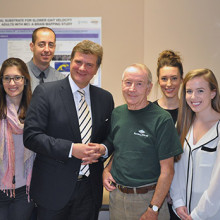
Members of the study’s research team, from left to right: Korbin Blue, Research Assistant (Co-op Student); Yanina Sarquis-Adamson, Lab Research Assistant; Frederico Faria, Post-Doctoral Fellow; Dr. Montero Odasso, Director, Gait and Brain Lab; research participant; Alanna Black, Lab Research Coordinator; Stephanie Cullen, Research Assistant (Undergraduate Student); and, Navena Lingum, Research Assistant (Master Student).
Scientist
Lawson cyclotron to produce new imaging agent that may better locate prostate cancer
Lawson Health Research Institute is the first in Canada to enter a sublicense agreement with The Centre for Probe Development and Commercialization (CPDC) to produce PSMA-1007, a new imaging agent that could help improve the detection of prostate cancer.
The radiopharmaceutical tracer can locate and bind to prostate specific membrane antigen (PSMA) – a protein on the surface of prostate cancer cells. This imaging agent makes the prostate cancer cells visible with PET/CT (positron emission tomography/computed tomography) imaging.
Dr. Glenn Bauman, a Radiation Oncologist at the London Regional Cancer Program at London Health Sciences Centre and Scientist with Lawson, has been involved in a number of research developments in PSMA PET/CT.
“Until now, a PET imaging agent called 18F-DCFPyL, was commonly used in research. More recently, we've been looking at a PET radiopharmaceutical called PSMA-1007 that may give us clearer pictures in the pelvis and the area of the prostate,” says Dr. Bauman, who is also a Professor of Oncology and Medical Biophysics at Western University’s Schulich School of Medicine and Dentistry.
Dr. Michael Kovacs, Director of the Lawson Cyclotron & PET Radiochemistry Facility at St. Joseph’s Health Care London, says the license means London will have a local supply of PSMA-1007 that is “more or less a magic bullet for prostate cancer cells.”
Radiopharmaceuticals decay quickly after production and so there is a need to produce them locally. Lawson’s cyclotron, which is housed at St. Joseph’s, is one of fewer than roughly two dozen facilities in Canada and delivers products to the GTA, Windsor and London.
“The cyclotron is a type of particle accelerator where we can accelerate particles called protons to high energy and fire them into a target that makes radioisotopes every day,” Dr. Kovacs explains. “The raw radioisotope is taken to the lab to synthesize PET radiopharmaceuticals, including PSMA imaging agents, before going through quality control.”
“Being able to produce PSMA-1007 locally is exciting, as outsourcing comes with logistical challenges if a production run fails or transportation fails,” explains says Dr. Bauman. “Having our own means of production is a real advantage to us as we conduct our research.”
CPDC, which holds the rights to produce PSMA-1007 in Canada, is already running a clinical trial in hopes of having it available in clinical settings. They expect to have study results in two to three years.
Early studies show the clearer images from PSMA-1007 may have the biggest impact in patients with a recurrence of prostate cancer who have already had treatment. The return of cancer can be very small and difficult to detect with conventional methods. In many of those cases, studies are finding a rise in PSMA levels can be an early signal of the cancer’s return, allowing for earlier diagnosis with PSMA PET.
Looking forward, PSMA-1007 has the potential to be used as a theranostic agent where by the isotope is used deliver radiation treatment directly to the cancer, but this application is likely many years away.
This is the part two of a three-part series on PSMA PET imaging research. Check out part one and three.