


Search
Search
898 Search Results:
… Page 2 PREAMBLE This document will summarize the retirement planning process for the Credentialed Professional Staff … Health Care London (St. Joseph’s) who wish to begin the planning of their impending partial or full retirement of … Chair/Chief time and opportunity for succession planning with the least disruption to patient care. The …
RREETTIIRREEMMEENNTT PPLLAANNNNIINNGG RREESSOOUURRCCEE GGUUIIDDEE FFOORR CCRREEDDEENNTTIIAALLEEDD PPRROOFFEESSSSIIOONNAALL SSTTAAFFFF at London Health Sciences Centre and St. Josephs Health Care London Developed by: Medical Affairs London, ON Page 2 PREAMBLE This document will summarize the retireme...
… Page 2 PREAMBLE This document will summarize the retirement planning process for the Credentialed Professional Staff … Health Care London (St. Joseph’s) who wish to begin the planning of their impending partial or full retirement of … Chair/Chief time and opportunity for succession planning with the least disruption to patient care. The …
RREETTIIRREEMMEENNTT PPLLAANNNNIINNGG RREESSOOUURRCCEE GGUUIIDDEE FFOORR CCRREEDDEENNTTIIAALLEEDD PPRROOFFEESSSSIIOONNAALL SSTTAAFFFF at London Health Sciences Centre and St. Josephs Health Care London Developed by: Medical Affairs London, ON Page 2 PREAMBLE This document will summarize the retireme...
… injury/concussion Students attending school, or those planning to return to school in the near future (secondary … injury/concussion Students attending school, or those planning to return to school in the near future (secondary …
Return to School (RTS) Group Program* Contact Who We Are Parkwood Institute Return to School (RTS) GROUP PROGRAM The RTS Group Program is facilitated by a Speech Language Pathologist (SLP) and is designed to meet the specific needs of students who are intending to return to studies or have already r...
Revolutionizing rehab
St. Joseph’s Health Care London is taking giant strides in the science of rehabilitation and movement, with direct benefit to patients.
St. Joseph’s is setting a long-time vision into motion.
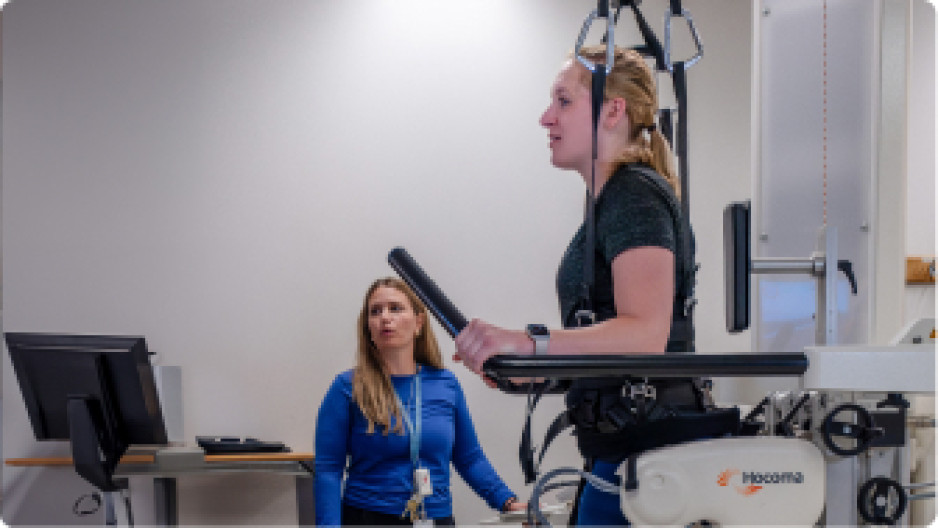
“Five years ago, we had a vision of leveraging our long history and expertise in providing innovative rehabilitation treatments to improve the lives of people with mobility needs on a larger scale,” says Roy Butler, President and CEO of St. Joseph’s Health Care London (St. Joseph’s). “That dream has come to life.”
While experts at St. Joseph’s had the knowledge, innovative spirit and passion to achieve the vision, they needed a partner who shared the same enthusiasm.
William and Lynn Gray answered that call. With their generosity and ground-breaking investment, The Gray Centre for Mobility and Activity was created.
“Lynne and I are very pleased with the steady forward advancement of the centre’s mission since its establishment just a few short years ago,” says Bill Gray. “The innovative thinking and idea generation that seeks new solutions to the issue of mobility have really taken root. We hoped that The Gray Centre would have an impact on care ... and it has.”
“We’ve watched the development of The Gray Centre with enormous pride and are pleased to have our name associated with it, and the excellence it stands for,” adds Lynne Gray.

A unique concept
Established in 2020, The Gray Centre at St. Joseph’s Parkwood Institute is a regional hub focused on researching leading-edge treatments and interventions in mobility and activity. The centre’s unique model of linking research and care allows researchers to work side-by-side with clinicians, patients, and caregivers to uncover optimal methods for maintaining mobility throughout a person’s life.
“Scientists at The Gray Centre are leading the way in integrating technology and solutions in care to better understand how we can enhance each patient’s treatment plan to improve their functionality and ability to move,” says Butler.
Pioneering Research
More than 50 ongoing rehabilitation research projects at Parkwood Institute are exploring areas such as spinal cord and traumatic brain injury rehabilitation, pain, outcomes for amputees, virtual exercise and cognitive behavioral therapy, gait analysis as a measure of dementia progression, and stroke rehabilitation and recovery.
The Gray Centre is a catalyst and connector for these projects by investing in cutting-edge technology, providing seed grants, embedding researchers from Western University, leveraging clinical expertise, attracting world-class researchers and translating new knowledge into clinical practice by training students and clinicians, and fostering sustainable practice change.
More than $1.3 million granted through St. Joseph’s Health Care Foundation has advanced work at The Gray Centre over the past year. From researcher support to new equipment such as two transcranial magnetic stimulators, a portable handheld ultrasound and several sensored mats for gait assessment donors have stepped up to advance this work.
Leadership with Purpose
At the helm of The Gray Centre is Siobhan Schabrun, PhD, a world-renowned neuroscientist and the inaugural William and Lynne Gray Research Chair in Mobility and Activity. Thanks to a partnership with Western University’s Faculty of Health Sciences and Schulich School of Medicine & Dentistry, donor funding for the chair made through St. Joseph’s Health Care Foundation was matched, creating a $5-million endowed position.
Schabrun’s innovative research benefits people suffering from chronic pain. With a focus on non-invasive brain stimulation techniques to enhance neuroplasticity and improve mobility and activity outcomes, she and her team are, in essence, retraining the brain’s pain response. This innovative work bridges the gap between neuroscience and rehabilitation, offering new hope for individuals with musculoskeletal and neurological conditions.
Originally trained as a physiotherapist with a PhD in neuroscience from the University of Adelaide in Australia, Schabrun has attracted more than $15 million in competitive research funding and written or contributed to more than 140 scholarly publications.
FLOATing Forwards

The newest advancement is a first-in-Canada and a marvel of medical engineering that is transforming options in rehabilitation research and practice.
The Reha-Stim Medtec FLOAT system at St. Joseph’s Parkwood Institute enables patients with mobility limitations to walk, supported, without fear of falling. They "float" in a controlled environment using a combination of robotics, body-weight support and real-time feedback. The device has a harness attached to a robotic arm, which adjusts the level of support based on the patient's movements. Sensors provide continuous feedback for maximum learning and greatest benefit to physical therapists and patients alike. The FLOAT system has shown significant improvements in patients' mobility, balance and overall functional independence.
“Innovative equipment like the new FLOAT System is an example of the type of innovation that does not exist anywhere else in Canada,” says Bill Gray. “The real-life application of technologies like this are what The Gray Centre is intended to be about.”
Through the combined efforts of dedicated professionals, cutting-edge technology and philanthropist partners, St. Joseph’s Gray Centre has combined vision with passion and is transforming lives, one step at a time.
Date: 1. Do you have any ALLERGIES to Medications? YES NO a. If YES, please list the medication and describe what happens? 2. Please list any prescription AND non-prescription medications you are taking now: Name Dose/Amount How Often a. b. c. d. e. f. g. h. i. j. k. 3. Do you take Calcium/Vitamin...
Rheumatology Infusion Room LOCATION AND HOURS The Rheumatology Infusion Room is located within the Rheumatology Clinic at St. Josephs Hospital: in Zone D, on Level 2. You will check in at the same reception area as when you see your rheumatologist. Hours of Operation: Monday to Friday (excluding sta...
… Working Group 6 5. Hospital commitment to accessibility planning 6 6. Recent barrier-removal initiatives 7 7. … (Appendix A). 5. Hospital commitment to accessibility planning At its meeting on 23 April 2003, the Joint ELT SLT … that the Hospital adopt the following Accessibility Planning Policy: LHSC and SJHC are committed to the …
Annual Accessibility Plan regarding ONTARIANS WITH DISABILITIES ACT for the St. Josephs Health Care, London September 2003 - August 2004 Submitted to Cliff Nordal Chief Executive Officer 30 September 2003 Prepared by Nick Kokkoros Facilitator Accessibility Working Group This publication is available...
… Working Group 6 5. Hospital commitment to accessibility planning 7 6. Recent barrier-removal initiatives 7 7. … Group. Derek Lall, Senior Project Consultant, Facilities Planning and Development, is the Co-ordinator of the SJHC … Working Group Member Department Derek Lall Facilities Planning and Development Purvi Desai Facilities Management …
Annual Accessibility Plan for the St. Joseph Health Care, London September 2004 - August 2005 Submitted to Cliff Nordal Chief Executive Officer 30 September 2004 Prepared by SJHC Accessibility Working Group Co-ordinator, Derek Lall This publication is available on the hospitals website and in altern...
CARING FOR THE BODY, MIND & SPIRIT SINCE 1869 Renowned for compassionate care, St. Joseph's is one of the best academic health care organizations in Canada dedicated to helping people live to their fullest by minimizing the effects of injury, disease and disability through excellence in care, teachi...
… be notified to ensure a consistent and organized action planning. • ENS 2 is immediately activated for Code Green, … be notified to ensure a consistent and organized action planning. • ENS 2 is immediately activated for Code Green, …
~ SIJOSEPHs HEALTH CARE LONDON CORPORATE Procedure: SEVERE WEATHER Owner of Procedure: Emergency Management and Risk Specialist Approval by: Emergency Management Committee Date: 2022-06-02 Original Effective Date: 2021-05-03 Reviewed Date(s): 2022-05-27 Revised Date(s): 2022-05-27 PURPOSE Adverse or...
… in thinking abilities: Difficulty with memory, attention, planning ahead, reasoning and imagining can also affect … in thinking abilities: Difficulty with memory, attention, planning ahead, reasoning and imagining can also affect …
Parkwood Institute Main Building Sexual Health after a Brain Injury This pamphlet contains information for patients living with a brain injury, including: How sexual health may be affected after a brain injury How to cope with changes to sexual health following a brain injury Tips for being sexua...
Parkwood Institute Main Building Sexual Health After Stroke Sexual Health After Stroke Stroke Rehabilitation Program Page 2 You can do it, we are here to help! Sex and sexuality are important parts of being human. After having a stroke, many things can change. The way in which you experience your bo...
Parkwood Institute Main Building Sexual Health After Stroke Sexual Health After Stroke Stroke Rehabilitation Program Page 2 You can do it, we are here to help! Sex and sexuality are important parts of being human. After having a stroke, many things can change. The way in which you experience your bo...
Sick Day Management for People with Type 1 Diabetes When you are unwell, managing your glucose levels can be a challenge. Be prepared and know how to manage your diabetes when you are sick. Important reminders 1. Take diabetes medication as usual. Insulin treatment should never be stopped. If you ar...
Sick Day Management for People with Type 1 Diabetes When you are unwell, managing your glucose levels can be a challenge. Be prepared and know how to manage your diabetes when you are sick. Important reminders 1. Take diabetes medication as usual. Insulin treatment should never be stopped. If you ar...
Sick Day Management for People with Type 2 Diabetes When you are unwell, managing your glucose levels can be a challenge. Be prepared and know how to manage your diabetes when you are sick. Important reminders 1. Check your glucose level every 4 hours or as recommended by your health care team. Targ...
Sick Day Management for People with Type 2 Diabetes When you are unwell, managing your glucose levels can be a challenge. Be prepared and know how to manage your diabetes when you are sick. Important reminders 1. Check your glucose level every 4 hours or as recommended by your health care team. Targ...
Simple CT scanning procedure can predict effectiveness of ovarian cancer treatment
Technology developed at Western University and Lawson Health Research Institute can provide a new window into whether or not patients are responding to treatment for advanced ovarian cancer. A multi-centre clinical trial has demonstrated that CT Perfusion, which measures blood flow and blood volume to tumours associated with ovarian cancer, can provide an accurate prediction of how well a treatment is working, allowing physicians the opportunity to better plan treatment. Funding for the trial was provided by the US National Cancer Institute through the National Clinical Trials Network including NRG Oncology and ECOG-ACRIN.
“CT perfusion is homing into the change in blood flow to the tumour before and after treatment,” said Ting-Yim Lee, professor at Western University’s Schulich School of Medicine & Dentistry, scientist at Lawson Health Research Institute, and a Medical Physicist at St. Joseph’s Health Care London. “In this particular case we can see that blood flow tends to decrease in those who will survive longer without symptoms, whereas for those whose symptoms will recur within six months, we saw blood flow to the tumour increase after their treatment.”
The study was published in the journal, Clinical Cancer Research. Its authors point out that in 60 to 85 per cent of ovarian cancer patients, relapse will occur after initial treatment. By using CT perfusion to identify which patients are more likely to benefit from a specific therapy enables better patient selection and treatment planning, and also provides a biomarker for future clinical trials assessing new treatment options. The authors also point out that although the trial is promising, further studies are required to corroborate the current findings.
“Using this method we are able to see a change in the blood flow as early as four weeks after treatment. This means we don’t have to wait months to determine whether symptoms will recur, we are able to tell whether the treatment is effective much sooner,” said Lee.
Developed by Lee and his team at Western University’s Robarts Research Institute, CT perfusion uses X-ray dye in combination with existing CT scanners to measure blood flow. The technology is already used globally to assess blood flow to the brain after stroke. This clinical trial for use in ovarian cancer took place across 19 U.S. centres, and also demonstrated that the technology is easily implemented onto any existing CT scanner, and requires minimal training to be successful.
Scientist
EXPECTATIONS OF SINUS SURGERY INTRODUCTION The majority of patients will experience significant improvement in their sinus symptoms after surgery. However, it takes time for the body to heal. While some patients may notice improvement immediately following surgery, others may take weeks before they ...
… discrete steps: Step 1: The first step is pre-operative planning. This involves discussion between the patient and … discrete steps: Step 1: The first step is pre-operative planning. This involves discussion between the patient and …
SINUS TUMORS INTRODUCTION A tumor is a mass or growth. Tumors of the nose and paranasal sinuses are rare. They represent less than 1% of all tumors. These lesions can be either benign (non-cancerous) or malignant (cancerous). They vary in location, size and type. The care for a patient with a sinona...