


Search
Search
719 Search Results:
… 22ND & 23RD, 2019 HAND AND UPPER LIMB SYMPOSIUM SURGERY & REHABILITATION OF THE UPPER LIMB: Back t o Basics NOVEMBER … This 2 day symposium for health professionals will focus on rehabilitation of the elbow, wrist and hand. Roth McFarlane … 15:00 Management of Peripheral Nerve Injuries: surgery to rehabilitation Dr.Doug Ross, Dr. Tom Miller & Juliana …
November 22ND & 23RD, 2019 HAND AND UPPER LIMB SYMPOSIUM SURGERY & REHABILITATION OF THE UPPER LIMB: Back t o Basics NOVEMBER 22ND & 23RD, 2019 SYMPOSIUM DESCRIPTION This 2 day symposium for health professionals will focus on rehabilitation of the elbow, wrist and hand. Roth McFarlane Hand & Upper L...
Exploring mobile software to better support youth mental health
Mental health services are rooted in relationships. When it comes to delivery, and specifically community-based and outpatient services, connection and communication between the individual and care provider need to be the focus.
When we think of youth in particular, technology is a regular form of communication for them.
“Our research team at Lawson is looking at how technology can assist in the delivery of mental health services for youth in a way that still supports the important components of treatment,” says Dr. Cheryl Forchuk, Assistant Scientific Director at Lawson. “In our work with youth, they’ve talked about wanting the technology they are already using integrated into their care.”
In the health care sector, the use of technology needs to be carefully tested and implemented, to ensure it is not only meeting the needs of those using it but also that it complies with the standards for privacy and security.
On February 7, 2019, Lawson Health Research Institute and InputHealth welcomed community members and stakeholders for the announcement of a new health care technology solution that is being researched by Dr. Forchuk and her team, with generous contributions from the provincial government.
TELEPROM-Y is a mobile-based TELEMedicine and Patient-Reported Outcome Measurement Youth study aiming to improve access to specialized services and reduce inpatient mental health admissions for youth. The initiative is one of 11 that received funding from Ontario’s second round of the Health Technologies Fund (HTF), a program of the Ontario Ministry of Health and Long-Term Care administered by Ontario Centres of Excellence.
TELEPROM-Y received $395,109 in provincial funding with $494,630 in matching contributions for a total investment of $889,739.
InputHealth’s CEO Damon Ramsay and Chief Medical Officer Puneet Seth, along with Jennifer Moles from the Ontario Centres of Excellence were on hand with Dr. Cheryl Forchuk to hear more about how the technology and funding will help support youth. Project contributors Woodstock General Hospital and Youth Opportunities Unlimited (Y.O.U.) also attended the announcement.
This project is taking a unique approach to creating connections with youth. Researchers will use an electronic Collaborative Health Record (CHR) developed by InputHealth, an innovative Canadian digital health software company, which allows for secure communication. Patients will have access to virtual visits, prompts and reminders, text or email messages, and educational materials delivered by phone.
Image
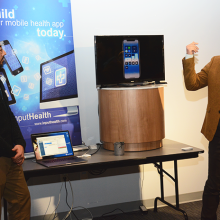
InputHealth's Puneet Seth and Damon Ramsay provided a demonstration of the software being used in the study.
Dr. Forchuk explains that “the study is focusing on an important transitional period. The majority of mental illnesses occur between the ages of 16 to 25 years old.” The research team is recruiting participants between these ages who have symptoms of anxiety and/or depression, and are receiving outpatient services from a hospital-based mental health care program at London Health Sciences Centre, St. Joseph’s Health Care London and Woodstock General Hospital, or community-based services from partner organizations.
A key aspect is to assess whether the technology is effective and efficient, while acceptable to both the staff and youth using the app.
“Careful evaluation is essential to make sure we are doing the right things for the people we serve,” adds Dr. Forchuk, who is also the Beryl and Richard Ivey Research Chair in Aging, Mental Health, Rehabilitation and Recovery.
Image

The mobile software will also be evaluated on its ability to improve the ease of access to care; monitor mood and behaviour changes for earlier intervention; enhance information exchange between patient and health care provider; and, support the overall experience for the youth.
Other project contributors include St. Michael’s Hospital Centre for Excellence in Economic Analysis Research, The Forge (McMaster University), Thunder Bay Regional Health Sciences Centre and Western University.
The study extends previous findings from the Youth Mental Health Engagement Network study (Y-MHEN), which developed, delivered and evaluated an interactive web-based personal health record, the Lawson SMART Record (LSR), to assist mental health patients in managing their care and connecting with care providers.
The Health Technologies Fund is a program of the Ontario Ministry of Health and Long-term Care and is administered by the Ontario Centres of Excellence. Program supports the development of made in Ontario health technologies by accelerating evaluating, procurement, adoption and diffusion within the Ontario health system.
Scientist
… and Immunology Program • Breast Care Program • Cardiac Rehabilitation and Secondary Prevention Program • … Program (including: Asthma Centre, COPD and Pulmonary Rehabilitation Program, Pulmonary Function Lab, General … - Complex Care Unit - Veterans Care Units - Southwestern Rehabilitation - Palliative Care Unit - Veterans Arts …
Care Matters Here. Learn More. sjhc.london.on.ca BODY | MIND | SPIRIT Leena Justus Registered Nurse Mount Hope Centre for Long Term Care Renowned for compassionate care, St. Josephs is one of the best academic health care organizations in Canada, dedicated to helping people live their fullest by mi...
… and Immunology Program • Breast Care Program • Cardiac Rehabilitation and Secondary Prevention Program • … and outpatient care including assessment, treatment and rehabilitation for individuals with a mental illness who … J. HOBBINS BUILDING WESTERN COUNTIES WING NEUROBEHAVIOURAL REHABILITATION CENTRE Beds …
Leena Justus Registered Nurse Mount Hope Centre for Long Term Care St. Josephs provides exceptional care, earning the complete confidence of those we serve. Your care matters here. Renowned for compassionate care, St. Josephs is one of the best academic health care organizations in Canada, dedicated...
… Referral to: CARDIAC REHABILITATION & SECONDARY PREVENTION PROGRAM 268 Grosvenor … CLINICIAN: REFERRAL EVENT: PLEASE INDICATE THE CARDIAC REHABILITATION SITE: NS5255 (Rev. 20112/12/19) NAME: … Referral to: CARDIAC REHABILITATION & SECONDARY PREVENTION PROGRAM 268 Grosvenor …
Referral to: CARDIAC REHABILITATION & SECONDARY PREVENTION PROGRAM 268 Grosvenor Street, Room B3-689, London, ON N6A 4V2 Telephone: 519-667-6704 / Fax: 519-667-6532 POINT OF REFERRAL: REFERRING CLINICIAN: REFERRAL EVENT: PLEASE INDICATE THE CARDIAC REHABILITATION SITE: NS5255 (Rev. 20112/12/19) NAME...
… 3 of 38 redevelopment to accommodate the consolidation of rehabilitation services, in addition to other significant … Cardiology, and Endocrinology moves – Dec. 2001 - Adult Rehabilitation to SJHC – Feb. 2002 - Medicine (Phase 1 - 25 … spectrum of services including: acute ambulatory care; rehabilitation; tertiary and forensic mental health care; …
Page 1 of 38 Financial Statements of St. Josephs Health Care, London Year ended March 31, 2004 Growing a healthy community through care, teaching and research St. Josephs Health Care, London Financial Statements Page 1 of 38 MMeessssaaggee ffrroomm DDaawwnn BBuuttlleerr TTrreeaassuurreerr ooff tthhe...
… London and region for certain ambulatory care, day surgery, rehabilitation, complex care, long-term and veterans care, … London and region for certain ambulatory care, day surgery, rehabilitation, complex care, long-term and veterans care, …
St. Josephs Health Care, London Financial Statements Financial Statements of ST. JOSEPHS HEALTH CARE, LONDON Year ended March 31, 2005 St. Josephs Health Care, London Financial Statements Management's Report The accompanying financial statements of St. Josephs Health Care, London have been prepared ...
… London and region for certain ambulatory care, day surgery, rehabilitation, complex care, long-term and veterans care, … London and region for certain ambulatory care, day surgery, rehabilitation, complex care, long-term and veterans care, …
St. Josephs Health Care, London Financial Statements Financial Statements of ST. JOSEPHS HEALTH CARE, LONDON Year ended March 31, 2006 St. Josephs Health Care, London Financial Statements Management's Report The accompanying financial statements of St. Josephs Health Care, London have been prepared ...
… London and region for certain ambulatory care, day surgery, rehabilitation, complex care, long-term and veterans care, … London and region for certain ambulatory care, day surgery, rehabilitation, complex care, long-term and veterans care, …
St. Josephs Health Care, London Financial Statements Financial Statements of ST. JOSEPHS HEALTH CARE, LONDON Year ended March 31, 2007 St. Josephs Health Care, London Financial Statements Management's Report The accompanying financial statements of St. Josephs Health Care, London have been prepared ...
… London and region for certain ambulatory care, day surgery, rehabilitation, complex care, long-term and veterans care, … London and region for certain ambulatory care, day surgery, rehabilitation, complex care, long-term and veterans care, …
St. Josephs Health Care, London Financial Statements Financial Statements of ST. JOSEPHS HEALTH CARE, LONDON Year ended March 31, 2009 1 St. Josephs Health Care, London Financial Statements Management's Report The accompanying financial statements of St. Josephs Health Care, London have been prepare...
… London and region for certain ambulatory care, day surgery, rehabilitation, complex care, long-term and veterans care, … London and region for certain ambulatory care, day surgery, rehabilitation, complex care, long-term and veterans care, …
St. Josephs Health Care, London Financial Statements Financial Statements of ST. JOSEPHS HEALTH CARE, LONDON Year ended March 31, 2011 St. Josephs Health Care, London Financial Statements original signed original signed MANAGEMENTS REPORT The accompanying financial statements of St. Josephs Health C...
… London and region for certain ambulatory care, day surgery, rehabilitation, complex care, long-term and veterans care, … London and region for certain ambulatory care, day surgery, rehabilitation, complex care, long-term and veterans care, …
St. Josephs Health Care, London Financial Statements Financial Statements of ST. JOSEPHS HEALTH CARE, LONDON Year ended March 31, 2012 St. Josephs Health Care, London Financial Statements original signed original signed MANAGEMENTS REPORT The accompanying financial statements of St. Josephs Health C...
… London and region for certain ambulatory care, day surgery, rehabilitation, complex care, long-term and veterans care, … London and region for certain ambulatory care, day surgery, rehabilitation, complex care, long-term and veterans care, …
St. Josephs Health Care London Financial Statements Financial Statements of ST. JOSEPHS HEALTH CARE LONDON Years ended March 31, 2013 and 2012 St. Josephs Health Care London Financial Statements 1 | P a g e original signed original signed MANAGEMENTS REPORT The accompanying financial statements of S...
… London and region for certain ambulatory care, day surgery, rehabilitation, complex care, long-term and veterans care, … London and region for certain ambulatory care, day surgery, rehabilitation, complex care, long-term and veterans care, …
St. Josephs Health Care London Financial Statements Financial Statements of ST. JOSEPHS HEALTH CARE LONDON Year ended March 31, 2014 St. Josephs Health Care London Financial Statements 1 | P a g e original signed original signed MANAGEMENTS REPORT The accompanying financial statements of St. Josephs...
… care, complex care and veterans care, long-term care, rehabilitation and specialized geriatrics and specialized … care, complex care and veterans care, long-term care, rehabilitation and specialized geriatrics and specialized …
1 News Release St. Josephs Health Care, London reports success on overall budget for last fiscal year and signals continued financial challenges for next two years - New board of directors appointed: Dr. Gerald Killan takes the reigns as board chair St. Josephs Health Care Foundation has most succes...
… provides a wide spectrum of services, including acute care, rehabilitation, tertiary and forensic mental health, complex … of $3.1 million, due primarily to Ophthalmology and Rehabilitation. The full impact of this will not be felt … – ENT, Cardiology, and Endocrinology moves – Dec. 2001 – Rehabilitation move to SJHC – Feb. 2002 On top of mergers, …
FINANCIAL STATEMENTS OF ST. JOSEPHS HEALTH CARE, LONDON Year ended March 31, 2002 Cover photo (left to right) Fay Beaton, Chair, Family Advisory Council and Member, Patient and Family Services Planning Team; Tobi Flanagan, Occupational Therapist, Geriatric Psychiatry and Member, Geriatric Psychiatry...
… of redevelopment to accommodate the consolidation of rehabilitation services, in addition to other significant … a broad spectrum of services, including acute care, rehabilitation, tertiary and forensic mental health care, … – ENT, Cardiology, and Endocrinology moves – Dec. 2001 – Rehabilitation move to SJHC – Feb. 2002 Exhibit 1 Milestone …
FINANCIAL STATEMENTS OF ST. JOSEPHS HEALTH CARE, LONDON | Year ended March 31, 2003 Visit our web site: www.sjhc.london.on.ca Financial Statements of St. Josephs Health Care, London Year ended March 31, 2003 St. Josephs Health Care, London (SJHC) is a very complex organization. Reflective of the sig...
First clinical guidelines in Canada for pain following spinal cord injury
Researchers at Lawson Health Research Institute are the first in Canada to develop clinical practice guidelines for managing neuropathic pain with patients who have experienced a spinal cord injury (SCI).
Neuropathic pain is complex and chronic, and is the most common complication reported by people following SCI. The research team worked with care providers at Parkwood Institute, part of the St. Joseph’s Health Care London family, and an international panel to address the complex and unique challenges for managing pain during recovery and rehabilitation.
In 2003, Dan Harvey sustained a spinal injury after falling off a trampoline. Using his personal experience, as well as his experiences meeting with newly injured people, Harvey contributed to the development of the new guidelines.
“Neuropathic pain – and pain in general – affects every person with a spinal cord injury very differently. Some people have it, some people don’t. But for those who do have it, it can make rehabilitation and recovery much more difficult,” explains Harvey.
“On top of just learning how to use your body again, you also have to deal with various forms of physical pains, which can make it challenging to mentally adapt to an injury.”
For those with chronic pain, it may be hard to just get out of bed in the morning, feel well enough to leave the house, or even fall asleep. “I have fairly extensive neuropathic pain, so I’m well aware of how difficult it can be to get a full night’s sleep, or show attentiveness at work or at school when it literally feels like your legs are on fire,” says Harvey.
Image
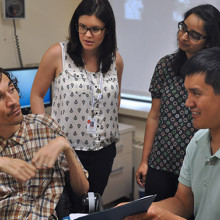
Dan Harvey with Lawson researchers Stacey Guy, Swati Mehta and Dr. Eldon Loh.
Dr. Eldon Loh, Lawson Researcher and Physical Medicine and Rehabilitation Specialist at St. Joseph’s, and his team recognized that pain can be an overlooked part of a spinal cord injury and plays a major factor in the success of rehabilitation. It’s difficult for someone in pain to participate fully in their own recovery, and so long-term disability becomes more likely. Pain is difficult to manage and it often takes multiple approaches to find something that works for each person.
“This is a starting point for us to standardize how we approach pain in the clinic. We have identified gaps and offered recommendations to not only manage the pain, but also ensure that our patients can fully benefit from rehabilitation,” says Dr. Loh.
The results of the three-year process led to recommendations for screening and diagnosis, treatment and models of care. Important clinical considerations accompany each recommendation.
“For those in hospital following an injury, it’s about making sure they can be as independent as possible before discharge. Over time, we want to keep pain levels under control so that they are able to live life to the fullest,” adds Dr. Loh.
The research will inform new tools and resources for care providers and patients.
Harvey believes the guidelines will have a tremendous impact for patients whose pain may have been overlooked. “Pain can be created through many different avenues and the effects can snowball after a person is discharged and sent home. If you don’t check all of the boxes, you might be missing a very important item.”
The new guidelines have been published in the international journal Spinal Cord. The Ontario Neurotrauma Foundation and Rick Hansen Institute provided funding for the research study.
A special thanks to individuals from St. Joseph's who were involved in the project: Steve Orenczuk, Patrick Potter, Keith Sequiera, Lindsey Guilbault, Robert Teasell, Anna Kras-Dupuis, Dalton Wolfe, Alba Casalino and Dwight Moulin.
Image
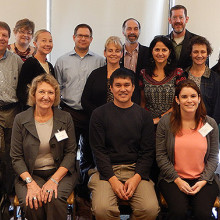
Additional members of the panel that developed the new clinical practice guidelines.
First-in-North-America resource touts health benefit of fermented foods
New network helps consumers, researchers and food industry find and share trusted information about ‘ferment-ceuticals’
London (Ont.) – A one-stop network, the first of its kind in North America, has begun sharing easily digested research, recipes and other resources about the health benefits of fermented foods.
The new Canadian Fermented Foods Initiative (CFFI) launches officially on Nov. 17 with a gathering of research and industry experts from across the country and Europe.
The collaboration helps consumers, researchers, health professionals and food industry share trusted, science-based expertise and information about fermented foods.
Funded by the Weston Family Foundation, the initiative is led by Jeremy Burton, PhD, who heads of one of Canada’s largest microbiome research programs and is Interim Vice President Research at St. Joseph’s Health Care London and Lawson Research Institute. His research leadership is joined by Raylene Reimer, PhD, professor of nutrition at the University of Calgary; and University of Alberta professor Ben Willing, PhD, former Canada Research Chair in Microbiology of Nutrigenomics.
Fermented foods such as sourdough bread, sauerkraut, kimchi and kombucha offer more than just good taste and an economical way to preserve food, Burton says. Large, population-based studies show people who eat fermented foods are generally healthier, with fewer digestive issues and lower risk of chronic diseases.
“How exactly does that work – and why? Well, that’s the big question we’re trying to solve,” Burton says. “One day, I believe, ‘ferment-ceuticals’ will be engrained in our diets and our health vocabulary.”
St. Joseph's is a leader in the field. A paper authored by the team and published this week in Advances in Nutrition represents the most comprehensive synthesis to date of research on fermented foods and human health.
Connor Flynn, a London, Ont., chef, master food preserver and high school teacher whose video recipes are included in the CFFI website, adds, “Fermenting foods is an old practice that’s never fallen out of flavour, but has sometimes fallen out of favour to North Americans. Now it has become popular again.”
To learn more about the CFFI, including fermented food recipes and the chef behind them, head to fermentedfoods.ca.
- 30 -
To arrange interviews with CFFI project lead Jeremy Burton and chef Connor Flynn, who are available Friday Nov. 14 from 7 am – 8 am ET and Nov. 14 from 1 – 4 pm ET, contact:
Deb (Flaherty) Van Brenk, Communication Consultant
St. Joseph’s Health Care London
@email
About St. Joseph’s Health Care London
Renowned for compassionate care, St. Joseph’s Health Care London is a leading academic health care centre in Canada dedicated to helping people live to their fullest by minimizing the effects of injury, disease and disability through excellence in care, teaching and research. Through Lawson Research Institute, our innovation arm, and with collaborative engagement with other health and academic partners, St. Joseph’s has become an international leader in the areas of: chronic disease management; medical imaging; specialized mental health care; rehabilitation and specialized geriatrics; and surgery. St. Joseph’s operates through a wide range of hospital, clinic and long-term and community-based settings, including: St. Joseph’s Hospital; Parkwood Institute; Mount Hope Centre for Long Term Care; and the Southwest Centre for Forensic Mental Health Care.
For Researchers
HULC publishes high-impact clinical research and trains the next generation of clinicians and researchers, to improve management of painful, disabling conditions affecting the arm/hand. Our research leads to new devices, treatments and processes for managing injuries (like fractures and work injuries) or diseases (like arthritis and osteoporosis) that impair the function of the person, their arm and/or hand See links on this page for outputs and summaries of this work, and work in progress. We conduct:
- Measurement of patient outcomes and perspectives
- Clinical trials of new surgery and rehabilitation interventions
- Studies identifying the predictors of health and work outcomes
Learn more about research studies from the HULC clinical research lab:
- Outcome measures
- Tools and Products of Research
- Patient program
- COVID-19 project
- Training Resources
- Open Access Publications
- Lay Summaries
- Past Study Reports
- Media
- Presentations
- Item Perspective Classification framework (IPC) Information Site