


Search
Search
719 Search Results:
… Parkwood Institute Access Referral Form pg 2 REHABILITATION GOALS FUNCTION I=Independent S=Supervision … Language of Preference Cultural Preferences: client phone: REHABILITATION GOALS PROPOSED DISCHARGE PLAN: Alpha FIM … Parkwood Institute Access Referral Form pg 2 REHABILITATION GOALS FUNCTION I=Independent S=Supervision …
Language of Preference / Cultural Preferences: Smoke free policy has been reviewed with patient Most recent/updated progress notes available in Cerner (if no, please send) History & Physical notes updated in Cerner (if no, please send ower or Attorney for Personal Care (if not in place identify SDM ...
… Parkwood Hospital Driving Assessment and Rehabilitation Program 801 Commissioners Road East London, … situations �� Slow processing and reaction time A driver rehabilitation evaluation will examine the strengths and … difficulty, a driver evaluation may be indicated. A driver rehabilitation specialist can provide a comprehensive …
Parkwood Hospital Driving Assessment and Rehabilitation Program 801 Commissioners Road East London, Ontario N6C 5J1 Phone: (519) 685-4070 Fax: (519) 685-4576 DRIVING AND SPINA BIFIDA Spina bifida is a congenital defect in which part of one or more vertebrae (the bone structure that surrounds the spi...
… Parkwood Hospital Driving Assessment and Rehabilitation Program 801 Commissioners Road East London, … in the vehicle being considered prior to purchase. A driver rehabilitation specialist can provide recommendations for … all vans are not suitable for modifications. A driver rehabilitation specialist can assist in making the correct …
Parkwood Hospital Driving Assessment and Rehabilitation Program 801 Commissioners Road East London, Ontario N6C 5J1 Phone: (519) 685-4070 Fax: (519) 685-4576 DRIVING AFTER A SPINAL CORD INJURY After a spinal cord injury has occurred, a person is no longer able to drive an automobile in the normal ma...
… says Kerrie Dewachter, Coordinator of the Treatment and Rehabilitation Program. “Their clinicians can even hop on … says Kerrie Dewachter, Coordinator of the Treatment and Rehabilitation Program. “Their clinicians can even hop on …
SPRING 2023 A publication of St. Josephs Health Care London A Space to Call Home All faiths and spiritual practices are welcome in a new multi-faith room at Mount Hope Centre for Long Term Care. 2 A publication of St. Josephs Health Care London Spring 2023 | Issue 07 CONTRIBUTORS Dahlia Reich Alliso...
… Specialized Hospital Services: Schedule G Cardiac Rehabilitation Provincial Resources Bone Marrow Transplant … Health Care, London Visits Mental Health Inpatient Days Rehabilitation Total Acute Activity, incl. Inpatient and Day … Abuse Conditions Percent of stroke patients discharged to rehabilitation Percent of stroke patients managed on a …
H-SAA Amending Agreement #2 for 11/12 v1 Sept 22 Page 1 2008-2012 H-SAA AMENDING AGREEMENT # 2 THIS AMENDING AGREEMENT (the Agreement) is made as of the 1st day of April, 2011 B E T W E E N: SOUTH WEST LOCAL HEALTH INTEGRATION NETWORK (the LHIN) AND St. Joseph's Health Care, London (the Hospital) WH...
… Institute, Mental Health Care Building Neuro- behavioral Rehabilitation Centre Southwest Centre for Forensic Mental … Institute, Mental Health Care Building Neuro- behavioral Rehabilitation Centre Southwest Centre for Forensic Mental …
Student Placement Checklist CARING FOR THE BODY, MIND & SPIRIT SINCE 1869 Renowned for compassionate care, St. Josephs is one of the best academic health care organizations in Canada dedicated to helping people live to their fullest by minimizing the effects of injury, disease and disability through...
… London and region for certain ambulatory care, day surgery, rehabilitation, complex care, long-term and veterans care, … London and region for certain ambulatory care, day surgery, rehabilitation, complex care, long-term and veterans care, …
St. Josephs Health Care London Financial Statements Financial Statements of ST. JOSEPHS HEALTH CARE LONDON Year ended March 31, 2016 St. Josephs Health Care London Financial Statements 1 | P a g e original signed original signed MANAGEMENTS REPORT The accompanying financial statements of St. Josephs...
… within limits, as identified by progress made during rehabilitation and outlined by surgeon and physical … within limits, as identified by progress made during rehabilitation and outlined by surgeon and physical …
Total Shoulder Arthroplasty Protocol Precautions Precautions should be implemented for the first 12 weeks postoperatively unless surgeon specifically advises patient or therapist differently: Avoid strengthening activities of the rotator cuff to protect the subscapularis tendon detachment and subse...
Standing up to falls
By merging world class care with research and artificial intelligence, St. Joseph’s Health Care London is catching falls before they happen.
They wreak havoc on independence and well-being, making them one Canada’s most pressing health challenges: falls.
A leading cause of injury-related hospitalizations, even death, among older adults, a fall can happen anytime, anywhere – with 50 per cent occurring at home. But what if we could predict and prevent falls before they happen?
A pioneering initiative at St. Joseph’s Health Care London (St. Joseph’s) is doing just that. The 3FM Clinic, short for Falls, Fractures, Frailty and Mobility, at St. Joseph’s Parkwood Insitute is at the leading edge of falls prevention in Canada, integrating research with clinical practice to offer hope and practical solutions to older adults.
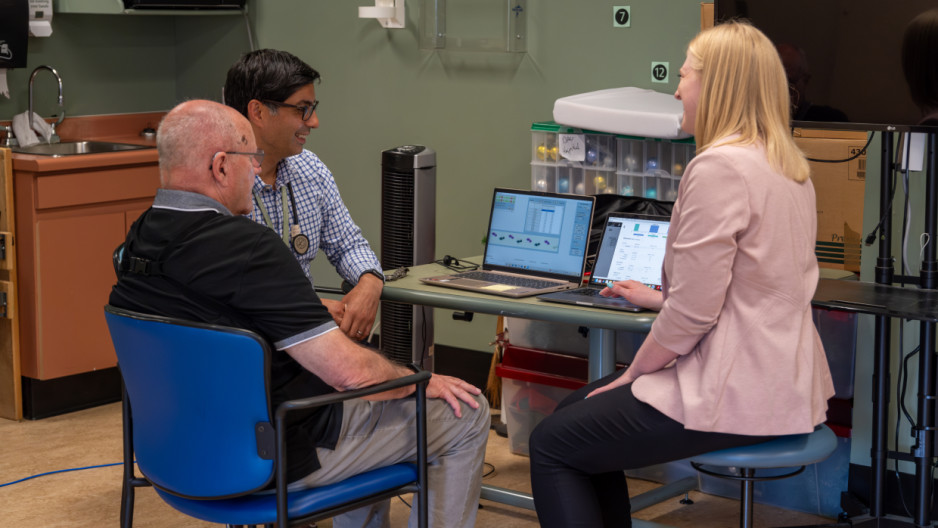
Led by St. Joseph’s geriatrician Dr. Jaspreet Bhangu and Western University rehabilitation scientist and physiotherapist Janelle Unger, PhD, the visionary 3FM Clinic is working to prevent falls before they happen.
“We know there are a number of factors that can cause an older adult to fall such as illness, medication side effects, balance and gait issues, cognitive impairment, visual changes and environmental hazards,” says Bhangu. “What we’re working to understand is how those factors together impact individual patients and their risk of falling.”
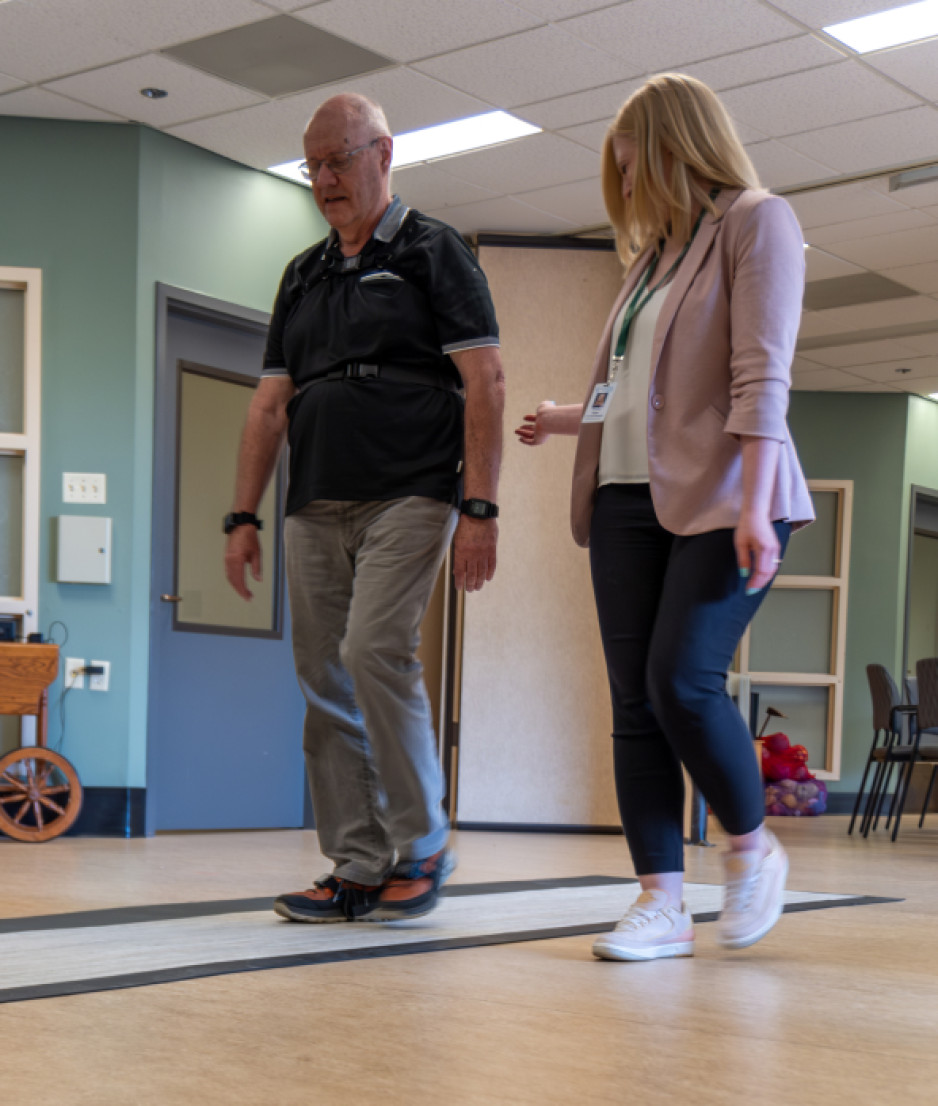
To do so, the 3FM Clinic team – one of the largest, most diverse teams of its kind in the country – completes a multi-step evaluation of patients:
- Nurses gather their medical history, current medications, functional abilities and personal goals.
- Physical therapists measure the patient’s gait (how they walk) and balance to understand their physical capabilities.
- Occupational therapists test their vision, cognitive function and identify issues that might hinder the individual’s ability to perform routine tasks safely.
- A geriatrician focuses on medical risk factors such as bone health, medications and cardiovascular health to help manage risks associated with aging. The team then creates a customized care plan that incorporates exercises, therapeutic interventions and educational strategies.
On the research side, Unger and her team in the RED Neuro Lab at St. Joseph’s Gray Centre for Mobility and Activity are leveraging artificial intelligence (AI) to predict falls more accurately.
“Traditional fall prediction models often rely on limited data and lack real-world input from clinicians and patients,” explains Unger. “By partnering with Bhangu and the clinical team, as well as the patients in the 3FM Clinic, we’re able to integrate clinical information with biomechanical data collected from wearable sensors known as inertial measurement units (IMUs).”
An IMU is a device that tracks and measures a person’s movement and orientation and provides valuable data on how that person moves and stays stable.
“We plan to use AI to analyze the data collected through the IMU’s and are working to create accurate fall prediction models,” says Unger. “This research, funded by Western’s Bone and Joint Institute, has the potential to improve care decisions, enhance preventive strategies and ultimately reduce the incidence of fall-related injuries and hospitalizations for our patients and people across the globe.”
By embracing innovative research and compassionate care, the 3FM Clinic is a model for future efforts in fall prevention and geriatric care, offering a safer, more independent future for older adults.
You can prevent falls too:
- Use assistive devices: Properly fitted walkers or canes provide essential support and stability.
- Fitted footwear: Shoes (not slippers or flip-flops) with appropriate tread and low heels help prevent slips and falls. They should also fit your feet.
- Home improvements: Improved lighting, clear walkways and assistive bathroom fixtures.
- Exercise: Participate in strength and balance exercises to enhance physical fitness.
- Medication reviews: Regularly have your medications reviewed to identify if you are at risk of falling.
Stephanie Marrocco recognized for exceptional student leadership
Stephanie Marrocco is the 2020 recipient of the Leadership Award for Fellows and Students. She is a PhD candidate working with Dr. Dalton Wolfe, at Parkwood Institute, a part of St. Joseph’s Health Care London. Her doctoral research focuses on practice patterns of physiotherapists to determine which practices are associated with the best possible outcomes in persons with spinal cord (SCI) and acquired brain injury (ABI). Her work involves mobilizing physiotherapists, hospital leadership, and researchers towards greater collaboration.
Marrocco is an invaluable part of her lab, helping to develop and implement experiential learning opportunities for Health Studies and Kinesiology students as well as mentoring students one on one. “She is an exceptional leader in all that she does, and is very deserving of this award,” says Dr. Cheryl Forchuk, Lawson Scientist and Marrocco’s nominator.
The Research 2 Practice (R2P) team at Parkwood Institute is endeavoring to establish a new model for the way research teams operate within a clinical environment. This involves embedding the team within the hospital and integrating research with clinical and teaching activities using implementation science and practice-based research methods. “Marrocco has been a true innovator in working alongside myself in developing this approach and has been integral in implementing this model. I was honoured to support her nomination,” says Dr. Wolfe, Lawson Scientist.
Marrocco is an exceptional leader and strong advocate of the “exercise as medicine” perspective. She co-led two program retreats for the Parkwood SCI Rehabilitation Program and has helped develop a national strategy for physical activity programming for persons with SCI. She is formerly a representative for the Lawson Association of Students and Fellows, the first representative of this committee placed at Parkwood Institute Research. Marrocco offers a student perspective and advocates for trainees at Parkwood Institute Research and maintains a leadership role on the R2P team.
“I am extremely grateful for this award. It is a good feeling to know that my peers and those I look up to are so supportive,” says Marrocco.
Steven Macaluso
Steven Macaluso, MD
Associate Professor, Schulich School of Medicine and Dentistry
Key Areas of Focus:
Implementation Science and Education
Phone:
519-685-4292 ext. 45062
Email:
Website:
Publications:
Accepting Grad Students:
No
About:
Dr. Steven Macaluso is a physiatrist at Parkwood Institute and an Associate Professor and the current Residency Program director in the Department of Physical Medicine and Rehabilitation in the Schulich School of Medicine and Dentistry at Western University. He completed a Bachelor of Science degree in Kinesiology prior to completing his medical degree at Western University in 2007. He went on to complete residency training in Physical Medicine and Rehabilitation at Western University in 2012.
He is currently a consultant physiatrist on the Stroke and Neuro rehabilitation unit at Parkwood Institute and has outpatient clinics at Parkwood Institute, and the Fowler Kennedy Sports Medicine Clinic. His current academic endeavors are focused on promotion of physical activity amongst individuals with impairment and disability, including formation of physical activity guidelines the design and implementation of an online evidence-based resource and clinical skills guide for the management of musculoskeletal disorders. Dr. Macaluso also has a special interest in Sports Medicine, has provided medical coverage for Team Canada at national and international levels, and is currently serving as a team physician for the Canadian Wheelchair Curling Team.
… London and region for certain ambulatory care, day surgery, rehabilitation, complex care, long-term and veterans care, … London and region for certain ambulatory care, day surgery, rehabilitation, complex care, long-term and veterans care, …
St. Josephs Health Care London Financial Statements Financial Statements of ST. JOSEPHS HEALTH CARE LONDON Year ended March 31, 2015 St. Josephs Health Care London Financial Statements 1 | P a g e original signed original signed MANAGEMENTS REPORT The accompanying financial statements of St. Josephs...
… Active Length of Stay Target ( %; Parkwood Institute Rehabilitation Program patients with moderate or severe stroke; 2015-16 Q3; and National Rehabilitation System (NRS)) 714 72.00 85.00 90.60 All team … a collaborative process (both the acute care hospital and rehabilitation hospital) to ensure all stakeholders, …
St. Josephs Health Care London Corporate (excluding Mount Hope) Page 1 of 13 Excellent Care for All Quality Improvement Plans (QIP): Progress Report for the 2015/16 QIP St. Josephs Health Care London Corporate (excluding Mount Hope) ID Measure/Indicator from 2016/17 Org Id Current Performance as s...
… Active Length of Stay Target ( %; Parkwood Institute Rehabilitation Program patients with moderate or severe stroke; 2015-16 Q3; and National Rehabilitation System (NRS)) 714 72.00 85.00 90.60 All team … a collaborative process (both the acute care hospital and rehabilitation hospital) to ensure all stakeholders, …
St. Josephs Health Care London Corporate (excluding Mount Hope) Page 1 of 13 Excellent Care for All Quality Improvement Plans (QIP): Progress Report for the 2016/17 QIP St. Josephs Health Care London Corporate (excluding Mount Hope) ID Measure/Indicator from 2016/17 Org Id Current Performance as s...
… experience at care transitions in our 2018-2019 QIP for our rehabilitation patient population. The wait time for an … brain injury St. Joseph’s Acquired Brain Injury (ABI) Rehabilitation Program is part of a pilot project – the ABI … EMDC for the pilot by the coordinator of St. Joseph’s ABI Rehabilitation Program. Those deemed appropriate to …
St. Josephs Health Care London 1 PO Box 5777, STN B London, ON N6A 4V2 Quality Improvement Plan (QIP) Narrative for Health Care Organizations in Ontario 3/29/2018 This document is intended to provide health care organizations in Ontario with guidance as to how they can develop a Quality Improvement ...
… Our Services CARE OF THE ELDERLY CARE, RECOVERY AND REHABILITATION COMPLEX CHRONIC DISEASE MANAGEMENT … Our Services CARE OF THE ELDERLY CARE, RECOVERY AND REHABILITATION COMPLEX CHRONIC DISEASE MANAGEMENT … Our Services CARE OF THE ELDERLY CARE, RECOVERY AND REHABILITATION COMPLEX CHRONIC DISEASE MANAGEMENT …
STRATEGIC PLAN 2015 | 2018ST. JOSEPHS HEALTH CARE LONDON Realizing our Vision St. Josephs Vision, Mission and Values OUR VISION OUR MISSION OUR VALUES RESPECT, EXCELLENCE, COMPASSION STRATEGIC PLAN 2015 TO 2018 Our Patients, Residents and Families GOAL GUIDED BY THEIR VOICES; EXCELLENCE ALWAYS STRA...
… practices of tomorrow STRATEGIC PRIORITIES 1. Recovery and rehabilitation - body, mind and spirit. 2. Integrated … practices of tomorrow STRATEGIC PRIORITIES 1. Recovery and rehabilitation - body, mind and spirit. 2. Integrated …
Strategic Plan 2015 - 2018 Our Vision From the shortest visit to the longest stay, we earn complete confidence in the care we provide, and make a lasting difference in the quest to live fully. Our Mission We help all who come to us for care to maintain and improve their health. We work with people t...
… Our Services CARE OF THE ELDERLY CARE, RECOVERY AND REHABILITATION COMPLEX CHRONIC DISEASE MANAGEMENT … Our Services CARE OF THE ELDERLY CARE, RECOVERY AND REHABILITATION COMPLEX CHRONIC DISEASE MANAGEMENT … Our Services CARE OF THE ELDERLY CARE, RECOVERY AND REHABILITATION COMPLEX CHRONIC DISEASE MANAGEMENT …
STRATEGIC PLAN 2015 | 2018ST. JOSEPHS HEALTH CARE LONDON Realizing our Vision St. Josephs Vision, Mission and Values OUR VISION OUR MISSION OUR VALUES RESPECT, EXCELLENCE, COMPASSION STRATEGIC PLAN 2015 TO 2018 Our Patients, Residents and Families GOAL GUIDED BY THEIR VOICES; EXCELLENCE ALWAYS STRA...
… PRACTICES OF TOMORROW Strategic Priorities 1. Recovery and rehabilitation - body, mind and spirit. 2. Integrated … enable independence and quality of life. CARE, RECOVERY AND REHABILITATION Programs and teams focused on return to … Our central hub for community and regional recovery and rehabilitation programs is at Parkwood Institute. Here, the …
Because of our commitment to care, teaching and research... St. Josephs is earning complete confidence. CARING FOR THE BODY, MIND & SPIRIT SINCE 1869 With 17 years of health care restructuring and hospital renewal recently completed, St. Josephs is at an important and exciting juncture. This is St. ...
… with multiple health conditions, people living with complex rehabilitation needs of all kinds – it is not enough to … of specialized ambulatory care and complex recovery and rehabilitation. Strategic Priorities INNOVATING AND BUILDING … with multiple health conditions, people living with complex rehabilitation needs of all kinds – it is not enough to …
sjhc.london.on.ca 2018-2021 Strategic Plan Reaching Out Connecting Care Innovating Together Contents Board Chair and CEO Message Background Mission, Vision, Values Strategic Priorities Reaching Out Connecting Care Innovating Together Leveraging Technology Empowering People Key Principles Uncom...