


Search
Search
858 Search Results:
June 16, 2020; Page 1 of 3 Duloxetine (Cymbalta) Why is this medication prescribed? Duloxetine works by increasing the brain levels of two chemical messengers, norepinephrine and serotonin, that help to lessen the intensity of incoming pain signals. Duloxetine is used to treat pain from damaged ne...
July 12, 2022; Page 1 of 2 Abobotulinumtoxin A (Dysport) for Cervical Dystonia/Spasmodic Torticollis What is cervical dystonia and how is it typically treated? Cervical dystonia is a rare neurological disorder involving involuntary muscle contractions in the neck that cause the head to twist or turn...
Easing the pressure for patients with chronic wounds
Chronic wounds represent a significant burden in Canada. Between four and 30 per cent of patients develop a chronic wound, depending on the health care setting. Over 85 per cent of all Spinal Cord Injury (SCI) survivors will experience health complications related to pressure ulcers, injuries to the skin and underlying tissue resulting from prolonged pressure. These types of wounds can significantly reduce participation in meaningful activities and overall quality of life.
Research from around the world shows that electrical stimulation can help speed the healing of pressure ulcers. This therapy is currently done by a trained health care provider and is not readily available for people across Canada.Electrical stimulation therapy (E-Stim) is a wound treatment that involves applying low levels of electrical current to the wound bed and surrounding tissues. It stimulates several healing processes, promotes local circulation and prevents infections.
The E-Stim Collaboration: A Best Practice Implementation Project for Better Pressure Ulcer Care aims to improve the coordination of pressure ulcer care and promote the use of evidence-informed wound treatments for people living with SCI. In particular, the research project is studying how to best provide E-Stim to people with pressure ulcers, in their own communities.
“Over the years I’ve seen the serious impact pressure ulcers have on the lives of people with spinal cord injury and other health challenges. This is what drives my commitment to not only develop best practice guidelines, but also to ensure they are put into action,” says Dr. Pamela Houghton, Associate Scientist, Lawson and Professor, School of Physical Therapy at Western University. “Advances in technology make it possible for more people with care needs to live at home.”
The pilot project in the South West LHIN has a unique model that builds capacity in the community and taps into the lived experience of people with pressure ulcers and SCI. It brings together the expertise of researchers, clinicians and managers from academia, hospital centres and community care.
Partners include the Parkwood Institute Research program at Lawson Health Research Institute, Western University, Saint Elizabeth’s Health Care Research Centre, Sunnybrook Health Sciences Centre and the South West Community Care Access Centre. An interdisciplinary specialized team, called SCIPUT, has been established within the Spinal Cord Injury Rehabilitation program provided at Parkwood Institute, St. Joseph’s Health Care London.
“Our collaborative team is using the PLAN-DO-STUDY-ACT quality improvement model. This allows us to learn from each cycle and make adjustments as we go,” says Dr. Houghton. “We have just completed the first cycle and are reporting on lessons learned.” Funded by the Rick Hansen Foundation, the team hopes this will set the stage for a larger cross-country initiative.
Those interested in participating can contact phoughto@uwo.ca. The study is open to:
- Individuals with an open pressure ulcer and with a condition that causes limited mobility and/or requires a wheelchair;
- Those who are able and willing to participate in treatment plan, and communicate feedback; and,
- People who are eligible to receive services from South West CCAC.
|
Image
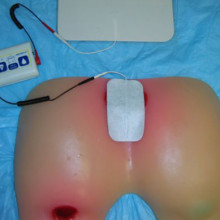
Electrical stimulation (E-Stim) directly stimulates several wound healing processes, promotes local circulation and prevents wound infections. It produces faster healing and wound closure. A trained health care provider applies low levels of electrical current to the pressure ulcer using specialized equipment. |
Embracing health research this holiday season
Community members, patients and families, and those working in the health field attended a special open house on November 28 by research groups at Lawson Health Research Institute. Together, they celebrated the holiday spirit and the gift of hope that is made possible through hospital-based research.
A part of St. Joseph’s Health Care London, Parkwood Institute represents the next era in care, recovery and rehabilitation. Across the site, clinical and research teams in different disciplines and specialties collaborate not only with each other but also with patients and families.
“Many people in the community know the high-quality and compassionate care that is supported by the various clinical teams at Parkwood Institute, but aren’t aware of the research happening at this site,” says Dr. Cheryl Forchuk, Beryl and Richard Ivey Research Chair in Aging, Mental Health, Rehabilitation and Recovery, and Assistant Scientific Director at Lawson.
“Lawson researchers at Parkwood are tackling important challenges with highly innovative and meaningful solutions that help improve care and quality of life.”
For the past three years, the open house gives guests a more in-depth understanding of hospital-based research and its impact. Dr. Forchuk notes that it is a great chance to talk to the researchers and their teams, and to learn about research in a really fun and interactive way. Guests may also learn about opportunities to participate in studies, as the research teams rely on people in the community getting involved.
Image
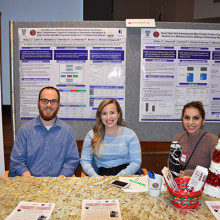
There were 12 interactive program displays from Parkwood Institute Research, a Lawson program, in the areas of cognitive vitality and brain health, mobility and activity and mental health:
- Cognitive Clinical Trials Group (CCTG)
- Collaboration of Rehabilitation Research Evidence (CORRE)
- Gait and Brain Lab
- Geriatric Mood Disorders Lab
- MacDonald Franklin OSI Research Centre (Occupational Stress Injury)
- Mental Health Nursing Research Alliance (MHNRA)
- Mental Health INcubator for Disruptive Solutions (MINDS) of London
- Neuropsychiatry and Therapeutic Brain Stimulation Research Group
- Occupational Therapy and Spiritual Care Research Lab
- R2P (Research to Practice)
- Rehabilitation Mental Health
- Wound Care
The open house had a festive theme and many of the exhibits involved a problem solving or interactive elements to encourage learning and foster teamwork.
Karen Vecchio, federal Member of Parliament for Elgin-Middlesex-London, was among the over 200 people in attendance.
Image
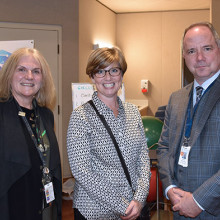
At the open house, from left: Dr. Cheryl Forchuk, MP Karen Vecchio and Roy Butler, St. Joseph's Vice President.
“London is a great community to conduct research,” explains Dr. Forchuk. “We are a mid-size city surrounded by rural areas, in many ways reflecting Canada as a whole. A lot of our projects cover the country with multiple sites and results found here by our leading experts are being implemented in health centres and national strategies in this country and around the world.”
Scientist
(yj~ SIJOSEPHs HEALTH CARE LONDON Evacuation Fire Hazardous Chemical Spill Bomb Threat/Suspicious Object Critical Infrastructure Failure External Disaster YELLOW Missing Person WHITE Violent Person Hostage Taking Person with a Weapon Adult Medical Emergency Pediatric Medical Emergency Emergency Colo...
… pending or completed. B Procedures requiring the use of specialized equipment or training as approved by the Chief … pending or completed. B Procedures requiring the use of specialized equipment or training as approved by the Chief …
Delineation of Privileges Draft - September 2001 DRAFT November 2, 2001 London Health Sciences Centre And St. Josephs Health Care London Delineation of Procedural Privileges Department of Emergency Medicine Category Privileges Educational/Experience Requirements A All activities and procedures gene...
… pending or completed. B Procedures requiring the use of specialized equipment or training as approved by the Chief … pending or completed. B Procedures requiring the use of specialized equipment or training as approved by the Chief …
London Health Sciences Centre And St. Josephs Health Care London April 2016 Delineation of Procedural Privileges Department of Emergency Medicine Category Privileges Educational/Experience Requirements A All activities and procedures generally performed by physicians certified in Emergency Medicine....
… pending or completed. B Procedures requiring the use of specialized equipment or training as approved by the Chief … pending or completed. B Procedures requiring the use of specialized equipment or training as approved by the Chief …
London Health Sciences Centre And St. Josephs Health Care London April 2016 Delineation of Procedural Privileges Department of Emergency Medicine Category Privileges Educational/Experience Requirements A All activities and procedures generally performed by physicians certified in Emergency Medicine....
… pending or completed. B Procedures requiring the use of specialized equipment or training as approved by the Chief … pending or completed. B Procedures requiring the use of specialized equipment or training as approved by the Chief …
London Health Sciences Centre And St. Josephs Health Care London April 2016 Delineation of Procedural Privileges Department of Emergency Medicine Category Privileges Educational/Experience Requirements A All activities and procedures generally performed by physicians certified in Emergency Medicine....
… Category A Delineation. Procedures requiring the use of specialized equipment and/or training as approved by the … Category A Delineation. Procedures requiring the use of specialized equipment and/or training as approved by the …
ApprovedbyDepartmentChief,CWCCandMACDecember2018 Delineation of Procedural Privileges Department of Emergency Medicine Divisions of Adult and Paediatric Emergency Medicine Delineation Privileges Educational and Experience Requirements A Allactivitiesandproceduresgenerallyperformed byphysiciansce...
… chronic pain) and suicide prevention. We have a highly specialized palliative care unit and team at Parkwood … chronic pain) and suicide prevention. We have a highly specialized palliative care unit and team at Parkwood …
End-of-Life Care Contact St. Josephs Health Care London St. Josephs supports individuals making informed decisions about their end-of-life care. This includes talking with family, planning ahead when possible, and deciding when to decline or withdraw treatment (to allow natural death). Patients and ...
… offers complex care, rehabilitation, palliative care, specialized geriatric services and veterans care for both … Care London: Regional Mental Health Care London offers specialized bed-based and community-based mental health care … offers complex care, rehabilitation, palliative care, specialized geriatric services and veterans care for both …
Energy Conservation and Demand Management Plan Made for Ontario Regulation 397/11 Green Energy Act, 2009 Authored by: Mark Read June 18, 2014 2 The Green Energy Act - Regulation 397 The Energy Conservation and Demand Management Plan outlined in the following report is the second component of a two p...
… Regional Mental Health Care, London and St. Thomas offer specialized bed-based and community based mental health care … with serious mental health illness. New facilities for specialized mental health services will be built beside … Cord Injury / Acquired Brain Injury Manuella Giuliano Specialized Geriatric Services Vivianne Van Leeuwen Human …
Annual Accessibility Plan for St. Josephs Health Care, London September 2007 - August 2008 Submitted to Cliff Nordal Chief Executive Officer 30 September 2007 Prepared by SJHC Accessibility Working Group Co-ordinator, Derek Lall This publication is available on the St. Josephs Heath Care, Londons we...
… and regional mental health services. New facilities for specialized mental health services will be built beside … Injury / Acquired Brain Injury-Parkwood Catherine Glover Specialized Geriatric Services Karen Shuttleworth … Recently submitted drawings to the MOH for the two new specialized mental health buildings at Parkwood Hospital and …
Annual Accessibility Plan for the St. Joseph Health Care, London September 2005 - August 2006 Submitted to Cliff Nordal Chief Executive Officer 30 September 2005 Prepared by SJHC Accessibility Working Group Co-ordinator, Derek Lall This publication is available on the hospitals website and in altern...
… Regional Mental Health Care, London and St. Thomas offer specialized bed-based and community based mental health care … with serious mental health illness. New facilities for specialized mental health services will be built beside … Development and Learning Services Manuella Giuliano Specialized Geriatric Services Vivianne Van Leeuwen Human …
Annual Accessibility Plan for St. Josephs Health Care, London September 2008 - August 2009 Submitted to Cliff Nordal Chief Executive Officer 30 September 2008 Prepared by SJHC Accessibility Working Group Chair, Derek Lall This publication is available on the St. Josephs Heath Care, Londons website a...
… Canada for over 130 years and offers the broadest range of specialized clinical services in Ontario. Building on the … care and veterans care, long-term care, rehabilitation and specialized geriatrics and specialized mental health care. Facilities and services …
MEDIA RELEASE For Immediate Release: June 20, 2008 LHSC and St. Josephs win national award for energy and environmental stewardship (LONDON, Ontario) London Health Sciences Centre (LHSC) and St. Josephs Health Care, London (St. Josephs) are the recipients of the 2008 Energy and Environmental Stewar...
Welcome to ePay ePay Guide Revision Date: 2013 02 15 How to View your Pay Statement Electronically London Health Sciences Centre provides electronic pay statements through a secure, web based method called ePay, which is part of our PeopleSo Human Resources system. The informa on below outlines how ...
CARING FOR THE BODY, MIND & SPIRIT SINCE 1869 Renowned for compassionate care, St. Joseph's is one of the best academic health care organizations in Canada dedicated to helping people live to their fullest by minimizing the effects of injury, disease and disability through excellence in care, teachi...
HEALTH CARE LONDON ESSENTIAL CAREGIVER COVID-19 GUIDELINES AND EDUCATION REQUIREMENTS ~~ STJOSEPHs HEALTH CARE LONDON Essential Caregiver COVID-19 Guidelines and Education Requirements Caregiver A caregiver is defined in the Fixing Long-Term Care Act, 2021, O. Reg 246/22 section (4) as follows: a. i...
Evaluating virtual symptom tracking for COVID-19 positive patients, new study
LONDON, ONTARIO - A research study from the Cardiac Arrythmia Network of Canada (CANet) and Lawson Health Research Institute is testing the use of a new online patient care platform designed to help track symptoms for COVID-19 positive patients.
Patients are now being enrolled in the study from the Urgent COVID-19 Care Clinic at London Health Sciences Centre. This virtual clinic helps identify, triage, monitor and manage potential complications for people recovering from COVID-19 at home. Patients can self-monitor their health with ongoing access to virtual physician support.
The COVID-19 Virtual Care at Home research study is testing the use of VIRTUES (Virtual Integrated Reliable Transformative User-Driven E-health System), a virtual, patient-centred platform created by CANet to help guide COVID-19 positive patients in managing their illness. They will have remote access to a team of health care providers including those specialized in the fields of cardiology, emergency medicine, internal medicine, infectious disease, neurology and respirology.
“Using VIRTUES, the care team can monitor a range of symptoms remotely that tells us a lot about how the patient is doing. In addition to tracking their temperature, we are using a home-based pulse oximeter to measure pulse rate and oxygen saturation,” says project co-lead Dr. Marko Mrkobrada, LHSC physician and Lawson Associate Scientist.
As symptoms are logged and tracked, there are alerts for communication between the patient and members of the care team. They can react quickly if additional care is needed such as a visit to the doctor’s office or hospital.
“The COVID-19 pandemic has highlighted the need for effective virtual health care,” says Dr. Anthony Tang, CANet CEO and Scientific Director. “Technology solutions support this care by giving both patients and health care providers fast and accurate access to critical information about symptom progression.”
As a made-in-Canada solution, CANet partnered with Clearbridge Mobile, an application development company in Toronto, to adapt an existing virtual care platform. “We responded quickly to provide a way for health care providers to remotely monitor, triage and manage care for patients with COVID-19, and help identify early on those who are at higher risk of complications,” adds Dr. Tang. Before the pandemic, VIRTUES was used for remote monitoring and care for patients with implantable cardiac defibrillators and pacemakers.
“We want to learn more about making health care technology user-friendly. Patients will have more information about their care and hopefully will experience reduced anxiety,” explains project co-lead Dr. Erin Spicer, LHSC physician and Lawson Associate Scientist. “While the majority of COVID-19 cases don’t require hospitalization, this system allows us to more closely monitor a patient’s progress and make informed decisions if their symptoms worsen.”
This research project highlights the importance of collaborative effort. Most importantly, with patient partners' active participation in helping design the VIRTUES platform and this research project. Along with CANet’s investment to adapt the VIRTUES platform for this project, the Department of Medicine at Western University’s Schulich School of Medicine & Dentistry has provided active support with many sub-specialists and investments from the Centre of Quality, Innovation and Safety (CQuinS) program.
“I am proud to be associated with this vital initiative. This research project will be comforting for patients contracted with COVID-19, providing reassurance that they are cared for by experts and monitored with technology advancement.” Dr. James Calvin, citywide Chair/Chief of Medicine.
The research team explains that these types of remote care systems may be able to play an important role in stemming the spread of the virus, while providing high-quality, accessible care using fewer resources. It also provides a means of rapid and accurate tracking of case recovery.
“We want to keep people safe. Following evaluation of VIRTUES here in London, we hope to see it implemented across the province and beyond. Patients have access to enhanced care while being able to hopefully stay in their homes during their recovery, helping to decrease exposure of COVID-19 in the community and for frontline health care workers,” adds Dr. Tang.
-30-
About Lawson Health Research Institute
Lawson Health Research Institute is one of Canada’s top hospital-based research institutes, tackling the most pressing challenges in health care. As the research institute of London Health Sciences Centre and St. Joseph’s Health Care London, our innovation happens where care is delivered. Lawson research teams are at the leading-edge of science with the goal of improving health and the delivery of care for patients. Working in partnership with Western University, our researchers are encouraged to pursue their curiosity, collaborate often and share their discoveries widely. Research conducted through Lawson makes a difference in the lives of patients, families and communities around the world. To learn more, visit www.lawsonresearch.ca.
About Cardiac Arrhythmia Network of Canada
CANet is a Pan-Canadian multidisciplinary and multi-sectoral research and development network of investigators, well-positioned industry partners, patients, caregivers, and healthcare providers focused on arrhythmia research, technology development and commercialization, and digital transformation activities. CANet is funded in part by the federal government's Networks of Centres of Excellence (NCE), Canada's flagship science and technology program.
Media Contacts
Celine Zadorsky
Senior Media Relations Consultant
Communications & Public Engagement
T: 519-685-8500 ext. 73502
Celine.zadorsky@lhsc.on.ca