


Search
Search
675 Search Results:
… each visit • For indoor visits only - each visitor must be tested for COVID-19 within the past 14 days, with a … each visit • For indoor visits only - each visitor must be tested for COVID-19 within the past 14 days, with a …
Updated July 17, 2020 Visiting Guidelines Veterans and Long-term Care Residents The following guidelines for visits with veterans at Parkwood Institute and residents at Mount Hope Centre for Long Term Care are in place to keep everyone safe from potential exposure to COVID-19. Visit guidelines Vete...
… 3. Confirm with the screener they have: had a COVID-19 test within the past 14 days and have received a negative … passed all screening, including having a negative COVID-19 test within the past two weeks. Both the resident and … 3. Confirm with the screener they have: had a COVID-19 test within the past 14 days and have received a negative …
Mount Hope General Visitor Policy Fact Sheet Would you like to visit a resident at Mount Hope Centre for Long Term Care? Please follow the guidelines below. General visitors must pre-schedule their visits at least 24 hours in advance and can visit one resident per visit, once a week for up to one ho...
… 4. confirm with the screener you have: had a COVID-19 test within the past 14 days and have received a negative … end of their life or in palliative care. Do I need to be tested for COVID-19 before entering the building? No, … or palliative care do not have to have a negative COVID-19 test to enter the building. I want to hug or be closer than …
Mount Hope Essential Visitor Policy Fact Sheet Are you an essential visitor(designated caregiver)? Here is what you need to know. Essential visitors (designated caregivers) are people: visiting a resident at the end of their life or in palliative care. who are a paid support worker (paid companion...
… 3. confirm with the screener you have: a. had a COVID-19 test within the past 14 days and have received a negative … above, however, you do not have to have a negative COVID-19 test to enter the building. I’m a general visitor. What do I … must confirm with the screener you have: • had a COVID-19 test within the past 14 days and have received a negative …
Visiting long term care residents at St. Josephs Your questions answered for visits with residents at Mount Hope Centre for Long-Term Care and St. Josephs Veterans Care Program Who is an essential visitor? Essential visitors (designated caregivers) are people: visiting a resident at the end of thei...
COVID-19 shown to leave unique lung fingerprint
LONDON, ON – Researchers at Lawson Health Research Institute (Lawson) developed and tested an artificial neural network for diagnosing COVID-19. The AI system was trained to learn and recognize patterns in ultrasound lung scans of patients with confirmed COVID-19 infection at London Health Sciences Centre (LHSC) and compared them to ultrasound scans of patients with other types of lung diseases and infections.
“The AI tool that we developed can detect patterns that humans cannot. Lung ultrasound scans of patients with COVID-19, as well as other lung diseases, produce a highly abnormal imaging pattern, but it is almost impossible for a physician to tell apart different types of infections by looking at these images. There are details, however, that distinguish COVID-19 at the pixel level that cannot be perceived by the human eye,” explains Dr. Robert Arntfield, Lawson Researcher and Medical Director of the Critical Care Trauma Centre at LHSC.
“The neural network was able to identify the unique characteristics among different scans, and exceed human-level diagnostic specificity. Our study of over 100,000 ultrasound images showed that while trained physicians could – as expected - not distinguish between different causes of lung disease, the AI had nearly perfect accuracy in making the diagnosis. It’s almost like the AI sees a QR code that we cannot see, unique to the disease.”
LHSC is a global leader in the use of point-of-care ultrasound. It has become an important tool for the diagnosis and care of critically ill patients experiencing acute respiratory failure. The convenience, portability and low cost of using these machines makes them ideally suited for pandemic conditions.
This study is part of a collaborative effort by a small group of local clinicians driven to innovate and create technology that solves complicated problems with AI. “There are a lot of brilliant minds in our city, and I’m very proud that we were able to rapidly pull together a local team to design, develop and test a complex idea,” says Dr. Arntfield. “We are already expanding on these findings with more research.” Lawson has recently approved Dr. Arntfield’s “Project Deep Breathe” which aims to go beyond COVID-19 and explore multiple conditions where lung ultrasound and AI can be paired together.
The study, “Development of a convolutional neural network to differentiate among the etiology of similar appearing pathological B lines on lung ultrasound: a deep learning study”, is published in BMJ Open.
-30-
About Lawson Health Research Institute
Lawson Health Research Institute is one of Canada’s top hospital-based research institutes, tackling the most pressing challenges in health care. As the research institute of London Health Sciences Centre and St. Joseph’s Health Care London, our innovation happens where care is delivered. Lawson research teams are at the leading-edge of science with the goal of improving health and the delivery of care for patients. Working in partnership with Western University, our researchers are encouraged to pursue their curiosity, collaborate often and share their discoveries widely. Research conducted through Lawson makes a difference in the lives of patients, families and communities around the world. To learn more, visit www.lawsonresearch.ca.
Media Contacts
Celine Zadorsky
Senior Media Relations Consultant
Communications & Public Engagement
T: 519-685-8500 ext. 73502
Celine.zadorsky@lhsc.on.ca
… and section 1.3 above are required to undergo rapid antigen testing on Monday, Wednesday and Fridays. 2.1 Staff and … of St. Joseph’s are encouraged to complete their rapid testing in the community (i.e., pharmacies) and must provide … Safety Services. Staff and affiliates are to complete rapid testing on their own time regardless of where testing is …
~ SIJOSEPHs HEALTH CARE LONDON ~ CORPORATE STF063 Policy: COVID-19 Vaccination Owner: Director, Occupational Health and Infection Control Integrated Director, Medical Affairs Sponsor: Vice President, Human Resources and Facilities Integrated Vice President, Medical and Academic Affairs Approval...
… 4. confirm with the screener you have: had a COVID-19 test within the past 14 days and have received a negative … end of their life or in palliative care. Do I need to be tested for COVID-19 before entering the building? No, … or palliative care do not have to have a negative COVID-19 test to enter the building. I want to hug or be closer than …
St. Josephs Veterans Care Program Essential Visitor Policy Fact Sheet Are you an essential visitor(designated caregiver)? Here is what you need to know. Essential visitors (designated caregivers) are people: visiting a resident at the end of their life or in palliative care. who are a paid support...
… 4. Confirm with the screener they have: had a COVID-19 test within the past 14 days and have received a negative … passed all screening, including having a negative COVID-19 test within the past two weeks. Both the resident and … 4. Confirm with the screener they have: had a COVID-19 test within the past 14 days and have received a negative …
St. Josephs Veterans Care Program General Visitor Policy Fact Sheet Would you like to visit a resident at Parkwood Institutes Veterans Care Program? Please follow the guidelines below. General visitors must pre-schedule their visits at least 24 hours in advance and can visit one resident per visit, ...
… College; (e) up-to-date inoculations, screenings, and tests as may be required by the occupational health and … (b) the names and qualifications of all witnesses who will testify at the hearing and a detailed summary of the … College; (e) up-to-date inoculations, screenings, and tests as may be required by the occupational health and …
ST. JOSEPHS HEALTH CARE, LONDON CREDENTIALED PROFESSIONAL STAFF BY-LAW EFFECTIVE APRIL 1, 2024 AMENDED AND APPROVED BY THE: ST. JOSEPHS BOARD OF DIRECTORS - January 29, 2024 ST. JOSEPHS HEALTH CARE SOCIETY - March 27, 2024 Contents Article 1 Definitions and Interpretation 0 ...........................
… investigation reports, progress notes and laboratory test results. Legal Authority for PIB: Public Hospitals Act … investigation reports, progress notes and laboratory test results. Legal Authority for PIB: Public Hospitals Act …
Personal Information Bank (PIB) Details Title: Chronic Reportable Diseases Location of Records: Infection Prevention and Control, Occupational Health and Safety Services Description: Records relating to patients or staff diagnosed with reportable disease that require reporting to London Middlesex He...
… in this handout very carefully. The instructions have been tested to ensure they minimize discomfort while producing a … clean bowel. An incompletely clean bowel may mean that the test will have to be repeated. More importantly, if the … http://sjhc.london.on.ca Two days before your test Eat a normal evening meal (supper). This will be the …
CT Colonography Alternate Bowel Prep This preparation is for patients with impaired kidney function (eGFR value of less than 30). Preparation Instructions Please follow the instructions in this handout very carefully. The instructions have been tested to ensure they minimize discomfort while produci...
… in this handout very carefully. The instructions have been tested to ensure they minimize discomfort while producing a … clean bowel. An incompletely clean bowel may mean that the test will have to be repeated. More importantly, if the … http://sjhc.london.on.ca Two days before your test Eat a normal evening meal (supper). This will be the …
CT Colonography Bowel Prep This preparation is for patients with normal or mildly impaired kidney function (eGFR value of 30 or greater). If you have serious kidney disease (eGFR value of less than 30), have your doctor call St. Josephs Medical Imaging department for alternate preparation instructio...
… may be, or have had blood drawn recently for a pregnancy test, tell your doctor. Please also inform the radiologist, … may be, or have had blood drawn recently for a pregnancy test, tell your doctor. Please also inform the radiologist, …
CARING FOR THE BODY, MIND & SPIRIT SINCE 1869 Renowned for compassionate care, St. Josephs is one of the best academic health care organizations in Canada dedicated to helping people live to their fullest by minimizing the effects of injury, disease and disability through excellence in care, teachin...
… Test: Indication (s): Echocardiogram (2D) Saline Bubble … Monitor 48 hour Holter Monitor 24 hour Exercise Stress Test Research Electrocardiogram New murmur Chest Pain … Test: Indication (s): Echocardiogram (2D) Saline Bubble … Monitor 48 hour Holter Monitor 24 hour Exercise Stress Test Research Electrocardiogram New murmur Chest Pain …
CARDIOVASCULAR INVESTIGATION UNIT REFERRAL FORM Cardiovascular Investigation Unit St. Josephs Hospital; B3-030 268 Grosvenor St. London, ON N6A 4V2 Telephone: 519 646-6000 ext.64221 Fax: 519 646-629 PATIENT INFORMATION Surname: ___________________________ Given Name: ________________________________...
… Test: Indication (s): Echocardiogram (2D) Saline Bubble … Monitor 48 hour Holter Monitor 24 hour Exercise Stress Test Research Electrocardiogram New murmur Chest Pain … Test: Indication (s): Echocardiogram (2D) Saline Bubble … Monitor 48 hour Holter Monitor 24 hour Exercise Stress Test Research Electrocardiogram New murmur Chest Pain …
CARDIOVASCULAR INVESTIGATION UNIT REFERRAL FORM Cardiovascular Investigation Unit St. Josephs Hospital; B3-030 268 Grosvenor St. London, ON N6A 4V2 Telephone: 519 646-6000 ext.64221 Fax: 519 646-6292 PATIENT INFORMATION Surname: ___________________________ Given Name: _______________________________...
Cyclotron hits 10,000-bombardment milestone
Cyclotron staff at St. Joseph’s Health Care London have recorded a 10,000-mark milestone in the same understated way they work every day to improve patient care and cutting-edge research.
No balloons, no streamers, no fanfare: Just an efficient note atop a printout as the bombardment number spun past 9,999 in the early hours of Dec. 31.
“It’s taken us 15 years to get to this point and our work continues to grow,” says Michael Kovacs, PhD, Lead of Lawson’s Nordal Cyclotron & PET Radiochemistry Facility and Leader of the Imaging Research Program at Lawson Research Institute, the innovation arm of St. Joseph’s.
“The numbers are great but the real satisfaction is knowing every single bombardment means something important to a patient or a researcher working towards better patient health.”
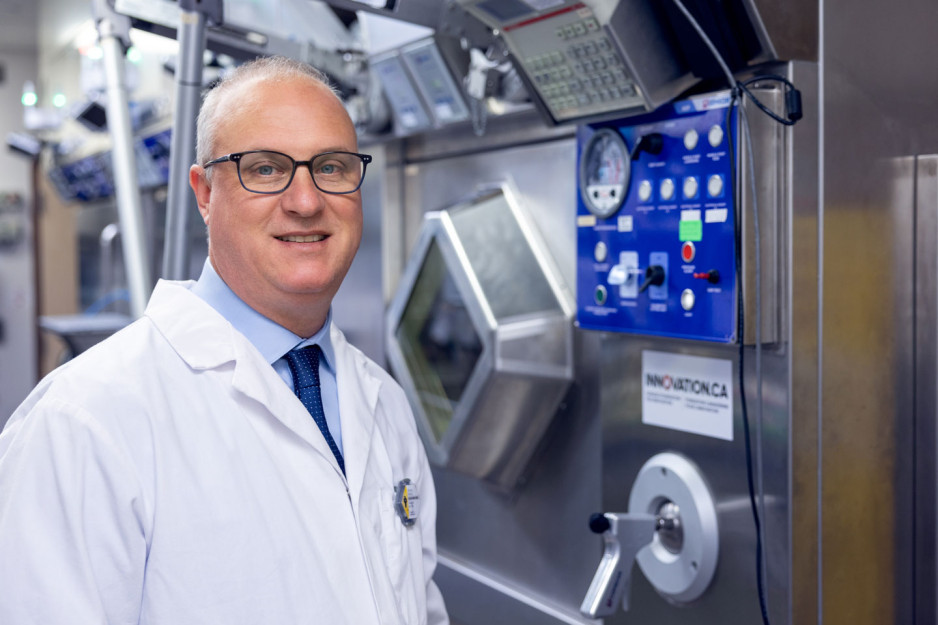
St. Joseph’s GE PETtrace cyclotron is a particle accelerator that produces radioisotopes for use in positron emission tomography (PET) scans across Southwestern Ontario, from Windsor to Toronto. It is a vital tool for ultra-precise cancer diagnoses and for advanced research into scores of diseases.
In patient care, each “bombardment” – a grouping of radioisotopes that are then lab-processed, tested and made into smaller batches – can be used to aid cancer scans for as many as 25 people.
“A precise scan can make a dramatic difference, a life-changing difference, in how someone’s cancer is diagnosed and custom-managed,” Kovacs says. “If we think of the PET scanner as the engine of that transformative work, the cyclotron’s radioisotopes are its rocket fuel.”
Isotopes injected into patients are designed to have a short radioactive half-life – between two minutes and 110 minutes – which is another reason St. Joseph’s cyclotron is such an asset for timely care in the region.
“You can’t store or stockpile them. You have to use them almost immediately, so it’s essential to local and area hospital centres to have a ready, reliable source nearby,” Kovacs says.
About half the batched bombardments are used in patients to help with clinical diagnoses that will guide doctors’ treatment decisions.
The other half are used for research trials and pre-clinical research through Lawson, in fields as diverse as oncology, cardiology, neurology, psychiatry, metabolic disease and infectious diseases. In one promising study, for example, they’re being used to image specific brain proteins as researchers explore new disease-modifying treatment pathways for Alzheimer disease.
The next burgeoning field, Kovacs says, is theranostics: the science of diagnosing cancer and precision-attacking it at the same time. “That’s exciting for me, to be able simultaneously to see what we treat and treat what we see.”
About 15 highly specialized staff work at St. Joseph’s cyclotron facility, plus PhD-candidate researchers and other trainees.
Generous donors through St. Joseph’s Health Care Foundation have made much of this advanced research and next-level technology a reality. During the past few years, the Foundation granted nearly $800,000 in donor support to fund extensive renovations to the facility, making it possible to increase production of isotopes and expand life-saving care. Recently, $1 million in donations supported a new PET/CT scanner – the heart of Canada’s first national GE centre of excellence in molecular imaging and theranostics being developed at St. Joseph’s Hospital.
“We know the cyclotron is a critical tool in our imaging work and we are grateful to those donors who stepped up to help us with renovations that enabled the doubling of our facility’s production capability,” says Michelle Campbell, President and CEO of St. Joseph’s Health Care Foundation. “This renovation helps keep St. Joseph’s imaging program at the cutting edge of clinical care.”
The 40-tonne, room-sized cyclotron is more than a machine, and more than the experts who process, test, ship and use the radioisotopes, Kovacs notes.
It’s also testament to the vision of St. Joseph’s long-time chief medical physicist Frank Prato, PhD, and to the support of hospital administrators who saw its need and potential, he adds.
“We are innovators, and our vision is that we’re going to expand St. Joseph’s imaging expertise on an even larger world stage,” Kovacs says.
… A Basic Guide for Exercise and Diabetes Before During After Test Blood glucose must be between 5-14 mmol/L Test blood glucose every 30 minutes during long periods of exercise Test blood glucose after exercise. Test overnight if the … A Basic Guide for Exercise and Diabetes Before During After Test Blood glucose must be between 5-14 mmol/L Test blood …
Check T.H.I.S A Basic Guide for Exercise and Diabetes Before During After Test Blood glucose must be between 5-14 mmol/L Test blood glucose every 30 minutes during long periods of exercise Test blood glucose after exercise. Test overnight if the exercise was high intensity, long duration, or unplan...
… and courts in reference to the elements of the capacity test and a capable patient’s right to refuse treatment … Court’s interpretation of Ontario’s current statutory test of capacity, namely that a person’s best interests are … witnessed by a health care professional or lawyer who can attest to the person’s capacity at the time of executing the …
SPECIAL ISSUE AN EXCHANGE OF VIEWS ON WHAT CONSTITUTES REASONABLE REVIEW OF TREATMENT CAPACITY Capacity Reviews -Clinical and Liberty Outcomes ...... 1 Richard OReilly, M.B., F.R.C.P.C, Robert Solomon, LL.B., LL.M., John Gray, Ph.D. Capacity, Rights and Interests .. 10 Stephen A. State Ph.D. Respons...
… study ever conducted. Their research uses cognitive testing and precise neuroimaging methods, such as Magnetic … study ever conducted. Their research uses cognitive testing and precise neuroimaging methods, such as Magnetic …
Cognitive Vitality and Brain Health: Dementia Detecting dementia progression To date, there is no definitive way for health care professionals to forecast the onset of dementia in a patient. But two physicians at St. Josephs Health Care London are committed to cutting-edge research that will predict...
Dementia research hits the ‘mark’
St. Joseph’s Health Care London is at the forefront of national research exploring biomarkers to better predict dementia and slow its onset.
Dr. Michael Borrie is now seeing grandchildren of patients who came to his clinic when he first started Alzheimer’s research 30 years ago.
His message to this new generation is more hopeful than ever, bolstered by ever-more-reliable ways of early detection and being tantalizingly close to a future of predicting dementia and intervening even before symptoms appear.
“The ultimate goal is to slow cognitive decline – and to stop it if we can – so that people can live independently, and happier, for a lot longer,” says Borrie, Medical Director of the Aging Brain and Memory Clinic at St. Joseph’s Health Care London (St. Joseph’s).
“We’re aiming to alter the trajectory of dementia,” he says.

A geriatrician, clinician and researcher, Borrie is also Platform Lead for the Comprehensive Assessment of Neurodegeneration and Dementia (COMPASS-ND), a long-term study within the Canadian Consortium on Neurodegeneration and Aging (CCNA).
Recently, the Canadian Institutes of Health Research announced $20.6 million in funding to continue the work of CCNA, a 30-site, multi-pronged project of which the St. Joseph’s-based team is the lead player. The grant will enable them to advance the frontiers of dementia research to benefit real-world patients here and across the country.
Solving mysteries with biomarkers
Despite the prevalence of Alzheimer’s and other neurodegenerative diseases – and with more than 10,000 new diagnoses in Canada each year – there are still many mysteries to solve: Why do some people have early-onset dementia while others, super-agers, remain alert and active in their 90s? What’s happening genetically, in their environment and personal medical history to advance or protect against the disease?
What is known, however, is the link between damaged nerve cells and specific proteins that misfold and clump together to form amyloid plaques and tau tangles in the brain. Detecting these abnormal proteins early is an important key to diagnosis and prediction.
Locally, the most comprehensive tool has been state-of-the-art brain Positron Emission Tomography (PET) scanning at St. Joseph’s Imaging. Lawson researchers are also involved in reliably detecting amyloid proteins by analyzing participants’ cerebrospinal fluid (CSF) – a surprisingly accurate way of confirming imaging results, says geriatrician Dr. Jaspreet Bhangu, a Lawson scientist and head of the biomarker project.
Through the BioMIND regional research project, Lawson scientists are analyzing PET scans, blood and CSF samples to check for specific protein biomarkers. If shown to be reliable, a series of these tests over time could signal whether the disease is progressing, and could predict whether it will progress or respond to treatment.
All that gets added to an arsenal that includes tests of behaviour, memory and cognitive function.
“It’s a triple assessment, or even a quadruple one, that we can conduct over time. We hope to use these advanced tests to provide vital information, similar to what is done in certain types of cancer,” Bhangu says.
But that’s not all.
Testing potential treatments
St. Joseph’s is also one of the country’s most active sites for clinical trials into whether novel medications might be able to directly pinpoint and destroy the proteins that cause Alzheimer disease.
“This is the intersection of cutting-edge research, top-notch resources and excellent clinical practice to develop personalized treatments,” says Bhangu. “What makes us unique in Canada among dementia researchers is that our science is taking us from bench to bedside – a rapid turnaround from research to direct patient benefit.”
If a person has a strong family history of Alzheimer disease and no symptoms – but does have positive biomarkers confirming presence of disease – they may then choose to take part in a randomized controlled trial to try to alter the trajectory of the disease.

“It’s still in a research context, still in clinical trials – but if Health Canada ultimately approves a treatment, we’ll have the ability and the patient database to be able to translate our findings into clinical practice much more quickly instead of waiting for years,” says Borrie.
All this is good news for a generation eager for answers, Borrie says.
“When we learn more about the mechanisms of the disease, we can find more effective, earlier treatments. And if we can treat people earlier, we hope to move the disease progression curve to the right, to add more years of good cognitive health to someone’s life.”