


Search
Search
1059 Search Results:
… Physiatry Outpatient Acquired Brain Injury Referral Form Parkwood Institute 550 Wellington Rd London N6C 0A7 Phone: … Physiatry Outpatient Acquired Brain Injury Referral Form Parkwood Institute 550 Wellington Rd London N6C 0A7 Phone: …
July 2017 Physiatry Outpatient Acquired Brain Injury Referral Form Parkwood Institute 550 Wellington Rd London N6C 0A7 Phone: 519-685-4579 Fax: 519-685-4075 Patient Name: Referring Physician: DOB (YY/MM/DD): Phone: OHIP #: Fax: Address: Billing Number: Referral Date: Contact phone: Physicians Signat...
… Parkwood Institute Driver Assessment and Rehabilitation … Parkwood Institute Driver Assessment and Rehabilitation …
Parkwood Institute Driver Assessment and Rehabilitation Centre Driver Assessment and Rehabilitation Program/DriveABLE Mailing address Location PO BOX 5777, STN B 550 Wellington Road London, ON N6A 4V2 London ON N6C 0A7 Tel: (519) 685-4070 Fax: (519) 685-4066 Referral (Please forward any relevant med...
… SJHC tertiary services. The position is linked wit SGS at Parkwood Hospital. /media/3130 … SJHC tertiary services. The position is linked wit SGS at Parkwood Hospital. …
Regional Best Practice Guidelines Initiative in Long Term Care This initiative has been developed by the Ministry of Health and Long Term Care to support long term care homes (LTCH) in adopting evidence-based practices that support systematic and consistent approaches to quality care for residents. ...
… independent of the hospital. For more about the PPAO call: Parkwood Institute’s Mental Health Care Building: Patient … about the Patient Council and the services offered call: Parkwood Institute’s Mental Health Care Building: 519 … independent of the hospital. For more about the PPAO call: Parkwood Institute’s Mental Health Care Building: Patient …
Mental Health Care Patient Bill of Rights Respect = Excellence = Compassion St. Josephs Mental Health Care Patient Bill of Rights Acknowledgements: St. Josephs Health Care London (St. Josephs) and the mental health care Patient Council acknowledges, with appreciation, the work of the Centre for Addi...
Mobility and Activity
Researchers at Lawson are propelled by the people who will benefit from the best in complex rehabilitative science.
One in 10 Canadians has a mobility disability – and we’re laser-focused on discovering how to help people whose lives have been upended by spinal cord injuries, stroke, brain injuries, chronic pain, accidents, falls, trauma or degenerative disease.
Situated at the Gray Centre for Mobility and Activity within St. Joseph’s Health Care London’s Parkwood Institute, the region’s largest provider of rehabilitation and recovery health, we bring our research into practice using all the resources a health institute and teaching hospital can offer together.
We share our innovations with the world – and we share the world’s research too, as we’ve created and curated the biggest database of international research on stroke, traumatic brain injury and spinal cord injuries.
Lawson mobility researchers comprise one of the largest and most accomplished teams in the country: including a research chair, established world-class scientists, emerging researchers, dozens of trainees and more than 100 students.
Our work helps people around the world lead active and healthy lives. Read on to discover where it will lead you.
Lawson leads mobility and activity research:
… death as it relates to geriatric populations delivered at Parkwood Institute and webcasted to our other sites and 19 … to mental health. The presentation was well-attended at Parkwood Institute’s Mental Health Care Building and was … programs. Stephen Yeo, teaching supervisor and chaplain at Parkwood Institute Mental Health Building has been integral …
Leadership in Mission Report on Mission, Spiritual Care and Health Care Ethics 2015/2016 Report on Governance and Leadership As we approached 2015/16 we knew the year would provide opportunities and challenges. We would fi nally be through all our restructuring and construction and would have the op...
… death as it relates to geriatric populations delivered at Parkwood Institute and webcasted to our other sites and 19 … to mental health. The presentation was well-attended at Parkwood Institute’s Mental Health Care Building and was … programs. Stephen Yeo, teaching supervisor and chaplain at Parkwood Institute Mental Health Building has been integral …
Leadership in Mission Report on Mission, Spiritual Care and Health Care Ethics 2015/2016 Report on Governance and Leadership As we approached 2015/16 we knew the year would provide opportunities and challenges. We would fi nally be through all our restructuring and construction and would have the op...
… Lant and Rev. Albert Chovaz light a candle at the annual Parkwood Thanksgiving service. 3 Report on Governance and … Joseph’s patients, particularly those in complex care at Parkwood Hospital and at Regional Mental Health Care London, … was approached with great sensitivity and compassion. Parkwood Hospital 10 At one point there were clinical …
Leadership in Mission Report on Mission, Spiritual Care and Health Care Ethics St. Josephs Health Care London 2013/2014 Report to St. Josephs Health Care Society 2 Contents Page 3 Report on Governance and Leadership Page 8 Report on Heath Care Ethics Page 13 Report on Spiritual Care Page 18 Living o...
… Board Chair Ann Fleming and CEO Cliff Nordal, taken at Parkwood Hospital 3 St. Joseph’s Health Care London | Annual … 19. Tai Chi classes at Mount Hope 20. Tuning in to the Parkwood Hospital Foundation 22. The changing face of … congratulate our leaders, physicians and staff members at Parkwood Hospital for weathering months of renovation and …
ST. JOSEPHS HEALTH CARE LONDON | ANNUAL REPORT TO THE COMMUNITY | 2002/2003 2 Dedication This years Annual Report to the Community is dedicated to the St. Josephs Health Care, London staff members and volunteers who continue to give so much of themselves to help manage SARS restrictions. Thank you t...
… This year, we particularly mark the 20th anniversary of the Parkwood Hospital Foundation. We are pleased that this … Eastwood, Dr. Haydn Bush 10 11 Helping seniors stay at home Parkwood Hospital’s specialized geriatric services is … independent and in their own homes as long as possible. Parkwood Hospital health professionals provide clinical …
St. Josephs Health Care London Annual Report 1 care 2 3 At St. Josephs Health Care, London, there are so many ways to care, all stemming from one vision to be a respected source of excellent health care. Uniting an organization of such diversity, embodying programs in rehabilitation, acute/ambulato...
… following module: Suicide Risk Assessment and Prevention Parkwood Institute, Main and Mental Health X X X X X X X X X … following module: Suicide Risk Assessment and Prevention Parkwood Institute, Main and Mental Health X X X X X X X X X …
Assigned Learning Student Affairs Learning Modules Advanced Law Enforcement Anesthesia Assistant Clinical Nutrition/ Dietitics Clinical Science Wound Healing (Masters) Clinical Trials Dental Hygiene Development Services Worker ECG Technician Echo Technician Ethics Food & Nutrition Management Healthc...
… following module: Suicide Risk Assessment and Prevention Parkwood Institute, Main and Mental Health X X X X X X X X X … following module: Suicide Risk Assessment and Prevention Parkwood Institute, Main and Mental Health X X X X X X X X X …
Student Affairs Learning Modules Advanced Law Enforcement Anesthesia Assistant Clinical Nutrition/ Dietitics Clinical Science Wound Healing (Masters) Clinical Trials Dental Hygiene Development Services Worker ECG Technician Echo Technician Ethics Food & Nutrition Management Healthcare/ Medical Admin...
… following module: Suicide Risk Assessment and Prevention Parkwood Institute, Main and Mental Health X X X X X X X X X … following module: Suicide Risk Assessment and Prevention Parkwood Institute, Main and Mental Health X X X X X X X X X …
Student Affairs Learning Modules Advanced Law Enforcement Anesthesia Assistant Clinical Nutrition/ Dietitics Clinical Science Wound Healing (Masters) Clinical Trials Dental Hygiene Development Services Worker ECG Technician Echo Technician Ethics Food & Nutrition Management Healthcare/ Medical Admin...
Research Bites: Why it is important to keep moving as we age
8:00pm - 9:00pm
Dr. Tim Doherty is a clinician scientist at Lawson’s Parkwood Institute Research with a primary focus on the impact of aging on nerve and muscle function. He will discuss the impact of aging on mobility, why this is important, and how we can improve or prevent loss of mobility in older adults.
Virtual Event Details
Speaker: Dr. Tim Doherty
Date: Monday, November 9, 2020
Time: 4 - 5 p.m.
Location: This will be a virtual event hosted as a WebEx video meeting.
Meeting number (access code): 172 547 4015
Meeting password: M7JJdJA3
If joining by phone: call 519-685-8100
*No registration is required for this free public event.
About Research Bites
Presented by Parkwood Institute Research, a program of Lawson Health Research Institute, these informative and interactive talks focus on specific illnesses, their prevention and related research being conducted by researchers in London and area.
… articles authored by the mental health professionals of Parkwood Institute and Southwest Centre for Forensic Mental … unique stylistic variations required by the subject matter. Parkwood Institute Mental Health Care Building Research and … Improvement Address correspondence to: Dr. Jatinder Takhar Parkwood Institute Mental Health Care Building 550 …
ISSN 2368-6294 (Print) ISSN 2368-6308 (Online) DECEMBER 2014 | VOL 11 No. 2 Editor J. D. Mendonca PhD CPsych ACADEMIC DETAILING AS A FOCUSED, ENGAGING AND FEASIBLE METHOD OF QUALITY IMPROVEMENT AMONG PSYCHIATRISTS: A pilot Ontario study Kamini Vasudev, Joel Lamoure, Michael Beyaert, Varinder Dua, Da...
… articles authored by the mental health professionals of Parkwood Institute and Southwest Centre for Forensic Mental … stylistic variations required by the subject matter. Parkwood Institute Mental Health Care Building Research and … Campbell Address correspondence to: Dr. Amresh Shrivastava Parkwood Institute Mental Health Care 550 Wellington Road …
ISSN 2368-6294 (Print) ISSN 2368-6308 (Online) MAY 2015 | VOL 12 No. 1 Editor J. D. Mendonca, PhD CPsych BRIEF REPORTS The Flip-Side To Readmission: Focussed After-Care Research Insights is a peer-reviewed journal designed to publish reviews, case studies and research articles authored by the mental...
Research shared and celebrated at 17th Annual Mental Health Research Half Day
From falls prevention to depression therapies, scientists at Lawson Health Research Institute are conducting important mental health studies. Held on Thursday, September 15, the 17th Annual Mental Health Research Half Day at the Parkwood Institute Mental Health Program was a chance to share and celebrate this research.
The Mental Health Research Half Day featured poster and oral presentations, as well as the 12th Annual Tony Cerenzia Research Lecture. Clinical, administrative and research staff attended to learn more about research happening at Parkwood Institute and the Southwest Centre for Forensic Mental Health Care, part of the St. Joseph’s Health Care London family.
“The Mental Health Research Half Day provides an opportunity for researchers at Parkwood Institute and the Southwest Centre for Forensic Mental Health Care to present their research findings to clinical and administrative staff,” said Dr. Richard O’Reilly, Director of Psychiatric Research at Parkwood Institute & Southwest Centre and a Scientist at Lawson. “It is important that all clinical staff, who may not be directly involved in research, know what studies are being conducted and their impact on patient care.”
The 12th Annual Tony Cerenzia Research Lecture was delivered by Dr. Nathan Herrmann, Associate Scientist, Evaluative Clinical Sciences, Hurvitz Brain Sciences Research Program, Sunnybrook Research Institute and Head of the Division of Geriatric Psychiatry at Sunnybrook Health Sciences Centre. Dr. Herrmann delivered an engaging lecture titled “Managing Neuropsychiatric Symptoms in Dementia: An Evidence-Based Approach”.
Attendees were engaged not only by this highly informative lecture but also by the poster and oral presentations which covered a broad range of research topics. Presenters were also enthusiastic about the day and the opportunities it provided.
“The Mental Health Research Half Day is a great event which provides networking opportunities here at Parkwood Institute. It allows staff from across St. Joseph’s to learn about different research happening across program areas,” said Erin Finley, an Occupational Therapist (OT) in Geriatric Psychology at Parkwood Institute.
Finley and her colleagues were one of seven poster presentations. Their research project, titled “Fall prevention initiative in geriatric psychiatry”, aimed to reduce the rate of falls with injury among patients with dementia in a behavioural health unit. Within an 18-bed unit, they were able to significantly reduce falls with injury with zero incidences in the last two months of their data collection period.
Scientist
Researchers testing triple intervention to combat dementia
Researchers at Lawson Health Research Institute are the first in the world conducting a clinical trial to test a triple intervention aimed at treating Mild Cognitive Impairment (MCI) and delaying the onset of dementia. The Mobility, Exercise and Cognition (MEC) team will be incorporating physical exercises, cognitive training and vitamin D supplementation to determine the best treatment for improving mobility and cognition.
“We have learned the brain processes involved in motor-control - for example how a person walks - and cognition - for example how that person solves a problem - share similar locations and networks in the brain,” explains Dr. Manuel Montero Odasso, Lawson Scientist and Geriatrician at St. Joseph’s Health Care London. “Problems with mobility are connected to lowering function in the mind, and so can be a good indicator of future progression into dementia.”
Dr. Montero Odasso is also an Associate Professor in the departments of Medicine and Epidemiology and Biostatistics at the Schulich School of Medicine & Dentistry, Western University.
Image
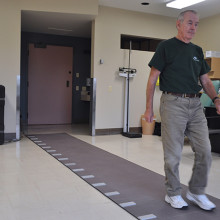
Gait assessment looks at the way in which we move our whole body from one point to another, helping to analyze mobility and the brain processes involved.
MCI is an intermediate stage between the expected cognitive decline of normal aging and the more serious decline of dementia. It can involve problems with memory, language, thinking and judgment. While many older individuals experience decline in both mobility and cognition, each are assessed and treated separately with no specific recommendations available for physicians.
The SYNERGIC Trial will combine physical exercises, cognitive training and vitamin D to test how these interventions work together to improve cognition in older adults at risk for dementia. The trial is targeting cognitive decline at the earliest stage, individuals with MCI, where interventions are more likely to have an effect and can be monitored.
Image
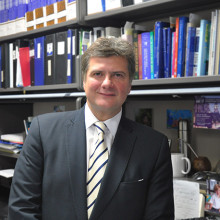
Dr. Manuel Montero Odasso, Lawson Scientist and lead for the SYNERGIC Trial.
Dr. Montero Odasso explains that both physical and cognitive exercises have shown promising effects for maintaining cognition, while vitamin D deficiency is associated with cognitive decline. A key feature of this trial is that participants will receive individualized and progressive training.
“By delaying declines in cognition, we can improve a person’s quality of life. This research will help to support a more comprehensive preventative treatment with clinical guidelines for physicians whose patients are at risk of developing dementia,” states Dr. Montero Odasso. “Even more, each one year delay of progression to dementia in older individuals at risk has the opportunity to save billions of dollars for the Canadian health care system.”
Individuals over 60 years old with mild cognitive impairment without dementia are eligible for this clinical trial. Those interested in participating are encouraged to contact Research Coordinator Alanna Black at 519.685.4292 ext. 42179.
Participants will be asked to complete a routine of exercises and cognitive training three times a week for six months, with one final assessment at 12 months. The main site for the study is Parkwood Institute with physical exercises taking place at the Labatt Health Sciences Building at Western University, in Dr. Kevin Shoemaker’s Laboratory for Brain and Heart Health.
This study has been funded by the Canadian Consortium on Neurodegenerative in Aging (CCNA) which represents Canada-wide research aimed at enhancing the quality of life and services for individuals diagnosed with a neurodegenerative disease. The MEC team in London, led by Dr. Montero Odasso, includes expert researchers in the field of mobility who aim to develop common assessments for the interaction of cognition and mobility for older people to aid as a diagnostic tool for detecting dementia.
Image
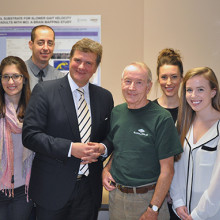
Members of the study’s research team, from left to right: Korbin Blue, Research Assistant (Co-op Student); Yanina Sarquis-Adamson, Lab Research Assistant; Frederico Faria, Post-Doctoral Fellow; Dr. Montero Odasso, Director, Gait and Brain Lab; research participant; Alanna Black, Lab Research Coordinator; Stephanie Cullen, Research Assistant (Undergraduate Student); and, Navena Lingum, Research Assistant (Master Student).
Scientist
… Joseph’s Hospital (SJH) 268 Grosvenor Street, London, ON ● Parkwood Institute 550 Wellington Road, London, ON ● Parkwood Institute - Regional Mental Health Care 550 … LHSC UH and VH 0800-2000 seven days a week, 365 days a year Parkwood Institute: Care coordinators are available on site …
The Resident & Fellow Handbook This handbook is the property of: Dr. _____________________________ Resident / Clinical Fellow in the Department of: ________________________________ If found, please return to the Security office or notify me by email at: ________________________________ Preface Th...
… Return to School (RTS) Group Program* Contact Who We Are Parkwood Institute Return to School (RTS) GROUP PROGRAM The … Speech-Language Pathologist (C) Reg. CASLPO Location: Parkwood Institute 550 Wellington Road London, Ontario N6C … Return to School Group Program Parkwood Institute Who we serve Program modules My story …
Return to School (RTS) Group Program* Contact Who We Are Parkwood Institute Return to School (RTS) GROUP PROGRAM The RTS Group Program is facilitated by a Speech Language Pathologist (SLP) and is designed to meet the specific needs of students who are intending to return to studies or have already r...