


Search
Search
696 Search Results:
Getting the data on homelessness
At a virtual event, a research team led by Lawson Health Research Institute announced details of a new project aimed at better understanding how many people in Canada are homeless and who they are. Developing more accurate sources of data related to homelessness helps ensure the proper supports and services are available.
“The homeless experience varies significantly across Canada, especially within different rural and remote regions of the country,” says Dr. Cheryl Forchuk, Assistant Scientific Director at Lawson and Distinguished University Professor at Western University.
With funding from the Public Health Agency of Canada, the Homelessness Counts research project builds on past work looking at how existing databases, such as provincial health data, could be better integrated and used as a more accurate, accessible and cost-effective way to determine homelessness.
Many communities rely on shelter data, but not all regions have shelters and not all people who are experiencing homelessness use shelters even when available. There is also a standard “point in time” method that requires potentially hundreds of volunteers to go out and actually count the people in that area who are homeless.
“Generally, these methods will still miss people who are temporarily staying with others or living in rough or abandoned areas, and is limited to a single point in time – often just one day of counting. It’s often not feasible for smaller communities to do this due to the effort required and it’s a population often missed in our census data,” explains Dr. Richard Booth, Scientist at Lawson and Associate Professor at Western.
In the initial stages of the project, the team is holding focus groups with several representative communities across Canada to learn more about how data is tracked and accessed. They will consult with groups providing services such as homeless serving agencies, mental health and addiction agencies, hospitals, emergency services and municipal governments. Individual interviews will also be held with people with lived experience of homelessness.
“To offer effective and efficient services, we need to know how many people are experiencing homelessness, along with their characteristics, location and needs. Right now, it’s difficult to track if things are getting better or worse, or simply changing, and if efforts to reduce the homeless population are making a difference. We don’t fully know the unique challenges of the ‘invisible homeless’ or if different subgroups are emerging,” says Dr. Booth.
More demographics could be regularly included in the data, for example gender, ethnicity, sexual orientation, involvement in the criminal justice system, psychiatric diagnoses, physical diagnoses and housing status.
The team will bring together this information with existing datasets to improve the performance of an algorithm previously developed through a provincial research study, as well as insights gleaned from a rapid report on COVID-19 and homelessness. Machine learning will be used to generate enhanced risk and burden modeling.
Dr. Forchuk adds that “homelessness is a complex social problem that touches on many different systems. It is made even more difficult to tackle when we have big gaps in the data. Our hope is to prototype a centralized surveillance system that can be scaled up across Canada to help make the right services available in the right places.”
Scientist
Getting the data on homelessness
A team at Lawson Health Research Institute is hosting forums for communities across the country to better understand homelessness in Canada, including the number of people experiencing it. The first six forums have been scheduled in communities across Ontario, including Thunder Bay, North Bay, Kingston, Chatham-Kent, London and Brantford. These will be followed by future forums in various locations across Canada.
With funding from the Government of Canada, the Homelessness Counts research project is collecting data surrounding the homelessness situation in Canada.
The forums will allow an opportunity for members of the community to come together to discuss issues surrounding homelessness and provide feedback to the research team.
“The homelessness experience varies significantly across Canada, especially within different rural and remote regions of the country,” says Dr. Cheryl Forchuk, Assistant Scientific Director at Lawson. “Developing more accurate sources of data related to homelessness helps ensure the proper supports and services are available.”
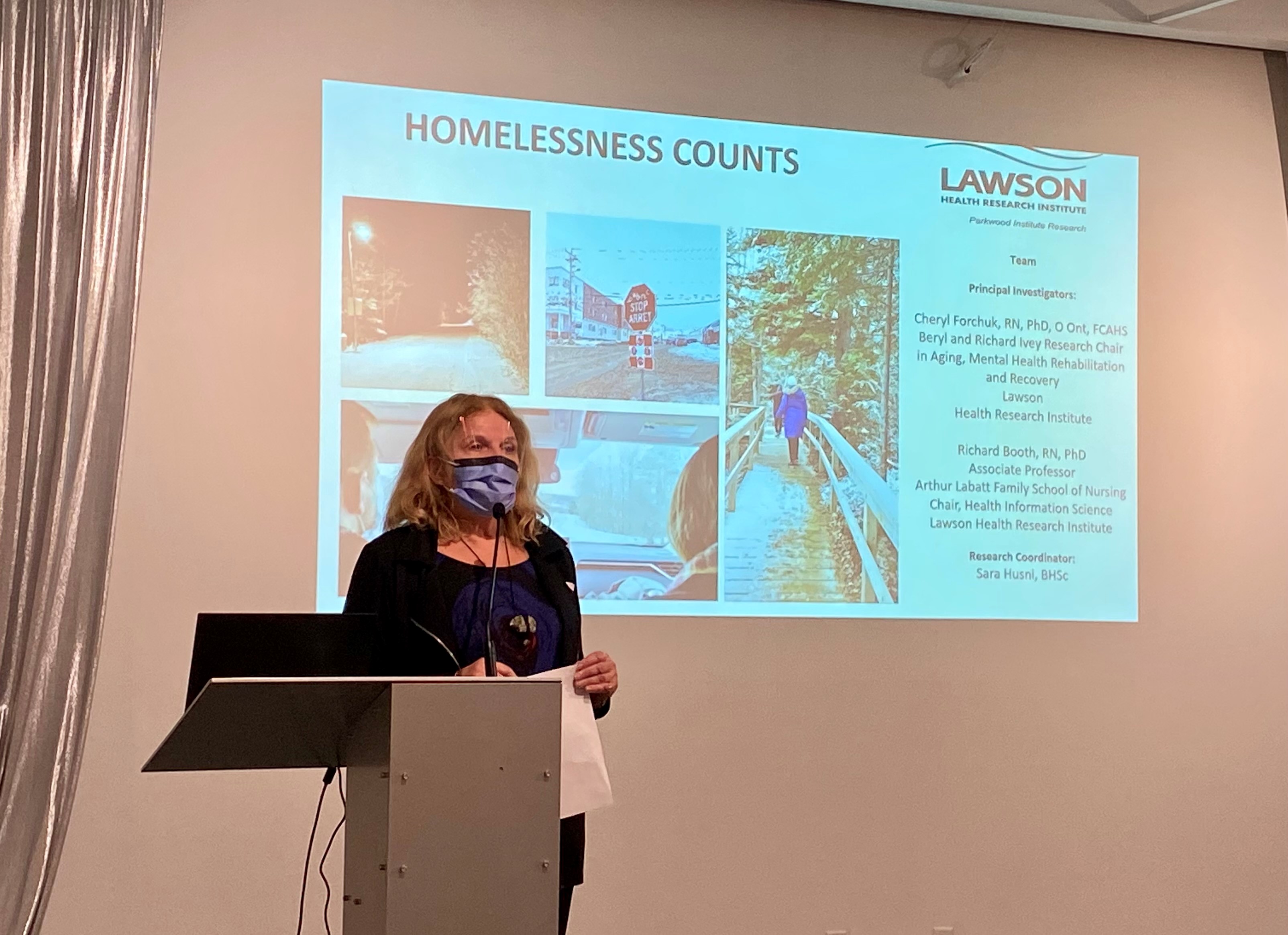
This project builds on past work looking at how existing databases, such as provincial health data, could be better integrated and used as a more accurate, accessible and cost-effective way to determine rates of homelessness. This can allow a more accurate picture as numbers continue to rise.
This project has been made possible through funding from the Public Health Agency of Canada and Reaching Home, a community based federal program aimed at preventing and reducing homelessness across Canada.
“Homelessness has a direct impact on the health and wellbeing of every Canadian community and further marginalizes vulnerable Canadians. We value the importance of the data collection by Lawson Health Research Institute, as it helps give us a better understanding of the homelessness situation in Canada,” says The Honourable Ahmed Hussen, Minister of Housing and Diversity and Inclusion. “Our government is committed to helping Canadians who are experiencing or at risk of homelessness which is why we are pleased to support this initiative. By working with other orders of government, non-governmental organizations, Indigenous partners and communities, we can increase the availability of safe, inclusive housing options and work towards reducing chronic homelessness in Canada.”
Since January 2021, the team has collected data from 28 distinct communities with homelessness challenges. They have visited a variety of community shelters and organizations to meet with those with lived experience, as well as service providers.
“We have been to every province and territory in Canada to collect data. We have interviewed more than 400 people experiencing homelessness in each community and have had focus groups with 190 service providers,” says Dr. Forchuk.
Preliminary data being presented at the forums will highlight issues by community, however nationally the research team has found that the extent of homelessness is a growing problem and has been elevated during the pandemic. The team has also noted a number of regional differences when it comes to homelessness in respect to urban versus rural communities.
“Our ultimate goal is to gather the most accurate numbers of people experiencing homelessness across the country so we can collectively work together towards solutions, “adds Dr. Forchuk. “Solutions such as an increase of services that are targeted to address specific concerns and vulnerable populations in each unique community.”
Scientist
Media Contact
Celine Zadorsky
Senior Media Relations Consultant
Communications & Public Engagement
T: 519-685-8500 ext. 73502
Celine.zadorsky@lhsc.on.ca
Getting the data on homelessness
LONDON, ON – At a virtual event today, a research team led by Lawson Health Research Institute announced details of a new project aimed at better understanding how many people in Canada are homeless and who they are. Developing more accurate sources of data related to homelessness helps ensure the proper supports and services are available.
“The homeless experience varies significantly across Canada, especially within different rural and remote regions of the country,” says Dr. Cheryl Forchuk, Assistant Scientific Director at Lawson and Distinguished University Professor at Western University.
With funding from the Public Health Agency of Canada, the Homelessness Counts research project builds on past work looking at how existing databases, such as provincial health data, could be better integrated and used as a more accurate, accessible and cost-effective way to determine homelessness.
Many communities rely on shelter data, but not all regions have shelters and not all people who are experiencing homelessness use shelters even when available. There is also a standard “point in time” method that requires potentially hundreds of volunteers to go out and actually count the people in that area who are homeless. “Generally, these methods will still miss people who are temporarily staying with others or living in rough or abandoned areas, and is limited to a single point in time – often just one day of counting. It’s often not feasible for smaller communities to do this due to the effort required and it’s a population often missed in our census data,” explains Dr. Richard Booth, Scientist at Lawson and Associate Professor at Western.
In the initial stages of the project, the team is holding focus groups with several representative communities across Canada to learn more about how data is tracked and accessed. They will consult with groups providing services such as homeless serving agencies, mental health and addiction agencies, hospitals, emergency services and municipal governments. Individual interviews will also be held with people with lived experience of homelessness.
“To offer effective and efficient services, we need to know how many people are experiencing homelessness, along with their characteristics, location and needs. Right now, it’s difficult to track if things are getting better or worse, or simply changing, and if efforts to reduce the homeless population are making a difference. We don’t fully know the unique challenges of the ‘invisible homeless’ or if different subgroups are emerging,” says Dr. Booth.
More demographics could be regularly included in the data, for example gender, ethnicity, sexual orientation, involvement in the criminal justice system, psychiatric diagnoses, physical diagnoses and housing status.
The team will bring together this information with existing datasets to improve the performance of an algorithm previously developed through a provincial research study, as well as insights gleaned from a rapid report on COVID-19 and homelessness. Machine learning will be used to generate enhanced risk and burden modeling.
Dr. Forchuk adds that “homelessness is a complex social problem that touches on many different systems. It is made even more difficult to tackle when we have big gaps in the data. Our hope is to prototype a centralized surveillance system that can be scaled up across Canada to help make the right services available in the right places.”
-30-
About Lawson Health Research Institute
Lawson Health Research Institute is one of Canada’s top hospital-based research institutes, tackling the most pressing challenges in health care. As the research institute of London Health Sciences Centre and St. Joseph’s Health Care London, our innovation happens where care is delivered. Lawson research teams are at the leading-edge of science with the goal of improving health and the delivery of care for patients. Working in partnership with Western University, our researchers are encouraged to pursue their curiosity, collaborate often and share their discoveries widely. Research conducted through Lawson makes a difference in the lives of patients, families and communities around the world. To learn more, visit www.lawsonresearch.ca.
Media Contacts
Celine Zadorsky
Senior Media Relations Consultant
Communications & Public Engagement
T: 519-685-8500 ext. 73502
Celine.zadorsky@lhsc.on.ca
1 | P a g e 2015/16 LIST OF GRANTS PAID Patient Care Grants Hydrocollator, $2,955 - Mount Hope Centre for Long Term Care Physiotherapists will use a hydrocollator to provide therapeutic heat that will help to treat residents for various conditions, including arthritis, soft tissue injury, musculoske...
St. Josephs Health Care Foundation 2016-17 Allocations MEDICAL COLLABORATION London Medical Innovation and Commercialization Network City Innovation Grant, $4,013,287 PATIENT CARE Chapel Refurbishment, $195,000 - St. Joseph's Hospital The 100-year-old chapel at St. Josephs Hospital received upgrades...
St. Josephs Health Care Foundation 2017-18 Allocations PATIENT CARE Life Experiences in Complex Care, $3,049 Parkwood Institute Main Building Patients in the Complex Care Program were able to attend various community outings, while those who were unable to leave were provided with special on-site p...
… and essential caregivers • Respect and adherence to local/regional guidance and government directives • Proactive, … and essential caregivers • Respect and adherence to local/regional guidance and government directives • Proactive, …
' ~ i S! JOSEPHs HEALTH CAR[ LON DON Policy SJ_GEN053 Essential Caregiver Visitor Policy for Mount Hope Appendix B Guiding Principles Under the Fixing Long-Term Care Act, 2021, residents have a right to receive visitors. At a minimum, residents are permitted to have four indoor visitors (combination...
… of sub- regions and Health Links to facilitate regional integrated health care service delivery; breaking … [2] Incremental/One-Time $0 $0 $0 $0Organ Transplantation Regional Trauma Neurosciences Other Cardiac Services ` … of sub- regions and Health Links to facilitate regional integrated health care service delivery; breaking …
SOUTH WEST LOCAL HEALTH INTEGRATION NETWORK (the LHIN) and St. Joseph's Health Care, London (the Hospital) ____________________________________ Hospital Service Accountability Agreement for 2018 - 20 Hospital Service Accountability Agreement for 2018-20 2 TABLE OF CONTENTS ARTICLE 1. DEFINITIONS AND...
… [2] Base [2] Incremental/One-Time Cardiac Surgery $0 $0 Regional Trauma $0 $0 Neurosciences $0 $0 Bariatric Services … [2] Base [2] Incremental/One-Time Cardiac Surgery $0 $0 Regional Trauma $0 $0 Neurosciences $0 $0 Bariatric Services …
1/3 HSAA AMENDING AGREEMENT 2019- 20 SCHEDULES HSAA AMENDING AGREEMENT THIS AMENDING AGREEMENT (the Agreement) is made as of the 1st day of April, 2019 B E T W E E N : (the LHIN) (the Hospital) AND WHEREAS the LHIN and the Hospital (together the Parties) entered into a hospital service accountabili...
2008-15 H-SAA AMENDING AGREEMENT THIS AMENDING AGREEMENT (the "Agreement") is made as of the 1" day of July, 2014 BETWEEN: SOUTH WEST LOCAL HEALTH INTEGRATION NETWORK (the"LHIN") AND St. Joseph's Health Care, London (the "Hospital") WHEREAS the LHIN and the Hospital (together the "Parties") entered ...
… by the LHIN. (c) Hospitals shall maintain the established regional or provincial service catchment area to ensure … by the LHIN. (c) Hospitals shall maintain the established regional or provincial service catchment area to ensure …
SOUTH WEST LOCAL HEALTH INTEGRATION NETWORK (the LHIN) and St. Josephs Health Care, London (the H os p i ta I) Hospital Service Accountability Agreement for 2008-1 0 HospitaI Service Accountability Agreement for 2008-1 0 TABLE OF CONTENTS l a O BACKGROUND ..............................................
Harm reduction research is improving care for patients who use substances
Research from Lawson Health Research Institute is helping to advance harm reduction strategies in hospitals for people who use substances. In an announcement today, Arielle Kayabaga, Member of Parliament for London West, on behalf of the Honourable Ya’ara Saks, Canada’s Minister of Mental Health and Addictions, announced how $72,768 in funding from Health Canada’s Substance Use and Addictions Program is supporting this ongoing work at London Health Sciences Centre (LHSC) and St. Joseph’s Health Care London (St. Joseph’s).
“Here in London, just like many other cities across Canada, we’re seeing substance use harms continue to take a tragic toll on our families and friends,” says MP Kayabaga. “We are committed to supporting organizations who are on the ground in communities, helping to keep people who use substances safe.”
Research from Lawson has found patients who use methamphetamine reported stigma and a lack of understanding about addiction among health-care providers and hospital staff. This can sometimes result in patients not seeking care, experiencing withdrawal while receiving care or leaving a hospital against medical advice.

Building on those findings, a team led by Lawson researchers, Drs. Cheryl Forchuk and Michael Silverman, has been working to implement and study harm reduction strategies at LHSC and St. Joseph’s, including those aimed at facilitating changes in attitude, knowledge, organizational support and safety approaches.
“There’s a lot of stigma and misunderstanding about substance use,” says Dr. Forchuk, Scientist and Assistant Scientific Director at Lawson. “This project aims to embed education on substance use and harm reduction as a foundational way to improve care and outcomes.”

As part of the research project, Darren Scott, a Peer Harm Reduction Worker with Regional HIV/AIDS Connection who has lived experience with substance use, and Tammy Fischer, a Clinical Nursing Educator in LHSC’s Mental Health and Addictions Program, have been working to educate health-care workers about harm reduction practices.
“I am able to share with patient caregivers how I was treated while I was in active addiction,” shares Scott. “I can let them know what people are going through from the other side and provide advice on how to care for them. The health-care teams have been fantastic and very open-minded throughout this project. I have received feedback that it is vital to include people with lived experience in this education.”
One area of focus from this study has been education around sharps boxes in inpatient hospital rooms. Sharps boxes allow for the safe disposal of sharps like needles to protect the health and safety of patients and health-care teams. Through this study, the research team identified that when sharps boxes are removed from the rooms of patients suspected of using substances to discourage substance use it leads to harm.
“About half of patients who use substances are still using in-hospital, since suddenly stopping use is often not feasible nor safe. Access to sharps boxes decreases the risk of injury to health-care teams and patients,” Fischer explains. “People who use any injection must have safe means to dispose of used equipment.”
The team launched a campaign to educate health-care teams on the importance of keeping sharps boxes in patient rooms. Preliminary data from interviews with patients who use substances found they noticed a difference after this education. Patients felt more comfortable speaking to health-care teams and noted they could be more open about discussing their addiction.
Government of Canada funding is critically important to this work and builds on just over $1 million in previously announced funding. The project is one of several harm reduction research initiatives being explored collaboratively through LHSC and St. Joseph’s to ensure people who use substances receive the highest quality of equitable care.
“This investment is part of our comprehensive and compassionate approach to reducing harms as a result of substance use. We will continue to use every tool at our disposal to build a safer, healthier and more caring future for all Canadians,” says Minister Saks. “Supporting local organizations who have deep roots in their communities and have the trust of their patients is making a real difference in people’s lives in the community of London, Ontario.”
HEADACHES AND SINUS DISEASE INTRODUCTION Headache is very common and affects millions of adults in the US. Headaches have many causes and can present in a variety of ways. Most headaches are not related to sinus disease. Among patients who have sinus disease, some patients have headaches related to,...
Homelessness Counts: Research Launch Event
2:00pm - 3:00pm
Image

The homeless experience varies significantly across Canada, especially within different rural and remote regions of the country. Understanding the number of people experiencing homelessness - and where - is crucial. We need more accurate numbers to ensure the proper supports and services are in place.
Homelessness Counts builds on past work looking at how existing databases, such as provincial health data, could be used as an alternative way to determine homelessness among the population.
With funding from the Public Health Agency of Canada, the aim of this research project is to access and integrate existing sources of information to better understand how many people in Canada are homeless and who they are.
Join the research team for a virtual launch event for the project, hosted as a Zoom Webinar and shared live on Facebook.
Wednesday, May 19, 2021
10 – 11 am
SPEAKERS:
- Dr. Cheryl Forchuk, Assistant Scientific Director, Lawson Health Research Institute
- Dr. Richard Booth, Associate Professor, Western University’s Arthur Labatt Family School of Nursing
- Craig Cooper, Manager, Homeless Prevention, City of London
Production of this event has been made possible through a financial contribution from the Public Health Agency of Canada. The views expressed herein do not necessarily represent the views of the Public Health Agency of Canada.
… Victoria Hospital: Parking Garage, adjacent to the London Regional Cancer Centre (Parkade 8). Walk in only University … Victoria Hospital: Parking Garage, adjacent to the London Regional Cancer Centre (Parkade 8). Walk in only University …
London Health Sciences Centre (LHSC) & St. Josephs Health Care London Hospital Checklist of Mandatory Requirements Further information can be found on the Orientation Website London Health Sciences Centre (LHSC) & St. Josephs Health Care London Hospital Checklist of Mandatory Requirements Requiremen...
… Victoria Hospital: Parking Garage, adjacent to the London Regional Cancer Centre (Parkade 8). Open 24 hours Victoria … Victoria Hospital: Parking Garage, adjacent to the London Regional Cancer Centre (Parkade 8). Open 24 hours Victoria …
London Health Sciences Centre (LHSC) & St. Josephs Health Care London Hospital Checklist of Mandatory Requirements July Main Group Requirement Initiate By Date Due Date Instruction on How to Complete Submission Method Hospital Appointment Letter Immediately Immediately Attachment within the LHSC & S...
… Victoria Hospital: Parking Garage, adjacent to the London Regional Cancer Centre (Parkade 8). Walk in only University … Victoria Hospital: Parking Garage, adjacent to the London Regional Cancer Centre (Parkade 8). Walk in only University …
Hospital Checklist of Mandatory Requirements Requirement Initiate By Date Due Date Instruction on How to Complete Submission Method Review, sign, and return the Hospital Appointment Letter to Medical Affairs Immediately Immediately Attachment within the LHSC & St. Josephs hospital package email Emai...
… Victoria Hospital: Parking Garage, adjacent to the London Regional Cancer Centre (Parkade 8). Walk in only University … Victoria Hospital: Parking Garage, adjacent to the London Regional Cancer Centre (Parkade 8). Walk in only University …
Hospital Checklist of Mandatory Requirements Requirement Initiate By Date Due Date Instruction on How to Complete Submission Method Review, sign, and return the Hospital Appointment Letter to Medical Affairs Immediately Immediately Attachment within the LHSC & St. Josephs hospital package email Emai...
… Victoria Hospital: Parking Garage, adjacent to the London Regional Cancer Centre (Parkade 8). Walk in only University … Victoria Hospital: Parking Garage, adjacent to the London Regional Cancer Centre (Parkade 8). Walk in only University …
Hospital Checklist of Mandatory Requirements Requirement Initiate By Date Due Date Instruction on How to Complete Submission Method Review, sign, and return the Hospital Appointment Letter to Medical Affairs Immediately Immediately Attachment within the LHSC & St. Josephs hospital package email Ema...
… Victoria Hospital: Parking Garage, adjacent to the London Regional Cancer Centre (Parkade 8). Walk in only University … Victoria Hospital: Parking Garage, adjacent to the London Regional Cancer Centre (Parkade 8). Walk in only University …
Hospital Checklist of Mandatory Requirements Requirement Initiate By Date Due Date Instruction on How to Complete Submission Method Review, sign, and return the Hospital Appointment Letter to Medical Affairs Immediately Immediately Attachment within the LHSC & St. Josephs hospital package email Ema...