


Search
Search
2373 Search Results:
… Diabetes Research Investigator Profiles Dr. Edith Arany, MD, Ph.D., Dr. Arany is an imaging scientist at Lawson and an assistant professor in the departments of Medical Biophysics, … Diabetes Research Investigator Profiles Dr. Edith Arany, MD, Ph.D., Dr. Arany is …
Diabetes Research Investigator Profiles Dr. Edith Arany, MD, Ph.D., Dr. Arany is an imaging scientist at Lawson and an assistant professor in the departments of Medical Biophysics, Pathology and Medicine at the University of Western Ontario. Dr. Aranys laboratory, located at St. Josephs Hospital, st...
… LEADERSHIP ROLE RESIDENCY PROGRAM DIRECTORS COMMENTS ANESTHESIA & PERIOPERATIVE MEDICINE John Fuller (Interim) … Ashraf Fayad (LHSC - UH) Jeff Granton (Interim) Amy Rice (St. Joseph's) George Nicolaou (LHSC - VH) CLINICAL NEUROLOGICAL SCIENCES David Steven NEUROLOGY - Jorge Burneo Anita Florendo- Cumbermack …
DEPARTMENT DEPARTMENT CHIEFS SITE CHIEFS DIVISION CHIEFS MEDICAL DIRECTORS OTHER LEADERSHIP ROLE RESIDENCY PROGRAM DIRECTORS COMMENTS ANESTHESIA & PERIOPERATIVE MEDICINE John Fuller (Interim) Ashraf Fayad (LHSC - UH) Jeff Granton (Interim) Amy Rice (St. Joseph's) George Nicolaou (LHSC - VH) CLINICAL...
… Package ☐ Clinical Instructor Orientation Name: School: Clinical Placement Term: St; Joseph’s Employee Yes ☐ No Prior to the START of … and the evacuation routes. mailto:studentaffairs-stjosephs@sjhc.london.on.ca … Package ☐ Clinical Instructor Orientation Name: School: Clinical Placement Term: …
Package Clinical Instructor Orientation Name: School: Clinical Placement Term: St; Josephs Employee Yes No Prior to the START of Placement Check each of the below boxes, once completed/discussed Indicate /A for 'not applicable' Corporate Network Login: You will receive your corporate hospital log...
… Clinical Instructors and Pyxis Education Pyxis Medstation Training All Instructors of student groups will be required to have … Clinical Instructors and Pyxis Education Pyxis Medstation Training All Instructors of student groups will be … Clinical Instructors and Pyxis Education …
Clinical Instructors and Pyxis Education Pyxis Medstation Training All Instructors of student groups will be required to have training and access to Pyxis in order to supervise nursing students in the complete process for closed loop medication administration. Instructors of student groups will need...
Clinical Research
Research at Lawson spans the continuum of life and mirrors the clinical areas of across St. Joseph’s Health Care London. Lawson is involved in all types and phases of clinical trials. Ethical clinical research and participant safety are our utmost priority.
Where does clinical research happen?
Depending on the research being done, it can take place in many different locations, including:
- Doctor’s offices
- Hospitals
- Medical centres
- Community nusing stations
- Academic centres, such as universities and medical schools
- Clinics
- At your home
Frequently Asked Questions
- What is a clinical trial?
- Participating in clinical trials
- Regulations and guidelines
- Considerations for participants and questions to ask
- Clinical Trials Ontario
- It Starts With Me
- Where can I find open clinical trials?
Contact
If you have questions, please call 519-667-6649 or email @email.
… OPHTHALMOLOGY RESEARCH DAY 2009 Four Points Sheraton – Bristol C Ball Room Wellington Road - London, Ontario Friday, November 6, 2009 PROGRAM 8:30 a.m. Registration - Four Points Sheraton Bristol C Ball Room 9:00 a.m. Welcome - Dr. C. Hutnik Chair, … OPHTHALMOLOGY RESEARCH DAY 2009 Four Points Sheraton – Bristol C Ball Room Wellington Road - London, Ontario Friday, …
OPHTHALMOLOGY RESEARCH DAY 2009 Four Points Sheraton Bristol C Ball Room Wellington Road - London, Ontario Friday, November 6, 2009 PROGRAM 8:30 a.m. Registration - Four Points Sheraton Bristol C Ball Room 9:00 a.m. Welcome - Dr. C. Hutnik Chair, Research Moderator Dr. C. Hutnik 9:10 a.m. CCTV ver...
Clinical trial will evaluate new therapy for patients with treatment-resistant depression as a result of bipolar disorder
LONDON, ON – Researchers at Lawson Health Research Institute are offering new hope to patients with treatment-resistant depression through participation in a national clinical trial. The study is the first randomized controlled trial to examine the efficacy of a new treatment called magnetic seizure therapy (MST) for patients with treatment-resistant depression as a result of bipolar disorder.
Treatment-resistant depression is a severe form of depression that does not respond to traditional therapies like medication. It is particularly common in patients with depression from bipolar disorder who are left with limited treatment options.
For years electroconvulsive therapy (ECT) has been the gold standard for patients with treatment-resistant depression. ECT uses an electric field to induce a seizure that provides a therapeutic benefit. But while ECT is effective, many patients opt out of treatment due to stigma surrounding the therapy and the potential for cognitive side effects like disorientation and amnesia.
MST has emerged as a promising alternative. MST works in a similar way to ECT but uses a focused magnetic field as opposed to electricity. As a result, MST induces a more focused seizure to reduce the risk of cognitive side effects.
“Magnetic seizure therapy has already been shown as a promising treatment for major depressive disorder or unipolar depression,” explains Dr. Amer Burhan, local site lead, researcher at Lawson and neuropsychiatrist at St. Joseph’s Health Care London. “For the first time, we’re studying how effective the treatment is for depression as a result of bipolar disorder and whether it can reduce the risk of cognitive side effects associated with electroconvulsive therapy.”
The clinical trial is being led by the Centre for Addiction and Mental Health (CAMH) and will also be offered through Lawson and University of British Columbia (UBC) Hospital. Lawson researchers will invite eligible patients with treatment-resistant depression from bipolar disorder to participate in the trial at Parkwood Institute, a part of St. Joseph’s Health Care London.
Eligible patients will be randomized to receive either ECT or MST. Patients will be offered support throughout the study with the goal of improving patient outcomes in both groups. Patient outcomes will be compared to study the efficacy of MST and whether it is associated with reduced cognitive side effects.
MST will be delivered under anesthesia in 12 to 20 sessions. Sessions will last 10 to 15 minutes each with 60 to 90 minutes of recovery time.
“Magnetic seizure therapy holds promise of one day replacing electroconvulsive therapy as the gold standard for treatment-resistant depression,” says Dr. Burhan. If proven as a viable first-line treatment, MST would be very easy to implement in existing ECT clinics. MST would therefore be readily available to patients in need.
“We are on the leading edge of the field of brain stimulation for treatment-resistant depression in collaboration with CAMH and UBC,” says Dr. Burhan. “Our goal is to continue informing the care process through clinically-relevant research that serves patients, medical professionals and the public.”
-30-
About Lawson Health Research Institute
Lawson Health Research Institute is one of Canada’s top hospital-based research institutes, tackling the most pressing challenges in health care. As the research institute of London Health Sciences Centre and St. Joseph’s Health Care London, our innovation happens where care is delivered. Lawson research teams are at the leading-edge of science with the goal of improving health and the delivery of care for patients. Working in partnership with Western University, our researchers are encouraged to pursue their curiosity, collaborate often and share their discoveries widely. Research conducted through Lawson makes a difference in the lives of patients, families and communities around the world. To learn more, visit www.lawsonresearch.ca.
Media Contacts
Celine Zadorsky
Senior Media Relations Consultant
Communications & Public Engagement
T: 519-685-8500 ext. 73502
Celine.zadorsky@lhsc.on.ca
Clinical trial will evaluate new therapy for treatment-resistant depression as a result of bipolar disorder
Treatment-resistant depression is a severe form of illness that does not respond to traditional therapies like medication and counselling. It is particularly common in patients with depression from bipolar disorder who are left with limited treatment options.
“There are some mental illnesses that can become resistant to therapy, similar to how infections, for example, can become resistant to antibiotics,” explains Dr. Amer Burhan, researcher at Lawson Health Research Institute and neuropsychiatrist at St. Joseph’s Health Care London. “Patients with those illnesses need more options.”
Brain stimulation is a field that holds promise for this patient population.
“When people are in a state of depression, research shows their brain networks are not functioning properly,” says Dr. Burhan. “Brain stimulation aims to stimulate neurons in the brain to correct activity and improve patient outcomes.”
Through involvement in a national clinical trial, Dr. Burhan and his research team at Lawson are offering new hope with a treatment called magnetic seizure therapy (MST). The study is the first randomized controlled trial to examine the efficacy of MST for patients with treatment-resistant depression as a result of bipolar disorder.
For years electroconvulsive therapy (ECT), one form of brain stimulation, has been the gold standard for patients with treatment-resistant depression. ECT uses an electric field to induce a seizure that provides a therapeutic benefit by stimulating the brain. But while ECT is effective, many patients opt out of treatment due to stigma surrounding the therapy and its potential for cognitive side effects like disorientation and amnesia.
MST has emerged as a promising alternative. MST works in a similar way to ECT but uses a focused magnetic field as opposed to electricity. As a result, MST induces a more focused seizure to reduce the risk of cognitive side effects.
Image
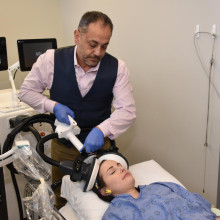
“Magnetic seizure therapy has already been shown as a promising treatment for major depressive disorder or unipolar depression,” explains Dr. Amer Burhan, local site lead for the clinical trial. “For the first time, we’re studying how effective the treatment is for depression as a result of bipolar disorder and whether it can reduce the risk of cognitive side effects associated with electroconvulsive therapy.”
The clinical trial is being led by the Centre for Addiction and Mental Health (CAMH) and will also be offered through Lawson and University of British Columbia (UBC) Hospital. Lawson researchers will invite approximately 30 eligible patients with treatment-resistant depression from bipolar disorder to participate in the trial at Parkwood Institute, a part of St. Joseph’s Health Care London.
Eligible patients will be randomized to receive either ECT or MST. Patients will be offered support throughout the study with the goal of improving patient outcomes in both groups. Patient outcomes will be compared to study the whether MST is effective and whether it is associated with reduced cognitive side effects.
MST will be delivered under anesthesia in 12 to 20 sessions. Sessions will last 10 to 15 minutes each with 60 to 90 minutes of recovery time.
“Magnetic seizure therapy holds promise of one day replacing electroconvulsive therapy as the gold standard for treatment-resistant depression, but we need to learn more about where it fits in our toolbox of potential treatments,” says Dr. Burhan.
If proven as a viable first-line treatment, MST would be very easy to implement in existing ECT clinics. MST would therefore be readily available to patients in need.
“We are on the leading edge of the field of brain stimulation for treatment-resistant depression in collaboration with CAMH and UBC,” says Dr. Burhan. “Our goal is to continue informing the care process through clinically-relevant research that serves patients, medical professionals and the public.”
Those who would like more information about the trial can email @email or @email.
… LEADERSHIP ROLE RESIDENCY PROGRAM DIRECTORS COMMENTS ANESTHESIA & PERIOPERATIVE MEDICINE John Fuller (Interim) … Fayad (LHSC - UH) Melissa Chin and Jon Borger Amy Rice (St. Joseph's) George Nicolaou (LHSC - VH) CLINICAL NEUROLOGICAL SCIENCES David Steven NEUROLOGY - Jorge Burneo Anita Florendo- Cumbermack …
DEPARTMENT DEPARTMENT CHIEFS SITE CHIEFS DIVISION CHIEFS MEDICAL DIRECTORS OTHER LEADERSHIP ROLE RESIDENCY PROGRAM DIRECTORS COMMENTS ANESTHESIA & PERIOPERATIVE MEDICINE John Fuller (Interim) Ashraf Fayad (LHSC - UH) Melissa Chin and Jon Borger Amy Rice (St. Joseph's) George Nicolaou (LHSC - VH) CLI...
… Noppens (LHSC - UH) Melissa Chin and Jon Borger Amy Rice (St. Joseph's) George Nicolaou (LHSC - VH) CLINICAL NEUROLOGICAL SCIENCES David Steven NEUROLOGY - Jorge Burneo Anita Florendo- Cumbermack … NEUROSURGERY - Mel Boulton Keith MacDougall Shawn Steele - Site Chief, St. Joseph's All Sites Joe Armstrong …
DEPARTMENT DEPARTMENT CHIEFS SITE CHIEFS DIVISION CHIEFS MEDICAL DIRECTORS OTHER LEADERSHIP ROLE RESIDENCY PROGRAM DIRECTORS COMMENTS Rudy Noppens (LHSC - UH) Melissa Chin and Jon Borger Amy Rice (St. Joseph's) George Nicolaou (LHSC - VH) CLINICAL NEUROLOGICAL SCIENCES David Steven NEUROLOGY - Jorge...
… Interested in Creating an Advance Directive? (Living Will) With … and siblings feel that Terri should be kept alive at all costs, and that by not allowing a feeding tube to keep her fed and hydrated, she is being “killed”. The best way to avoid a similar acrimonious battle is to put your …
Interested in Creating an Advance Directive? (Living Will) With the attention focused on the Terri Schiavo case in the media, many people are wondering: What can I do to prevent this from happening in my family? Terri Schiavo is the severely brain-damaged woman in Florida who is at the heart of the ...
… ~ SIJOSEPHs HEALTH CARE LONDON CORPORATE Procedure: CODE BLACK – … Owner of Procedure: Emergency Management and Risk Specialist and Corporate Security Leader Approval by: Emergency … Date(s): 2021-12-03 Revised Date(s): 2021-12-03 PURPOSE St. Joseph’s Health Care London is committed to ensuring the …
~ SIJOSEPHs HEALTH CARE LONDON CORPORATE Procedure: CODE BLACK Bomb Threat/Suspicious Object Owner of Procedure: Emergency Management and Risk Specialist and Corporate Security Leader Approval by: Emergency Management Committee Date: 2021-12-09 Original Effective Date: 2018-12-18 Reviewed Date(s): ...
… (iJ~ SIJOSEPHs HEALTH CARE LONDON Code Blue Drill Report Form This form must be completed after each Code Blue drill. Provide a copy … completed form to the Emergency Management and Risk Specialist. Other building system operations are evaluated during … HEALTH CARE LONDON Code Blue Drill Report Form This form must be completed after each Code Blue drill. Provide a copy …
(iJ~ SIJOSEPHs HEALTH CARE LONDON Code Blue Drill Report Form This form must be completed after each Code Blue drill. Provide a copy of the completed form to the Emergency Management and Risk Specialist. Other building system operations are evaluated during the drill to ensure proper functionality. ...
… Revised Date(s): 2023-09-07 This procedure applies to: St. Joseph’s Health Care London Or Mount Hope Centre for Long-Term Care Parkwood Institute Main Building Parkwood Institute Mental Health Care Building St. Joseph’s Hospital … Revised Date(s): 2023-09-07 This procedure applies to: St. Joseph’s Health Care London Or Mount Hope Centre for …
CORPORATE PROCEDURE EMC011 Procedure: Code Blue (Acute Site) Adult Medical Emergency Owner: Director, Patient Relations, Security Services and Chief Privacy and Risk Officer Sponsor: Vice-President, Patient Care and Risk Approval by: Emergency Management Committee Date: 2023-09-07 Original Effectiv...
… Revised Date(s): 2023-09-07 This procedure applies to: St. Joseph’s Health Care London Or Mount Hope Centre for Long-Term Care Parkwood Institute Main Building Parkwood Institute Mental Health Care Building St. Joseph’s Hospital … Revised Date(s): 2023-09-07 This procedure applies to: St. Joseph’s Health Care London Or Mount Hope Centre for …
CORPORATE PROCEDURE EMC011 Procedure: Code Blue (Non-Acute Site) Adult Medical Emergency Owner: Director, Patient Relations, Security Services and Chief Privacy and Risk Officer Sponsor: Vice President, Patient Care and Risk Approval by: Emergency Management Committee 2023-09-07 Original Effective ...
… Revised Date(s): 2023-09-07 This procedure applies to: St. Joseph’s Health Care London Or Mount Hope Centre for Long-Term Care Parkwood Institute Main Building Parkwood Institute Mental Health Care Building St. Joseph’s Hospital … Revised Date(s): 2023-09-07 This procedure applies to: St. Joseph’s Health Care London Or Mount Hope Centre for …
CORPORATE PROCEDURE EMC003 Procedure: Code Brown - Hazardous Chemical Spill Owner: Director, Patient Relations, Security Services and Chief Privacy and Risk Officer Sponsor: Vice President, Patient Care and Risk Approval by: Emergency Management Committee Date: 2023-09-07 Original Effective Date: 20...
… ~ SIJOSEPHs HEALTH CARE LONDON CORPORATE Procedure: CODE … Owner of Procedure: Emergency Management and Risk Specialist Approval by: Emergency Management Committee Date: … Date(s): 2021-12-03 Revised Date(s): 2021-12-03 PURPOSE St. Joseph’s Health Care London is committed to ensuring the …
~ SIJOSEPHs HEALTH CARE LONDON CORPORATE Procedure: CODE CRITICAL INCIDENT Owner of Procedure: Emergency Management and Risk Specialist Approval by: Emergency Management Committee Date: 2021-12-09 Original Effective Date: 2017-11-24 Reviewed Date(s): 2021-12-03 Revised Date(s): 2021-12-03 PURPOSE St...
… Revised Date(s): 2023-08-30 This procedure applies to: St. Joseph’s Health Care London Or Mount Hope Centre for Long-Term Care Parkwood Institute Main Building Parkwood Institute Mental Health Care Building St. Joseph’s Hospital … Revised Date(s): 2023-08-30 This procedure applies to: St. Joseph’s Health Care London Or Mount Hope Centre for …
CORPORATE PROCEDURE EMC001 Procedure: Code Green Evacuation Owner: Director, Patient Relations, Security Services and Chief Privacy and Risk Officer Sponsor: Vice President, Patient Care and Risk Approval by: Emergency Management Committee Date: 2023-06-22 Original Effective Date: 2018-05-15 Review...
… PROCEDURE EMC005 Procedure: Code Grey – Critical Infrastructure Failure Owner: Director, Patient Relations, … Revised Date(s): 2023-08-30 This procedure applies to: St. Joseph’s Health Care London Or Mount Hope Centre for Long-Term Care Parkwood Institute Main Building Parkwood Institute Mental Health Care …
CORPORATE PROCEDURE EMC005 Procedure: Code Grey Critical Infrastructure Failure Owner: Director, Patient Relations, Security Services and Chief Privacy and Risk Officer Sponsor: Vice President, Patient Care and Risk Approval by: Emergency Management Committee Date: 2023-06-22 Original Effective Dat...
… Subject: Ethics Policy No.: #500-18 Section: General Administration Date(s) Board Approved: March 27, 2019 June 17, … Date of Next Review: March 27, 2021 DEFINITIONS: Ethics – Standards of conduct which indicate how one should behave … principles about right and wrong (as defined by The Josephson Institute of Ethics). Key Stakeholders – include …
Policy #500-18/Ethics DRAFT Jan 2019 Page 1 of 3 Board Policy Subject: Ethics Policy No.: #500-18 Section: General Administration Date(s) Board Approved: March 27, 2019 June 17, 2015 Reviewed by: Governance Committee Date(s) Committee February 1, 2019 Recommended: June 11, 2015 Date of Next Review: ...