


Search
Search
1901 Search Results:
… expect during the procedure • You will need to lie flat on your stomach for this procedure. Your lower back will be cleaned with an antiseptic solution and your upper back and legs will be covered with sterile … expect during the procedure • You will need to lie flat on your stomach for this procedure. Your lower back will be …
CARING FOR THE BODY, MIND & SPIRIT SINCE 1869 Renowned for compassionate care, St. Joseph's is one of the best academic health care organizations in Canada dedicated to helping people live to their fullest by minimizing the effects of injury, disease and disability through excellence in care, teachi...
… be moving to LHSC with the program. Please continue with your high-risk referrals to St. Joseph’s until June 4. Low … be moving to LHSC with the program. Please continue with your high-risk referrals to St. Joseph’s until June 4. Low …
BULLETIN Acute Care Hospital Redevelopment News for Physicians in the Community Issue 4 - April 2011 Planned service reductions during LHSCs adult mental health care program move All adult acute mental health care services at LHSC are moving to new spaces at Victoria Hospital, April 11-29, 2011. As ...
… be moving to LHSC with the program. Please continue with your referrals to obstetrician/gynecologists as you normally … be moving to LHSC with the program. Please continue with your referrals to obstetrician/gynecologists as you normally …
BULLETIN Acute Care Hospital Redevelopment News for Physicians in the Community Issue 5 - June 2011 St. Josephs Hospital Perinatal program begins move to LHSC June 4, 2011 All perinatal program services currently located at St. Josephs Health Care, London, including the tertiary care obstetrical and...
Major Ronald Miller's story
“I just wasn’t myself,” says Major Ronald Miller when reflecting on his experience with post-traumatic stress disorder (PTSD). “I could see a significant change in my personality that just wasn’t me.”
Major Miller first joined the Canadian Armed Forces in 1971 as a young infantry private in the 1st Battalion, The Royal Canadian Regiment and later became an Officer in the Royal Canadian Artillery, which included a tour in Germany during the Cold War.
After the Cold War, he reoriented his career towards peacekeeping which saw him deployed to seven different conflict zones. “It was during the Civil War in El Salvador in 1991 that I experienced a number of incidents that first triggered my PTSD,” explains Major Miller. “From that time forward the PTSD was always there but I suppressed it.”
It wasn’t until 2016 that Major Miller’s PTSD resurfaced. After retiring from the Canadian Armed Forces in 2008, he started working a number of contracts in support of the military.
“Over the years, I was exposed to the kind of death and destruction that can be rather difficult from a psychological standpoint. The older I got, the less I was able to suppress those experiences. In fall 2016, I was supporting a NATO military exercise in the UK when I began experiencing horrible nightmares every night. I knew I needed to seek help.”
He reached out to Veteran Affairs Canada and was referred to the Operational Stress Injury (OSI) Clinic at Parkwood Institute, a part of St. Joseph’s Health Care London, where he was diagnosed with PTSD. It was there that he learned about PTSD research being conducted by Dr. Ruth Lanius, Scientist at Lawson Health Research Institute and Psychiatrist at London Health Sciences Centre.
Image
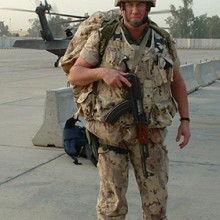
“I saw the need to help by participating in research, not only for myself but for my friends who have succumbed to the illness.”
Major Miller participated in Dr. Lanius’ neuroimaging research which uses advanced imaging technologies like PET/MRI to study differences in brain activity and neural connections between healthy individuals and those with different subtypes of PTSD. Dr. Lanius hopes that patterns of brain activity can one day be used as an objective biomarker to accurately diagnosis different subtypes of PTSD and uncover new targets for therapy.
“The research experience was interesting. I was interviewed while in the MRI and had to talk about incidents that trigger my PTSD to study my brain waves,” explains Major Miller.
In one study, Dr. Lanius is studying patterns of brain activity for those with ‘moral injury,’ an intense feeling of shame or guilt that can sometimes affect veterans with PTSD.
“Sometimes you’re involved in situations that you don’t have control over but that you feel responsible for,” says Major Miller. “You wonder, ‘Could I have done something differently?’”
Major Miller was happy to participate in any study that might help. Today, he is managing his PTSD through a combination of therapies that work for him.
“My biggest fear was giving up the things I love. I’ve been a soldier since day one and I’m sure I will be until the day I die. It’s important we come up with solutions to ensure our veterans receive proper care. Through research, we can tailor treatment to the individual rather than looking for a broad brush solution that might not suit everyone.”
This story is also featured on Research Canada’s Patient Stories website.
… would be best for you, or the decision you would make for yourself. CARING FOR THE BODY, MIND & SPIRIT SINCE 1869 … in care, teaching and research. sjhc.london.on.ca Ask Yourself: What would the patient say if he or she could … situations are unique. The SDM hierarchy may be complex in your family. Contact your social worker to discuss your …
CARING FOR THE BODY, MIND & SPIRIT SINCE 1869 Renowned for compassionate care, St. Josephs is one of the best academic health care organizations in Canada dedicated to helping people live to their fullest by minimizing the effects of injury, disease and disability through excellence in care, teachin...
… Family Family I wish to waive: Extended Health Dental Does your spouse have coverage through another plan? Yes No If … Family Family I wish to waive: Extended Health Dental Does your spouse have coverage through another plan? Yes No If …
Group Benefit Application M M D D Y Y EFFECTIVE DATE PART 1: EMPLOYEE INFORMATION Employee Last Name First Name Middle Initial Group Number Account/Div # 86936/005/F Employee ID (Do not have to complete) Sex Male Female Date of Birth M M D D Y Y PART 2: GROUP BENEFIT COVERAGE INFORMATION I wish to e...
… Family Family I wish to waive: Extended Health Dental Does your spouse have coverage through another plan? Yes No If … Family Family I wish to waive: Extended Health Dental Does your spouse have coverage through another plan? Yes No If …
Group Benefit Application EFFECTIVE DATE M M D D Y Y PART 1: EMPLOYEE INFORMATION Employee Last Name First Name Middle Initial Group Number Account/Div # 86936/005/F Employee ID (Do not have to complete) Sex Male Female Date of Birth M M D D Y Y PART 2: GROUP BENEFIT COVERAGE INFORMATION I wish to e...
… Family Family I wish to waive: Extended Health Dental Does your spouse have coverage through another plan? Yes No If … Family Family I wish to waive: Extended Health Dental Does your spouse have coverage through another plan? Yes No If …
Group Benefit Application M M D D Y Y EFFECTIVE DATE PART 1: EMPLOYEE INFORMATION Employee Last Name First Name Middle Initial Group Number Account/Div # 86936/005/F Employee ID (Do not have to complete) Sex Male Female Date of Birth M M D D Y Y PART 2: GROUP BENEFIT COVERAGE INFORMATION I wish to e...
… ine to be called by the next available receptionist and have your health card ready. From Grosvenor Entrance 1: … ine to be called by the next available receptionist and have your health card ready. … ine to be called by the next available receptionist and have your health card ready. Directions - Ivey Eye Institute Map …
Zone Zone 4 Tunnel Access Zone A Elevators Zone 2 1 Zone Zone ZONE A ELEVATORS TUNNEL ACCESS ZONE B ELEVATORS ZONE F ELEVATORS ZONE D ELEVATORS ZONE C ELEVATORS PARKING ELEVATORS TUNNEL ACCESS GROSVENOR STREET CHEAPSIDE STREET RI CH M O N D S TR EE T W EL LI N G TO N S TR EE T N ZONE E ELEVATORS GRO...
… Community Treatment Orders Interview Guide Questions: 1. In your own words please describe your experience to date as a CCB member as it relates to hearings re CTOs. 2. What has been your experience with mandatory uncontested CTO reviews … Community Treatment Orders Interview Guide Questions: 1. In your own words please describe your experience to date as a …
MARCH 2013 | VOL. 10 NO. 1 OUTCOMES, INHERENT CONTRADICTIONS AND PUZZLING ISSUES: Consent and Capacity Board (CCB) members experiences with Community Treatment Orders (CTOs) Deborah Corring, Cathy Plyley, Joe Skufca Research Insights of the Regional Mental Health Care London and St. Thomas is a peer...
March for Science - London, Ontario
2:00pm - 4:00pm
On Saturday, April 22, join the March for Science – London, Ontario.
- When: Saturday, April 22, 2017 from 10 a.m. to 12 p.m.
- Where: Northwest corner of Victoria Park, London, Ontario
Be sure to show your support for health sciences by wearing your Lawson-branded clothing!
The March for Science is a global movement that began in the United States (US). It champions robustly funded and publicly communicated science as a pillar of human freedom and prosperity. Marchers join as a diverse, nonpartisan group to call for science that upholds the common good and for political leaders and policy makers around the world to enact evidence-based policies in the public interest.
This Saturday’s March for Science coincides with Earth Day. There will be marches taking place in 517 cities around the world.
There will be free sign-making opportunities on campus at Western University in the Physics and Astronomy Building atrium today (April 20) and tomorrow (April 21) from 12 p.m. to 5 p.m.
For more information, view the event poster, visit the March for Science – London, Ontario Facebook page or contact Amanda Moehring at @email.
… - VRCC 10:30am Yoga - L 1:30pm Travel Log - L 2:30pm Colour your world - L 29 10:30am Dance Away MVDR - L 1:30pm Bingo … - VRCC 10:30am Yoga - L 1:30pm Travel Log - L 2:30pm Colour your world - L 29 10:30am Dance Away MVDR - L 1:30pm Bingo …
Therapeutic Programs - Marian Villa 2 October 2022 Sunday Monday Tuesday Wednesday Thursday Friday Saturday 1 2 10:15am Frisbee Golf - L 1:30pm Bingo - MVDR 3 10:30am Puzzling Minds - L 1:30pm Calming Corner - L 4 1:30 -4:00 Massages -MVDR 10:30am Chatterbox - L 1:30pm Bingo - L 5 10:30am Book Worm ...
… Scrabble - L 2:30pm Exercise Group - L 6:00pm What's Yours Like? (Board Game) - L 2:30pm Music Therapy - L 1:30pm … Yard Games - L 3:15pm Supportive Music 6:00pm What's Yours Like? (Board 1:30pm Bingo in MVDR 10:30am Mind … Bingo in MVDR 10:30am Catholic Mass - RH 6:00pm What's Yours Like? (Board Game) - L 3:00pm Go with the Flow - V …
~ SIJOSEPHs HEALTH CARE LONDON Therapeutic Programs - Marian Villa 3 August 2022 Sunday Monday Tuesday Wednesday Thursday Friday Saturday 1 2 3 4 5 6 Civic Holiday 9:30am Fun & Fit - L 9:30am Yard Games - L 10:15am Puzzling Minds- Lauren - 11:00am Outdoor Walks Lauren - 11:00am Frisbee Golf - L 1:30...
… Writing - L 1:30pm Bingo - L 3:30pm Yoga - L 6:00pm What's Your Like (board game) - L 9:30am Cranium Crunches - L … Afternoon at the Park - 6:00pm Pub Night 6:00pm What's Your Like (board game) - L 2:30pm Bocce Ball - L CO 21 22 23 … Aerobics - L 1:30pm Bingo - L 3:30pm Yoga - L 6:00pm What's Your Like (board game) - L 10:15am Outdoor Walks 4/5 - CY …
~ SIJOSEPHs HEALTH CARE LONDON Therapeutic Programs - Marian Villa 5 August 2022 Sunday Monday Tuesday Wednesday Thursday Friday Saturday 1 2 3 4 5 6 Civic Holiday 3:30pm Water Colour Art - L 1:30pm Bingo in MVDR - L 3:30pm Seated Zumba - L 9:30am Cranium Crunches - L 10:15am Outdoor Walks 4/5 - CY ...
… Writing - L 1:30pm Bingo - L 3:30pm Yoga - L 6:00pm What's Yours Like (Board Game) - L 14 9:30am Cranium Crunches - L … - MVDR 1:30pm Bingo - L 3:30pm Yoga - L 6:00pm What's Yours Like (Board Game) - L 21 9:30am Cranium Crunches - L … Drive - CO 1:30pm Bingo - L 3:30pm Yoga - L 6:00pm What's Yours Like (Board Game) - L 28 9:30am Cranium Crunches - L …
Therapeutic Programs - Marian Villa 5 SEPtEmbEr 2022 Sunday Monday TuEsday WEdnEsday Thursday Friday Saturday 1 10:30am Exercise Group - L 1:30pm Entertainment: Music - L 2 10:15am Book Club - L 10:30am Food Council - MVDR 1:30pm Yard Games - L 3:30pm Trivia and Treats! 4/5 - MVDR 3 4 1:30pm Bingo -...
Mark your calendars for London Health Research Day 2019
Mark your calendars for London Health Research Day, taking place on April 30, 2019.
London Health Research Day provides a forum for learners to showcase their innovative work and engage in networking opportunities with peers, faculty and industry leaders. A special keynote lecture presented by a world-class scientist will also take place as part of The Lucille & Norton Wolf Health Research Lecture Series.
Date: Tuesday, April 30, 2019
Location: London Convention Centre
More information will be available in the coming months. We look forward to seeing you at London Health Research Day 2019.
London Health Research Day is presented in partnership by Lawson Health Research Institute and the Schulich School of Medicine & Dentistry.
Regional Mental Health Care London and St. Thomas 10th Annual Research Half Day, May 13, 2009 BOOK OF ABSTRACTS & RESEARCH REPORT 2008 by RMHC RESEARCH COMMITTEE 1 Book of Abstracts RMHC 10th Annual Research Half Day May 13, 2009 and Research Report 2008 RESEARCH INSIGHTS of the Regional Mental Heal...
… Historical comments on model building in neuroscience or is your brain really like the transit map of the London … Historical comments on model building in neuroscience or is your brain really like the transit map of the London …
MAY 2010 | VOL 7 No.1 BOOK OF ABSTRACTS 11TH ANNUAL RESEARCH HALF DAY MAY 12, 2010 & RESEARCH REPORT 2009 RMHC Research Committee http://www.lawsonresearch.com/v1.0/website/research_themes/Mental%20Health/HTML/our_publications.htm Regional Mental Health Care London and St. Thomas 11th Annual Researc...
… Journals Non Peer-reviewed2 O'Reilly R. Our expert answers your questions about CTOs. Canadian Psychiatry Aujourd'hui … Journals Non Peer-reviewed2 O'Reilly R. Our expert answers your questions about CTOs. Canadian Psychiatry Aujourd'hui …
Regional Mental Health Care London and St. Thomas 12th Annual Research Half Day, May 11, 2011 BOOK OF ABSTRACTS & RESEARCH REPORT 2010 by RMHC RESEARCH COMMITTEE 1 Book of Abstracts 2011 RESEARCH INSIGHTS of the Regional Mental Health Care London and St. Thomas Vol.8, No.1 2011 Message from the Dire...
… in Art Studio-WC 1:00 -3:00 28 10:15 Mass CH 29 11:00 Know Your Facts 1:30 Green Thumbs 1:30 Bingo – MVDR 1:30 Marian … in Art Studio-WC 1:00 -3:00 28 10:15 Mass CH 29 11:00 Know Your Facts 1:30 Green Thumbs 1:30 Bingo – MVDR 1:30 Marian …
May 2017 Marian Villa 1 THERAPEUTIC PROGAMS SUNDAY MONDAY TUESDAY WEDNESDAY THURSDAY FRIDAY SATURDAY 1 2 3 4 5 6 11:00 Group Exercise 11:00 Mind Aerobics 10:15 Mass CH 10:30 Greek Orthodox 9:30 Smarty Pants 10:00 Royalty 1:30 Bingo MVDR 1:30 Marian Delight- MVDR 1:30 Pay It Forward - TS 3:00 Mile i...