

Search
Search
719 Search Results:
… Pulmonary Rehabilitation Program Why consider pulmonary rehabilitation? Pulmonary rehabilitation is the standard of care for people with … Pulmonary Rehabilitation Program Why consider pulmonary rehabilitation? Pulmonary rehabilitation is the standard of … Pulmonary Rehabilitation Program Fact Sheet …
Pulmonary Rehabilitation Program Why consider pulmonary rehabilitation? Pulmonary rehabilitation is the standard of care for people with moderate to severe chronic obstructive pulmonary disease (COPD) who are experiencing symptoms of breathlessness, cough and activity limitations despite medication/...
… Pulmonary Rehabilitation Program Lifestyle Change and Self-Management Workbook Page | 1 Pulmonary Rehabilitation Program Dr. Michael Nicholson, Medical … Page | 2 Table of Contents Introduction to Pulmonary Rehabilitation. 5 … Page | 3 Introduction to Pulmonary Rehabilitation Adapted from Better Living with COPD What is …
Pulmonary Rehabilitation Program Lifestyle Change and Self-Management Workbook Page | 1 Pulmonary Rehabilitation Program Dr. Michael Nicholson, Medical Director Tajana Jokic, Program Coordinator Authors Megan Graat, R. Kin, MPH Karen Unsworth, MSc Lia Kutzscher, RN (EC) MScN CRE Andraena Tilgner, RR...
… time targets. At Parkwood Institute’s Main Building, the Rehabilitation Program will continue a focus on appropriate … performance Efficient Achieve Efficient Length of Stay in Rehabilitation Percent of Moderate and Severe Stroke Rehab … Meeting Active Length of Stay Target % / Parkwood Institute Rehabilitation Program patients with moderate or severe …
1 Quality Improvement Plan (QIP) Narrative for St. Josephs Health Care London 04/01/2016 2 Overview St. Josephs Health Care Londons (St. Josephs) Strategic Plan for 2015-2018 has three strategic priorities related to enhancing the quality and safety of the care we provide to our patients, residents ...
… SCE2-Pc4-2015-12-07 www.SpinalCordEssentials.ca During your rehabilitation, you will have a lot of questions for your … my prognosis for recovery? 3. What are important goals for rehabilitation? 4. What is my discharge date? Question: … SCE2-Pc4-2015-12-07 www.SpinalCordEssentials.ca During your rehabilitation, you will have a lot of questions for your …
Questions for Your Care Team Ask your Doctor or Health Care Team anything you want. PLANNING 2015 University Health Network - Toronto Rehab. All rights reserved. SCE2-Pc4-2015-12-07 www.SpinalCordEssentials.ca During your rehabilitation, you will have a lot of questions for your doctor or care team....
… Comprehensive Outpatient Rehabilitation Program Parkwood Institute, Arthur J. Hobbins … made to other agencies / services? Please Specify if known REHABILITATION GOALS Presenting Difficulties (Requirements … Comprehensive Outpatient Rehabilitation Program Parkwood Institute, Arthur J. Hobbins …
Comprehensive Outpatient Rehabilitation Program Parkwood Institute, Arthur J. Hobbins Building PO Box 5777 STN B, London, ON, N6A4V2 Tel: 519-685-4578 Fax: 519-685-4802 Referral Form FOR OFFICE USE ONLY Referral Date: MR#: Contact Date: Intake Date: CLIENT INFORMATION Name: DOB (YY/MM/DD): Address: ...
… Request referral to multi-disciplinary outpatient rehabilitation program Please note: Referrals are not … Occupational Therapy, Physiotherapy, Neuropsychology, Rehabilitation Therapy, Speech Language Pathology, and … Request referral to multi-disciplinary outpatient rehabilitation program Please note: Referrals are not …
Office Use Only Date Referral Received:____________ Parkwood Institute MR#:__________ Parkwood Institute Acquired Brain Injury Program 550 Wellington Rd. London, Ontario N6C 0A7 Telephone: 519 685 4064 Fax: (519) 685-4551 Toll free: 1-866-484-0445 Client Information Name: Health Card #: Address: Tow...
… Parkwood Institute Driver Assessment and Rehabilitation Centre Driver Assessment and Rehabilitation Program/DriveABLE Mailing address Location PO … Parkwood Institute Driver Assessment and Rehabilitation Centre Driver Assessment and Rehabilitation Program/DriveABLE Mailing address Location PO …
Parkwood Institute Driver Assessment and Rehabilitation Centre Driver Assessment and Rehabilitation Program/DriveABLE Mailing address Location PO BOX 5777, STN B 550 Wellington Road London, ON N6A 4V2 London ON N6C 0A7 Tel: (519) 685-4070 Fax: (519) 685-4066 Referral (Please forward any relevant med...
… government. Pictured: June Baeker, a patient in the Stroke Rehabilitation Program, recalls her travels to Cuba with … government. Pictured: June Baeker, a patient in the Stroke Rehabilitation Program, recalls her travels to Cuba with …
Leadership in Mission Report on Mission, Spiritual Care and Health Care Ethics 2015/2016 Report on Governance and Leadership As we approached 2015/16 we knew the year would provide opportunities and challenges. We would fi nally be through all our restructuring and construction and would have the op...
… government. Pictured: June Baeker, a patient in the Stroke Rehabilitation Program, recalls her travels to Cuba with … government. Pictured: June Baeker, a patient in the Stroke Rehabilitation Program, recalls her travels to Cuba with …
Leadership in Mission Report on Mission, Spiritual Care and Health Care Ethics 2015/2016 Report on Governance and Leadership As we approached 2015/16 we knew the year would provide opportunities and challenges. We would fi nally be through all our restructuring and construction and would have the op...
… Without the people who attended to my spirituality, my rehabilitation would have been empty.” Brett’s poignant … the credit with her outpatient acquired brain injury (ABI) rehabilitation team. The 2014 Sisters’ award winners, from … Without the people who attended to my spirituality, my rehabilitation would have been empty.” Brett’s poignant …
Leadership in Mission Report on Mission, Spiritual Care and Health Care Ethics St. Josephs Health Care London 2013/2014 Report to St. Josephs Health Care Society 2 Contents Page 3 Report on Governance and Leadership Page 8 Report on Heath Care Ethics Page 13 Report on Spiritual Care Page 18 Living o...
… 7. Education – a key component of St. Joseph’s future 8. Rehabilitation on one site – a year later 10. Expressions … weathering months of renovation and movement to consolidate rehabilitation services and prepare for expanded complex … the challenges of living with a brain injury; Jay Myatt, rehabilitation therapist, Parkwood Hospital, centre, worked …
ST. JOSEPHS HEALTH CARE LONDON | ANNUAL REPORT TO THE COMMUNITY | 2002/2003 2 Dedication This years Annual Report to the Community is dedicated to the St. Josephs Health Care, London staff members and volunteers who continue to give so much of themselves to help manage SARS restrictions. Thank you t...
… an organization of such diversity, embodying programs in rehabilitation, acute/ambulatory care, specialized mental … Parkwood Hospital offers a Driver Assessment and Rehabilitation Program for people whose license has been … Specialist – Orthopedics Kyle Goettl Nurse Clinician – Rehabilitation/ Stroke Amputee Program Pat Barker …
St. Josephs Health Care London Annual Report 1 care 2 3 At St. Josephs Health Care, London, there are so many ways to care, all stemming from one vision to be a respected source of excellent health care. Uniting an organization of such diversity, embodying programs in rehabilitation, acute/ambulato...
… programs, residential hospice, complex continuing care and rehabilitation and long-term care homes. In-home services … programs, residential hospice, complex continuing care and rehabilitation and long-term care homes. In-home services …
The Resident & Fellow Handbook This handbook is the property of: Dr. _____________________________ Resident / Clinical Fellow in the Department of: ________________________________ If found, please return to the Security office or notify me by email at: ________________________________ Preface Th...
… brain-injury-program/outpatient- rehabilitation https://www.sjhc.london.on.ca/concussion- … w.sjhc.london.on.ca/acquired-brain-injury-program/outpatient-rehabilitation … w.sjhc.london.on.ca/acquired-brain-injury-program/outpatient-rehabilitation … w.sjhc.london.on.ca/acquired-brain-injury-program/outpatient-rehabilitation …
Return to School (RTS) Group Program* Contact Who We Are Parkwood Institute Return to School (RTS) GROUP PROGRAM The RTS Group Program is facilitated by a Speech Language Pathologist (SLP) and is designed to meet the specific needs of students who are intending to return to studies or have already r...
… developed in collaboration with Parkwood Outpatient Stroke Rehabilitation Programs and the Parkwood Driving Program • … developed in collaboration with Parkwood Outpatient Stroke Rehabilitation Programs and the Parkwood Driving Program • …
SIJOSEPHs HEALTH CARE LONDON Returning to Driving TOOLKIT FOR CLIENTS AND THEIR THERAPISTS Developed May 2020 WHY? Some medical conditions such as a stroke may impact skills you need to return to driving As you may not be able to drive right now, you can work on these exercises while you rec...
… within limits, as identified by progress made during rehabilitation and outlined by surgeon and physical … for the physiotherapist, to guide post-operative care and rehabilitation. It should only be initiated and performed … within limits, as identified by progress made during rehabilitation and outlined by surgeon and physical …
Reverse Total Shoulder Arthroplasty Protocol Shoulder Dislocation Precautions Precautions should be implemented for the first 12 weeks postoperatively unless surgeon specifically advises patient or therapist differently: No shoulder motion behind lower back and hip (no combined shoulder adduction, ...
Revolutionizing rehab
St. Joseph’s Health Care London is taking giant strides in the science of rehabilitation and movement, with direct benefit to patients.
St. Joseph’s is setting a long-time vision into motion.
“Five years ago, we had a vision of leveraging our long history and expertise in providing innovative rehabilitation treatments to improve the lives of people with mobility needs on a larger scale,” says Roy Butler, President and CEO of St. Joseph’s Health Care London (St. Joseph’s). “That dream has come to life.”
While experts at St. Joseph’s had the knowledge, innovative spirit and passion to achieve the vision, they needed a partner who shared the same enthusiasm.
William and Lynn Gray answered that call. With their generosity and ground-breaking investment, The Gray Centre for Mobility and Activity was created.
“Lynne and I are very pleased with the steady forward advancement of the centre’s mission since its establishment just a few short years ago,” says Bill Gray. “The innovative thinking and idea generation that seeks new solutions to the issue of mobility have really taken root. We hoped that The Gray Centre would have an impact on care ... and it has.”
“We’ve watched the development of The Gray Centre with enormous pride and are pleased to have our name associated with it, and the excellence it stands for,” adds Lynne Gray.

A unique concept
Established in 2020, The Gray Centre at St. Joseph’s Parkwood Institute is a regional hub focused on researching leading-edge treatments and interventions in mobility and activity. The centre’s unique model of linking research and care allows researchers to work side-by-side with clinicians, patients, and caregivers to uncover optimal methods for maintaining mobility throughout a person’s life.
“Scientists at The Gray Centre are leading the way in integrating technology and solutions in care to better understand how we can enhance each patient’s treatment plan to improve their functionality and ability to move,” says Butler.
Pioneering Research
More than 50 ongoing rehabilitation research projects at Parkwood Institute are exploring areas such as spinal cord and traumatic brain injury rehabilitation, pain, outcomes for amputees, virtual exercise and cognitive behavioral therapy, gait analysis as a measure of dementia progression, and stroke rehabilitation and recovery.
The Gray Centre is a catalyst and connector for these projects by investing in cutting-edge technology, providing seed grants, embedding researchers from Western University, leveraging clinical expertise, attracting world-class researchers and translating new knowledge into clinical practice by training students and clinicians, and fostering sustainable practice change.
More than $1.3 million granted through St. Joseph’s Health Care Foundation has advanced work at The Gray Centre over the past year. From researcher support to new equipment such as two transcranial magnetic stimulators, a portable handheld ultrasound and several sensored mats for gait assessment donors have stepped up to advance this work.
Leadership with Purpose
At the helm of The Gray Centre is Siobhan Schabrun, PhD, a world-renowned neuroscientist and the inaugural William and Lynne Gray Research Chair in Mobility and Activity. Thanks to a partnership with Western University’s Faculty of Health Sciences and Schulich School of Medicine & Dentistry, donor funding for the chair made through St. Joseph’s Health Care Foundation was matched, creating a $5-million endowed position.
Schabrun’s innovative research benefits people suffering from chronic pain. With a focus on non-invasive brain stimulation techniques to enhance neuroplasticity and improve mobility and activity outcomes, she and her team are, in essence, retraining the brain’s pain response. This innovative work bridges the gap between neuroscience and rehabilitation, offering new hope for individuals with musculoskeletal and neurological conditions.
Originally trained as a physiotherapist with a PhD in neuroscience from the University of Adelaide in Australia, Schabrun has attracted more than $15 million in competitive research funding and written or contributed to more than 140 scholarly publications.
FLOATing Forwards

The newest advancement is a first-in-Canada and a marvel of medical engineering that is transforming options in rehabilitation research and practice.
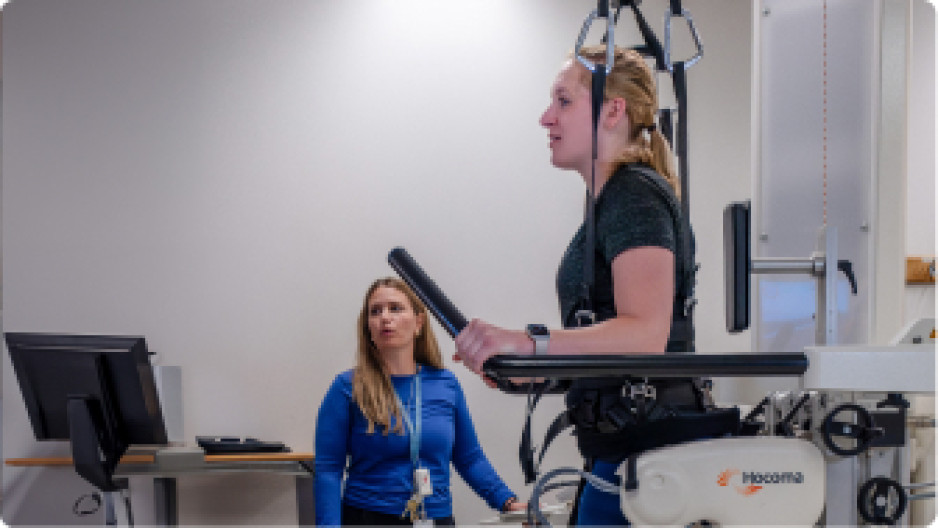
The Reha-Stim Medtec FLOAT system at St. Joseph’s Parkwood Institute enables patients with mobility limitations to walk, supported, without fear of falling. They "float" in a controlled environment using a combination of robotics, body-weight support and real-time feedback. The device has a harness attached to a robotic arm, which adjusts the level of support based on the patient's movements. Sensors provide continuous feedback for maximum learning and greatest benefit to physical therapists and patients alike. The FLOAT system has shown significant improvements in patients' mobility, balance and overall functional independence.
“Innovative equipment like the new FLOAT System is an example of the type of innovation that does not exist anywhere else in Canada,” says Bill Gray. “The real-life application of technologies like this are what The Gray Centre is intended to be about.”
Through the combined efforts of dedicated professionals, cutting-edge technology and philanthropist partners, St. Joseph’s Gray Centre has combined vision with passion and is transforming lives, one step at a time.
… Parkwood Hospital Driving Assessment and Rehabilitation Program 801 Commissioners Road East London, … in the vehicle being considered prior to purchase. A driver rehabilitation specialist can provide recommendations for … all vans are not suitable for modifications. A driver rehabilitation specialist can assist in making the correct …
Parkwood Hospital Driving Assessment and Rehabilitation Program 801 Commissioners Road East London, Ontario N6C 5J1 Phone: (519) 685-4070 Fax: (519) 685-4576 DRIVING WITH RHEUMATOID ARTHRITIS Rheumatic disease includes nearly 100 different conditions, which cause pain in the joints and connective ti...
Ricardo Viana
Ricardo Viana, MD, OT
Associate Professor, Schulich School of Medicine and Dentistry
Key Areas of Focus:
Amputation; Stroke
Phone:
519-685-4292 ext. 45027
Email:
Accepting Grad Students:
No
About:
Dr. Ricardo Viana is a physiatrist at Parkwood Institute and an Associate Professor in the Schulich School of Medicine and Dentistry at Western University. Prior to studying medicine, Dr. Viana was an cccupational therapist. Dr. Viana completed his medical training in 2008 and his Physical Medicine and Rehabilitation residency training in 2013. Dr. Viana’s clinical focus is on Stroke and Amputee rehabilitation as well as neuromuscular and pain medicine.
Dr. Viana has two primary research interests. First, is understanding the impact of dual-task performance on mobility, balance and falls for those with amputation. And second, is systematic reviews in support of the Evidence Based Review Stroke Rehabilitation. Dr. Viana also has a growing interest in education, both medical education and knowledge translation in the clinical setting.
Robert Teasell
Robert Teasell, MD
Professor, Schulich School of Medicine and Dentistry
Key Areas of Focus:
Stroke
Phone:
519-685-4292 ext. 44559
Email:
Website:
Social:
Accepting Grad Students:
Yes
About:
Dr. Robert Teasell is a physiatrist at Parkwood Institute, a Professor in the Schulich School of Medicine and Dentistry at Western University, former Chair-Chief and current Research Director of the Department of Physical Medicine and Rehabilitation. He is a Clinical Researcher with Lawson Health Research Institute, Parkwood Institute Research and Director of the CORRE Research Group. Dr. Teasell has authored over 800 publications including over 350 peer-reviewed articles and has been involved with $24 million of research funding. He has won over 50 awards including Lawson Scientist of the Year, and Post-Acute Stroke Excellence Award, both in 2018, American Congress of Rehabilitation Medicine and National Stroke Association in the United States.
Dr. Teasell has supervised many graduate students and since 2014, three research team members have won the Lawson Leadership Impact Award (best graduate student at Lawson Institute) and three have become Vanier Scholars. Research interests include the Clinical Application of Best Evidence in Neurorehabilitation. Projects include: Stroke Rehabilitation Evidence-Based Review, Acquired Brain Injury Evidence-Based Review and Spinal Cord Injury Evidence-Based. The details of all projects within the CORRE Research Group can be found on the lab website.